




























Most stories about AI in cybercrime follow the same script: a model writes better
phishing emails, a model finds a vulnerability, a model runs the attack. Volta
breaks that script.
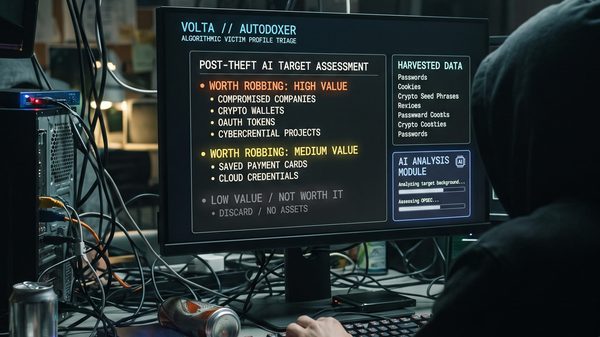
According to Cisco Talos, the malware — tracked as Volta Autodoxer — steals data
the old-fashioned way. Passwords, cookies, session tokens, screenshots. Nothing
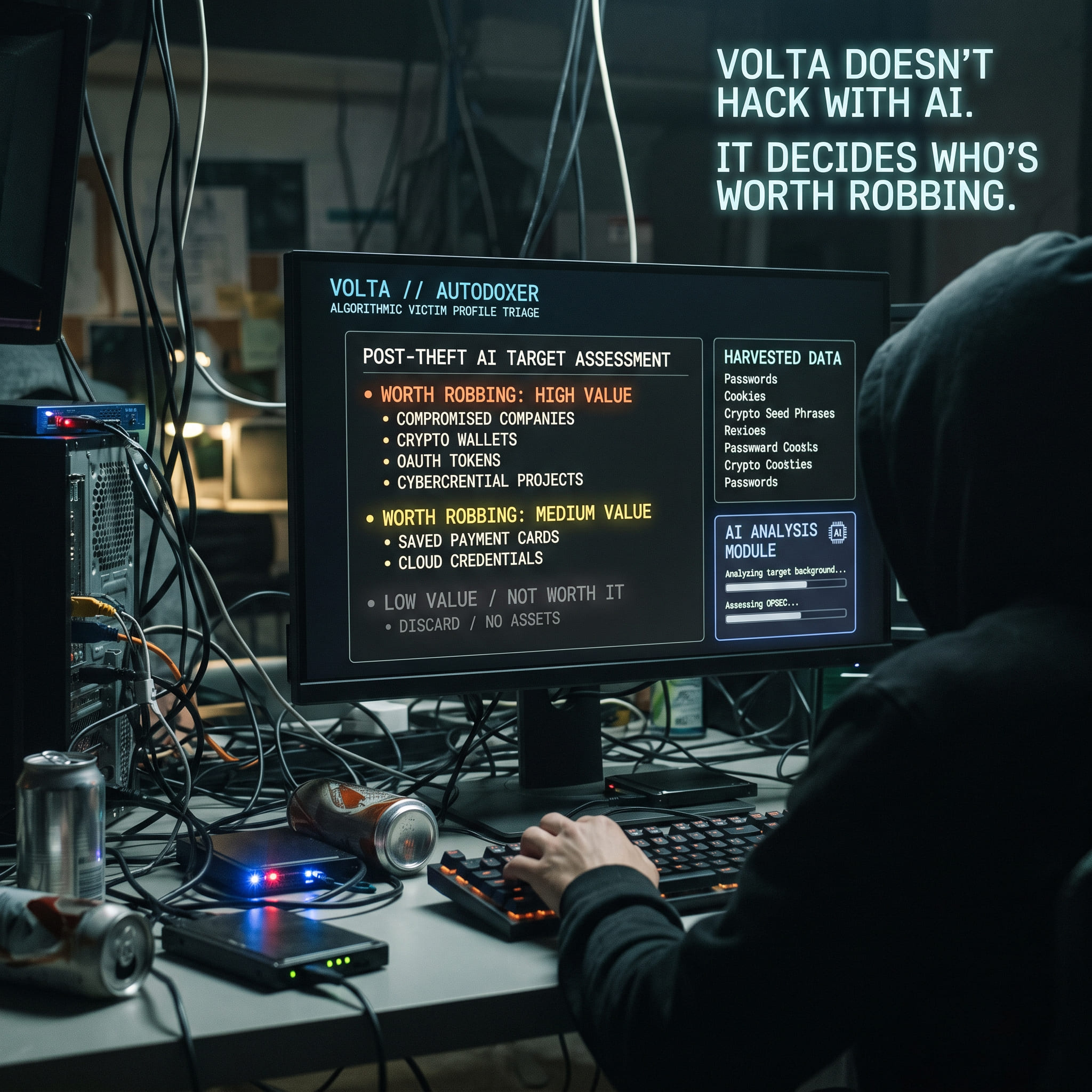
about the intrusion is intelligent. The AI shows up afterwards, when the stolen
data has to be sorted, verified, and turned into a list of people worth robbing.
That distinction sounds small. It is not. It moves the guardrail problem from
“can a model be convinced to attack?” to “can a model be convinced to analyze?”,
and the second question has a much easier answer.
A note on sourcing: this account is based on a single report that summarizes
Cisco Talos, Wired, and The Hacker News coverage. The underlying Talos technical
paper was not reviewed for this article, so treat specific implementation details
as reported rather than independently confirmed.
The AI Is Not in the Attack
Volta is an infostealer. It harvests credentials and session data from infected
machines, and it does that with techniques that predate the current AI cycle.
The intelligence is in the second stage. Once the data is exfiltrated, Volta
feeds it to large language models and asks them to build a structured profile of
each victim: where they live, where they work, roughly how much money they have,
and how hard their accounts would be to break.
Security researchers have spent two years documenting what happens when AI is
pointed at the attack itself. Autonomous exploitation is already reshaping cyber
warfare,
with agents finding and using vulnerabilities faster than human teams can
respond. Volta is a different layer of the same stack: it assumes the breach
already happened and automates the part that used to require a patient human
analyst with a spreadsheet.
That has a practical consequence. Defenses built around “stopping the hack” do
nothing here. By the time the models are involved, the data is already gone.
What Volta Actually Collects
The list is what makes the triage step possible, and it is broader than a
password dump.
According to the reporting, Volta gathers:
- saved passwords and cookies from Chromium-based browsers such as Chrome and Edge
- Outlook mail profiles
- Slack workspace data
- payment card details
- seed phrases for crypto wallets
- session tokens for Discord, Telegram, Steam, and Roblox
- two-factor codes from Microsoft Authenticator
- SSH keys
- cloud provider credentials
- saved Wi-Fi profiles
- screenshots
On top of that, it assembles context that most stealers ignore: geolocation, home
address, employer and corporate domain, birth year, the last digits of payment
cards, Slack workspace names and links, document ownership metadata, Roblox
account valuations, and indicators of whether an iPhone backup exists.
It also uses access to the victim’s Gmail inbox to check whether the stolen data
is still valid and to infer additional details from old messages. That is the
step that turns a pile of credentials into a dossier. Verification is what
separates a list of emails from a list of targets.
240 Words and a Router
The mechanically interesting part is how Volta gets a commercial model to do the
work.
The malware reaches models through the OpenRouter API. It tries an OpenAI model
first, falls back to Moonshot’s Kimi K2, then to Google’s Gemini 2.5 Flash. The
fallback is not random: Volta inspects each response for refusal language such as
“I can’t” or “I’m unable” and moves to the next provider when it finds it.
The prompt is reported to be about 240 words. It does not ask the model to steal
anything or to help with an intrusion. It presents the model as a forensic
intelligence analyst working from a source dataset, and asks it to sort victims
into categories: how much money they hold, whether they are worth attacking, what
return an attack might produce, and how exposed their operational security is.
The dataset may be fabricated from the model’s point of view. That does not
matter. The model is not being asked to endorse a crime. It is being asked to
classify rows in a table.
That is the whole trick, and it explains why the AI is kept away from the
intrusion itself. The reporting states plainly that Volta avoids using models for
the attack because they might refuse. So it uses them where refusal is unlikely:
administration.
Why “the Model Refused” Is Not a Security Control
Every major AI provider prohibits using its models to facilitate cyberattacks.
Those policies work reasonably well when the request is explicit.
Volta never makes an explicit request. It decomposes the crime into tasks that
each look benign in isolation: parse this data, verify this email, rank this
person by liquidity, flag the weakest account. No single prompt looks like a
breach. The harm lives in the assembly.
This is the same structural problem that makes sandboxes and guardrails stop
containing AI
once the system can reason about the boundary it is being kept inside. The
boundary is checked at the request level. The misuse happens at the workflow
level.
The fallback chain makes it worse. A single provider’s refusal is no longer a
dead end; it is a routing event. If one model declines, another may not. Safety
behavior that varies between vendors becomes a commodity that an attacker can
shop around for.
The Barrier Just Got Lower
The reporting pairs Volta with a separate CrowdStrike observation: roughly four
hacker groups, at noticeably different levels of sophistication, now lean on AI.
That is the part worth paying attention to. Experienced crews already knew how to
pick valuable targets. They did not need help. The groups that benefit from
Volta-style triage are the ones that could previously steal data but could not
tell which victim was worth the follow-up.
Sorting victims by wealth and security posture is exactly the skill that
separated professional crews from opportunistic ones. Automating it compresses
that gap. It also raises the expected quality of whatever comes next: a
well-targeted phishing email built from real employment, location, and account
data is far more dangerous than a generic one.
The financial sector already sees this pattern from the other direction —
attackers have spent years using AI to make fraud cheaper and more
convincing.
Volta suggests the same industrialization is reaching the boring middle of the
cybercrime workflow: not the break-in, not the ransom note, but the paperwork.
If tools like this get packaged and sold, the barrier drops again. A buyer would
not need to understand models, prompts, or routing. They would buy a ranked list.
If Your Data Is Already in a Stealer Log
The honest starting point: if your credentials appear in an infostealer dump,
assume the attacker has already read the data. Volta’s verification step means
the usual “maybe it’s stale” comfort does not apply.
What actually helps, in rough order of impact:
- Rotate credentials from a clean device. Change passwords for email, banking,
cloud, and work accounts first — email is the reset path for everything else. - Revoke sessions, not just passwords. Stealers take session cookies. Changing
a password without invalidating active sessions can leave the attacker inside. - Replace SMS and app-based 2FA where you can. Hardware security keys are the
only factor that a stolen session token does not defeat. - Move crypto funds to a new wallet. If seed phrases were on the infected
machine, the old wallet is compromised regardless of how strong the password is. - Tell your employer if a work device or corporate account was involved. Slack
workspaces and cloud credentials are in the collection list, and the corporate
domain is part of the profile. - Check the recovery paths. Inbox access lets an attacker reset accounts you
have not thought about in years.
On phones, the practical baseline — lock screen, Play Protect, app permissions,
and update discipline — is covered in these Android security settings that
actually matter.
None of it is exotic. Most of it is unglamorous maintenance that people skip.
The Uncomfortable Part
Volta is not a story about a model going rogue. It is a story about a model being
useful.
The safety conversation around AI and cybercrime still centers on capability:
what a model can be persuaded to do, and how well vendors refuse. Volta shows a
cheaper path. Use the model for the part that is not a crime yet — organizing,
verifying, scoring — and let humans or simple scripts handle the rest.
That is harder to regulate, harder to detect, and much harder to refuse. A model
that says no to “help me hack this company” will happily say yes to “rank these
ten records by estimated net worth.” Both requests serve the same operation.
The defensive implication is uncomfortable but clear: assume exfiltration, assume
verification, and build your security around limiting what a verified profile is
worth. Session revocation, hardware keys, and separating your money from your
email matter more than another layer of malware scanning.
The malware got smarter after the breach. The defenses have to assume the breach
already happened.
Source: Al Jazeera, 2 November 2026, summarizing Cisco Talos, Wired, and The Hacker News reporting

Independent technology writer focused on artificial intelligence, emerging technologies, and digital innovation. Covers AI applications in sports, productivity, and online business.