



























So, Here’s the Story in Short
You know that annoying moment when you’re walking down the street, you see a new restaurant, and you wonder: “Is this place any good?” — In a normal setup, you’d have to fish out your phone, unlock it, open an app, type the name… it’s a whole process.
Google just made all that friction disappear completely.
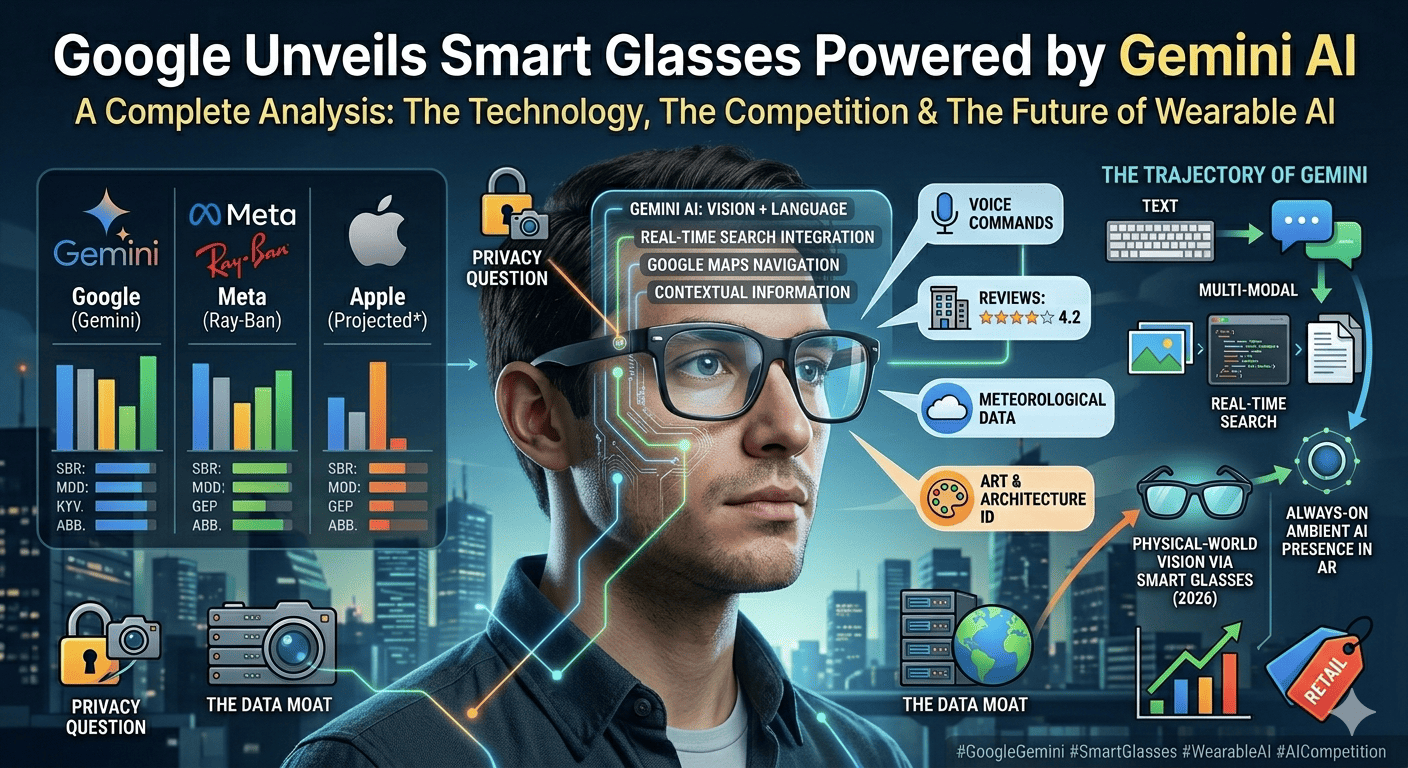
At their big conference this year, they unveiled two different smart glasses powered by their AI, Gemini. The whole concept boils down to this: you just look at something and ask out loud, and the glasses answer instantly. No phone, no typing, no hassle at all.
This is the kind of feature that sounds like a gimmick on paper until you actually try it yourself. Once you adapt to it, you realize you never want to go back to the old way.
How It Actually Works (Without the Tech Jargon)
There is a tiny camera integrated into the frame that streams live video to Gemini in real time. This means Google’s system literally sees whatever you are looking at, right as it happens.
And here is the coolest part: the system isn’t just guessing based on static training data. When you ask it “What’s this place?”, Gemini digs instantly through Google Search, Google Maps, your Gmail, and your Google Calendar — basically everything Google knows about the world and about you — to deliver a genuinely useful, contextual answer.
Practical Things You’ll Actually Use the Glasses For:
- Walking past a restaurant ← “What’s the vibe here?” ← reviews and ratings pop up instantly.
- Looking at a strange cloud ← “What even is that?” ← Gemini explains the scientific phenomenon.
- When a text message arrives ← the glasses read it out loud in your ear so you can keep walking uninterrupted.
- Getting lost in a new city ← turn-by-turn directions directly through the built-in speakers.
- Seeing an unfamiliar monument ← “Who is this guy?” ← a quick, contextual history lesson.
| Technical Specification | Product Details |
|---|---|
| AI Core Engine | Google Gemini — Multimodal natively, capable of live reasoning |
| Hardware Stack | Integrated micro-camera, open-ear stereo speakers, precision microphone array |
| Ecosystem Integration | Fully tied into Google Search, Maps, Gmail, Calendar, and YouTube |
| Design & Partners | Samsung Electronics, GentleMonster, Warby Parker |
| Form Factors | Two distinct, fashion-forward frame styles at launch |
| Launch Timeline | Late 2026 (Second half of the year) |
The Three-Way Corporate Fight: Google vs Meta vs Apple
Meta has been playing in this arena for a while now; they successfully sold over 7 million Ray-Ban smart glasses last year alone. That is a massive, real-world number, meaning millions of people are already walking around with Meta hardware on their faces. Meta pulled off making smart glasses “cool and acceptable”—something Google failed at miserably with Google Glass back in 2013.
But here is exactly where things get incredibly complicated and difficult for Meta:
| Strategic Vector | Google (Gemini) | Meta (Ray-Ban) | Apple (Projected) |
|---|---|---|---|
| AI Engine | Native Multimodal Gemini | Meta AI (LLaMA-based) | Next-Gen Siri |
| Camera Feed | Yes, continuous live AI stream | Yes, 12MP photos & video | Yes (Expected) |
| Ecosystem Moat | Full Google Suite & Search | Facebook, Instagram, WhatsApp | iCloud, iMessage, iOS Platform |
| Search Power | Google Search (Native) | Microsoft Bing (Limited) | Proprietary Search Index |
| Real-Time Vision | Yes — Core feature | Photo snapshot only | Advanced Spatial (Expected) |
| Current Sales | Zero — Upcoming product | 7,000,000+ units in market | Zero — R&D phase |
Why This Is Actual High-Octane Fuel for Gemini
There is a critical perspective that many tech reviewers miss: the glasses are not just a standalone retail product; they are **continuous data fuel**. In 2023, Gemini was a basic text chatbot answering prompt inputs. Then it learned to parse images, then it hooked into Search, and later into your emails and calendars. Every single step expanded its capability by giving it wider ambient access.
Smart glasses are the ultimate evolutionary step. They don’t just see a picture you deliberately choose to upload; they see what your eyes see throughout the day, every single day. This creates an unparalleled, continuous reinforcement learning loop.
The Real Problem Meta Cannot Brute-Force
Let’s be entirely fair: Meta did the heavy lifting on the design front. They made glasses look normal through their Ray-Ban partnership and backed it with cultural marketing that got everyday users to wear them without feeling awkward. Google Glass failed because users looked like cyborgs; Meta fixed that.
However, the one thing Meta cannot fix with good styling is information infrastructure. When you look at an old landmark and ask Meta’s glasses “What is this?”, it routes through Bing. It works okay, but it isn’t revolutionary. When you do the same with Google’s glasses, Gemini indexes the most robust information machine ever constructed, cross-references it with Maps, and yields an actionable answer. This gap is closed by data, not hardware.
Apple Is Currently Opting to… Observe
Apple remains the quiet third player in this landscape. Leaks indicate they have been prototyping smart glasses for years as a lighter, practical alternative to the bulky Vision Pro headset. Historically, Apple will wait out the initial market chaos, spot everyone else’s early mistakes, and enter with a pristine, premium-priced alternative ($600 to $1000) that integrates deeply with the iPhone ecosystem. However, entering late means fighting established user habits once Google and Meta have locked down the consumer baseline.
The Uncomfortable Privacy Elephant in the Room
Let’s address what everyone is thinking but rarely says out loud: you are putting a live camera on your face that constantly pipes data to a cloud-hosted AI model. This introduces ambient surveillance capabilities on a historical scale.
Think about the data granularity: where you go, who you interact with, what you linger your eyes on, and your exact daily routines down to the centimeter. Google maintains strict compliance and privacy parameters, but the technical architecture makes this level of mapping possible. This hardware era will live or die based on consumer trust—clear privacy indicators, strict local toggles, and total corporate transparency are mandatory if society is to accept it.
The question is: Whose glasses will you be wearing when they do?
Now shut down your screen and go touch grass.

Independent technology writer focused on artificial intelligence, emerging technologies, and digital innovation. Covers AI applications in sports, productivity, and online business.