



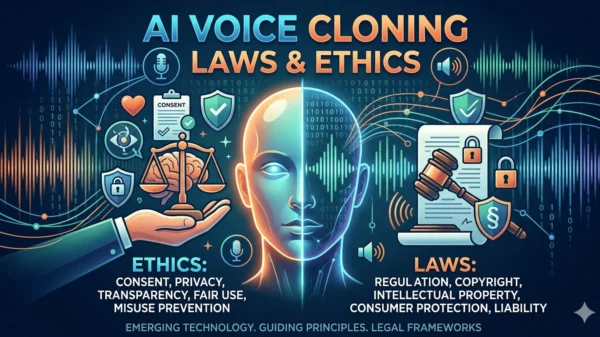















Imagine hearing your own voice saying something you never uttered. A heartfelt message to a loved one. A controversial opinion shared with millions. Or worse — a voice demanding money from your family, perfectly mimicking your tone, cadence, and emotional inflections.
This isn’t science fiction anymore. It’s happening right now, and the legal landscape is scrambling to catch up.
AI voice cloning has exploded from a novelty tech demo into a multi-billion-dollar industry in what feels like the blink of an eye. Anyone with a cloud subscription and a few minutes of audio can now create a near-perfect replica of another person’s voice. That capability brings real creative potential — but also serious risks and responsibilities.
If you’re a content creator, marketer, business owner, or simply curious about this technology, understanding the legal boundaries and ethical guidelines that govern voice cloning in 2026 isn’t optional. It’s essential.
Understanding AI Voice Cloning: What It Is and How It Works
Before the legal and ethical discussion, it helps to be clear on what’s actually happening technically.
AI voice cloning uses machine learning to analyze recordings of a person’s voice and build a synthetic model that can generate new speech in that voice. Modern systems need surprisingly little source material — as little as 10 to 30 seconds of audio can produce a convincing clone. The model learns pitch, timbre, pronunciation patterns, rhythm, and emotional delivery.
Quality has improved dramatically. Early systems sounded robotic and obviously artificial; 2026’s best systems capture subtle emotional nuance and can respond dynamically to context. That’s exciting for legitimate use cases — and unsettling for everyone else.
Legitimate Applications
- Audiobook narration — authors can narrate in their own voice without spending hours in a studio
- Accessibility — people losing their speech to illness can preserve their voice for future communication
- Localization — content can be translated into multiple languages while keeping the original speaker’s vocal character
- Film and gaming — productions can complete voice work after an actor becomes unavailable
- Customer service — businesses can maintain a consistent brand voice across touchpoints
- Education — educators can scale content production without vocal strain
The Legal Landscape in 2026: What’s Actually Illegal
Voice cloning law is evolving fast, and it’s still a patchwork — there’s no single federal rule you can rely on. You need to understand the layered regulations currently in place.
Federal Protection: The ELVIS Act
The most significant development is the ELVIS Act (Ensuring Likeness, Voice, and Image Security Act), passed in 2024 and in effect since December 2025 — the first major legislation specifically protecting voice and likeness rights from synthetic media.
Under the ELVIS Act, creating or distributing an unauthorized digital replica of someone’s voice is now federally illegal. Key points:
- The replica must be “realistic” — meaning it could reasonably be mistaken for the real person
- The use must be commercial or implicate right of publicity
- Violators face statutory damages of Range from $2,500 to $25,000.
per violation, even without proof of financial harm - Consent for one use doesn’t automatically extend to other uses
State-Level Regulations
Several states have layered on their own protections:
- Tennessee — one of the first states to act, prohibiting AI deepfakes and creating property rights in a person’s “forged digital likeness”
- California — multiple provisions addressing synthetic media and voice replication
- New York — a statutory Right of Publicity (since 2025) that covers voice under the likeness clause
- Washington — amended its biometric privacy law (HB 1493) to include voice data, with enhanced penalties as of June 2026
- Illinois — BIPA explicitly covers voiceprints, requiring explicit written consent to record or replicate a voice
- Texas — its Biometric Privacy Act covers voiceprints but allows consumer applications with synthetic voices where consent is obtained
International Regulations
If you operate globally, add these to your compliance checklist:
- European Union — the EU AI Act classifies voice cloning as “high-risk.” Services must label AI-generated content clearly, keep detailed creation logs, and provide deletion mechanisms. Penalties can reach 6% of global annual revenue.
- China — requires clear labeling of AI-generated content and mandates consent for voice synthesis involving identifiable individuals.
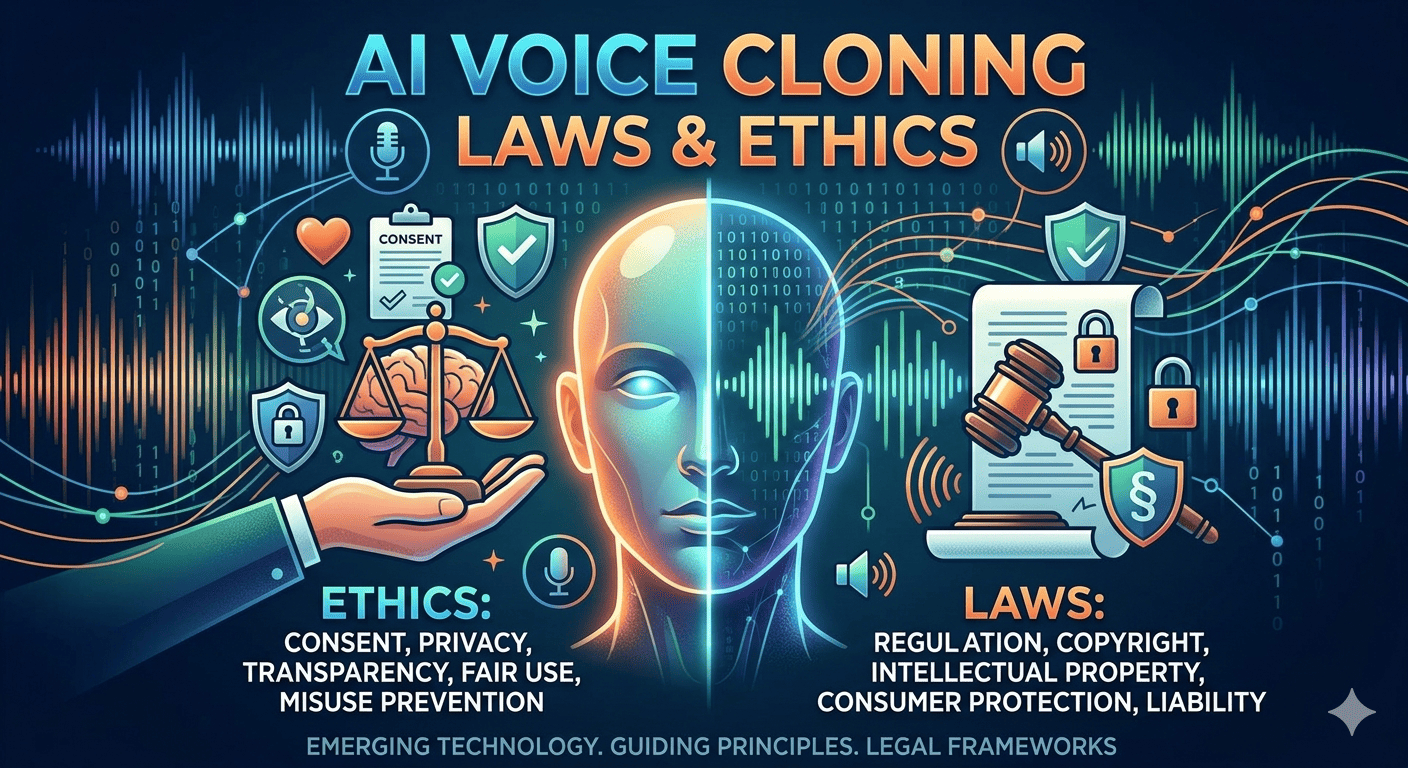
The Golden Rule: Consent Is Non-Negotiable
If there’s one principle to anchor every decision around voice cloning, it’s this: consent is non-negotiable.
The legal consequences are real, but that’s not the whole picture. Voices are deeply personal — tied to identity, emotion, and memory. Using someone’s voice without permission isn’t just a legal risk; it’s a violation of their control over their own identity.
What Valid Consent Actually Looks Like
Generic permission isn’t enough. The 2026 standard requires:
- Explicit permission — a clear, affirmative agreement, never assumed or implied
- Specific scope — exactly what the voice will be used for, in which channels, for how long
- Informed understanding — the person understands AI will be used to replicate their voice
- Documentation — a written agreement, not a verbal one
- Revocability — clear terms for how consent can be withdrawn
Consent Checklist
Before starting any voice cloning project, confirm you have:
- [ ] A written agreement signed by the voice owner
- [ ] A clear description of intended use cases
- [ ] A defined duration for how long the clone can be used
- [ ] Geographic distribution limits
- [ ] Clarity on whether the clone can be modified or combined with other AI
- [ ] Compensation terms, if applicable
- [ ] A process for terminating the agreement
- [ ] Attribution requirements
Platform Policies: The Layer That Actually Gets Enforced
Platform policies often go further than the law — and platforms enforce them aggressively.
YouTube, TikTok, Meta, and others require disclosure of AI-generated content. Ad networks have specific rules for synthetic audio in advertising. App stores have their own guidelines for voice cloning apps.
The practical takeaway: something can be technically legal and still get your content removed, your account suspended, or your ads rejected for violating platform terms. Always check the specific policy for each platform you use.
Ethical Considerations: Beyond What’s Legal
Legal compliance is your floor, not your ceiling. Being ethical means asking not just “can I do this?” but “should I do this?”
Transparency and Disclosure
Many jurisdictions now require labeling AI-generated audio — but the ethical case stands on its own. If your audience could reasonably mistake the voice for a real human recording, disclose it. This matters especially for:
- Advertising and promotional content
- Customer service interactions
- Political or advocacy content
- Financial and healthcare contexts
The goal isn’t to over-explain — it’s to make sure trust isn’t broken.
Voice as Identity
A voice carries more than its acoustic properties. It conveys emotion, builds rapport, and signals authenticity. Consider the impact on someone who hears their cloned voice used in a context they never agreed to — or used to scam their own family.
A Quick Harm-Potential Check
Before proceeding, ask:
- Could this voice clone be used to deceive or harm someone?
- Could it damage the voice owner’s reputation?
- Could it enable fraud, manipulation, or exploitation?
- Would I be comfortable if this use became public?
Weighing the Pros and Cons
Advantages
- Accessibility for people with physical limitations
- Efficient localization that preserves vocal character
- Preservation of a voice before illness or death
- Scalable content production
- Consistent brand voice at volume
- New creative possibilities
Risks
- Sophisticated voice-based fraud
- Fake audio used for misinformation
- Erosion of one of the last frontiers of personal privacy
- New vectors for identity theft
- Genuine difficulty verifying proper consent
- Real difficulty for audiences detecting synthetic audio
Practical Guidelines for Responsible Use
- Default to consent. If there’s any doubt about permission, don’t proceed until you have clear authorization.
- Document everything. Keep detailed records of consent agreements and how voice samples were sourced.
- Use reputable platforms with built-in consent verification rather than unregulated tools.
- Label proactively, even when not legally required — it builds trust.
- Stay current. The law is moving fast; check relevant jurisdictions periodically.
- Have a takedown plan ready in case someone objects.
- Respect scope limits. Consent for one project isn’t consent for another.
- Consider ongoing compensation rather than a single one-time payment for professional use.
Frequently Asked Questions
Is it legal to clone my own voice? Yes — this is one of the most common legitimate uses. Many voice cloning services offer self-cloning specifically. If you’re using it commercially or distributing through third parties, it’s still worth reviewing platform policies and potentially consulting a lawyer.
Can I clone a celebrity’s voice for my YouTube video? No. Using a celebrity’s voice without explicit permission — even for commentary or parody — risks a right-of-publicity violation. Fan projects and commentary may have some fair-use protection, but the line is blurry and expensive to test in court. Don’t risk it without legal counsel.
What can I do if someone clones my voice without permission? Several avenues exist in 2026: the ELVIS Act at the federal level, state right-of-publicity laws, BIPA claims in Illinois, Texas, or Washington, and general privacy or persona claims even outside states with specific voice laws. Document everything and preserve evidence as soon as you discover unauthorized use.
Can voice cloning be used for fraud? Yes — it’s one of the fastest-growing scam categories, letting criminals impersonate family members, bosses, or executives to trick people into transferring money or revealing sensitive information. It’s explicitly illegal, and law enforcement actively pursues these cases, but detection remains genuinely hard. Always verify unusual requests through an independent channel.
Do I need to disclose AI voice use in my podcast? It’s the ethical choice, and increasingly the legal one too. Requirements vary by jurisdiction, but disclosure builds audience trust — most ethical podcasters now flag synthetic voice use clearly.
Looking Ahead
Expect the regulatory landscape to consolidate further, with federal standardization likely around 2027 and more uniform right-of-publicity rules alongside real-time disclosure requirements. Platforms will keep building more sophisticated detection tools, and watermarking for synthetic audio will likely become standard.
But the technology keeps advancing on both sides. The arms race between cloning tools and detection systems will only intensify. Understanding, vigilance, and ethical practice remain your best protection.
The Bottom Line
AI voice cloning is a genuinely transformative technology. It can preserve a voice before illness takes it, make content more accessible, and unlock creative possibilities that didn’t exist a decade ago.
But potential for good doesn’t cancel out potential for harm. The same technology that lets an author narrate their own audiobook can let a scammer target an elderly victim. The power to create carries a matching responsibility.
The good news: responsible use isn’t complicated. Get consent. Be transparent. Stay within scope. Treat someone’s voice the way you’d want your own treated.
That’s the whole standard.
Sources
- Federal Trade Commission (FTC) — AI Oversight Guidance
- ELVIS Act — Federal Legislation
- EU AI Act — Official Text
- Illinois BIPA — State Statute
- Tennessee Voice Protection Law
- California Right of Publicity
- New York Right of Publicity Statute
- Washington State HB 1493
For more tech guides and resources, visit NextAppsZone.
Sources:
- Federal Trade Commission (FTC) – AI Oversight Guidance
- ELVIS Act – Federal Legislation
- EU AI Act – Official Text
- Illinois BIPA – State Statute
- Tennessee Voice Protection Law
- California Right of Publicity
- New York Right of Publicity Statute
- Washington State HB 1493

Independent technology writer focused on artificial intelligence, emerging technologies, and digital innovation. Covers AI applications in sports, productivity, and online business.