
































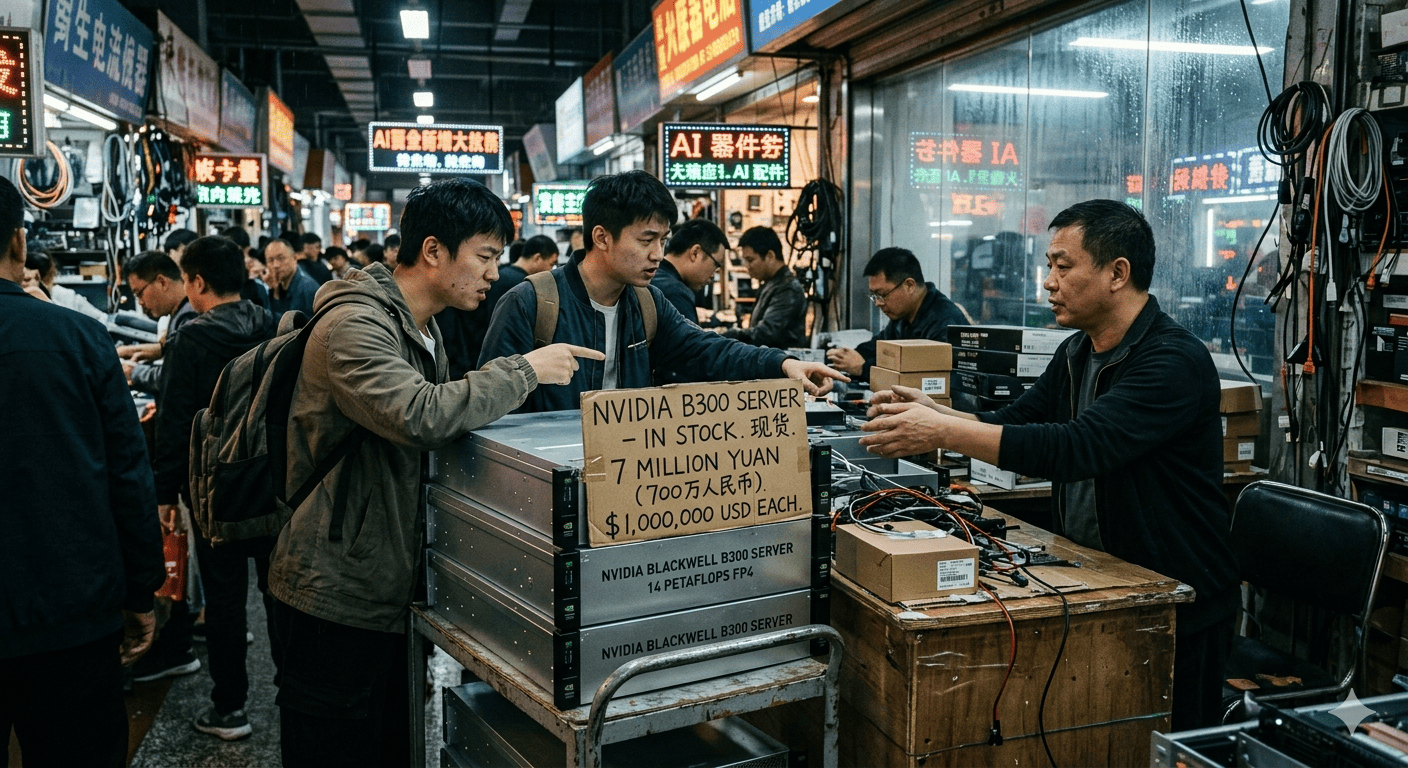
The fierce global competition for artificial intelligence (AI) has reached a stalemate in China following sanctions imposed by the White House in Washington. In April 2026, the price of a single Nvidia B300 AI server reached an unprecedented 7 million yuan (US$1 million) on the Chinese black market. While tech giants like Alibaba and Tencent may have the capital to weather this crisis, these exorbitant costs pose an existential threat to AI startups.
This dramatic price surge is not merely a financial hurdle; it’s a “barrier of entry” that is fundamentally reshaping the future of AI innovation in China.
Capital Depletion: The End of “Growth at All Costs”
For startups in Series A funding rounds, a $10-20 million round was sufficient to cover their expenses for two years. At current prices in 2026, purchasing a small batch of just 10 Nvidia B300 servers would immediately deplete between 50% and 100% of a company’s capital.
This is known as the “capital drain trap.” Startups and small businesses are forced to spend their entire budget on hardware and servers instead of hiring top talent or acquiring new customers. As a result, founders are left with two options: either sell off their equity or settle for less ambitious projects.
The Great “Compute Divide”
The $1 million price tag is widening the gap between the “Haves” and the “Have-nots”:
- The Giants: Large corporations and government-backed entities still secure hardware through established supply chains or long-term contracts.
- The Startups: These are the biggest victims. Small companies are effectively excluded from the high-end hardware market due to its high price..
This is leading to a consolidation of innovation. Instead of a diverse ecosystem, AI talent is being forced under the umbrellas of big tech firms that possess the necessary compute power to run advanced models like DeepSeek V4 or local LLMs.
Price Comparison: The “Scarcity Premium” in China (2026)
The “Scarcity Premium” in China has reached nearly 100% compared to global rates, making the mainland the most expensive place on Earth to run AI workloads.
| Server / Metric | Official Global Price (MSRP) | China Grey Market Price (2026) | Price Increase % |
| Nvidia B300 Server | ~550,000$ | ~1,000,000$ (7M Yuan) | +82% |
| Nvidia B200 Server | ~400,000$ | ~750,000$ | +87% |
| Monthly Rental (B300) | ~12,000$ – 15,000$ | ~26,000$ (190K Yuan) | +100% |
| Hardware Support | Full Official Warranty | None (High Risk) | N/A |
Forced Migration to the Cloud (and Lower Margins)
Unable to afford $1 million servers, startups are flocking to GPU rental services. However, monthly rental costs for a single B300 node have spiked to 190,000 yuan ($26,000).
This reliance on rented compute turns a startup’s agility into a massive recurring expense. High operational costs (OpEx) make it nearly impossible for new companies to achieve a positive ROI in the early stages, often leading to failure before their products can gain market traction.
The Hardware Maintenance Nightmare
Purchasing a $1 million server through unofficial “grey market” channels carries a terrifying risk: Zero Official Support.
In the Blackwell architecture era, these systems are incredibly complex. If a critical B300 unit fails, there is no official Nvidia warranty to cover it. For a startup, a single hardware malfunction can lead to weeks of downtime, resulting in lost data and potentially the total collapse of their services.
The “Huawei Hedge”: A Shift Toward Self-Reliance
There is one unintended consequence of these high prices: the rapid adoption of domestic alternatives like Huawei’s Ascend 950PR. With Nvidia prices hitting record highs, startups are being forced to optimize their code for Chinese-made chips.
While this transition is technically difficult—requiring a move away from Nvidia’s CUDA ecosystem—it is creating a more self-sufficient Chinese AI environment. In April 2026 alone, demand for Huawei’s Ascend chips has surged following the successful launch of models optimized specifically for domestic hardware.
The $1 million price tag of the Nvidia B300 graphics card is a natural selection mechanism. By 2026, only the most efficient capital-utilizing startups will survive. While the era of cheap computing is over, this pressure is creating a new generation of developers who achieve success through algorithmic efficiency and local hardware integration rather than relying on expensive power.
Stay tuned to NextAppsZone for the latest updates on the AI Hardware Race and global tech trends.

Independent technology writer focused on artificial intelligence, emerging technologies, and digital innovation. Covers AI applications in sports, productivity, and online business.