




























For most of the last three decades, the question about AMD was whether it would
survive Intel. In the last quarter of 2026, the question is whether it will beat it.
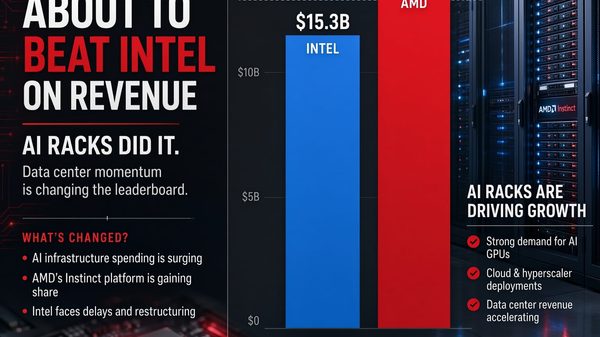
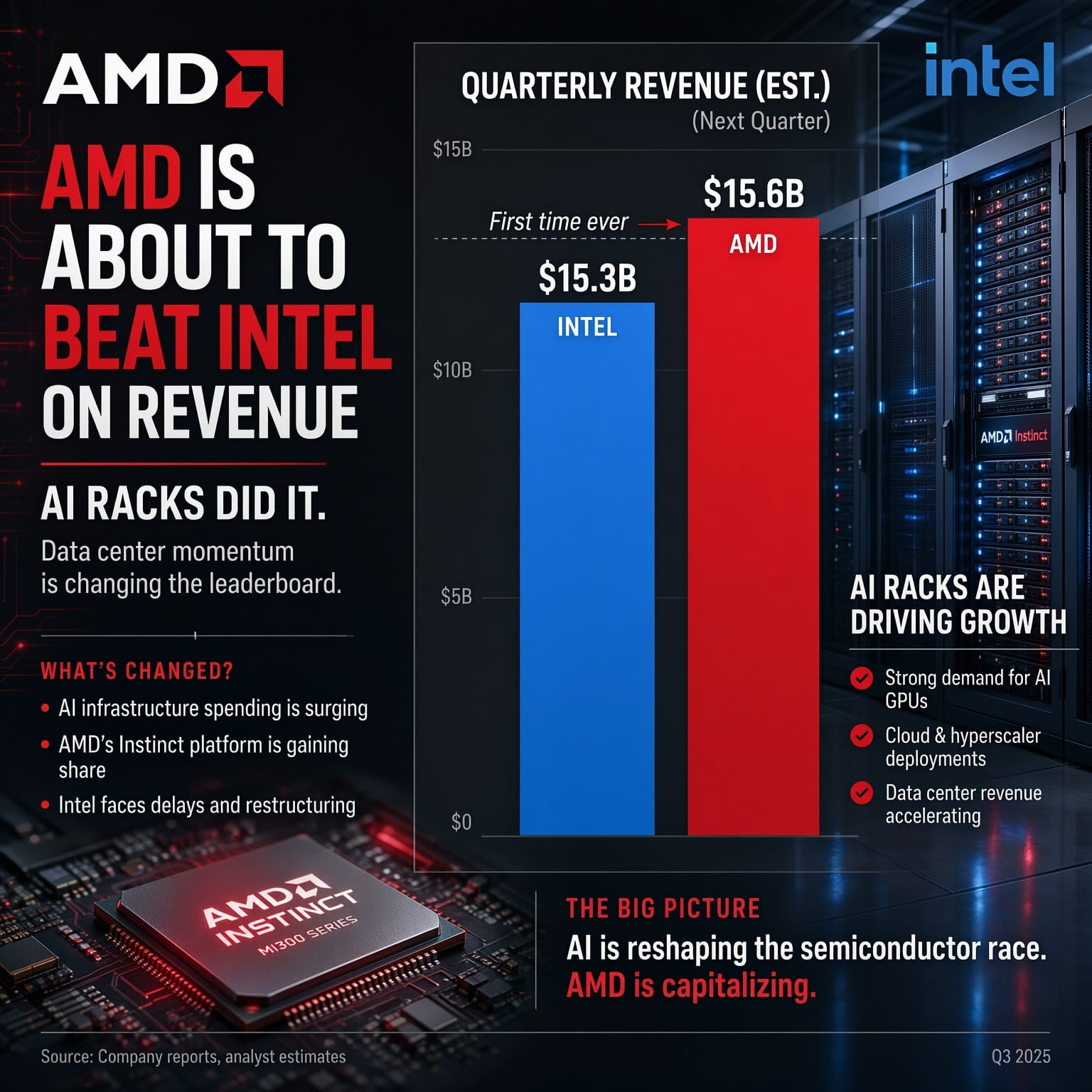
AMD’s guidance points to roughly $17 billion in revenue for Q4 2026. Intel expects
between $15 and $16 billion over the same period. If both companies hit their
numbers, AMD will report more quarterly revenue than Intel for the first time in its
history.
Three caveats belong at the top, not the bottom. These are guidance figures, not
reported results — the quarter is not closed. It is one quarter, not an annual title:
Intel still out-earned AMD for full-year 2025, $52.9 billion to $34.6 billion. And
revenue is not profit; nothing here says AMD is the more profitable company.
With that said, the direction of travel is not ambiguous.
Four Numbers That Explain the Reversal
| Year | Intel revenue | AMD revenue |
|---|---|---|
| 2021 | $79.0B | $16.4B |
| 2022 | $63.1B | $23.6B |
| 2025 | $52.9B | $34.6B |
| Q4 2026 (guidance) | $15.0–16.0B | ~$17.0B |
In 2021 Intel was nearly five times AMD’s size. The gap has closed from both ends:
Intel’s revenue fell, AMD’s rose. By 2025 the ratio was about 1.5x. On Q4 guidance,
it inverts.
That shape matters. A challenger catching a leader usually happens because the
challenger grows. Here, both things happened at once — and one of them was a
structural problem at Intel, not just a good product cycle at AMD.
The Revenue Isn’t Coming From PCs
The intuitive explanation — Ryzen chips are better, so people buy them — is only
part of the story, and probably the smaller part.
Ryzen’s competitiveness is real. Xataka’s assessment is that AMD’s consumer chips
have been strong for years in gaming, office work, and content creation. But consumer
PCs are not what moved a $16 billion company to $34 billion in four years.
The growth came from two product families that both live in the data center: EPYC
server processors and Instinct AI accelerators. Those are the lines that grew fastest
during the same two years AI demand exploded.
That distinction changes how to read the crossover. AMD is not winning because it
sells more laptops. It is winning because the part of computing that is growing
fastest happens to be the part where it bet early.
Helios Is the Real Strategic Move
Selling a chip is a component business. Selling a rack is a systems business. AMD has
been pushing toward the second.
Helios, its rack-scale computing platform, is the vehicle. According to Xataka,
Anthropic, Meta, Microsoft, OpenAI, and Oracle Cloud Infrastructure are already buying
Helios systems. Lisa Su has said AMD’s data-center solutions division will represent
more than 80% of the company’s revenue in 2027.
Read that projection carefully. It is a forecast from the CEO, not a reported result,
and it implies a company that will look almost nothing like the PC-chip vendor of
2019. It also explains why rack-scale matters: hyperscalers do not want to integrate
components themselves if a vendor will deliver a validated system. That is the same
shift described in what AI factories actually need from the
rack —
memory residency, latency, and I/O behavior are system properties, not chip
properties.
Whoever sells the system captures more of the value. AMD is trying to be that seller
before the window closes.
Intel’s Side of the Ledger
The comparison is not fair to Intel in one sense: Intel is carrying a turnaround.
Lip-Bu Tan arrived in March of last year, and by Xataka’s account the results and
investor sentiment have improved since. But two problems remain visible.
First, Intel is reportedly still struggling to meet demand for Xeon, its data-center
processor line — the exact market where AMD is gaining. A supply constraint in the
segment that matters most is not a margin problem; it is a share problem.
Second, the PC market has weakened because of sharp increases in component prices.
That is a familiar mechanism by now: AI demand has been driving up memory
prices,
and the resulting device costs cool the consumer market. Intel, which still depends
more on PCs than AMD does, absorbs more of that damage.
Intel’s counterargument is that it is playing a different game — a chip strategy
built around a different kind of AI
silicon
rather than the accelerator race. That may be right. It does not change the revenue
line this quarter.
What the Crossover Does and Doesn’t Prove
It proves that AMD executed a data-center transition faster than its larger rival.
It does not prove that AMD is now the stronger company. Intel is still larger on
annual revenue, still owns the installed base, and still runs a foundry business that
AMD does not have. Profitability, debt, and capital intensity are not in this
comparison — the source reports revenue only, and this article does not fill that gap
with estimates.
It also does not prove the lead lasts. Guidance can miss. A single quarter can flip
back. And AMD’s new revenue base is concentrated: five named hyperscaler customers
for Helios is a strong validation and a real dependency at the same time.
What to Watch
- The Q4 actuals. Guidance is a promise; the earnings report is the score. If
either company misses, the crossover may be delayed by a quarter. - Data-center mix. If Su’s 80% projection holds, AMD becomes a different company
with a different risk profile — more exposed to the AI capex
cycle
and less to consumer demand. - Xeon supply. Intel’s recovery depends on shipping the product it already has
demand for. - PC demand. The component-price squeeze is a shared headwind. It hurts the
company with more consumer exposure first.
The Symbolic Part
There is a temptation to treat this as a coronation. It is not.
AMD spent decades as the second source — the cheaper option, the alternative, the
company whose continued existence was good for competition. Getting to the point
where it can out-sell Intel for a quarter is a genuine achievement, and it came from
a bet on data-center silicon that most of the industry was slow to make.
But the more useful reading is about where the money moved. The PC, once the center
of the computing industry, is now the slow part. The growth is in racks, accelerators,
and the systems that hold them — and that is the market AMD spent the last five years
building for while Intel was defending the one it already owned.
One quarter does not settle a rivalry. It does show which way the current is running.
Source:
Xataka, 5 November 2026, by Laura López
AMD Reports Third Quarter 2026 Financial Results
Intel Reports Third-Quarter 2026 Financial Results
AMD forecast eases AI spending fears as data-center sales surge
AMD Delivers Full-Stack Compute for the Agentic AI Era
AMD Data Center Revenue Soars 97 Percent On AI, EPYC Demand
AMD Q3 2026 Earnings Call Transcript

Independent technology writer focused on artificial intelligence, emerging technologies, and digital innovation. Covers AI applications in sports, productivity, and online business.