








The most revealing number in Apple’s supply chain right now is not a product price.
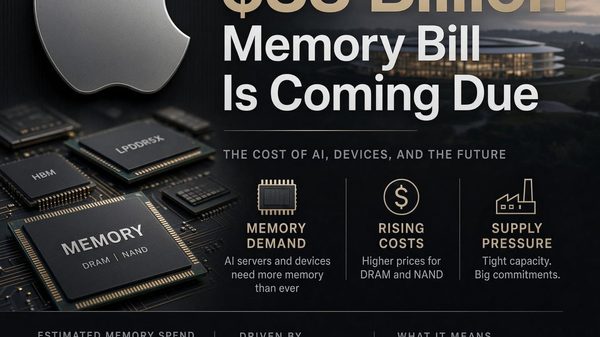
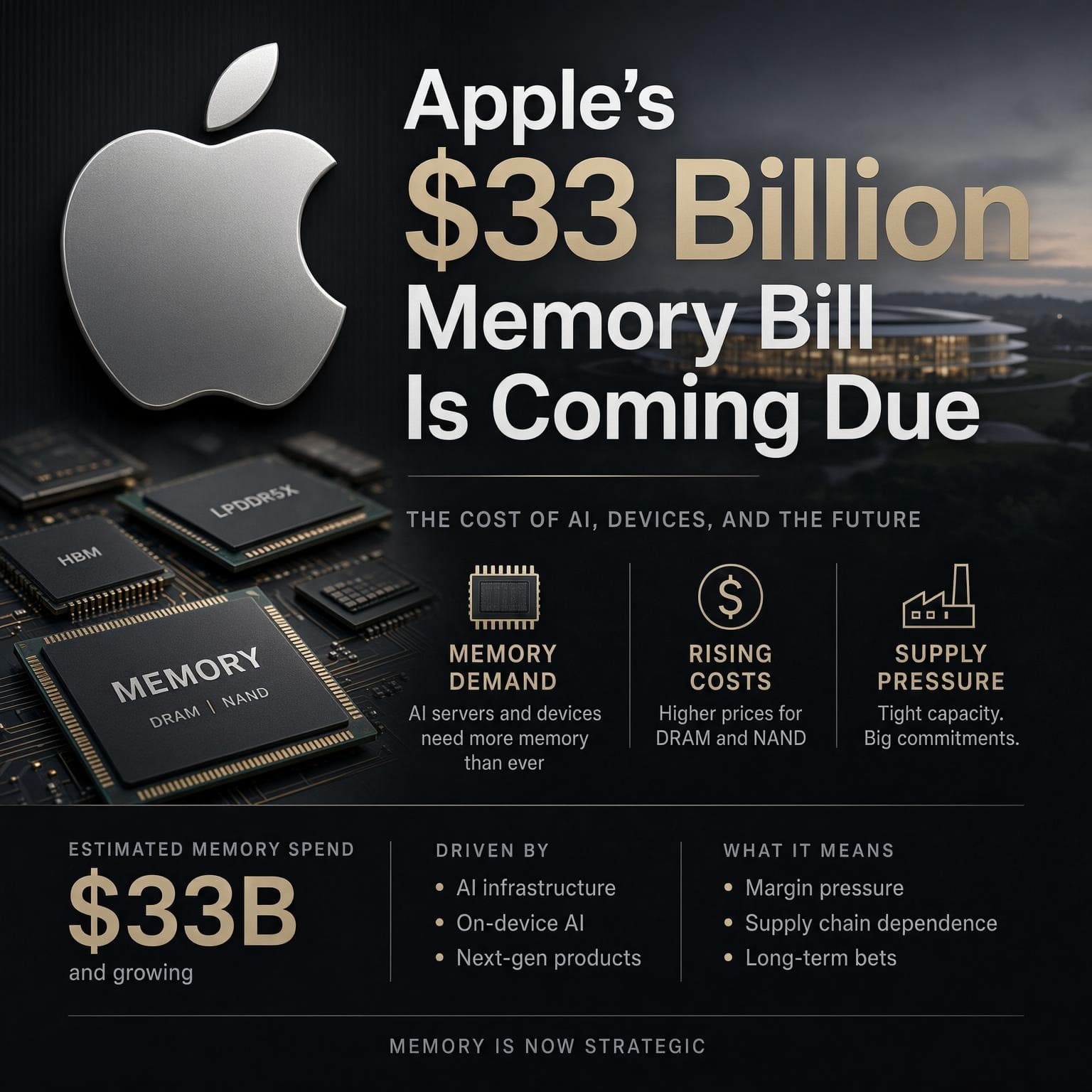
It is $33 billion.
Between June and September, Apple’s production-related purchase commitments rose by
that amount, according to a short CNN TURK report published on 6 November. The
figure is not money already spent. It is an obligation to buy in the future — a
forward bet that the components Apple needs will be available, and that locking in
supply now is cheaper than waiting.
Two caveats before going further. First, the report is brief and does not cite a
filing, an earnings call, or a named analyst for the $33 billion. Treat it as
reported, not audited. Second, purchase commitments do not tell us whether Apple
expects higher prices, higher volumes, or both.
What they do tell us is that the company is bracing.
What a Purchase Commitment Actually Is
A purchase commitment is a contract to buy something later. It sits on the balance
sheet as an obligation, not as inventory. When Apple commits to memory suppliers, it
is reserving capacity — and usually accepting a price formula in advance.
That matters in a shortage. If DRAM and NAND prices are climbing, the company that
locks in supply early pays less than the company that buys spot. It also means the
commitment is a signal: Apple would rather guarantee access than wait for the market
to soften.
The report is explicit that this is not a paid invoice. So the $33 billion is not
evidence that costs have already hit the income statement. It is evidence that
management expects them to.
Why an AI Data Center Is in the Same Queue as Your iPhone
The cause is the part that should sound familiar by now.
AI data centers need enormous amounts of memory. That demand competes directly with
the memory that would otherwise go into phones, laptops, and tablets. The CNN Türk
report states it plainly: AI data-center demand is reducing the chip supply allocated
to phones and computers.
This is not a new mechanism. AI has already been pushing up GPU memory
prices
for PC builders, and the global memory
shortage
has been building through the hyperscaler capex cycle. What is new is the consumer
device layer: the same shortage that made graphics cards expensive is now working its
way into the device in your pocket.
Samsung, SK Hynix, and Micron — the three companies that dominate memory supply —
reportedly do not expect the crisis to end soon. That is the most important sentence
in the report. A shortage with a visible end is a pricing problem. A shortage without
one becomes a planning constraint.
The Cushion Is Thinning
Apple has already taken one round of price increases.
Mac and iPad prices went up in June. iPhone models followed in September. Those
moves partially offset the rising component costs. Apple also benefited from
inventory bought at older, cheaper prices — stock that gave the company time to
adjust without passing the full cost to buyers immediately.
That advantage is shrinking. Inventory bought at pre-surge prices runs out. When it
does, the current cost of memory becomes the cost of the next device.
This is the part of the story that usually gets lost in coverage of quarterly
earnings. A company can absorb a cost increase for a while by drawing down cheap
stock and accepting thinner margins. Neither lasts forever, and both are visible in
advance to anyone watching commitments rather than revenue.
What Apple Has Said — and What It Hasn’t
Apple’s CEO John Ternus called the situation “unprecedented”, according to the
report. That is a strong word from a hardware executive, and it fits the moment:
Ternus took over as
CEO
into a memory market that is being repriced by AI demand.
But the more important detail is what Apple has not done. It has not announced a new
price increase. The report is clear on that point, and it should temper any headline
claiming otherwise.
So the current state is: costs are rising, previous increases have already been
absorbed, the cheap inventory is running out, and no new increase has been announced.
That is a company holding a position, not a company that has made a decision.
What Analysts Expect
The report relays an analyst view that Apple may struggle from the holiday shopping
period through 2027. It also says that if the production-capacity squeeze continues,
more expensive devices for consumers “would not be surprising”.
Note the hedging. This is expectation, not guidance. Nobody quoted in the report
predicts a specific price, a specific model, or a specific date.
The reasonable reading is a window rather than an event. Holiday 2026 is the first
test, because that is when volume meets constrained supply. 2027 is when the
commitments made this year come due.
What This Means If You Are Buying
The report does not tell you whether to buy now, and neither will this article. It
gives no timing signal, and pretending otherwise would be inventing one.
What it does support is a few practical inferences:
- Memory is the constrained input, not the chip. Configurations that lean on RAM
and storage are the ones most exposed to this shortage. If you are choosing between
tiers, that is where the cost pressure sits. - The cheap-inventory window is closing. Devices assembled from pre-surge stock
are the ones still carrying older costs. That is a statement about Apple’s
accounting, not a promise about retail prices. - Previous-generation models are the hedge. They were priced before this cycle
and are less directly tied to the current memory market — though the report says
nothing about discounts, so do not assume one. - The iPhone 18 pricing already reflects one increase. The September move is
baked into what the iPhone 18 Pro Max actually
costs,
so the question is what comes after it, not what should have been.
The Bigger Pattern
Apple is the clearest example of a shift that is larger than one company.
For two years, the cost of AI was discussed as a data-center problem: capex, power,
GPUs, water. The memory bill was treated as part of that world. It is not. Memory is
a shared input, and when AI absorbs supply, the price change propagates to every
device that uses the same part.
Apple’s $33 billion commitment is the company buying certainty in an uncertain
market. For buyers, the less comfortable translation is that the certainty is being
purchased in advance, and the cost of that certainty usually arrives later, on a
product page.
Source: CNN TURK, 6 November 2026 (short news brief)

Independent technology writer focused on artificial intelligence, emerging technologies, and digital innovation. Covers AI applications in sports, productivity, and online business.