






























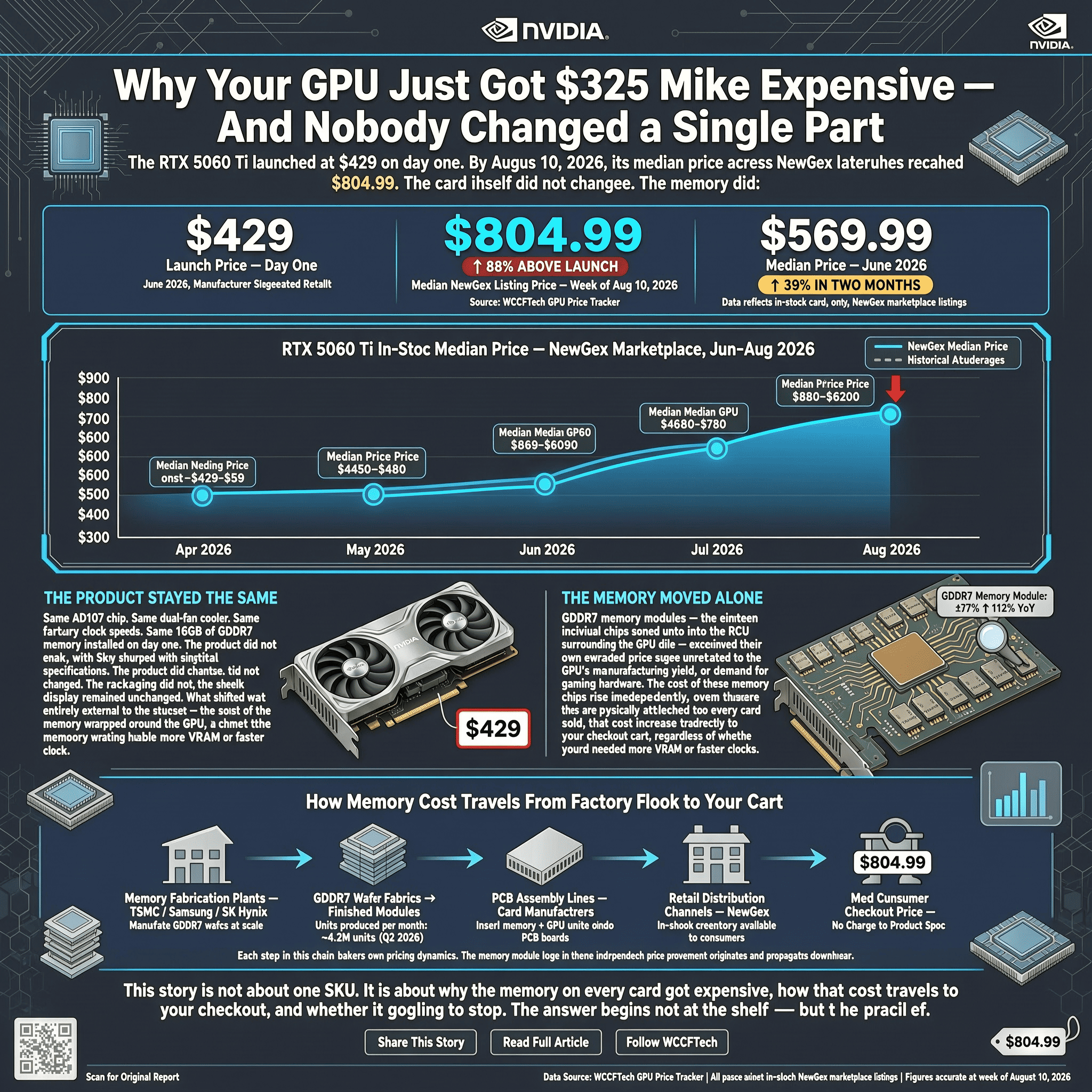
NVIDIA put the GeForce RTX 5060 Ti 16GB on shelves at $429. By the week of August 10, 2026, that same card was listing at a median of $804.99 across Newegg sellers for in-stock cards, according to WCCFTech’s GPU price tracker. That is 88% above the launch price, and a 39% jump in the two months since June, when the median was $569.99.
The numbers are worth reading twice, because the product itself did not change at all. Same chip, same cooler, same clock speeds, same 16GB of GDDR7 that shipped on day one. What moved was the price of the memory wrapped around the GPU. And that price has its own, separate story — one that starts far away from the shelves where this card sits.
This article follows that story. It is not about one SKU. It is about why the memory on every card got expensive, how that cost travels to your checkout, and whether it is going to stop.
The Quiet Detail That Gives the Whole Game Away
Start with the family, because the comparison does most of the work. The 8GB version of the exact same card, same die and same board layout, launched at $379. In August it was hovering around $529.99, up 40% from list, which is painful but nowhere near the 16GB card’s trajectory. Two nearly identical products. One doubled. The other climbed but stayed in reach of its launch price.
The median figures, as tracked across Newegg listings in mid-August 2026:
| Model | VRAM | Launch MSRP | Aug 2026 median | vs. MSRP |
|---|---|---|---|---|
| RTX 5060 Ti 8GB | 8GB | $379 | $529.99 | +40% |
| RTX 5060 Ti 16GB | 16GB | $429 | $804.99 | +88% |
| RTX 5070 | 12GB | $549 | $899.99 | +64% |
| RTX 5070 Ti | 16GB | $749 | $1,099.99 | +47% |
| RTX 5080 | 16GB | $999 | $1,499.99 | +50% |
| RTX 5090 | 32GB | $1,999 | $4,699.99 | +135% |
A couple of caveats before drawing conclusions. These are median asking prices from online listings, which include marketplace sellers, so they are not a single official NVIDIA price. Trackers disagree at the edges — other outlets measured the 16GB card closer to $589 in early August — because different trackers sample different listings and dates. What they agree on is direction: the cards carrying more memory for their class are running the hottest.
The pattern points somewhere specific. The 16GB Ti, the 5070, the 5090, the cards with the most VRAM relative to their price, are the ones going up the most. The one card that held a comparatively restrained position, the 8GB Ti, is the one with the least memory on it. Whatever is inflating these products, it is not the GPU.
What Memory Actually Does for AI
To see why memory became the battleground, it helps to look at what an AI workload does with it. A model does not run from disk. Every parameter, every weight, has to sit somewhere the chip can reach in nanoseconds, and large models fill gigabytes without breaking a sweat. A conversation makes it worse, because the model keeps a running record of everything said so far so it can answer coherently, and that record lives in memory too. There is a name for that accumulation, the KV cache, and it is one of the biggest memory consumers in the entire AI stack.
One caution before we push further. It would be sloppy to announce that AI inference has stopped being compute-bound, full stop. Whether a workload is limited by compute or by memory depends on the model, the batch size, the quantization, and the hardware underneath it. High-batch training and large-batch inference are still heavily compute-limited. What has shifted is that a wide slice of everyday AI work — the low-batch, single-request inference that chatbots and coding assistants do constantly — is pinned to memory bandwidth and capacity rather than raw flops.
That shift changes what AI customers buy. They no longer just want more compute. They want more and faster memory, and they are willing to pay almost anything for it. That willingness is what has turned the memory industry upside down.
HBM and GDDR: Same Family, Different Kitchens
Here is where people usually get the story wrong, and it deserves precision. AI accelerators use a specialized memory called HBM, for High Bandwidth Memory. Gaming cards use GDDR. Both are produced by the same three companies — SK hynix, Samsung and Micron — and both begin as DRAM dies from the same wafer fabrication lines. That shared base is real, and it is the root of the whole conflict.
But it would be misleading to say GDDR and HBM roll off the same production line like one product being converted into another. The two diverge sharply downstream. GDDR chips are cut, tested and shipped as flat components that a graphics card mounts directly on its board. HBM takes DRAM dies, stacks them vertically, drills microscopic connections through the stack, tests each layer, and packages the whole column onto a silicon interposer seated beside the processor. That stacking, testing and packaging is a genuinely different process, with different equipment, different yields and different facilities.
So what actually links them? Capacity and capital. They compete for the same finite DRAM wafer output and the same investment dollars at the wafer level. When AI demand turned HBM into the highest-margin product the memory industry has ever sold, the three giants pointed new capacity, new cleanrooms and new budgets at HBM. GDDR gets what is left. The mechanism is allocation, not conversion. The factories did not stop making GDDR to make HBM in the literal sense of one line switching products. They stopped investing in more GDDR and funneled the growth — the scarce capacity and the priority orders — toward HBM. Over time that starves the consumer market just as effectively.
The scale of the reallocation is documented, not anecdotal. Micron has stated that HBM consumes DRAM wafer capacity at roughly a three-to-one trade ratio compared with standard DDR5 — each HBM wafer replaces what would have been three wafers of conventional memory — and that industry supply would remain “substantially short” of demand through and beyond calendar 2026. SK hynix’s 2026 HBM output was reported sold out as early as January. The numbers explain the whole situation in one line: memory companies are earning more from AI memory than they ever did from anything else, and they are building for that customer.
How the Squeeze Travels from a Fab to Your Cart
The transmission path from that allocation decision to your checkout is surprisingly short, and it runs through NVIDIA itself.
NVIDIA does not just sell chips to board partners. It sells kits, bundling the GPU die together with its VRAM modules, and the partners — ASUS, MSI, Gigabyte and the rest — mount those kits on their own boards. When memory prices rise, the kit price rises, and the board partner has almost nowhere to hide.
The pressure is visible in the memory prices themselves. Industry reporting covered by TechPowerUp put a 2GB GDDR7 module at roughly $20 to $23 in 2026, while a 3GB module — the higher-density kind a mid-range refresh would use — was being quoted near $60 to $70, about three times the cost of the 2GB part. Do the arithmetic on a 32GB design like the RTX 5090, which uses sixteen 2GB modules: memory alone would exceed $320 at those quoted prices, before the die, the cooler, the board or a single dollar of margin.
Reports in mid-2026 indicated NVIDIA had notified partners of another kit price increase, this time covering GDDR7 and, notably, GDDR6 cards as well. The reports were not officially confirmed, and a kit price rise does not always reach the shelf immediately — partners can absorb some of it to clear stock. But retailers were already showing the effect, and board partners were separately facing higher costs for coolers, PCBs and packaging. The whole cost stack moved up, with memory leading it.
Why the 16GB Mid-Range Card Is the Poster Child
This is the part that makes the 5060 Ti 16GB such a clean illustration, and it comes down to arithmetic.
On a mid-range card, memory is a much bigger share of the total cost than people assume. An entry-level card with 8GB carries a modest amount of it. A flagship with 32GB is so expensive for other reasons that memory, even at $320-plus, remains a supporting cost. But a $429 card carrying 16GB of GDDR7 has memory as one of the two biggest line items on the board. When module prices rise sharply, a card like that has no buffer. The increase lands directly on the street price.
The other force is demand. The 16GB mid-range card is precisely what AI hobbyists want for running local models. Sixteen gigabytes is the threshold that fits a useful 7B to 14B model in 4-bit quantization on a single consumer card, and the 5060 Ti 16GB became the cheapest brand-new entry point to that world. So the card absorbs a cost push from the supply side and a demand pull from a whole new class of buyer at the same time.
The 8GB version shows what happens when only one of those forces is present. It is more expensive than it should be, but it stayed in the same postal code as its list price. The 16GB card did not.
Can the Pressure on VRAM Prices Last?
Nothing in the memory market is guaranteed to hold forever, but the forces keeping it tight have unusual staying power.
The relief valves are real but slow. The suppliers are pouring money into new capacity, and the numbers make the timing clear. SK hynix is building the Yongin cluster and new Cheongju fabs, with first cleanrooms scheduled for late 2028 and mid-2029. Micron pulled forward its Idaho fab to first wafers in mid-2027 and is building in New York with supply expected around 2030. None of that is a 2026 event. The new capacity that is genuinely landing this year is HBM-specific — SK hynix’s M15X began taking wafers in February 2026 — which does nothing to relax the consumer memory market.
The demand side is the variable. Micron now forecasts the HBM market at roughly $100 billion by 2028, larger than the entire DRAM market of 2024, and notes that tight conditions are expected to persist beyond calendar 2026. A slowdown in AI investment, or a genuine plateau in model demand, would loosen things. So would the two-market reality reversing. Neither is on the near-term calendar.
There are also counterweights closer to home. The RTX 50 SUPER refresh, which would have leaned on higher-capacity 3GB GDDR7 modules, was reportedly put on hold largely over memory pricing. GDDR6 cards, the older and cheaper models gamers normally retreat to, were dragged into the same price wave. And the local AI buyer, the person running models on their own hardware, is not fading. That is durable demand sitting underneath the mid-range market.
A crash would be a surprise. So would cheap GPUs before new capacity lands. The likeliest path is a long grind that only starts to ease when the supply side catches up, and the announced timetables put that somewhere in 2027 at the earliest.
What This Means if You Are Buying
The numbers give you better tools than the fear, so here is the practical side.
On VRAM itself, resist the universal rules. How much memory a game needs depends on the game, the texture settings, whether ray tracing is on, the resolution and the mods you run. For most current titles at 1080p and 1440p, 12 to 16GB remains comfortable, but a game with heavy texture packs and full ray tracing can chew past 16GB today. Buy for the games you actually play, at the settings you actually use, not for a hypothetical library.
If you genuinely need the memory, treat any card near its list price as a real find. Set a price alert, decide your ceiling in advance, and move when it fires. Restocks still happen. They just evaporate fast.
The used market deserves a hard look, but with updated expectations. A used RTX 3090 still offers 24GB and roughly double the bandwidth of the 5060 Ti 16GB (about 936 GB/s versus 448 GB/s), which makes it genuinely interesting for local AI. But it is no longer the bargain it was a year ago. eBay sold data from early August 2026 put the used 3090 median around $1,050 to $1,100 — up sharply as the shortage dragged the used market up with it. So the trade-off now involves power draw, age, no warranty, and a price that has itself been inflated by the same forces.
And if you are a pure gamer who does not touch local AI, the contrarian play is sitting in the table above. The 8GB 5060 Ti stayed far closer to its list price than its 16GB sibling. For 1080p gaming, that card carries the smallest memory premium in the entire lineup.
Frequently Asked Questions
Is the VRAM shortage real, or are manufacturers using AI as an excuse to raise prices?
The retail data and the supply chain reporting align. GDDR7 module prices are publicly reported at $20 to $23 for 2GB and $60 to $70 for 3GB modules, NVIDIA reportedly raised kit prices, and cards with more memory are measurably running further above MSRP. Micron’s own guidance describes industry supply as substantially short of demand through 2026 and beyond. That pattern is hard to explain with pricing power alone.
Why is the DDR5 in my desktop more expensive too, if this is a GPU story?
Because it is the same factories. DDR5 and GDDR share DRAM wafer capacity and capital with HBM, and HBM’s three-to-one wafer trade ratio against standard DDR5 tightens the whole DRAM market, desktop RAM included.
Should I worry about the VRAM in my current card?
No. The crisis affects what you pay next, not what you already own. Your card’s memory works exactly as well today as the day you bought it.
Is paying the premium for 16GB over 8GB worth it?
Only with a specific workload in mind. For local AI, 16GB can be a hard requirement, so the premium is the price of entry. For pure gaming, it depends entirely on the games and settings you run. Do not pay for memory you cannot name a use for.
Will prices drop when the next GPU generation arrives?
Not automatically. New cards enter the same constrained supply chain, and the RTX 50 SUPER refresh was itself delayed by memory pricing. Price trackers and alerts are a more reliable guide than launch calendars.
Is AMD a better buy right now because its cards often carry more VRAM?
It depends on the street price per gigabyte, not the label. AMD has been raising prices on its Radeon line too, so compare actual retail prices for the memory you need before committing to either brand.
The Bottom Line
The $429 card that now lists above $800 is not a story about NVIDIA greed, and it is not a story about scalpers. It is the visible end of a memory industry that reprioritized itself for AI, transmitted through GPU kits and board partners straight onto the shelf.
The GPU did not get better. The memory genuinely got scarce, at a three-to-one cost to the rest of the market. And the relief is scheduled for 2027 at the earliest.
That makes the coming months predictable. The cards with the heaviest memory loads for their price class will keep feeling it first, and the smartest purchases this year are the ones that buy the least memory they can genuinely live with. Plan around the scarcity, and it costs you far less than it costs the person who panics.
If you want the wider view — why every GPU is expensive this year, not just the memory-heavy ones — our pillar analysis of the 2026 graphics card market traces the full chain from AI demand to the checkout counter.

Independent technology writer focused on artificial intelligence, emerging technologies, and digital innovation. Covers AI applications in sports, productivity, and online business.