































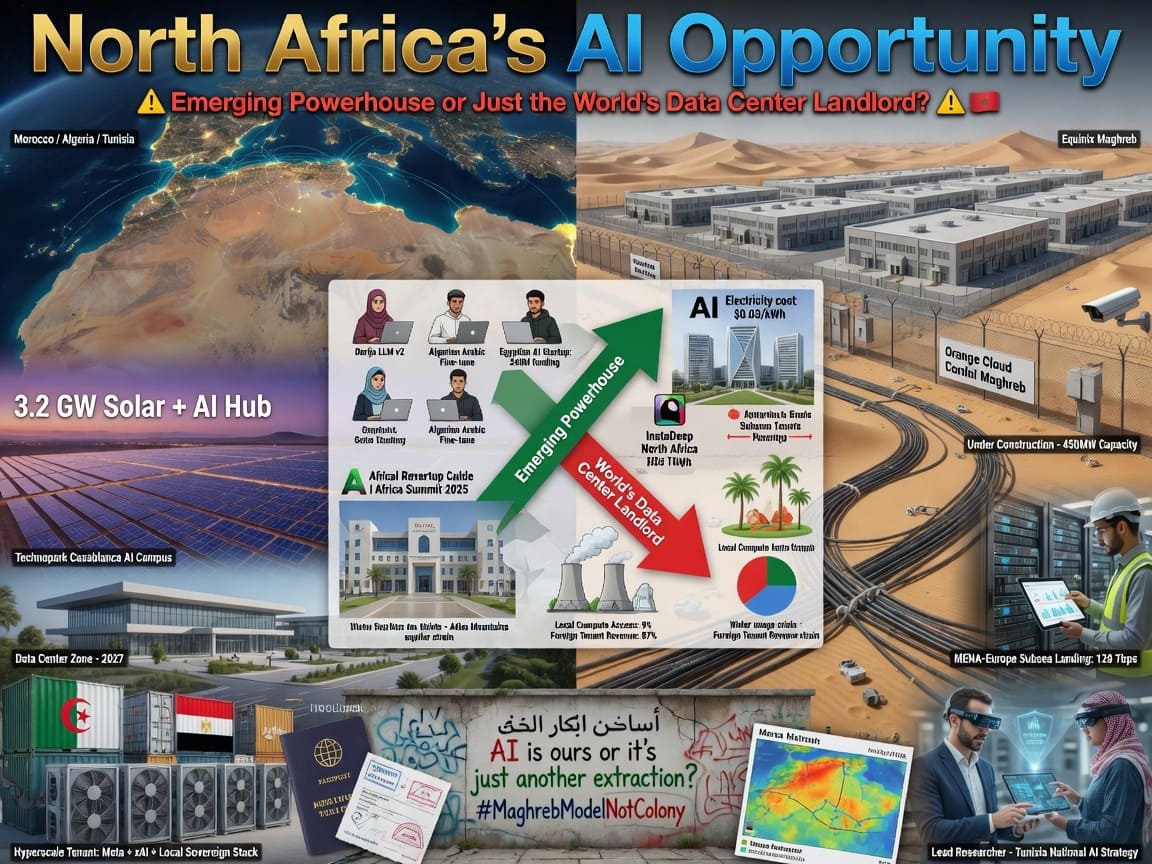
North Africa is suddenly everywhere in AI infrastructure news. Morocco just secured a $1.2 billion AI data center project backed by Nvidia and Naver. Egypt granted its tenth data center license in two years and launched its first sovereign AI facility. Algeria opened a high-performance computing center dedicated to AI in Oran. Tunisia and Libya both adopted national AI strategies within the last 18 months.
The numbers are real. The ambition is real. But the central question those numbers leave unanswered is whether North Africa is building a genuine AI capability — or constructing the physical infrastructure that other regions will use to run their models, process their data, and extract value from African resources.
This article examines what North Africa is actually building, what it is missing, and whether the region’s AI play is a strategic industrial transformation or an expensive real estate deal for foreign tech companies.
The Infrastructure Race Is Already Underway
North Africa’s AI push is not theoretical. It is financed, permitted, and under construction.
Morocco: The $1.2 Billion Bet
Morocco won a competitive bidding process against South Africa and other African nations to host the Nexus AI Factory, a sovereign AI data center near Casablanca. The project, unveiled at GITEX Africa 2026 in Marrakech, is backed by a consortium including U.S.-based Nexus Core Systems, Nvidia, South Korea’s Naver Cloud, and Lloyds Capital. TAQA Morocco will supply renewable energy.
The first phase targets 40 megawatts of capacity using Nvidia’s Blackwell GB200 GPUs, with a planned expansion to 500 megawatts. Morocco was selected over competing African nations, with investors citing the country’s political stability, proximity to Europe — roughly 15 kilometers across the Strait of Gibraltar — and direct connection to multiple undersea fiber optic cables.
Morocco’s government has committed additional investment through the Morocco AI 2030 roadmap and the broader Morocco Digital 2030 strategy, which aim to create approximately 240,000 digital jobs and contribute roughly $10 billion to GDP by 2030. The country climbed 14 places in the 2025 Government AI Readiness Index, reaching 87th globally and 8th in the MENA region.
A separate initiative in Tetouan, where Iozera plans to invest $500 million in a 386-megawatt data center, adds to the pipeline. The country currently has 14 data centers with just 1.5 megawatts of operational capacity as of the second quarter of 2026, per a BMI/Fitch Solutions report — meaning the planned capacity would represent an enormous scale-up.
Egypt: The Regional Hub Strategy
Egypt is moving faster than most observers expected. The National Telecom Regulatory Authority has issued ten data center licenses in the past two years, including a $400 million project from Hassan Allam Digital Infrastructure in partnership with A15.
In September 2026, Vodafone Business announced two landmark partnerships at the Grand Egyptian Museum. The first, with Elsewedy Electric and Cassava Technologies, will develop Africa Data Centres Egypt — the country’s largest data center — scaling to 200 megawatts with an initial investment expected to reach $200 million and total investment potentially approaching $1 billion. The second partnership, with Cassava Technologies and Nvidia, will establish Egypt’s first sovereign AI data center, bringing Nvidia’s advanced computing capabilities onto Egyptian soil for the first time.
Egypt’s Second National AI Strategy (2025–2030), released in January 2025, is built around six pillars: governance, technology, data, infrastructure, ecosystem, and talent. The infrastructure pillar specifically targets cutting-edge domestic data centers, intelligent cloud computing, ubiquitous 5G and fiber, and data center sustainability. The government aims to raise renewable energy’s share to 45 percent of the energy mix by 2028.
The country’s strategic position is hard to beat: it sits at the intersection of Africa, Europe, and Asia, sits atop extensive submarine cable networks, and offers competitive energy pricing. Egypt’s Digital Egypt Strategy for Offshoring targets $9 billion in export revenue from digitally enabled services by 2026.
Algeria: Digital Sovereignty First
Algeria’s approach is more explicitly sovereignty-driven. In March 2025, the Ministry of Post and Telecommunications inaugurated the country’s first high-performance computing center focused on AI in Oran, equipped with latest-generation GPUs and designed to give Algerian researchers, startups, and companies access to intensive computing capabilities.
In May 2026, Prime Minister Sifi Ghrieb chaired a government meeting to review a new national AI strategy built on three pillars: secure data architectures, robust digital infrastructure, and localized human talent. Algeria launched its first AI and cybersecurity startup cluster in early 2026, aimed at bridging academic research and commercial application.
A report titled “Why Algeria Is Positioned To Become North Africa’s AI Leader” argued that the country’s substantial human capital, national AI strategy focused on digital sovereignty, and infrastructure investments give it structural advantages. Whether that assessment holds up remains to be seen, but the policy direction is clear.
Tunisia and Libya: Building Foundations
Tunisia adopted its national AI strategy in 2022 through the National Agency for the Promotion of Scientific Research, and has since expanded AI courses in higher education and coding in primary schools. Its partnership with Huawei and the El-Khawarizmi Computing Center (CCK) is building cloud infrastructure. Tunisia also has a genuine startup ecosystem — companies like InstaDeep (now acquired by BioNTech) demonstrated that deep learning talent exists in the Maghreb.
Libya, coming from a lower base, adopted an AI Ethics Charter and launched its National AI Strategy 2026–2030 in June 2026, with 35 initiatives across six pillars. The strategy includes a planned Libya Sovereign Cloud (2026–2027), a National Academy for Artificial Intelligence (by 2028), and integration of AI ethics into school and university curricula by 2027.
What North Africa Is Actually Selling
The investment narrative centers on several competitive advantages that North Africa genuinely possesses.
Geographic proximity to Europe. Morocco’s 15-kilometer gap across the Strait of Gibraltar translates to low-latency connectivity to European markets. Egypt’s position at the Africa-Europe-Asia crossroads makes it a natural routing point for data traffic. For European companies seeking data sovereignty compliance while maintaining performance, North African locations offer a middle path between onshore European facilities and more distant alternatives.
Renewable energy. Morocco already has 45.3 percent of installed electricity capacity from renewable sources, targeting above 52 percent by 2030. Egypt is pushing toward 45 percent renewable energy by 2028. For energy-intensive AI workloads, this matters. Data centers consume enormous power, and the ability to source that power from renewables reduces both operating costs and regulatory exposure as European sustainability requirements tighten.
Submarine cable connectivity. Multiple undersea cable systems land along North African coasts, connecting the region to Europe, the Middle East, and sub-Saharan Africa. Morocco’s cables connect it to the Sahel region. Egypt hosts one of the world’s busiest cable corridors through the Suez Canal area.
Political stability (comparatively). Morocco and Egypt offer more predictable investment environments than many competing African markets. For infrastructure projects that require multi-year construction timelines and billion-dollar commitments, this matters.
Cost advantages. Construction, labor, and energy costs in North Africa remain lower than European equivalents, while proximity preserves latency advantages that purely Asian or sub-Saharan locations cannot match.
The “Data Center Landlord” Problem
Here is where the analysis gets uncomfortable.
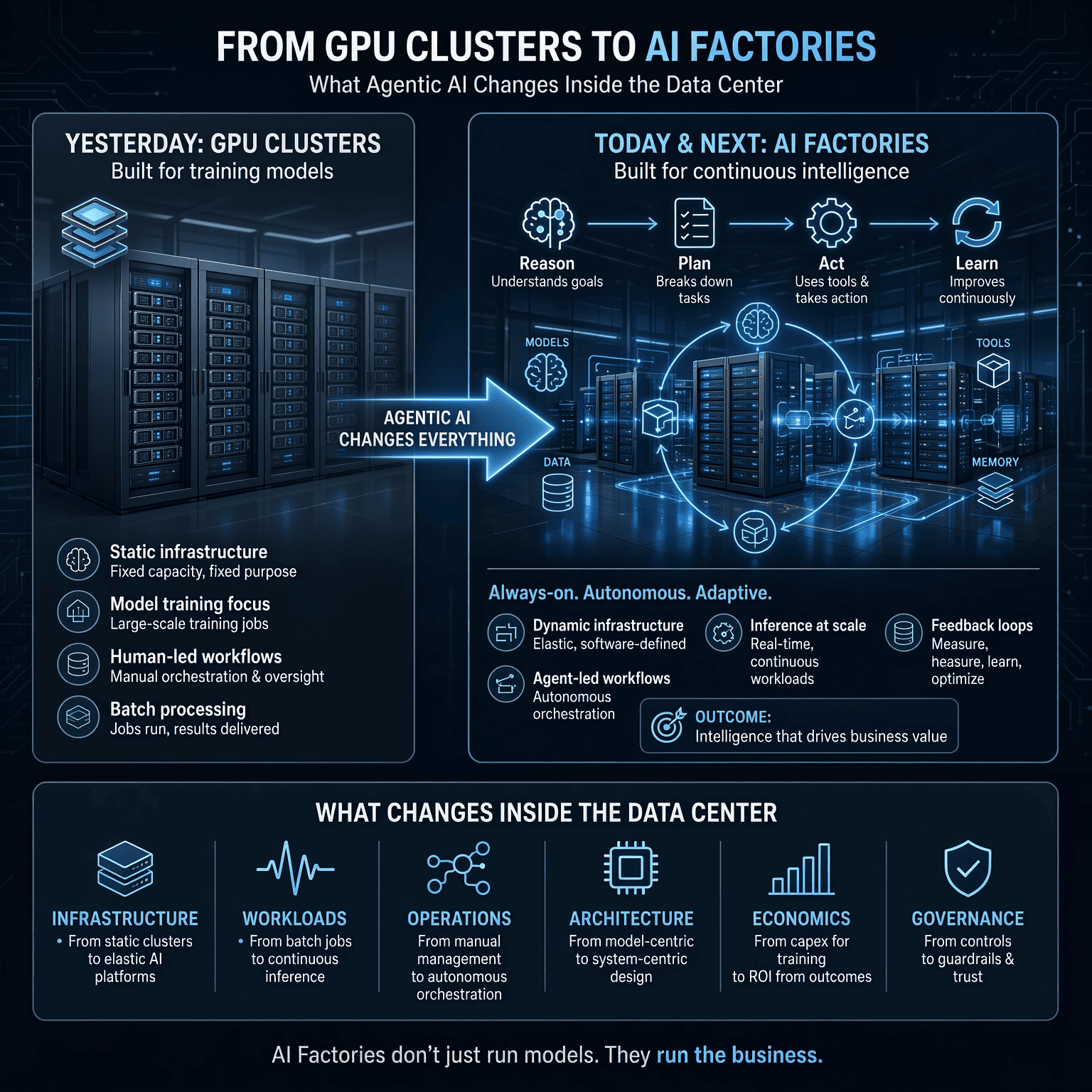
North Africa’s AI story is overwhelmingly an infrastructure story. The region is building data centers, securing power supply agreements, attracting foreign investment, and creating the physical conditions for AI computation. What it is not doing — at least not yet — is building the AI models, the research institutions, the commercial AI applications, or the talent base at a scale that would make it a genuine AI producer rather than an AI host.
Consider the structure of the largest projects:
- The Nexus AI Factory in Morocco is led by U.S.-based Nexus Core Systems, uses Nvidia GPUs, operates on Naver’s cloud platform, and is financed by Lloyds Capital. Morocco provides the location, the energy, and the regulatory framework.
- Egypt’s sovereign AI data center is a partnership between Vodafone Business and Cassava Technologies using Nvidia’s computing stack.
- Algeria’s HPC center imports latest-generation GPUs from foreign manufacturers.
In each case, the technology, the intellectual property, and the primary value capture sit with foreign companies. North Africa provides the electricity, the real estate, the fiber optic connectivity, and — crucially — the political deal that makes the project possible.
This is not inherently a failure. Hosting infrastructure is real economic activity. It creates construction jobs, operational positions, tax revenue, and secondary economic effects. But it is a fundamentally different proposition from building an AI industry.
The OECD’s 2026 review of AI governance in Africa flagged this distinction explicitly, noting that while several North African countries have adopted AI strategies, the gap between strategy documents and actual AI production capability remains significant.
The Missing Pieces: Talent, Research, and Applications
Three critical gaps stand between North Africa’s infrastructure investment and genuine AI capability.
Talent
Africa’s total AI talent pool is estimated at approximately 5,000 professionals — small but growing, with a 40 percent expansion reported in 2023. North Africa’s share of that pool is meaningful but insufficient for the scale of infrastructure being built.
Egypt’s strategy explicitly targets talent development, but the OECD review notes that limited access to compute, insufficient data, and brain drain continue to constrain the ecosystem. Tunisia has produced notable AI talent — InstaDeep being the most visible example — but that talent has largely migrated to European companies. Morocco, Algeria, and Libya face similar challenges.
The JICA 2025 report on Africa’s AI talent landscape identified weak industry-academia collaboration as a structural barrier across the continent. North African countries, despite long-established engineering traditions, have not yet built the kind of AI-specific training pipelines that would support the research and development capacity their infrastructure investments imply.
Research
The number of AI research papers originating from North Africa remains modest compared to Europe, China, or even other emerging AI regions like India and Southeast Asia. Algeria’s universities produce some AI research, but it is concentrated in a small number of institutions. Egypt’s applied innovation center, launched in 2020, has not yet produced globally visible AI breakthroughs.
Without a stronger research base, North African countries risk becoming consumers of AI technology rather than producers — dependent on foreign models, foreign frameworks, and foreign intellectual property even when running computation on their own soil.
Applications
The commercial AI application ecosystem in North Africa is nascent. Morocco’s AI Factory project mentions enterprise AI agents and chatbots, but these are small-scale domestic services, not the kind of platform-level AI products that generate outsized economic returns. Egypt has a growing startup scene, but AI-native companies remain a fraction of the broader tech ecosystem.
The AU’s 2025 High-Level Policy Dialogue on AI in Africa noted that over 83 percent of AI startup funding in Q1 2025 went to just four countries — Kenya, Nigeria, South Africa, and Egypt. Egypt’s inclusion is notable, but the broader North African picture remains thin.
The Geopolitical Dimension: Sovereignty as Strategy
North Africa’s AI push is not purely economic. It is also a sovereignty play.
Morocco’s Nexus AI Factory is explicitly marketed as “sovereign AI computing services” — meaning data storage, processing, and management remain within Moroccan jurisdiction. Egypt’s first sovereign AI data center makes the same pitch. Algeria’s national strategy emphasizes secure data architectures and digital sovereignty.
This framing reflects genuine concerns. As AI becomes embedded in critical infrastructure — healthcare, finance, government services, national security — dependence on foreign-controlled AI systems creates strategic vulnerability. The EU’s GDPR and emerging AI Act create regulatory pressure to keep European data within specific jurisdictional boundaries, and North African locations offer an alternative to both onshore European facilities and more distant cloud providers.
But sovereignty rhetoric and sovereignty reality are different things. Running Nvidia GPUs in a Moroccan data center does not give Morocco control over the AI models those GPUs execute, the training data those models consume, or the commercial value those models generate. True AI sovereignty requires domestic capability to develop, train, and deploy AI systems — not merely to host the hardware that runs them.
What Would It Take to Close the Gap?
If North Africa wants to move from data center landlord to AI producer, several things would need to change.
Investment in AI research at scale. Not AI training programs for government officials, but sustained funding for university research labs, doctoral programs, and postdoctoral positions in machine learning, natural language processing, computer vision, and adjacent fields. Algeria’s HPC center is a step, but hardware without research capacity is an expensive warehouse.
Retention of talent. North Africa’s AI talent drain to Europe and North America is real. Competing requires not just training programs but career paths — positions, compensation, and research environments that make staying more attractive than leaving. Hosting infrastructure does not solve this; if anything, it risks making the pull stronger by concentrating skilled jobs abroad.
Development of Arabic and Amazigh language AI. North Africa has a genuine opportunity in Arabic-language AI, a space where Western and Chinese models remain relatively weak. Egypt’s strategy mentions building an Arabic-language foundation model, but progress has been limited. Morocco and Tunisia, with their multilingual populations (Arabic, Amazigh, French), could contribute to multilingual AI development — but only if research institutions prioritize this work.
Domestic AI application development. Infrastructure is only valuable if someone uses it. North African governments could accelerate domestic AI adoption in agriculture, healthcare, education, and public services — creating demand for locally developed AI solutions rather than importing foreign ones.
Regional coordination. The Algeria-Tunisia digital platform launched in March 2026 at the International Conference on Innovative and Intelligent Information Technologies in Hammamet is a promising signal. But North African AI cooperation remains fragmented, with each country pursuing largely independent strategies. The African Union’s Continental AI Strategy, adopted in July 2024, provides a continental framework, but regional implementation has been uneven.
The Honest Assessment
North Africa’s AI infrastructure investment is real, substantial, and strategically motivated. The region has legitimate competitive advantages — geography, energy, connectivity, and relative political stability — that make it a rational location for AI-adjacent infrastructure.
But the gap between building data centers and building an AI industry is enormous. Currently, North Africa is firmly on the infrastructure side of that divide. The region is attracting foreign capital to build facilities that will be operated by foreign companies, using foreign technology, to serve customers who are primarily located elsewhere.
This is not a bad starting position. Infrastructure precedes capability. Electricity grids preceded industrialization. Fiber optic networks preceded the internet economy. But infrastructure alone does not create an AI industry, and the risk is that North Africa becomes locked into a role as the physical substrate of other regions’ AI ambitions — generating electricity, providing cooling, housing GPUs — while the intellectual property, the commercial value, and the strategic control remain elsewhere.
The window for changing this trajectory is not infinite. As AI infrastructure scales globally, the competitive advantages of any single location become less decisive. Morocco’s proximity to Europe matters less if European data centers expand. Egypt’s submarine cable access matters less if new cable routes bypass the Suez corridor. Renewable energy advantages erode as other regions build their own clean energy capacity.
The countries that will capture lasting value from the AI revolution are those that combine infrastructure with capability — that host the hardware and build the models, train the talent and create the applications, provide the connectivity and develop the intellectual property.
North Africa has laid a credible foundation. Whether it builds something on top of it — or simply rents out the ground floor — is the question that will determine whether this moment represents a genuine industrial transformation or just an expensive real estate play dressed up in AI branding.

Independent technology writer focused on artificial intelligence, emerging technologies, and digital innovation. Covers AI applications in sports, productivity, and online business.