






































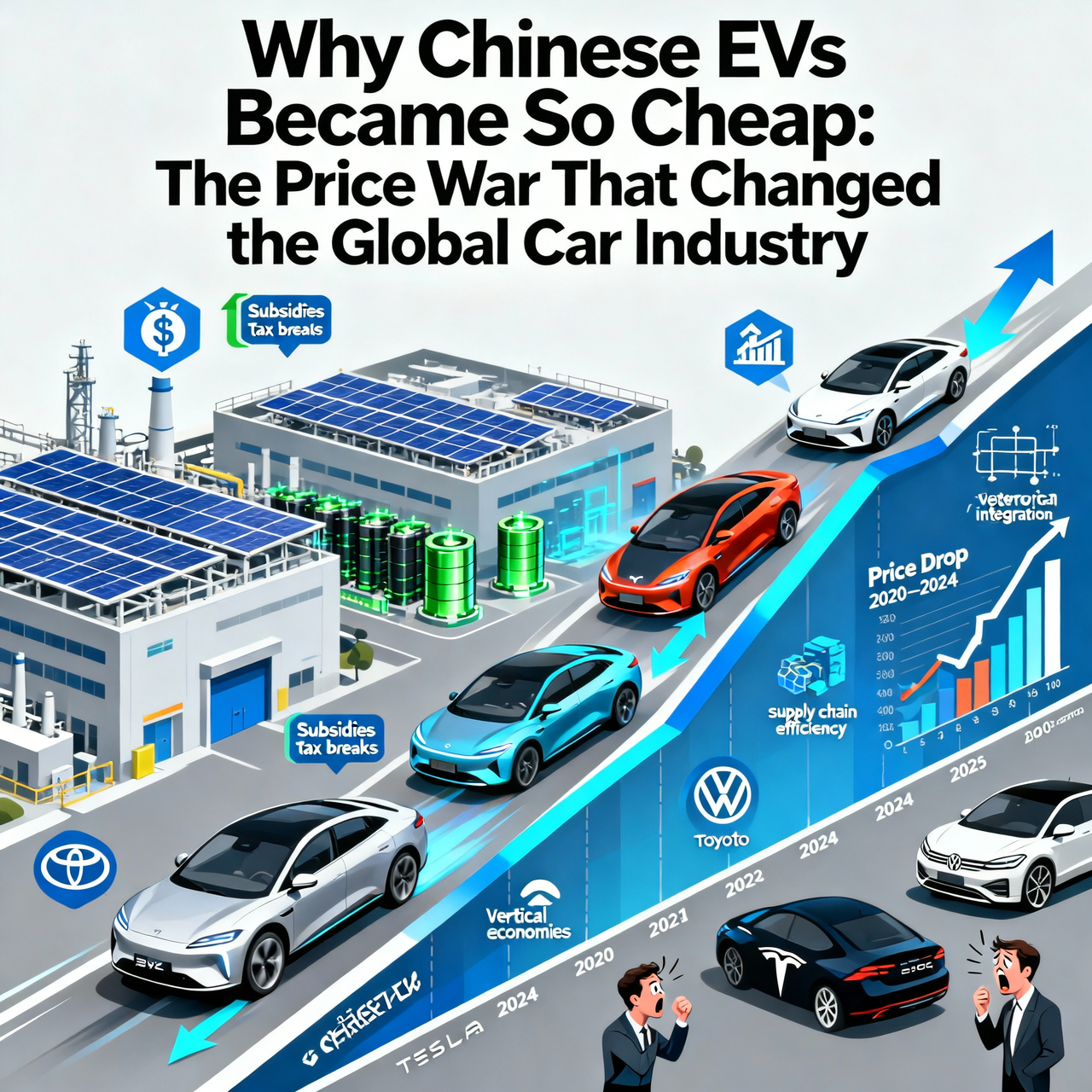
In March 2026, average discounts on BYD vehicles reached 10 percent, the deepest in two years. Research tied to the China Automobile Dealers Association estimates the country’s price war destroyed 471 billion yuan, roughly 69 billion US dollars, of industry revenue between 2023 and 2025, dragging the average new-car price down 11 percent. And yet the same period produced the cheapest, most competitive electric cars the world has ever seen.
The pillar article of this series explained how China reached the top of the global EV market. This second article answers the question everyone actually feels when they see a Chinese price tag: how is this possible?
Why are Chinese EVs so cheap, and why did price become a strategic weapon rather than an accident of manufacturing?
The anomaly first, the explanation second
Start with what the numbers show, because the scale of the anomaly is the real story.
In 2024, average global battery pack prices fell 20 percent to a record low of 115 US dollars per kilowatt-hour, per BloombergNEF. Inside China, prices fell roughly 30 percent in the same year, compared with 10 to 15 percent in the United States and Europe, a gap the IEA attributes to competition, efficiency, and integrated supply chains.
That battery gap is the engine of everything else. A battery is typically a third of an EV’s cost, so a battery cost advantage becomes a car price advantage, automatically, without any subsidy involved.
The second anomaly is timing. Western analysts had forecast that EVs would reach purchase-price parity with gasoline cars around 2026. In China, that milestone arrived years early. By early 2024, Chinese carmakers were openly selling “electric is cheaper than gas,” a claim that shook every traditional automaker’s planning assumptions. The full cost comparison between electric and gas cars shows why this flips the ownership math for buyers everywhere.
The anatomy of a cheap Chinese EV
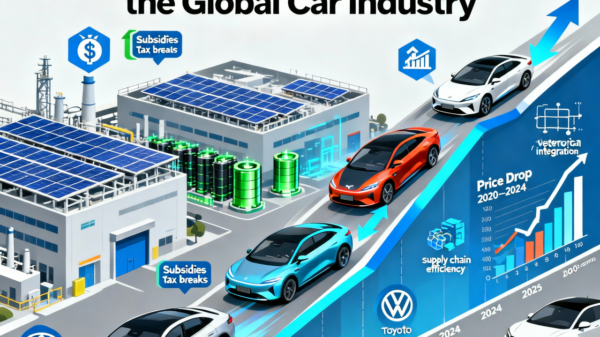
A Chinese EV is not cheap because of one trick. It is cheap because five cost advantages stack on top of each other, and each one compounds the next.
| Cost driver | How it lowers price | The proof |
|---|---|---|
| Battery control | The most expensive component is made where it costs least | China processes 70-95% of critical battery inputs; CATL and BYD hold ~56% of the global cell market |
| Vertical integration | No supplier margins stacked between factory and car | BYD is estimated to control up to 75% of its value chain in-house: cells, motors, chips, even ships |
| Scale | Fixed costs spread over enormous volume | BYD alone sold 4.6 million vehicles in 2025 |
| Speed | New technology reaches the showroom before it is obsolete | Chinese model development cycles run 20 to 24 months, against 40 to 50 in the West |
| Competition | Every company is forced to pass savings to buyers | More than 400 Chinese auto brands have exited the market since 2018 |
The battery layer
This is where the cheapness originates, and it is covered in depth in the first article of this series, which argues that China built the battery industry before it built the cars. Raw material prices collapse on top of that structural control. Battery-grade lithium carbonate fell from more than 500,000 yuan per ton to just above 100,000 yuan within about a year, and Chinese automakers with integrated supply chains captured that saving directly.
The vertical integration layer
Western automakers buy components from a long chain of suppliers, each adding margin on top of the last. China’s leaders did the opposite. BYD manufactures its own batteries, motors, power electronics, and semiconductors, and controls its own shipping. When you cut out three layers of supplier margin, analysts estimate a structural cost advantage of 25 to 30 percent that has nothing to do with labor or subsidies.
The speed layer
Chinese carmakers treat models like software: release, update, replace. New models and major refreshes arrive every 12 to 18 months, about four times faster than the traditional Western cycle. A 24-month development cycle means a Chinese company can respond to a competitor’s price cut, or adopt a battery improvement, while a Western rival is still approving the budget for its response. Speed compounds into cost because it lets winners iterate before losers can react.
The competition layer
All of the above would just mean higher profits if the market were gentle. It is not. China has roughly 90 active car manufacturers competing in the same market, and the domestic price war forces each of them to hand every efficiency gain to the buyer immediately. Whoever holds a cost advantage uses it to take market share, not to fatten margins. This is the least understood point: the cheapness is partly a product of ruthless domestic competition, not just superior efficiency.
The war machine underneath
The price war is not a negotiation tactic. It is a selection process running on industrial overcapacity.
China’s factories can produce about 55.5 million vehicles a year, against domestic demand of roughly 23 million. Average capacity utilization sits near 50 percent. With that much idle capacity, the rational play for every factory manager is to keep lines running and sell at any price, because the fixed costs are already sunk. The collective result is irrational: everyone discounts until the industry as a whole destroys value.
The casualties are documented. More than 400 brands have exited since 2018. Only a fraction of manufacturers run above 60 percent capacity. Small and mid-sized players are squeezed between BYD’s scale at the top and the brutal price floor everywhere else. Beijing has responded with an unusual admission: in February 2026, China banned selling cars below cost, and regulators have summoned executives from more than a dozen EV makers multiple times to warn against unreasonable discounting. The price war continued anyway.
Why cheapness became a strategic weapon
Chinese EV makers did not choose low prices because they like thin margins. They chose low prices because price is the only weapon that works against both domestic rivals and foreign incumbents.
The logic is strategic, not financial. A Chinese automaker can sacrifice margin in one market to establish volume, brand presence, and a customer base, then profit later from services, software, replacement parts, and the inevitable price recovery after competitors have been weakened or eliminated. The West has a name for selling below sustainable cost to win a market: dumping. The EU’s countervailing duties, up to roughly 35 percent for some brands, and the US 100 percent tariff are direct responses to this weapon.
But the weapon works even behind tariff walls. Chinese companies simply move the factory. BYD builds in Hungary, Brazil, and Thailand. Leapmotor assembles through Stellantis in Europe. The price advantage survives because it comes from the supply chain, not from the origin port. Tariffs slow the import flow but do not remove the cost gap, which is why the wider US-China tech war increasingly looks like a fight about manufacturing economics rather than products.
Who pays for the cheap cars
Every price has a bill, and it is important to be honest about who foots it.
Consumers pay less today, which is the intended outcome. But the bill arrives in other forms: automakers under pressure cut corners, brands that fail leave customers with orphaned vehicles and weak after-sales support, and the flood of discounted exports provokes tariffs that raise prices in protected markets. The China Automobile Dealers Association research on destroyed revenue is not a curiosity; it is a measure of how much value the industry is burning to maintain this pace.
The deeper cost is structural. When an industry is organized so that losing money is the rational strategy, the survivors become more consolidated, and consolidation eventually means higher prices again. The cheap era may end the same way it began: with a strategy, not a law of nature.
What the price war actually means
| Reader | What to take from this |
|---|---|
| Car buyer | The cheapness is real and deliberate, but check after-sales support and brand survival before buying |
| Investor | Margins across the global auto industry are being repriced down permanently |
| Western automaker | The gap is cost structure and speed, not wages; matching it requires vertical integration and much faster cycles |
| Regulator | Anti-dumping tariffs protect domestic industries but do not close the underlying cost gap |
The honest limits
Cheapness has a ceiling. The below-cost sales ban shows the state is worried about a race to the bottom that destroys even the winners. Tariffs raise the price of entry into the world’s richest markets. And a market that destroys 69 billion dollars of revenue is not stable by definition.
The question is not whether the price war can continue forever. It is what the industry looks like when it ends. If the survivors are the most integrated and the fastest, and history says they will be, then the world’s car market will settle at a permanently lower price level with a permanently Chinese cost floor underneath it. That is the real change the price war has already delivered, and it cannot be undone by tariffs.
The next article in this series looks at the company that started it: how BYD turned a phone-battery business into the most dangerous automaker on Earth.

Independent technology writer focused on artificial intelligence, emerging technologies, and digital innovation. Covers AI applications in sports, productivity, and online business.