



























I’ve launched seven products over the last four years. Three failed outright, two broke even, and two turned into real income streams. The difference between the failures and the successes wasn’t the quality of the idea — it was the process I used to validate, build, and sell. This article distills that process into a repeatable framework.
Most people who want to turn an idea into income make the same mistake: they build first and ask questions later. They spend months creating something nobody asked for, then wonder why nobody buys. The alternative is a phased approach where you test, validate, and build in small cycles — each one reducing your risk and increasing your odds of reaching payday. Here’s exactly how that works.
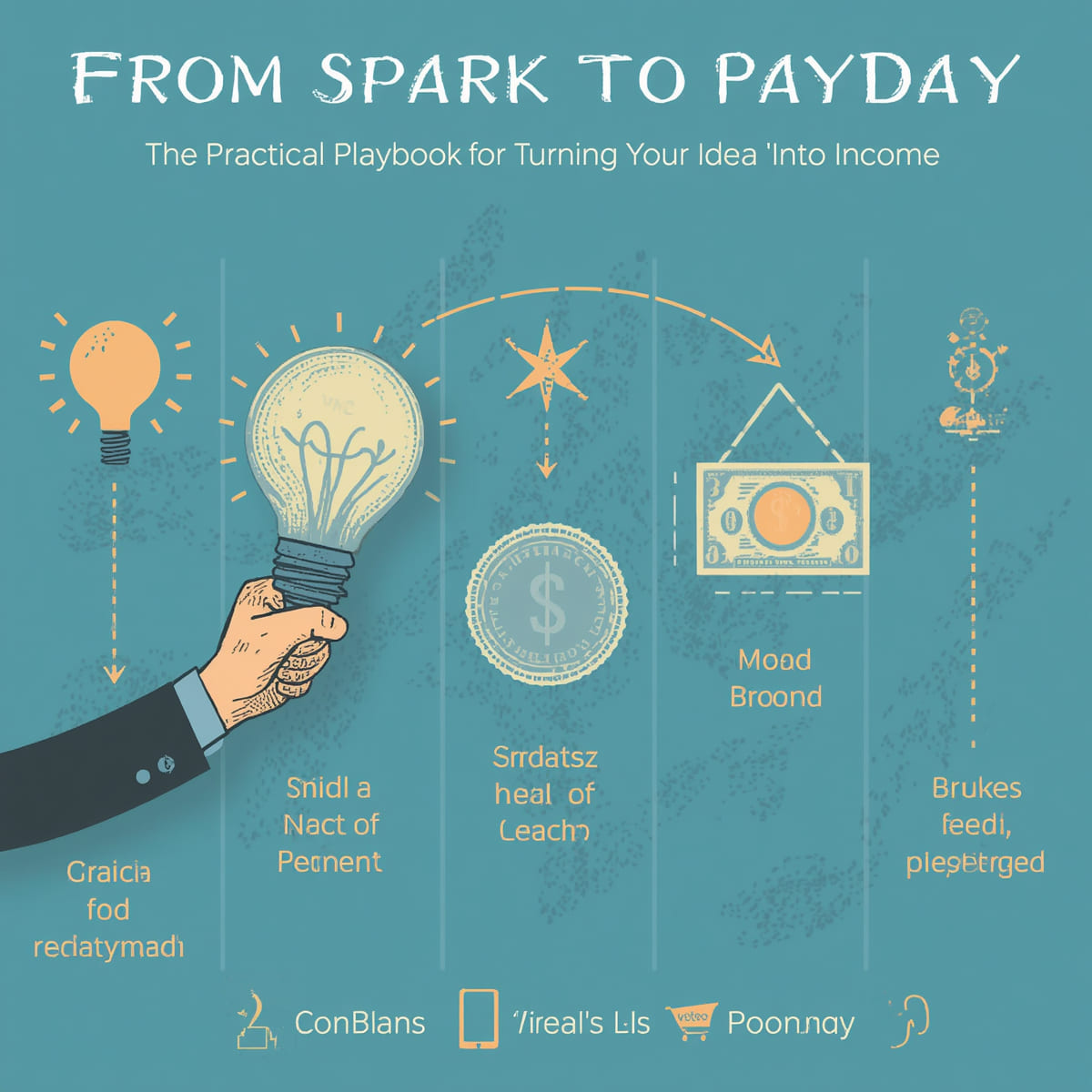
The Idea-to-Income Framework (Overview)
This framework has six phases. Each phase has a specific goal and a clear gate — you don’t move to the next until you pass it. This prevents the most common mistake: jumping to building before you’ve confirmed anyone actually wants what you’re making.
| Phase | Goal | Gate to pass |
|---|---|---|
| Phase 1 | Validate demand | 5 strangers say they’d pay |
| Phase 2 | Define the offer | One clear sentence of what you sell |
| Phase 3 | Create a trust trigger | A landing page or sample that proves credibility |
| Phase 4 | Find first customers | 5 paying customers |
| Phase 5 | Set the right price | Repeatable pricing that converts |
| Phase 6 | Systemize and grow | A process that runs without you |
Most people skip phases 1 and 2. That’s where the risk lives.
Phase 1 — Pressure-Test Your Idea Before You Build
Before you write a line of code, design a logo, or buy a domain name, you need to confirm that people actually want what you’re thinking of making. Not your friends. Not your family. Strangers who have no reason to be nice.
Here’s the test I use: write a two-sentence description of your idea and join a Facebook group or subreddit where your target audience hangs out. Post it and ask one question: “What’s the hardest part about [their problem]?” Do not mention your solution. Just listen.
If people describe the exact problem you’re solving — and they sound frustrated — you have something worth pursuing. If they describe a different problem entirely, your idea needs adjusting.
A more direct test: create a simple landing page with a “pre-order for $10” button. Drive a small amount of traffic to it. If nobody clicks, you saved yourself months of work.
Our guide on how I made my first $1000 using only free AI tools shows exactly how I used validation tests before building anything — it saved me from building three products nobody wanted.
Phase 2 — Define Your Minimum Viable Offer
An idea is not an offer. An offer is a specific transaction: “I will solve X problem for Y person and deliver it in Z format.”
The minimum viable offer answers three questions:
- Who exactly is this for? (Not “small businesses” — “freelance graphic designers who bill hourly”)
- What specific outcome do they get? (Not “better productivity” — “15 more billable hours per month”)
- What’s the simplest way to deliver it? (A PDF checklist, a 30-minute call, a Notion template, a simple tool)
If you cannot say your offer in one sentence that a stranger understands in five seconds, your offer is not ready.
When I launched my first paid product, it was literally a $7 Google Doc. That was the minimum viable offer. It solved one specific problem for one specific type of person. I improved it later, but the income started from that simple document.
Phase 3 — Build a Trust Trigger, Not a Product
Most people think you need a full product before you can sell. You don’t. You need a trust trigger — something that proves you can deliver value.
A trust trigger can be:
- A 10-minute video where you solve a small piece of the problem
- A Notion template or spreadsheet that delivers immediate value
- A detailed blog post or thread showing you know what you’re talking about
- A free 20-minute call where you give specific advice
The trust trigger does two things: it shows you understand the problem, and it gives the potential customer a taste of your solution. After experiencing that value, paying for the full version feels natural.
If you’re building a content-based business, our guide on how to start a tech blog under $50 walks through exactly how to create trust triggers with minimal investment.
Phase 4 — Find Your First Five Customers
Your first five customers will not come from a website launch. They will come from direct outreach. You have to talk to people one at a time and offer them your solution.
Here’s the approach that worked for me:
- Identify 20 people who match your target audience (from Twitter, LinkedIn, Reddit, or online communities)
- Send each a personal message: “I’m building something to help [their specific problem] — would you be open to trying it for free in exchange for honest feedback?”
- After they use it, ask: “Would you pay for this? If so, how much?”
- Ask for payment from the ones who said yes.
The goal is not to make money in this phase. The goal is to get five people who are willing to exchange money for what you built. Once you have that, you have proof of concept.
Phase 5 — Price for Value, Not Cost
Most first-time creators underprice. They calculate their time and materials, add a small margin, and end up charging 19forsomethingworth97.
Price is a function of value delivered, not cost incurred. If your solution saves a freelancer 10 hours per month at 50/hour,that′s500/month in value. Charging $49/month is reasonable.
Test three price points:
- Low: What feels almost too cheap ($19)
- Medium: What feels fair ($49)
- High: What feels slightly uncomfortable ($97)
Start at medium. If nobody buys, drop to low. If people buy without hesitation, raise to high. Repeat until you find the sweet spot.
Phase 6 — Systemize and Scale
Once you have paying customers and a price that works, you need to shift from “doing everything yourself” to “building a system that delivers value without your direct involvement.”
Systemization means:
- Standardizing your delivery process (same steps every time)
- Creating templates for common customer questions
- Setting up automated onboarding and payment collection
- Tracking metrics that tell you if things are working
Scaling means either:
- Reaching more of the same customer type (more marketing)
- Creating a higher-priced tier for existing customers
- Expanding to a related customer type with the same offer
The key is not to scale until phases 1-5 are working. Premature scaling kills more businesses than bad ideas.
Three Mistakes That Kill Ideas Before Payday
Mistake 1: Building for “everyone.” The more specific your audience, the easier it is to reach them. A product for “busy moms who meal prep” will outsell a product for “busy people” every time.
Mistake 2: Perfectionism before validation. Your first version should embarrass you a little. If it doesn’t, you spent too much time on it. Ship fast, get feedback, improve.
Mistake 3: Asking for opinions instead of money. “Does this sound interesting?” always gets yes. “Would you pay $29 for this right now?” gets the truth. Ask the real question.
Conclusion
Turning an idea into income is not about having the perfect concept or being the most talented person in the room. It’s about following a repeatable process: validate before building, define a specific offer, create a trust trigger, find your first customers one at a time, price for value, and systemize what works.
The framework works because it forces you to face the hard questions early — when they’re cheap to answer — instead of later, when they’re expensive. Start with Phase 1 today. Don’t skip ahead. Your idea will still be there tomorrow, but it might be a smarter idea after you talk to a few strangers.
FAQ
Q: How do I know if my idea is worth pursuing? A: If five strangers who match your target audience say they’d pay for it, you have enough validation to proceed. Before that, you’re guessing.
Q: What if I can’t build a product myself? A: Start with a service or a simple digital product. A personalized spreadsheet, a consulting call, a Notion template, or an email course all qualify as viable offers.
Q: How long does it take to go from idea to first sale? A: If you follow this framework, you can go from idea to first customer in 2-4 weeks. Most of that time is spent talking to potential customers, not building.
Q: Do I need a website to start selling? A: No. Your first sales should happen through direct messages and email. A website adds credibility later, but it’s not necessary for your first five customers.
Q: What’s the most common reason ideas fail? A: Building something nobody wants. That’s why Phase 1 (validation) is non-negotiable. Most failed products could have been avoided with five honest conversations.
Q: Should I quit my job to pursue my idea? A: No. Test your idea as a side project first. If you can generate consistent income from it over 3-6 months, then consider going full-time.

Independent technology writer focused on artificial intelligence, emerging technologies, and digital innovation. Covers AI applications in sports, productivity, and online business.