






































I’ve been testing AI agents since before they were cool. And I’ll be honest — most of them annoyed me.
Not because they didn’t work. But because they’d go off and do things without asking. You’d ask an AI agent to book a flight, and it would just… book it. Wrong date. Wrong airport. No way to stop it mid-action.
That’s why Google’s latest test — a new AI agent code-named Remy, built for Gemini — caught my attention. Because Remy isn’t trying to be the smartest AI agent. It’s trying to be the most respectful one.
Let me break down what Remy is, why user control is suddenly the hot topic in AI agents, and what this means for anyone who uses AI in their daily workflow.
What Is Google Remy?
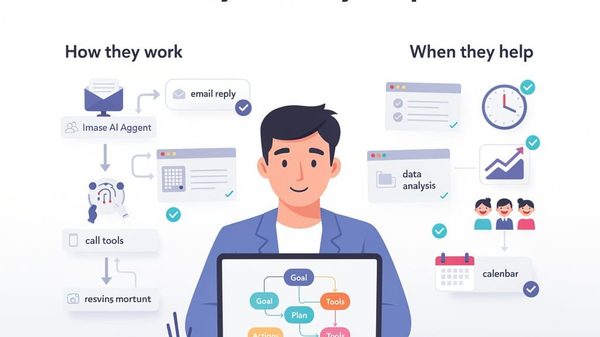
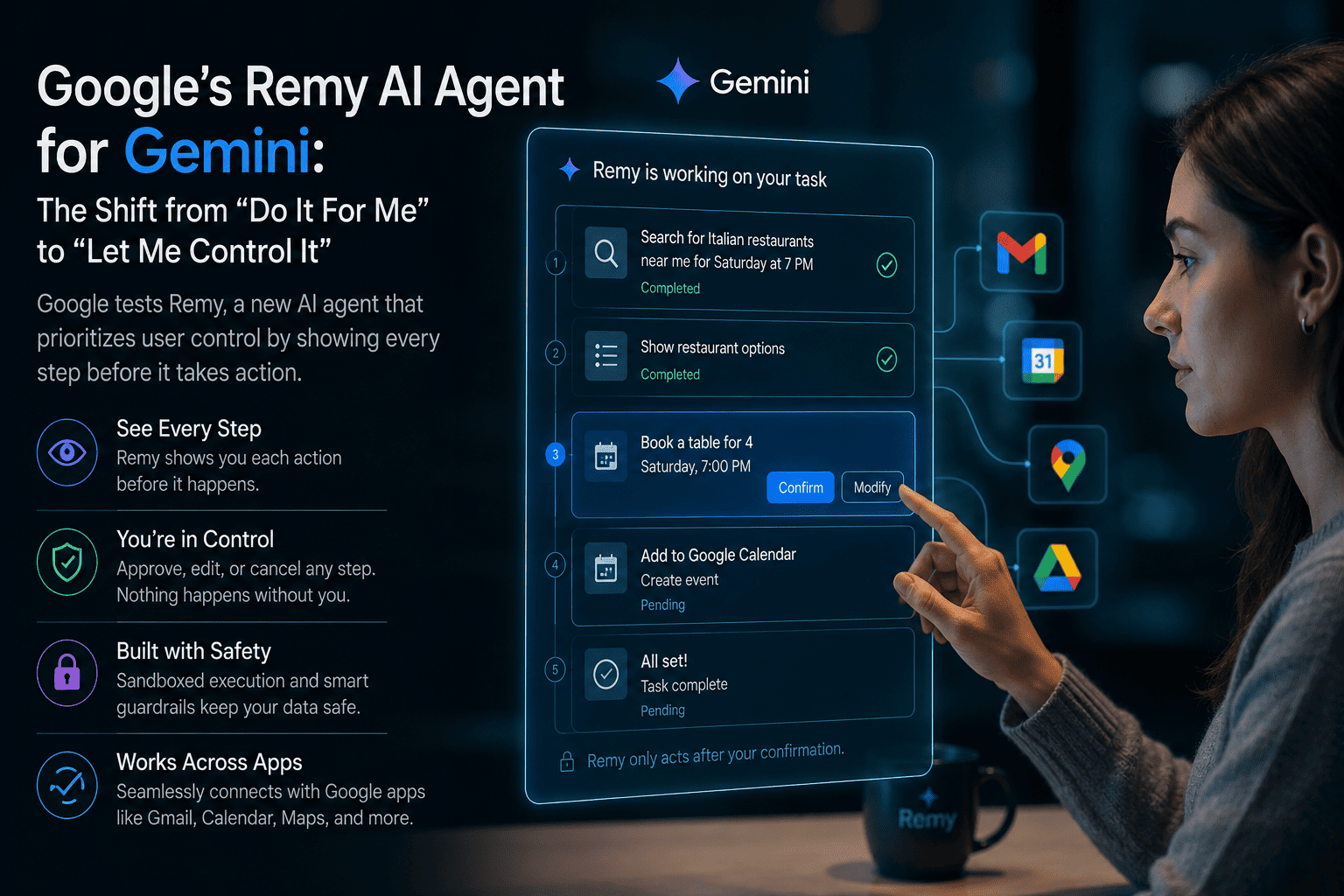
Remy is an experimental AI agent Google is testing inside Gemini. Unlike standard chatbot responses, Remy is designed to perform multi-step tasks across apps and services — but with a critical difference:
It shows you every step before it takes it.
Think of it like this: normal AI gives you answers. AI agents take actions. Remy is an AI agent that asks permission before each action.
Here’s a concrete example. You tell Remy: “Find a Italian restaurant near me for Saturday at 7 PM, book a table for 4, and add it to my calendar.”
Instead of doing all of that silently, Remy would:
- Show you the restaurant options it found
- Ask you to pick one
- Confirm the time before booking
- Show the calendar entry before saving it
- Then execute
This is a fundamentally different philosophy from competitors like OpenAI’s Operator or Anthropic’s Computer Use, which prioritise autonomy over transparency.
Source: The Verge — Google tests Remy AI agent | Source: Google AI Blog
Why “User Control” Is the Battleground of 2026
Here’s a question nobody asked in 2023: who’s responsible when an AI agent messes up?
If an AI agent accidentally deletes your calendar, books a non-refundable hotel on the wrong date, or posts something to social media that you didn’t approve — who gets blamed?
In 2025, we saw multiple high-profile incidents of AI agents taking unwanted actions. A travel agent AI booked a customer on a flight that didn’t exist. A coding agent pushed broken code to production. A customer service agent promised refunds the company couldn’t honour.
The industry realized something uncomfortable: autonomy without control is a liability.
This is the context for Remy. Google is betting that users will prefer an AI that slows down and asks questions over one that races ahead and makes mistakes.
If you’re curious how other AI tools handle autonomy vs. control, our Claude for Coding review covers how Claude handles multi-step coding tasks differently.
How Remy Works Under the Hood
Let me simplify the technical side for you.
Remy is built on three layers:
1. First, Remy figures out what you actually mean — not just the words you said
This figures out what you actually want. It’s not just keyword matching — Remy uses Gemini’s reasoning capabilities to understand context, ambiguity, and implicit requirements.
Example: “Book a dinner near work” — Remy knows it needs to figure out where “work” is (calendar data), what “dinner” means (evening meal, 7–8 PM range), and “near” (walking distance or short drive).
2. Action Planning Layer
This breaks your goal into discrete, ordered steps. Each step is shown to you as a card with:
- What action will be taken
- Which app or service it affects
- What data will be used
- A confirm or modify button
3. Execution Layer with Guardrails
Only after you confirm does Remy execute. It runs in a sandboxed environment — meaning it can’t access anything outside its allowed scope. If an action seems risky (deleting files, spending money, sharing data), Remy escalates back to you automatically.
Source: Google DeepMind — Building safe AI agents
Real Use Cases Where Remy Shines
Trip Planning Without the Headaches
Instead of researching flights, hotels, and restaurants separately across five tabs, you tell Remy your budget and preferences. It researches everything, presents options, and lets you mix and match before committing.
Email Management That Actually Respects Your Inbox
Remy can draft replies, suggest unsubscribes, and organize folders — but it shows you every change before making it. No more “where did that email go?” panic.
Form Filling and Data Entry
This is the boring but hugely practical use case. Remy can fill out forms, transfer data between spreadsheets, and update CRM entries — confirming each field before submission.
Pros and Cons
| Pros | |
|---|---|
| Full transparency | You see every action before it happens |
| Reduced errors | No surprise commits or unintended changes |
| Works across apps | Integrates with Google’s ecosystem (Calendar, Gmail, Maps, Drive) |
| Sandboxed execution | Limits damage if something goes wrong |
| Cons | |
|---|---|
| Slower than fully autonomous agents | Each step requires confirmation |
| Google ecosystem lock-in | Works best inside Google’s apps |
| Still experimental | Not publicly available, may change significantly |
| Cognitive load | Reviewing 10 steps per task can feel like work itself |
Honestly, #3 is the one that matters most for me.
5 Tips for Using AI Agents Without Losing Control
1. Start with read-only tasks. Before letting any AI agent write or delete, try it on tasks that only read data — summarizing emails, checking calendars, searching documents. Build trust first.
2. Check the undo policy. Does the agent support undo? Google’s Remy shows you actions before execution, but what about after? Always know how to reverse an action.
3. Set boundaries explicitly. Tell your AI agent what it should never do. “Never delete emails,” “Never spend money without triple confirmation,” “Never post to social media.” Write it down.
4. Use agent-specific accounts. Don’t let an AI agent use your main email or primary calendar. Create a separate “agent account” for testing. You’ll thank me later.
5. Audit agent logs weekly. Every responsible AI agent keeps logs. Review them. You’ll spot patterns — good and bad — that you can adjust.
For a broader look at how to evaluate whether an AI tool is right for you, check out our no-nonsense AI tool assessment framework.
How This Compares to Other AI Agents
| Feature | Google Remy | OpenAI Operator | Anthropic Computer Use |
|---|---|---|---|
| Control philosophy | Ask-first | Act-first | Suggest-then-act |
| Step-by-step confirmation | Yes | No (batch approval) | Partial |
| Sandbox | Yes | Yes | Limited |
| Ecosystem | Google apps | Web browser | Desktop apps |
| Public availability | Testing | Limited release | Beta |
Each approach has trade-offs. Remy prioritises safety and transparency. Operator prioritises speed. Computer Use sits in the middle.
The “best” choice depends entirely on what you’re doing. For sensitive tasks (finance, healthcare, legal), I’d pick Remy’s approach every time. For repetitive low-risk tasks (sorting files, drafting templates), a faster agent might be better.
What This Means for the Future of AI
Google’s bet with Remy signals something important: the market is shifting from “smarter” to “safer.”
In 2023–2024, AI companies raced to make models more capable. Bigger context windows, better reasoning, more tools. In 2026, the race is shifting to trust. Who can build an AI that users actually feel comfortable letting loose?
Remy is Google’s answer. Whether it wins remains to be seen — but the direction is clear.
The companies that figure out how to give users real control without sacrificing utility will win the next phase of AI adoption.
If you want to understand the bigger picture of where AI spending is going in 2026, our article on the $700 billion AI arms race explains why big tech is investing so heavily in agent infrastructure.
FAQ
Q: When will Google Remy be available?
A: As of May 2026, Remy is in internal testing with select users. Google hasn’t announced a public release date, but signs point to a limited rollout via Gemini Advanced by late 2026.
Q: Is Remy free or paid?
A: Based on Google’s current structure, Remy will likely require a Gemini Advanced subscription (part of Google One AI Premium, currently $19.99/month). Free tier access is unlikely given the compute costs.
Q: Can Remy work with non-Google apps?
A: Initial tests focus on Google’s ecosystem — Gmail, Calendar, Maps, Drive. Google has hinted at third-party integrations but hasn’t shared specifics yet.
Q: How is Remy different from Google’s earlier Bard/Gemini?
A: Bard and standard Gemini are conversational — they respond to prompts. Remy is agentic — it takes multi-step actions on your behalf across different apps, with user confirmation at each step. It’s a fundamentally different capability.
Source: Google I/O 2026 Keynote Highlights
Final Thoughts
I’ve tested a lot of AI agents over the past year. Most of them feel like handing the car keys to a teenager who just got their license — technically capable, but you’re nervous the whole time.
Remy feels different. It’s more like a driving instructor — letting you steer, but keeping their hands near the wheel.
That might not sound as impressive as “fully autonomous AI.” But trust me: in practice, it’s much more useful. Because an AI that asks permission is an AI you’ll actually use — instead of one you’re constantly second-guessing.
For more hands-on reviews and comparisons of AI tools, visit NextAppsZone.
Would you trust an AI agent that didn’t ask permission? Tell me in the comments?

Independent technology writer focused on artificial intelligence, emerging technologies, and digital innovation. Covers AI applications in sports, productivity, and online business.