




















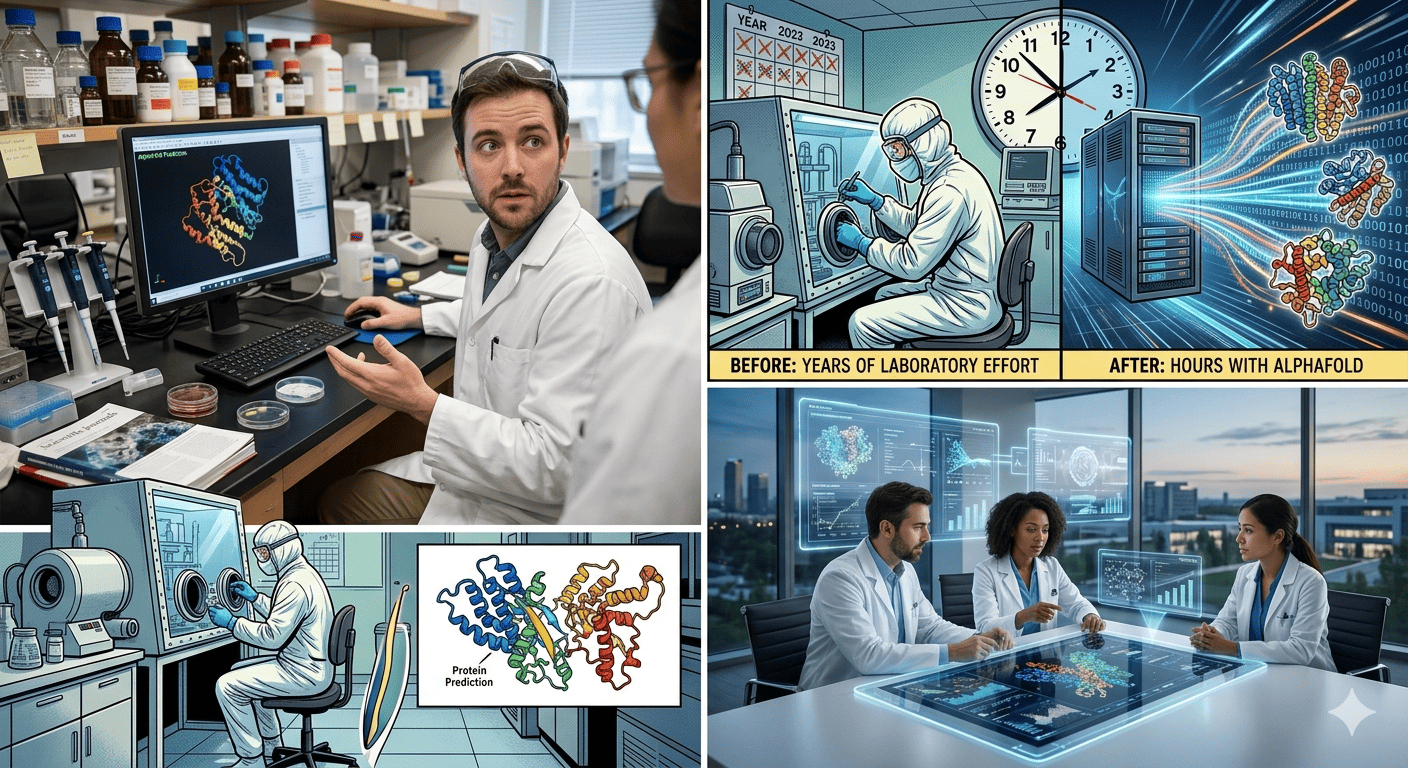
❝ I remember when my friend, a researcher in a molecular biology lab, first told me about AlphaFold. He said: ‘I was sitting in the university lab, having just finished an experiment that took weeks to purify a single protein. I heard my colleague say that a system had predicted the shapes of tens of thousands of proteins in just two days. At first, I laughed and told him: “Impossible, that’s just journalistic exaggeration.” But that evening, as I was browsing the results myself on their website, I felt a strange shiver: something in science had changed forever, and I was witnessing it firsthand.’
When he told me this story, I felt, for a moment, as if I were living his astonishment too. I realized that this technology doesn’t belong to scientists alone — it belongs to anyone who cares about the future of knowledge. ❞
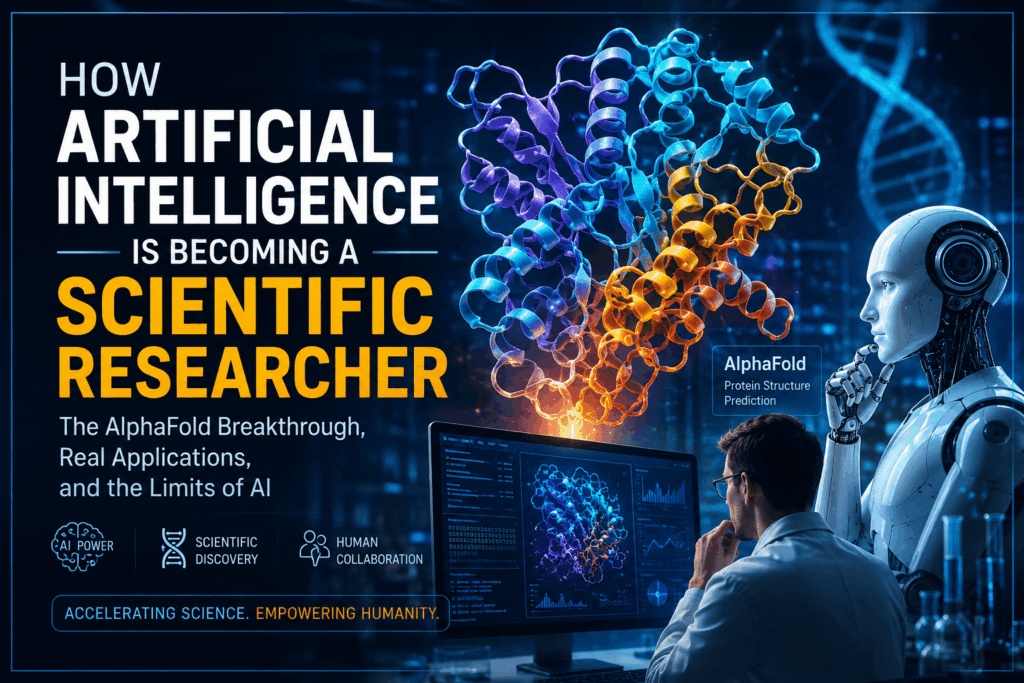
In recent years, DeepMind developed a system called AlphaFold, an artificial intelligence designed to understand the shape of proteins inside the human body.
🔬 The 50-Year Biological Mystery
Proteins are the foundation of life — they control diseases, cells, and medications.
However, determining the three-dimensional structure of proteins used to take years of laboratory experiments.
🤖 The AlphaFold Breakthrough: Decades of Work in Hours
AlphaFold was able to:
- Predict over 200 million protein structures, completely mapping the interactive blueprint of the human body.
- Solve scientific problems that had remained open for over 50 years.
- Produce results very close to real laboratory experiments.
⚡ Redefining Medicine: Real-World Impacts on Cancer and Alzheimer’s
- Scientists can now obtain results in hours instead of years.
- It has been used in cancer research and diseases such as Alzheimer’s.
- Its findings were published in major scientific journals such as Nature.
🧬 The 2026 Leap: AlphaFold 3 and the Molecular Revolution
While the initial breakthrough focused primarily on predicting individual protein structures (the milestone achieved by AlphaFold 2), the scientific landscape in 2026 has been entirely transformed by AlphaFold 3.
Artificial intelligence is no longer restricted to mapping isolated proteins; AlphaFold 3 has expanded its predictive genius to map the entire chemical highway of life. The system now models the complex interactions between proteins, nucleic acids (DNA and RNA), and chemical compounds known as ligands—the very molecules that form the basis of modern medication. By predicting how these molecular structures bind together with unprecedented precision, AI has evolved from a biological dictionary into an active launchpad for next-generation drug discovery, shortening the bridge between computer simulations and laboratory reality.
⚠️ The Blind Spots: Why AI Is Not a Biologist Yet
Even in this successful case:
- The AI does not “understand” why a protein has a certain shape.
- Scientists must still confirm the results in the laboratory.
- It cannot independently design a full drug without human involvement.
🧠 The New Rulebook of Modern Science
This is one of the most important real-world examples because it shows three key facts:
- Artificial intelligence can dramatically accelerate science 🚀
- It can solve problems that were once impossible or extremely slow ⏳
- But it does not replace human judgment and verification 🔍
🧩 From a simple chat tool to a complex research system
Artificial intelligence is no longer just a system for writing texts, extracting information, or answering simple questions. Over time, it has gradually evolved into something closer to a “research assistant” capable of processing and analyzing massive amounts of data in record time. This transformation does not mean it has become an independent scientist, but rather an important part of the modern scientific ecosystem.
But the real question is: can AI become a fully reliable researcher? And what are its actual limits?
⚠️ The persistent problem: convincing misinformation
Despite its power, one fundamental issue remains:
Artificial intelligence can confidently produce incorrect information.
This phenomenon is known as “hallucination,” where the model may:
- Invent non-existent scientific references.
- Provide inaccurate statistics or numbers.
- Mix correct and incorrect information.
- Generate answers that sound logical but are scientifically unreliable.
The most dangerous aspect is not the error itself, but the confidence with which it is presented — it rarely says “I don’t know.”
🧠 Inside the Machine: Why AI Prefers Eloquence Over Truth
To understand the issue, we must know how AI works:
It does not “think” or “understand” like humans. Instead, it:
- Predicts the next word based on patterns learned from massive datasets.
- Constructs statistically plausible sentences.
- Has no real awareness of truth or falsehood.
In other words, it is far better at producing language than at verifying accuracy.
🔬 The Practical Co-Pilot: Where AI Actually Shines
Despite its limitations, AI has become a powerful tool in research, especially in:
📚 1. Literature summarization
Instead of reading dozens of pages, researchers can quickly obtain summaries that capture the main ideas.
📊 2. Data analysis
It helps detect patterns in large datasets that humans might miss.
💡 3. Generating research ideas
It can suggest new scientific directions based on existing knowledge.
🌍 4. Making knowledge more accessible
It simplifies complex scientific concepts and speeds up understanding.
🧭 Mastering the Tool: A Guide for Responsible Research
The true value of AI does not come from trusting it blindly, but from using it as a supportive tool.
✔️ First: Treat it as an assistant, not a source
It helps you understand, but it should not be your final authority.
✔️ Second: Always verify information
Important claims must be checked against reliable scientific sources.
✔️ Third: Ask precise questions
The clearer the question, the better the answer.
✔️ Fourth: Do not rely on a single response
Cross-checking multiple sources is essential in research.
✔️ Fifth: Use academic databases
Such as Google Scholar, PubMed, and others.
Research Workflow: AI vs. Human Responsibility
| Research Phase | What AI Does | What the Human Scientist Must Do |
| Structure Prediction | Simulates and maps millions of molecular possibilities in seconds. | Conducts physical laboratory validation to confirm the biological reality. |
| Drug Discovery | Suggests optimized chemical formulas and molecular bonding paths. | Runs toxicity testing, animal models, and rigorous clinical trials. |
| Literature Review | Summarizes massive volumes of academic papers and extracts patterns. | Performs critical analysis and verifies cross-references against reliable databases. |
🔎 Can AI become a real researcher one day?
At present, the answer is: not fully.
Because scientific research requires more than information processing. It also needs:
- Critical thinking
- Contextual understanding
- Hypothesis testing
- Experimental validation
- Evidence-based decision-making
These capabilities are still beyond the full reach of AI.
🧾 Conclusion: A powerful tool… but not absolute truth
Today, AI stands in a middle ground:
- Not just a simple program
- Not yet a true scientific researcher
It is best described as a very fast and intelligent assistant that accelerates scientific work but still requires human oversight and verification.
In my view, the future is not about replacing humans, but about a partnership between human intelligence and artificial intelligence to produce faster, deeper, and more reliable knowledge.

Independent technology writer focused on artificial intelligence, emerging technologies, and digital innovation. Covers AI applications in sports, productivity, and online business.