



























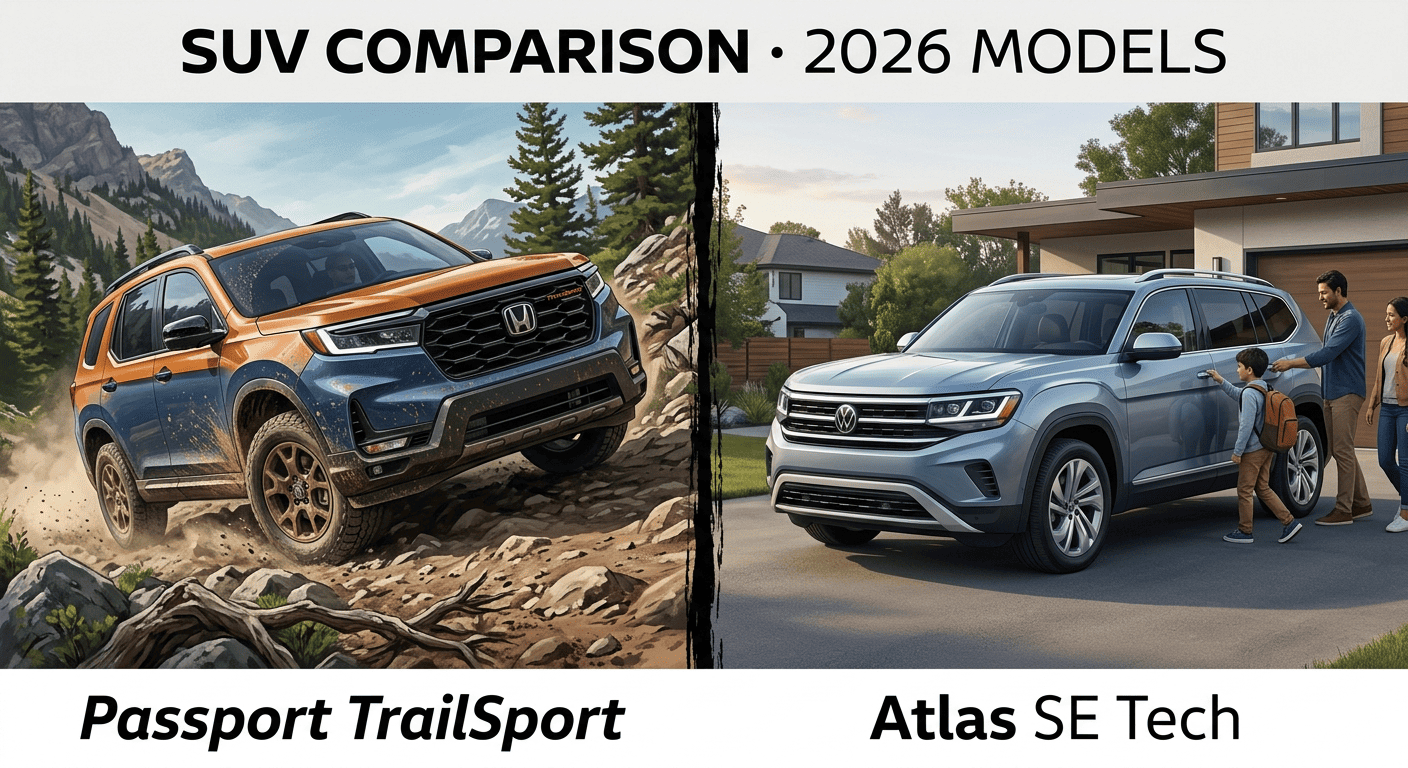
Two SUVs, two completely different promises — which one actually keeps its word?
Quick Overview
| Honda Passport TrailSport | VW Atlas SE w/ Technology | |
|---|---|---|
| Category | Trail-first · 5-seat mid-size SUV | Family-first · 7-seat family SUV |
| Price | $44,055–$46,944 USD | $40,785–$56,105 USD |
Most SUV comparisons are settled before the keys leave the hook. You already know roughly what you need — rows of seats for the school run, or real capability for the weekend trail — and the specs exist to confirm the decision you’ve mostly made. This one is different. The 2026 Honda Passport and the 2026 Volkswagen Atlas occupy adjacent parking spaces at the dealership but genuinely different worlds in use. Choosing between them is less a matter of which is better and more a matter of being honest about who you are.
The Atlas is a people-mover that takes the job seriously. Three rows, seven adults in comfort, enough cargo to embarrass a minivan, and a turbocharged engine that manages the whole enterprise with quiet competence. The Passport, fully redesigned for 2026, is something rarer: an SUV that put on its trail gear and actually went off road to earn the badge. In testing, it climbed rocky inclines that stopped modified trucks. That is not a press-release claim. It happened.
What each engine tells you
The Atlas runs a 2.0-liter turbocharged four-cylinder producing 269 horsepower and 273 lb-ft of torque, paired with an eight-speed automatic. On paper — and on road — it is entirely adequate. Zero to sixty in 7.3 seconds is not slow. The quarter mile in 15.6 seconds at 92 mph is honest family-SUV performance. Nothing here will make you feel like you’re driving something special, which is precisely the point: the Atlas is not trying to excite you. It is trying to get five to seven people somewhere without drama.
The Passport runs a 3.5-liter V6 producing 285 horsepower, mated to a ten-speed automatic. The extra cylinder matters most where the Atlas’s four-cylinder would start to breathe hard: at altitude, under load, on an incline with a trailer behind you. The automatic transmission does feel sluggish in casual urban driving — a legitimate complaint — but drop it into S mode and the hesitation disappears. This is an engine that rewards engagement, which fits the character of the vehicle perfectly.
“The Passport climbed rocky inclines that stopped modified trucks. That is not a press-release claim.”
Full Specifications Comparison
| Specification | Honda Passport TrailSport | VW Atlas SE Tech | Winner |
|---|---|---|---|
| Engine | 3.5L V6 · 285 hp | 2.0T I4 · 269 hp | Passport |
| Torque | ~262 lb-ft | 273 lb-ft | Atlas |
| Transmission | 10-speed auto | 8-speed auto | Tie |
| 0–60 mph | ~6.8 sec (est.) | 7.3 sec | Passport |
| Top speed | — | 117 mph (limited) | — |
| Quarter mile | — | 15.6 sec @ 92 mph | — |
| Towing capacity | 5,000 lbs | 5,000 lbs | Tie |
| Seating | 5 passengers | 7 passengers | Atlas |
| Drive options | AWD standard | FWD or AWD | Passport |
| Off-road hardware | Skid plates · all-terrain tires · TrailWatch camera | Standard AWD only | Passport |
| Approach/departure angles | Excellent (short overhangs) | Standard | Passport |
| Fuel economy (city) | ~13L/100km tested | 20 mpg | Atlas |
| Fuel economy (highway) | ~26 mpg est. | 27 mpg (FWD) / 26 mpg (AWD) | Atlas |
| Real-world highway (75 mph) | — | 25 mpg confirmed | — |
| Interior colors | Black only (Touring: brown) | Multiple options | Atlas |
| Infotainment screen | Built-in Google (Touring) | 12-inch screen | Atlas |
| Apple CarPlay / Android Auto | Yes | Yes (wireless) | Tie |
| Wireless charging | Yes | Yes | Tie |
| USB ports | — | 6 × USB-C | Atlas |
| Voice assistant | — | ChatGPT (Car-Net sub.) | Atlas |
| Smart home integration | — | HomeLink mirror (SE Tech+) | Atlas |
| Physical volume controls | Yes | No | Passport |
| Premium audio | Touring only | Touring only | Tie |
| Cargo behind row 3 | — | 4 carry-on bags | Atlas |
| Cargo behind row 1 | — | 38 carry-on bags | Atlas |
| Safety rating | IIHS Top Safety Pick | NHTSA 5-star | Tie |
| Forward collision warning | Standard | Standard | Tie |
| Blind spot monitoring | Standard | Standard | Tie |
| Adaptive cruise + lane keep | Available | Available | Tie |
| Warranty (basic) | 3yr / 36,000 mi | 4yr / 50,000 mi | Atlas |
| Free maintenance | — | 2yr / 20,000 mi | Atlas |
| Resale value | Excellent | Average | Passport |
| Reliability reputation | Best in class | Mixed | Passport |
| Availability | Long wait · no discounts | In stock | Atlas |
Inside: practicality vs personality
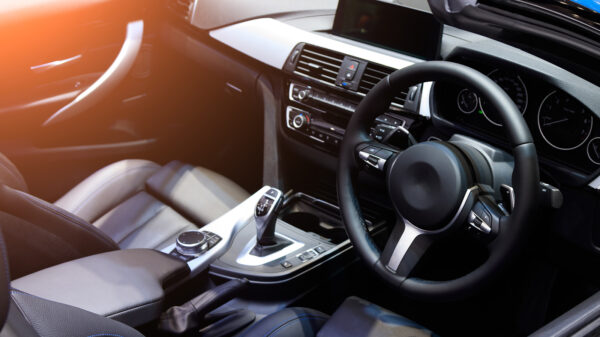
The Atlas cabin is a masterclass in suburban utility. Four carry-on bags fit behind the third row. Thirty-eight sit behind the first. The cupholders are thoughtful, the storage is plentiful, and the 12-inch infotainment screen handles Apple CarPlay, Android Auto, and wireless charging with six USB-C ports. There is even a ChatGPT voice assistant for subscribers. The HomeLink smart-home mirror — new for 2026 on the SE with Technology and above — lets you control your garage and lights from the driver’s seat. These are the features that make a vehicle genuinely easier to live with.
The Passport interior is honest rather than luxurious. The built-in Google screen and premium sound system are Touring-only privileges; lower trims get a more utilitarian setup. The exclusive black interior across most variants is a conscious choice for a vehicle that expects mud on its passengers’ boots, but it does make the cabin feel dim and utilitarian in ways that the Atlas — with its lighter palette options — avoids. If you spend most of your time in the cabin rather than outside the vehicle, the Atlas is simply a more pleasant place to be.
“The Atlas is a more pleasant place to be. The Passport is a more capable place to go from.”
Tech & AI: The Assistant Battle
In the specifications table, the Voice Assistant field on the Passport is completely blank (–), while the Atlas includes ChatGPT with a Car-Net subscription.
The Passport Touring trim has a built-in Google screen, which may allow access to Google Assistant through the system, but not as a fully integrated in-car smart assistant with the same level of independence or integration as the ChatGPT mentioned in the Atlas.
The article makes no mention whatsoever of any exclusive AI features in the Passport, while highlighting ChatGPT as a distinct feature of the Atlas.
In conclusion: The Atlas offers AI (ChatGPT) as a standout feature. The Passport doesn’t match it in this regard, relying solely on Google’s integrated system in its higher trims, which is closer to smartphone integration than a native smart assistant.
Fuel: the Atlas’s quiet advantage
The Atlas returns 20 mpg city and 27 mpg highway in front-wheel-drive form — 20/26 with AWD. Real-world highway testing at 75 mph produced 25 mpg. These are respectable numbers for a three-row, seven-seat SUV. The Passport’s fuel story is less flattering: 12.1 liters per 100km in testing versus an official 11.4. Fit custom tires — which many TrailSport buyers will do — and the number climbs further. For daily commuters, over the life of a vehicle, this gap compounds into a real cost difference that no off-road bragging rights can fully offset.
The trail: where this stops being close
Here is the thing about the Passport that numbers cannot fully capture: it is genuinely, technically capable off road in a way that almost no non-dedicated off-roader is. The approach and departure angles are excellent despite sharing a wheelbase with the five-row Pilot. The underbody skid plates are structural, not decorative. The TrailWatch front camera — which shows the ground under the nose in Trail mode — prevents the kind of expensive contact that ruins a weekend. The suspension, tuned for rough terrain without sacrificing highway comfort, performs a balancing act that engineers spent years getting right.
The Atlas, by contrast, offers 4Motion AWD as standard on the SE with Technology trim. It will handle light snow, wet roads, and the occasional unsealed lane without complaint. But nobody is taking an Atlas to the rocky incline where the Passport embarrassed modified trucks. That is not a criticism — it was never designed for it. It is simply a boundary to acknowledge before you sign the papers.
Pros & Cons
Honda Passport TrailSport
Pros:
- Genuine, proven off-road capability (outperformed modified trucks in testing)
- Strong V6 engine with real torque under load
- Excellent long-term resale value
- Comfortable, stable ride on highway despite all-terrain tires
- Short overhangs = outstanding approach and departure angles
- TrailWatch camera prevents expensive underbody damage
- Best long-term reliability reputation in the segment
Cons:
- Automatic transmission feels sluggish in normal city driving
- Disappointing real-world fuel economy (12.1L/100km tested)
- Interior is almost exclusively black — feels dark and utilitarian
- Premium audio and Google screen locked to Touring trim only
- Long waiting lists, dealers not discounting
- High price: $44,075–$46,965 USD
Volkswagen Atlas SE with Technology
Pros:
- True 7-seat comfort for adult passengers
- Best-in-class cargo space and practical storage throughout
- 27 mpg highway (FWD) — genuinely efficient for the size
- 4-year / 50,000-mile warranty + 2 years free scheduled maintenance
- 12-inch screen with wireless CarPlay, Android Auto, 6 USB-C ports
- ChatGPT voice assistant (with Car-Net subscription)
- HomeLink smart-home mirror (new for 2026, SE Tech and above)
- Multiple interior color options
- NHTSA 5-star safety rating
- More readily available with negotiable pricing
Cons:
- No physical volume or station controls — frustrating in daily use
- Interior style lags rivals like Kia Telluride and Mazda CX-90
- Minimal updates for 2026 (only new feature is the HomeLink mirror)
- No genuine off-road capability beyond light AWD assistance
- Four-cylinder can feel strained under heavy load or at altitude
- VW’s reliability record is more mixed than Honda’s
Resale & reliability
Honda’s reliability reputation is not mythology — it is 40 years of data. The Passport inherits a mechanical platform that has proven itself across multiple generations, and its resale values reflect that. High demand and constrained supply mean dealers are not discounting; the waiting list is real. This is one of those rare vehicles where the initial price is genuinely the total cost of ownership argument — because depreciation is slow and repair bills are infrequent.
The Atlas benefits from a four-year, 50,000-mile warranty and two years of free scheduled maintenance, which is unusually generous for the segment. VW’s reliability record is more mixed, but the warranty coverage blunts some of that risk. For a family vehicle covering school runs and weekend trips within cell service range, the Atlas represents a reasonable long-term bet.
Who should buy which
| Your situation | Buy this |
|---|---|
| You have 3 rows of people to move regularly | VW Atlas |
| You want genuine off-road capability | Honda Passport |
| Fuel economy is a priority | VW Atlas |
| Long-term reliability matters most | Honda Passport |
| You want the best warranty and free maintenance | VW Atlas |
| You want strong resale value | Honda Passport |
| You live mostly on pavement | VW Atlas |
| You want a daily driver that handles real trails | Honda Passport |
| Budget is the primary concern | VW Atlas |
| You’re considering a Bronco or 4Runner | Honda Passport (test this first) |
Bottom line
Buy the Volkswagen Atlas if you have three rows of people to move, live mostly on pavement, and want a vehicle that comes with a sensible warranty, reasonable fuel costs, and enough technology to keep everyone entertained. It is the more complete family tool.
Buy the Honda Passport TrailSport if you want a daily driver that can genuinely disappear down a rocky trail on a Saturday — and hold its value while doing it. Before you sign papers on a Ford Bronco or Toyota 4Runner, drive this first. It may be the most balanced vehicle in the segment that nobody is talking about loudly enough.
Tags: Honda Passport · VW Atlas , 2026 SUV , TrailSport , family SUV , off-road ,SUV comparison ,mid-size SUV

Independent technology writer focused on artificial intelligence, emerging technologies, and digital innovation. Covers AI applications in sports, productivity, and online business.