




























A Confession Before We Start
I almost got scammed my first week in crypto. I lost $200 to a “free Bitcoin” gift card scam that sounded completely legitimate. Then, a week later, I made a second mistake—I stored my seed phrase in a notepad app on my phone. Two months later, my phone got hacked, and I lost another $350 worth of tokens that felt like $35,000 at the time.
It was humiliating. But it was also educational. Those experiences taught me the most important lesson I’ve ever learned about crypto: the crypto world rewards those who do their homework and punishes those who don’t.
Three years later, I’ve made plenty more mistakes, learned from them, and built a portfolio I actually believe in. This guide is everything I wish someone had told me before my first purchase—straightforward, honest, and designed for complete beginners.
Part 1: What Crypto Actually Is (Without the Jargon)
Let me explain this like you’re five years old, because the crypto world loves to make simple things sound complicated.
Cryptocurrency is digital money that exists independently from governments and banks. No central authority controls it. Think of it like digital cash—you own it, you control it, and you can transfer it directly to anyone, anywhere in the world, usually within minutes.
Bitcoin was the first cryptocurrency, created in 2009 by someone using the name Satoshi Nakamoto (nobody knows who that really is). Since then, over 10,000 different cryptocurrencies have been created.
The core innovation is the blockchain. This is a decentralized digital ledger—a record book—that’s copied across thousands of computers simultaneously. When someone sends you crypto, the transaction gets verified by the network and permanently recorded. This removes the need for traditional financial middlemen like banks or payment processors.
Why does this matter? Because no single person, company, or government controls it. The rules are enforced by code and consensus, not by trust in a bank teller.
Part 2: Understanding Crypto Wallets (Where Your Crypto Actually Lives)
This is the confusing part that trips up almost every beginner. A crypto wallet doesn’t actually store your coins the way a bank stores your cash. Your coins live on the blockchain—a decentralized public ledger. What your wallet stores is your private key, which proves ownership of those coins.
Think of it like this:
- Your wallet address is like a bank account number (safe to share)
- Your private key is like your PIN (never share this)
- Your seed phrase is essentially a master backup of that private key, written in 12-24 English words
Custodial vs. Self-Custody Wallets
| Type | Description | Best For |
|---|---|---|
| Custodial (Exchange) | The exchange holds your keys. Like keeping money in a bank—convenient but you don’t truly own it. | Beginners, small amounts under $100 |
| Self-Custody | You hold your keys. Like keeping cash under your mattress—you’re fully responsible, but you actually own your assets. | Anyone with meaningful holdings |
Types of Wallets: Which One Do You Need?
| Wallet Type | Examples | Security Level | Best For | Cost |
|---|---|---|---|---|
| Exchange (Custodial) | Coinbase, Binance, Kraken | Depends on platform | Complete beginners | Free |
| Software/Hot | MetaMask, Trust Wallet, Phantom | Medium | DeFi, regular transactions | Free |
| Hardware/Cold | Ledger, Trezor | Highest | Long-term storage over $500 | ~$50-250 |
Hot wallets connect to the internet—they’re convenient but exposed to online threats. Cold wallets stay offline—they’re nearly unhackable but less convenient for daily use.
The Golden Rule
“Not your keys, not your crypto.”
If you don’t hold your own private keys, you don’t truly own the crypto. The exchange does.
My Storage Strategy Recommendations
| Your Holdings | Recommended Storage | Why |
|---|---|---|
| Under $100 | Keep on exchange | Convenience over control |
| $100-500 | Software wallet (Trust Wallet) | Control without hardware cost |
| $500+ | Hardware wallet (Ledger/Trezor) | Security for meaningful amounts |
| $5,000+ | Multiple hardware wallets | Geographic redundancy |
Part 3: How to Create Your First Software Wallet (Step by Step)
We’ll use MetaMask as the example since it’s the most popular Ethereum wallet, but the process is nearly identical for most software wallets.
Step 1: Download from the Official Source Only
Go to metamask.io and download the browser extension or mobile app. For mobile, use the App Store or Google Play—but verify the developer name is “MetaMask” because fake apps exist.
Critical: Never download from links in emails, DMs, or search engine ads. Type the URL yourself or use official app stores.
Step 2: Install and Click “Create a New Wallet”
Open MetaMask. You’ll see two options: “Create a New Wallet” or “Import Existing Wallet.” Choose Create New.
Step 3: Set Your Password
Create a strong password with at least 8 characters. This password unlocks MetaMask on your current device—it doesn’t replace your seed phrase.
Step 4: Write Down Your Seed Phrase (The Most Important Step)
MetaMask will display 12 words in a specific order. This is your seed phrase—the master key to your entire wallet.
Exactly what to do:
- Get a pen and paper right now
- Write all 12 words in order—exactly as shown
- Number them (1-12) so order is clear
- Store in a physically secure location (safe, locked drawer)
- Make a second copy stored elsewhere
What NOT to do:
- ❌ Never screenshot or save digitally
- ❌ Never save in cloud services (iCloud, Google Drive)
- ❌ Never share with anyone—real support never asks for this
- ❌ Never enter your seed phrase on any website claiming to “verify” it
This single step determines whether your crypto stays safe.
Step 5: Confirm Your Seed Phrase
MetaMask will ask you to confirm by selecting words in the correct order. This verifies you actually wrote it down.
Step 6: Your Wallet Is Ready
You’ll see your wallet address (starts with 0x…). Copy it and share it to receive crypto. You’re done.
Alternative: Trust Wallet (Multi-Chain Mobile Option)
Trust Wallet offers broader blockchain support for Bitcoin, Ethereum, Solana, and 100+ other chains:
- Download from App Store or Google Play
- Verify developer says “Trust Wallet”
- Tap “Create New Wallet”
- Write down your 12-word seed phrase (same rules apply)
- Your multi-chain wallet is ready
Alternative: Hardware Wallet (Maximum Security)
When your portfolio crosses $500-1000, hardware wallets become worth the investment:
- Buy directly from the manufacturer (Ledger.com or Trezor.io)
- Unbox while recording—verify no tampering
- Connect to your computer via USB
- Follow on-screen setup instructions
- Write down your 24-word seed phrase on the provided card
- Set your PIN (4-8 digits)
- Install apps for blockchains you need
Cost: Ledger Nano S Plus starts around $79; Nano X (Bluetooth) around $149.
Part 4: How to Receive Crypto Into Your New Wallet
- Open your wallet app
- Tap “Receive” or your address area
- Copy your wallet address (or tap to copy automatically)
- Send that address to whoever is sending you crypto
Important: Always verify the blockchain matches—sending Bitcoin to an Ethereum address typically means permanent loss of those funds.
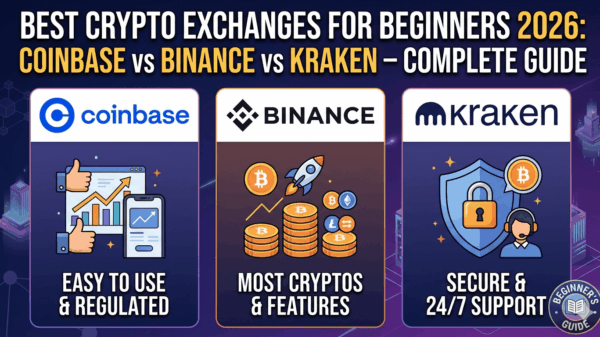
Part 5: Choosing the Right Exchange (Where to Buy)
Your exchange is where you’ll buy your first cryptocurrency. Think of it like a cryptocurrency grocery store.
Here’s the practical breakdown for 2026:
| Exchange | Best For | Typical Fees | My Honest Take |
|---|---|---|---|
| Coinbase | Complete beginners | 1.5-4% | Easiest interface. Worth higher fees for first months. |
| Kraken | Fee-conscious learners | 0.9-1.5% | Best balance of low fees and security. My recommendation. |
| Robinhood | Existing users | 0% (spread) | Convenient but limited control. |
| Binance | Global access | 0.1-0.5% | Lowest fees. Overwhelming for beginners. |
| Gemini | Security-focused | 1.49% | Strong compliance. Based in New York. |
My recommendation: Start with Coinbase or Kraken.
Red flags to avoid:
- Exchanges with no identity verification (KYC)
- No two-factor authentication option
- “Guaranteed returns” marketing
- Promises of “free Bitcoin”
Part 6: Setting Up Your Exchange Account (The Safe Way)
Step 1: Use a dedicated email
Create a new email specifically for crypto. Don’t reuse your primary email.
Step 2: Create a strong password
Minimum 16 characters. Use a password manager (Bitwarden, 1Password).
Step 3: Enable two-factor authentication (2FA)
This is mandatory, not optional. Use Google Authenticator or Authy. Never use SMS codes for crypto exchanges—these are vulnerable to SIM-swapping attacks.
Step 4: Complete identity verification
Have your government ID ready. This KYC process is required by law. Takes 5-15 minutes.
Step 5: Verify your bank account
Link a checking account for ACH transfers. You’ll confirm two small test deposits.
Step 6: Backup everything
Write down login credentials, 2FA backup codes, and recovery phrases. Physical backup in a safe place.
Part 7: Funding Your Account
| Payment Method | Speed | Fee | Best For |
|---|---|---|---|
| Bank transfer (ACH) | 1-3 business days | Free | Default method |
| Debit card | Instant | 3-4% | First small buy only |
| Wire transfer | 1 business day | $0-30 | Large amounts ($1,000+) |
| PayPal | Instant | Variable | Convenience |
Start small: Deposit $50-100 for your first purchase. This is “tuition money”—the cost of learning.
Part 8: Making Your First Purchase
Step 1: Navigate to buy/trade
Most platforms have a big blue “Buy” button. Click it.
Step 2: Select your asset
For beginners, stick to Bitcoin (BTC) or Ethereum (ETH) . These are the blue chips of crypto. Your first year, keep it boring.
Step 3: Choose your amount
Enter $25-100. You do not need to buy a whole Bitcoin—fractional purchases are normal.
Step 4: Review the order
Check total including fees before confirming.
Step 5: Confirm
That’s it. Your crypto now shows in your exchange wallet.
Pro tip: Your first purchase’s goal is learning the mechanics, not making money. Don’t check prices every hour.
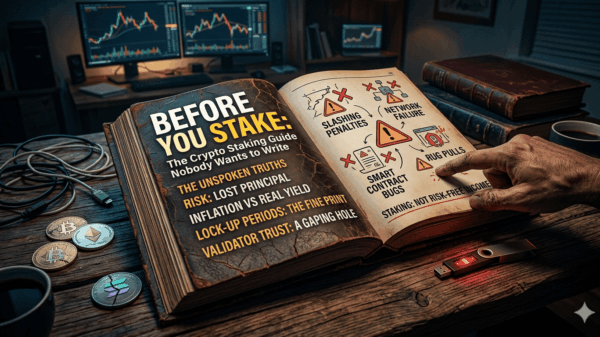
Part 9: Understanding Staking (The Passive Income Part)
Some cryptocurrencies use “proof-of-stake” to verify transactions. You “stake” (lock up) your coins as collateral and earn rewards—typically 3-12% annually.
Popular Staking Options for Beginners
| Asset | Typical APY | Lock-up Period | Risk Level |
|---|---|---|---|
| Ethereum (ETH) | ~4% | None (liquid staking) | Low |
| Solana (SOL) | ~6-8% | None (liquid staking) | Medium |
| Cardano (ADA) | ~4-5% | None | Low |
| Polygon (MATIC) | ~5% | None | Medium |
My recommendation: Don’t stake until you’ve held for six months and understand what you’re locking up. Staking is great, but not for day-one beginners.
Part 10: Wallet Security Tips
- Never share your seed phrase. Real support never asks for it. Anyone asking is a scammer.
- Use a password manager for device passwords, but NOT your seed phrase—keep that offline on paper.
- Enable biometric login on mobile (fingerprint or Face ID).
- Always send a test transaction (small amount first) before moving larger amounts.
- Consider a metal backup (Cryptosteel) for $30-50 to protect against fire/water.
- Don’t click links in DMs. Unexpected “support” messages are always scams.
- Disconnect from suspicious dapps and review token approvals periodically.
Part 11: Pros and Cons (Honest Assessment)
Advantages
- Full control: Your keys, your coins—no third-party risk
- Access to DeFi: Interact with decentralized apps, yield farming, NFTs
- 24/7 markets: No waiting for market open
- Self-custody: No bank required
- Fractional ownership: $10 gets you fractional Bitcoin
- Transparency: Every transaction visible on blockchain explorers
Challenges
- Responsibility: Lose your seed phrase, lose everything forever
- No bank-like recovery: No customer service to call
- Volatility: 40-80% drops happen
- Technical learning curve: Addresses, gas fees, private keys
- Scams everywhere: If it promises guaranteed returns, it’s a scam
- Tax complexity: Every transaction may be taxable
Part 12: Frequently Asked Questions
Is crypto legal?
Yes, in most countries including the US, UK, Canada, Australia, and EU. Regulations vary. In the US, the IRS treats crypto as property—every transaction can be taxable.
Is it safe?
Yes—when you use proper security practices. Bitcoin’s blockchain has never been hacked. The danger is user error: phishing scams, weak passwords, sharing seed phrases.
Is it too late to start?
Absolutely not. Major companies hold Bitcoin as treasury assets. Bitcoin ETFs trade on traditional stock exchanges. Entry points are easier than ever.
How much does it cost to create a wallet?
Software wallets are completely free. Hardware wallets cost $50-250. No hidden creation fees.
What happens if I lose my seed phrase?
Your crypto is permanently inaccessible. There is no “forgot password.” This is why proper backup is non-negotiable.
What’s the minimum I can invest?
Most exchanges allow purchases of $1-10. Begin with $25-100 as “learning money.”
Can I create multiple wallets?
Yes. Many users have separate wallets for DeFi, savings, and cold storage.
Part 13: Tips From Someone Who’s Been There
- Start boring. Your first year, hold only Bitcoin and Ethereum.
- Dollar-cost average (DCA). Recurring buys regardless of price beats timing the market.
- Track taxes from day one. Use CoinTracker or Koinly.
- Never check prices daily. Weekly is healthier.
- Your seed phrase is sacred. Write it on paper, store it securely.
- Ignore the noise. Social media promotes fear and greed.
- Accept you’ll make mistakes. Your first $100-500 is tuition money.
- If it sounds too good to be true, it is. “Guaranteed returns” = scam.
- Always use free trials first. Before committing to any paid service.
- Never pay for more than 3 months of any service upfront.
Part 14: Your 30-Day Action Plan
Week 1: Education and Setup
- Day 1-2: Read this guide again
- Day 3-4: Choose an exchange (Coinbase or Kraken)
- Day 5-7: Create account with proper security (dedicated email, strong password, 2FA)
Week 2: First Purchase
- Day 8-10: Link your bank account
- Day 11-12: Deposit $50-100
- Day 13-14: Buy Bitcoin or Ethereum
Week 3: Learning to Hold
- Days 15-21: Don’t check price daily. Weekly check-ins only. Notice your emotional reactions.
Week 4: Security and Next Steps
- Day 22-24: Download Trust Wallet and create your self-custody wallet
- Day 25-27: Practice restoring a wallet with $5
- Day 28-30: Decide next purchase amount, set up recurring buys
Final Thoughts
The difference between someone who gets wrecked in crypto and someone who builds long-term wealth comes down to security habits, not market timing. Your seed phrase is your entire financial life in crypto. Treat it accordingly.
Crypto isn’t going anywhere. The Bitcoin ETFs, corporate treasuries, and regulatory frameworks of 2026 prove that. But the biggest risk to beginners isn’t volatility—it’s impatience.
Your first purchase will feel strange. That’s normal. The second feels more natural. By the fifth, you’ll understand exactly what you’re doing. The hardest step is starting. Everything after that is learning.
Quick Reference Summary
| Category | Rating | Notes |
|---|---|---|
| Entry Ease | ★★★★★ | Easier than ever in 2026 |
| Security | ★★★☆☆ | Your habits matter most |
| Wallet Setup | ★★☆☆☆ | 5 minutes, very beginner-accessible |
| Learning Curve | ★★★☆☆ | Basic comprehension takes days |
| Long-term Value | ★★★★★ | Essential skill to build |
Overall: ★★★★☆ — Every crypto holder needs this knowledge.
Disclaimer: This guide is based on personal experience and research. I am not a financial advisor. Crypto carries real risks. Never invest more than you can afford to lose completely.
Questions? Drop them below.

Independent technology writer focused on artificial intelligence, emerging technologies, and digital innovation. Covers AI applications in sports, productivity, and online business.