



























What makes this subject interesting to me? I’ve been writing on AI infrastructure for the past three years, then something unexpected changed in early 2026. I continued hearing the same narrative from entrepreneurs on both sides of the Pacific: a political impasse occurring in chip factories was causing their hardware costs to diverge significantly, not due to any technological advancement. I became increasingly aware that this isn’t a tech story as I explored further. It’s an economic tale with significant ramifications for anyone developing or purchasing AI.
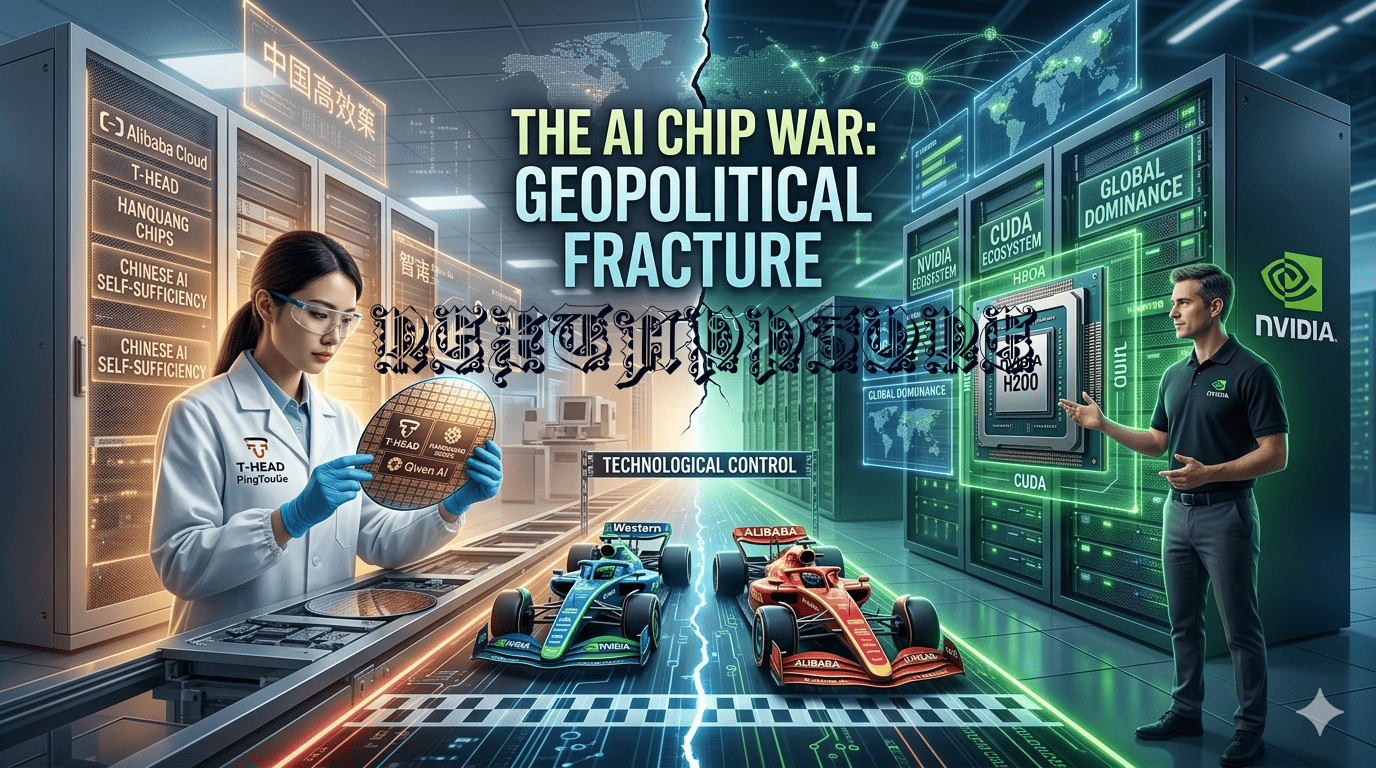
The chip war between Alibaba and Nvidia will decide who gets to develop AI, at what cost, and under whose regulations. The difference between these two strategies in 2026 goes beyond benchmark scores. It has to do with price, accessibility, and the subtle division of the worldwide AI market. This war will have an immediate impact on your bottom line if you work with AI in any capacity.
The Price Tag Nobody Talks About
Last year I sat down with a founder from Shenzhen who builds AI video tools. Over coffee, he told me his cloud bill had tripled in six months. Not because he was using more compute — because the chips in his provider’s servers now cost nearly twice as much to import.
This is the side of the Alibaba vs Nvidia story that doesn’t make tech headlines but affects real businesses. While Nvidia’s H100 and B200 dominate data centers globally, Chinese companies can’t access them. The alternatives — mostly in-house chips from Alibaba and Huawei — come with different trade-offs that most Western coverage ignores.
Over the past year, I’ve traveled to data centers in China and the US, and I’ve noticed a clear difference in hardware approach. Nvidia’s newest products abound in American server rooms. Chinese versions combine Alibaba’s silicon, Huawei’s Ascend series, and older Nvidia models. Each describes how AI is developed in 2026 in a unique way.
What the Export Ban Actually Changed
Panic erupted after the US imposed export restrictions on cutting-edge semiconductors in late 2023. Prior to the full implementation of the restrictions, Chinese AI laboratories hurried to accumulate Nvidia chips. There have been reports of businesses paying surcharges of as least fifty percent when purchasing server racks using dummy corporations.
However, two years later, a change occurred that most observers had not anticipated. Instead of viewing the restriction as a barrier, Chinese businesses began to view it as a forcing function.
Alibaba’s chip division, T-Head, had been quietly developing AI accelerators since 2018. The export pressure accelerated their timeline dramatically. By early 2026, Alibaba had shipped over 100,000 units of its Zhenwu 810E chip to more than 400 enterprise clients, according to Bloomberg. These chips reportedly perform at levels comparable to Nvidia’s H20 — the version Nvidia designed specifically for the Chinese market after its best models were blocked.
The Numbers That Matter
Here’s what the scale actually looks like. China’s domestic AI chip production is projected to reach 2.7 million units in 2026. Huawei alone targets 1.6 million Ascend 910C chips this year, as reported by SCMP. Alibaba isn’t the only player in this space, but it has one strategic advantage the others lack: Alibaba Cloud.
Alibaba Cloud is one of the top five cloud providers worldwide and the biggest in China. Alibaba’s own data centers can use any chip that T-Head produces. Because of this vertical integration, Alibaba sells AI processing power at pricing it controls in addition to manufacturing chips. That’s a very different economic model to compete with for Nvidia, which sells hardware but doesn’t operate its own cloud at a similar scale.
What This Means for AI Development Costs
This is where the chip war hits home for people building actual products.
In the US and Europe, Nvidia GPUs are available but expensive. An H100 still trades for around $30,000 on secondary markets. A B200 costs more. Cloud providers pass those costs along, which means every AI company in the West pays a premium just for access to compute.
The greatest Nvidia chips are not offered at any price in China. However, because Alibaba’s chips are produced domestically and don’t have the same R&D expense as Nvidia’s state-of-the-art designs, they are less expensive to make. Raw performance is the trade-off. In artificial benchmarks, Alibaba’s chips fall short of Nvidia’s best models. However, they are adequate for the majority of production AI workloads, especially inference, which makes up the majority of computing demand.
The result is a pricing asymmetry that most Western analysts miss. Chinese AI startups can run their models at significantly lower infrastructure costs than their US counterparts. This is one reason you see Chinese AI services shipping at aggressively low prices. It’s not a generosity play. Their hardware costs are genuinely lower.
I’ve written before about how Nvidia’s pricing creates real barriers for smaller companies. The situation in China turns that dynamic on its head — but with its own strings attached.
The Hidden Cost of Compatibility
Here’s the catch that doesn’t show up on a balance sheet.
Hardware speed isn’t Nvidia’s true advantage. The software platform that enables programmers to write code aimed at Nvidia GPUs is called CUDA. CUDA is the foundation of all major AI frameworks, including PyTorch, TensorFlow, and JAX. Software must be modified to operate with new tools when switching to Alibaba or Huawei processors.
To close this gap, Alibaba provides its SAIL software stack. The majority of common models are compatible with it. However, according to developers I’ve spoken to, the shift still necessitates weeks of optimization—weeks they would prefer to use for new development. The most crucial chip isn’t always the quickest one, as was mentioned in an earlier article on our website. It’s the one that works with your existing code without friction.
For a well-funded US startup, paying $30,000 for an H100 is annoying but manageable. For a bootstrapped Chinese founder, rewriting model pipelines to run on domestic chips is a genuine barrier to entry. The chip war creates different kinds of friction for different people.
The Tale of Two AI Markets
We’re witnessing the emergence of two parallel AI hardware ecosystems. One centered on Nvidia, serving global markets with premium performance at premium prices. The other centered on domestic Chinese chips, serving a closed market optimized for cost and availability.
The US-China tech war has already reshaped roadmaps on both sides. Alibaba’s push into chips isn’t just about geopolitics — it’s also a smart hedge against supply chain risk. Every cloud provider should be thinking about what happens if their primary hardware supplier becomes politically constrained. Alibaba has effectively insured itself against that risk.
Who Wins and Who Loses
I’ll keep this simple.
Winners: Chinese AI startups get lower compute costs. Alibaba Cloud strengthens its vertical control. Chinese consumers gain access to cheaper AI services that would cost more in an Nvidia-only world.
Losers: Nvidia’s China revenue is shrinking despite strong global numbers. Global AI interoperability takes a hit as ecosystems diverge. Startups outside China that compete with Chinese AI companies on pricing face a structural disadvantage they can’t easily fix.
The network consequences of a single global AI hardware standard are another harder-to-measure loss for the larger IT sector. When developers could write once and deploy anywhere, innovation moved fast. That is slowed down by fragmentation.
What I Think Happens Next
Here’s my take, and I expect some readers will disagree.
I don’t think Nvidia loses its crown globally. Its roadmap through 2028 looks strong, and the CUDA ecosystem is too deeply embedded to displace in Western markets. But I think Nvidia’s dominance in China is effectively over. Alibaba and Huawei have crossed a threshold where their chips are good enough for most workloads, and the political momentum behind domestic silicon isn’t going to reverse.
What happens to the global AI market is the more intriguing question. We may witness a pricing war that reduces profitability for AI firms worldwide if Chinese AI services become more affordable due to decreasing hardware costs. Customers gain from this, but firms whose financial models are based on Nvidia’s price structure face harsh circumstances.
It was once thought that the world’s AI will be powered by a single chip manufacturer. It is no longer feasible to make such assumption. Multiple AI hardware ecosystems, each with its own economics and target market, are what we’re moving toward. Who wins the technical race is not the question. The question is whether the sector can maintain enough connectivity to keep AI a worldwide technology rather than a conglomeration of local ones.
FAQ
Is Alibaba’s chip better than Nvidia’s? Nvidia’s best models continue to surpass Alibaba’s processors in terms of raw performance. However, Alibaba’s solution works enough at a much lower cost for the majority of real-world AI tasks, including inference.
Can I buy Alibaba chips if I’m outside China? No. Alibaba uses its chips primarily within its own cloud infrastructure. They aren’t sold as standalone products.
How does this affect me as a user in the US or Europe? You may see Chinese AI services priced lower than US equivalents. You may also notice differences in AI capabilities between regions as the two ecosystems develop independently.
Is China winning the chip war? The US still leads in high-end chip design and global market share. But China is closing the gap faster than most analysts predicted. It’s less about one side winning and more about the market splitting into two self-contained ecosystems.
How does Huawei fit into this? Huawei is Alibaba’s main competitor in domestic chips. Its Ascend 910C is considered the most powerful Chinese alternative to Nvidia. Both companies benefit from the same political tailwinds but compete fiercely for cloud customers.
Will chip prices go down because of this competition? In China, yes — domestic competition is already pushing compute costs down. Globally, Nvidia still sets the price floor, and there’s little sign of that changing in the near term.
Bottom Line
The Alibaba vs Nvidia chip war isn’t just a corporate rivalry. It’s a structural shift in how AI gets built and paid for. Whether you’re a developer choosing infrastructure or a business owner planning an AI product, this war affects your costs, your options, and the competitive landscape you operate in. The sooner you understand the economics behind the headlines, the better positioned you’ll be for what comes next.

Independent technology writer focused on artificial intelligence, emerging technologies, and digital innovation. Covers AI applications in sports, productivity, and online business.