








First: America Built Its Empire… But at a Massive Cost
Let me make something clear from the start.
Since the 1990s, the US has dominated technology not by accident, but through a simple system:
Whoever has more resources → wins.
Top universities, giant companies (Google, Microsoft, Amazon), venture capital that covers the planet, and the world’s strongest infrastructure in chips, cloud, and operating systems.
This system worked 100%.
But artificial intelligence flipped the table.
Why? Because technological power alone is no longer enough. And I was personally shocked when I followed small Chinese companies (most of them unknown) achieving strange results at just 10% of the cost.
Let me explain how we got here.
Phase 1: How America Built Its AI Empire
The West built its AI on a philosophy called:
“Greatness = massive computing power”
Double the chips, double the data, double the energy… and you’ll get a genius model.
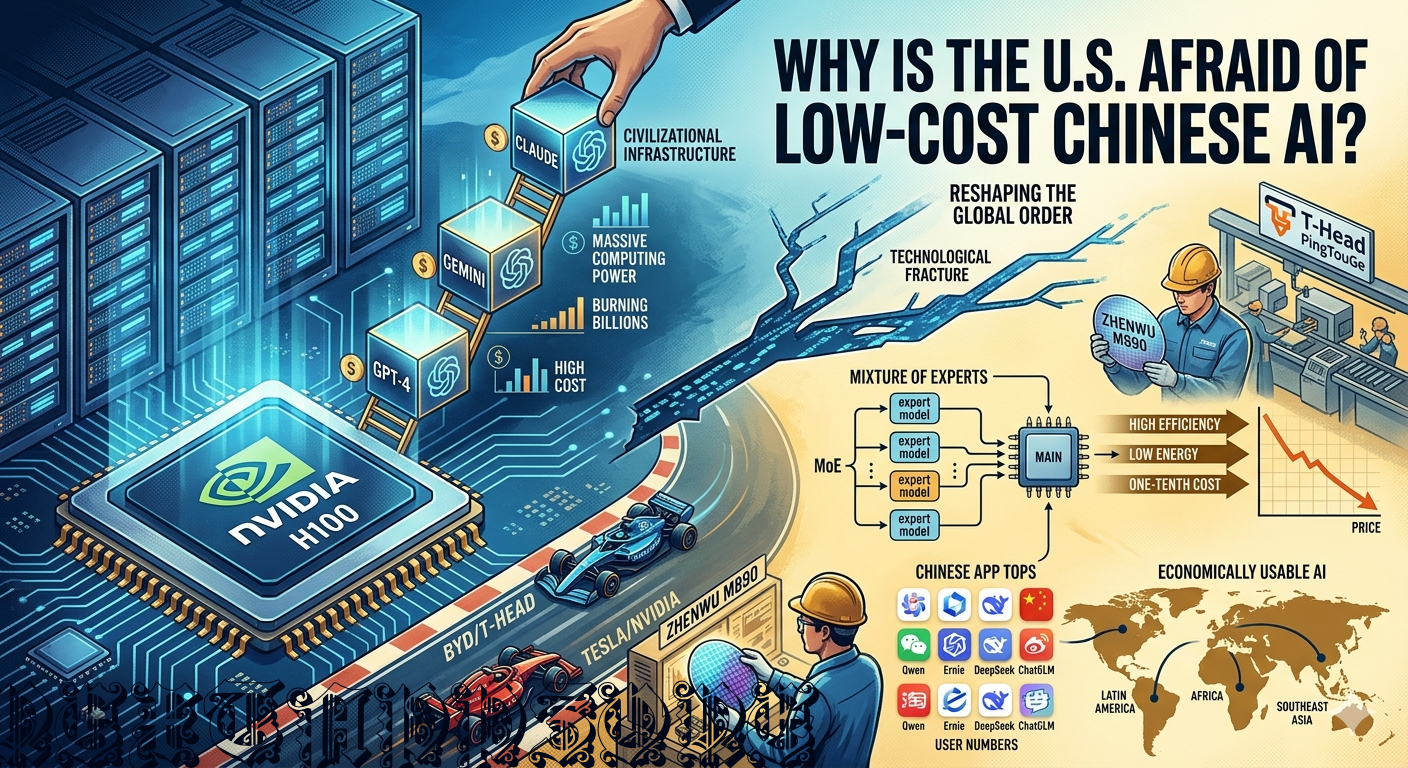
That’s why companies like OpenAI (ChatGPT), Google (Gemini), and Anthropic (Claude) burned billions on:
- Massive data centers costing as much as a small city.
- NVIDIA processors, each priced like a luxury car.
- Complex cooling systems and electricity consumption that makes you feel guilty.
Is this wrong? No.
But the problem started appearing on the horizon: every small improvement in performance required multiple times the spending. A 5% improvement could cost double the budget.
And here, the limits of the American model began to show. Honestly, I was excited about this model at first, but over time I realized it’s unsustainable.
China Found the Weak Spot and Hit Exactly Where It Hurts
Let me tell the story as it is.
In January 2013, Baidu founded China’s first deep learning lab. They were preparing for something big.
In March 2023, Baidu launched ERNIE Bot – China’s competitor to ChatGPT. The launch was disappointing, using pre-recorded videos instead of a live demo, and the audience was let down.
But just 5 months later, in August 2023, they opened it to the public. And suddenly… within a single month, CEO Robin Li (Li Yanhong) announced that operating costs dropped to one-tenth of the original price, while performance improved 10 times.
This isn’t magic. This is the “Mixture of Experts” approach I mentioned earlier, applied in practice.
China sat watching America burn money for two years, asking a completely different question:
“What if we could achieve nearly the same results… at one-tenth the cost?”
Sound crazy? It seemed that way in 2021. But in 2024, it became reality.
The idea is so simple it’s genius: instead of building an AI model that uses “all its power” for every question, why not activate only the specialized part?
Exactly like a hospital: you don’t need every single doctor to treat a common cold. A general practitioner is enough.
Results I’ve seen firsthand (in limited tests with open-source Chinese models): 4x higher efficiency and dramatically lower energy consumption.
Let me repeat this because it’s important: Efficiency has become more important than raw power.
| Company / Model | Date | Price Cut % | Commercial Impact / New Price |
| DeepSeek | May 6, 2024 | ~99% | Dropped to $1 per million tokens. Shocked Silicon Valley with ultra-low-cost math/coding reasoning. |
| Zhipu AI (ChatGLM) | May 13, 2024 | 80% | $1 per million tokens for a high-performance bilingual model. |
| AliCloud (Qwen-Long) | May 21, 2024 | 97% | $0.05 per 1,000 tokens ($1 per million tokens). |
| Baidu (Ernie Speed & Lite) | May 21, 2024 | 100% | Made two full foundation models completely free for enterprise businesses. |
| Baidu (Ernie 4.0 Turbo) | July 2024 | 70% | Slashed to 0.03 RMB/1k input tokens at the WAIC Conference in Shanghai. |
The Opinion of a Man Who Lived Both Games
Dr. Kai-Fu Lee – former president of Google China, former executive at Microsoft and Apple – founded a company called 01.AI in 2023.
In October 2024, he stated in an interview that “Chinese models lag behind American ones by only 6-9 months.”
This number terrifies Silicon Valley. Two years ago, the gap was years. Now it’s months.
He’s the same person who wrote the book “AI Superpowers” in 2018, predicting that China would catch up to the West. Many mocked him at the time. Today? His words seem prophetic.
In a lecture at NYU Shanghai in 2025, he said: “AI is just a tool. Love is what distinguishes us from it.” Beautiful words, but the problem is that running this “tool” requires massive electrical infrastructure.
Economics Beats Genius (Every Single Time)
Many people ask: “Who has the smartest model?”
Reality says: Nobody cares.
No, I’m not joking.
The golden rule of economics I learned the hard way:
The most widely adopted technology isn’t the best – it’s the most economically usable.
If a Chinese model gives you 90% of GPT-4’s quality at 5% of the price… what will you do?
As a startup founder, a student, a video editor, a doctor in a public hospital – your choice is clear.
And this is exactly what scares Silicon Valley.
It’s not fear of Chinese super-intelligence. It’s fear of “good enough” AI that will flood the world like a tidal wave.
I once had a conversation with a friend working at Microsoft. He said to me, literally: “Our problem is that the whole world wants cheap… and the Chinese discovered this secret before us.”
The Sanctions Paradox: A Backfire
In October 2022, America banned exports of advanced NVIDIA processors (A100, H100) to China. In October 2023, it tightened sanctions further.
The West said: “We’ve finished them.”
But Baidu had a plan. They had their internal deep learning platform PaddlePaddle (developed since 2016), and they had domestic chips from SMIC (though less powerful).
History teaches us: pressure on major powers often creates forced self-sufficiency.
China responded by developing its domestic chips, building a full ecosystem – development tools, cloud platforms, software libraries – completely independent from the West.
Does this mean China has surpassed the US technologically? No. But it means it has become independent of anyone.
And this is the real nightmare: a parallel technological system that’s hard to kill with sanctions.
The Next War Isn’t Algorithms… It’s Electricity
Let me shock you: AI consumes electricity like drinking water in summer.
As models advance, energy demand skyrockets.
One data center running GPT-4 consumes electricity equivalent to a small city (50,000 homes). Imagine.
Therefore, the company that can run a good model with the least energy will win.
Here, China may have an advantage for a simple reason: it has a massive capacity to build electrical infrastructure quickly (power plants, grids, cooling) and at low cost.
America’s electrical grid is old and fragmented, while China builds from scratch in whole regions.
I’m not saying this out of pessimism, but it’s an uncomfortable truth.
Just Like Electric Vehicles… History Repeats Itself
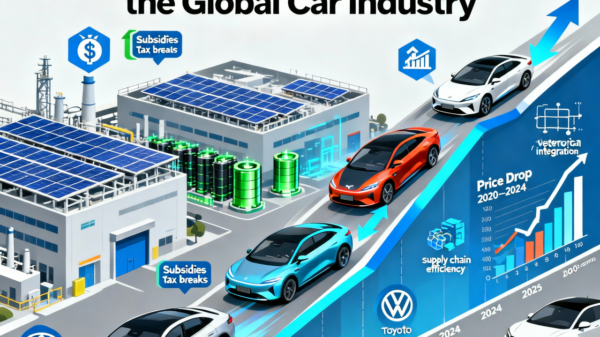
I remember 10 years ago, everyone mocked Chinese cars. Today? BYD sells more cars than Tesla in some markets.
How did this happen?
- The West innovated first (Tesla, Nissan Leaf).
- China focused on cost reduction and rapid scaling.
- Result: China now produces acceptable electric vehicles at half the price.
The same story is repeating with AI.
This is why Americans fear that AI could become like solar panels or consumer electronics – industries the West invented but China came to dominate.
Trust me, this scenario is painful for any American engineer, but it looks increasingly inevitable.
Price War – The Numbers That Terrify Silicon Valley
May 2024 – War Declared:
| Company | Date | Cut | Details |
|---|---|---|---|
| AliCloud (Qwen-Long) | May 21, 2024 | 97% | $0.05 per 1,000 tokens = $1 per million tokens |
| Baidu (Ernie Speed & Lite) | May 21, 2024 | 100% (free) | Two full models free for businesses |
| Zhipu AI | May 13, 2024 | 80% | $1 per million tokens |
| DeepSeek | May 6, 2024 | ~99% | $1 per million tokens |
July 2024 – Baidu Strikes Again (WAIC Conference, Shanghai):
| Model | Cut | New Price |
|---|---|---|
| Ernie 4.0 Turbo | 70% | 0.03 RMB/1k tokens (input), 0.06 RMB/1k tokens (output) |
| Ernie Speed & Lite | Free | Remains free |
Statement from Baidu Executive Cao Haitao:
“Everyone cares about cost reduction. Phones, cars, computers – all their prices drop over time. Whoever can lower prices has strong technology. No one can lose money forever.”
Who Will Be Wiped Out in the Price War?
Cao Haitao from Baidu predicted the price war will continue for at least a year, and three categories of companies will disappear:
- Shell companies: Those that just put their logo on an open-source model.
- Companies without a strong cloud infrastructure.
- Companies without a “data flywheel” – meaning they can’t collect user data to improve their model.
Why Can China Cut Prices This Much?
Factor 1: Market Size
- 430 million users of Ernie Bot alone (as of November 2024).
- Every user provides data that trains the model.
Factor 2: Intense Competition
“If one company cuts prices, the rest must follow or die” – Analyst from Weibo.
Factor 3: Modern Technologies
- Mixture of Experts (MoE): Only activate part of the model per request.
- 2025 models: Can compress a 100-billion-parameter model to 10% of its size while maintaining 90% of performance.
Factor 4: Government Support + Infrastructure
- Cheaper electricity
- Domestic chips (SMIC)
- Domestic cloud infrastructure
The Final Comparison Table – China vs. US (2024-2025)
| Metric | China | US | The Gap |
| Model Quality | 6–9 months behind | Best (GPT-4o, Claude 3.5) | Closing rapidly |
| Price (per million tokens) | $0.19 – $1 | $20 – $40 (GPT-4) | China is 20x to 100x cheaper |
| Open-Source Models | Qwen, DeepSeek, ChatGLM | Llama (Meta), Mistral | China leads the open-source ecosystem |
| User Count (Domestic) | 430 million+ (Ernie Bot alone) | ~200 million (ChatGPT globally) | China’s domestic market is massive |
| Practical Applications | Leading (Deep integration with real services) | Lagging relatively in mass deployment | China leads in market commoditization |
Timeline of Chinese AI Development (2018-2025)
| Year | Event | Details |
|---|---|---|
| 2018 | Book “AI Superpowers” by Kai-Fu Lee | Predicted China would catch the West |
| October 2022 | First US sanctions on NVIDIA | Banned A100, H100 exports to China |
| March 2023 | Baidu launches Ernie Bot | First ChatGPT competitor (initial version disappointing) |
| October 2023 | US tightens sanctions | Banned additional advanced processors |
| May 2024 | Price war begins | AliCloud cuts prices by 97% |
| July 2024 | Alibaba Qwen2 surpasses GPT-4 Turbo | Ranked 3rd globally after OpenAI and Anthropic |
| September 2024 | Kai-Fu Lee statement | Gap = only 6-9 months |
| November 2024 | Ernie Bot reaches 430 million users | |
| February 2025 | Baidu makes Ernie Bot completely free (from April 1) | |
| April 2025 | Qwen3 1.7B launched | Price = $0.19 per million tokens |
| Mid-2025 | Price war continues | Costs drop 60-70% annually |
Major Players in the Chinese AI Market
1. Baidu – Ernie Bot (文心一言)
- Launch date: March 2023
- Users: 430 million (November 2024)
- Business model: Was 49.9 RMB/month (~$7), became completely free from April 2025
- Strength: Long experience in Chinese language processing (since 2013) and massive search database
2. Alibaba – Tongyi Qianwen (通义千问) / Qwen
- Major achievement: July 2024, Qwen2-72B ranked 3rd globally after GPT-4o and Claude 3.5 Sonnet
- What Hugging Face said: CEO said “Qwen 72B is the king”
- Price: Cut by 97% in May 2024 ($0.05 per 1,000 tokens)
- Unique advantage: Strongest open-source model in the world
3. DeepSeek – The Surprise That Shocked Silicon Valley
- Specialty: Programming and mathematics – considered “the genius” in this field
- Context: In January 2025, shocked the world with a very low-cost model
- Price: Was free for a period, now very competitive
- Strength: DeepSeek-R1 has 128K token context window
4. Zhipu AI – ChatGLM
- Background: Tsinghua University (China’s MIT)
- Price cut date: May 13, 2024 – cut prices by 80%
- Unique: Bilingual model (Chinese-English)
5. Moonshot AI – Kimi Chat
- Secret weapon: Longest context in the world (200K+ tokens) – you can put an entire book in it
- Target audience: Researchers, lawyers, analysts
6. SenseTime
- Domain: Computer vision + AI
- Achievement: Their model surpassed GPT-4 Turbo in July 2024
The Numbers That Scare Silicon Valley
| What Silicon Valley Fears | The Scary Number |
|---|---|
| Gap of only 6-9 months between models | In 2023 the gap was years; in 2024 it became months |
| 97% price cut within two weeks | In May 2024, the Chinese market collapsed in price |
| 430 million users in China alone | More than Germany + France combined |
| Chinese models surpassing GPT-4 Turbo | July 2024 – a historic event |
Conclusion: What Is the US Really Afraid Of?
Let me be honest: America still leads in:
- Basic research (scientific papers published in Nature and Science)
- Cutting-edge models (upcoming GPT-5, etc.)
- Global cloud infrastructure (AWS, Azure)
But China may dominate something even more important: turning AI into a cheap, mass-market commodity available to everyone.
What does this mean?
It means that Africa, the Middle East, Southeast Asia, and Latin America will build their systems on Chinese AI. Not because they love China, but because they “cannot afford the Western alternative.”
Let me give you a real example: a hospital in Kenya with an annual tech budget of $50,000. Will it buy an American solution for $40,000, or a Chinese solution for $3,000? The answer is painful but clear.
This is the new source of global influence: whoever owns the AI that the world’s poor and middle classes actually use.
The Real Battle: Who Controls the World’s Cognitive Infrastructure?
In the past:
- Oil = control of energy.
- The internet = control of information.
Today:
- AI = control of knowledge, education, economics, media, and even ways of thinking.
This isn’t theoretical. Imagine if 2 billion students worldwide relied on Chinese AI to learn math, language, and history… What kind of “facts” would they learn?
This is why it’s civilizational infrastructure, not just a tech product.
The country whose AI system spreads globally may gain lasting influence over how billions of people think, work, and learn.
I know this sounds like science fiction, but it’s already happening on a small scale.
Final Verdict: What Is America Really Afraid Of?
America is not simply afraid that China will become “better” technologically.
It is afraid of something deeper: that China may become cheaper, more widely deployed, and more accessible globally than Western alternatives.
Because history teaches us:
Dominance doesn’t always go to the most advanced technology – but to the one that spreads fastest, costs least, and integrates into everyday life at scale.
The real question that will determine the next decade is not:
“Who has the smartest AI?”
But rather:
“Who owns the AI that the world actually uses?”
What do you think? Do you agree that the battle will be decided by deployment and price rather than technical genius?
(This post is my personal opinion, and I welcome discussion on any point – you’re certainly allowed to disagree!)
🎯 Summary Table of Companies, Dates, and Sources
| Name / Date / Concept | Key Details | Strategic Impact / Source |
| Baidu | China’s leading search engine and AI pioneer. | Long experience in Chinese NLP since 2013. |
| ERNIE Bot | Baidu’s flagship AI model, launched March 16, 2023. | Reached 430 million users by the end of 2024. |
| Robin Li (Li Yanhong) | CEO of Baidu. | Announced a 10x performance boost at 1/10th the cost. |
| Kai-Fu Lee | Former President of Google China, founder of 01.AI. | Author of “AI Superpowers” (2018). |
| 6–9 Months | The current gap between Chinese and American AI models. | Stated by Kai-Fu Lee in official tech interviews. |
| October 2022 / 2023 | Dates of strict US sanctions on NVIDIA processors. | Forced China toward domestic hardware self-sufficiency. |
| DeepSeek | Chinese AI startup specializing in coding & math. | Shocked Silicon Valley with ultra-low-cost reasoning models. |
| Alibaba Qwen | Surpassed GPT-4 Turbo, ranked 3rd globally in July 2024. | Declared “The King” by the CEO of Hugging Face. |
| SMIC | China’s domestic semiconductor chip manufacturer. | Building an independent hardware infrastructure. |
| PaddlePaddle | Baidu’s internal deep learning framework (since 2016). | China’s independent software stack alternative to PyTorch. |

Independent technology writer focused on artificial intelligence, emerging technologies, and digital innovation. Covers AI applications in sports, productivity, and online business.