

































IBM is betting enormous sums on a technology that still can’t reliably do what a laptop does. The question isn’t whether quantum computing will matter — it’s whether anyone will be ready when it does.
There is a particular kind of industrial bet that only makes sense at a very long time horizon — the kind where you spend the money not because the technology works today, but because you cannot afford to be absent when it does. IBM’s commitment of more than $10 billion to quantum computing over the next five years belongs to that category. It is not a product launch. It is a declaration of presence.
To put the figure in context: Microsoft and OpenAI are each spending comparable sums on AI data centers in a single year. The quantum race, once a niche pursuit of physics departments, has quietly approached the financial scale of the artificial intelligence boom. And like AI in its early years, it is advancing on a curve that makes its precise trajectory nearly impossible to predict — but its eventual arrival nearly impossible to doubt.
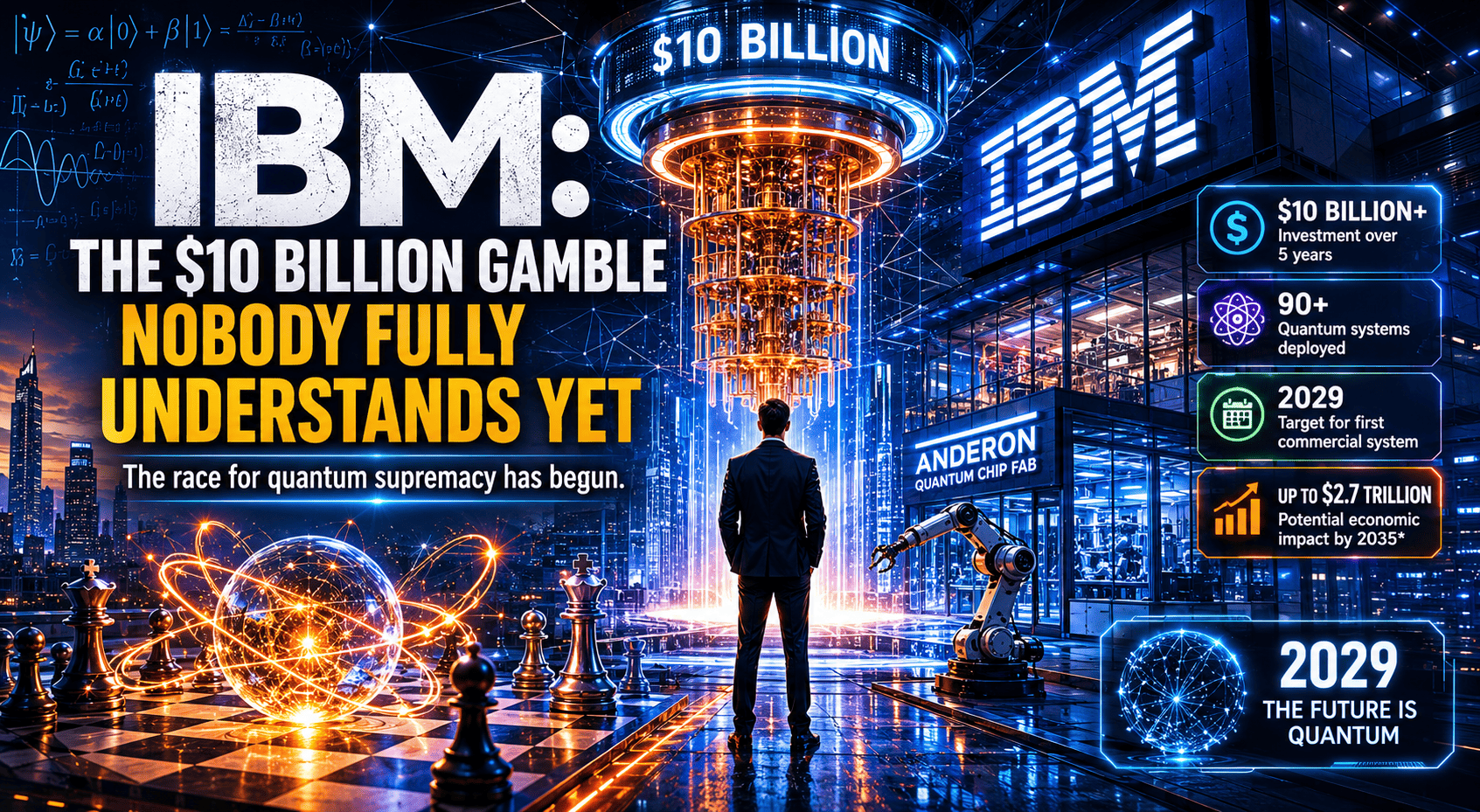
| Metric | Industry Benchmark & Targets |
| IBM Financial Investment | $10B+ over the next five years. |
| Hardware Deployment | 90+ operational systems (surpassing all rivals combined). |
| The Engineering Target Year | 2029 (Slated for the first commercial-scale system). |
| Projected Market Value | $2.7 Trillion (McKinsey estimate by 2035). |
What a qubit actually does — and why it’s so hard
The standard explanation of quantum computing runs something like this: classical computers store information as bits, each holding either a 0 or a 1. Quantum computers use qubits, which can hold both states simultaneously — a property called superposition — allowing them to process vast numbers of possibilities in parallel. The analogy usually invoked is a maze: a classical computer tries each path one at a time; a quantum computer explores all paths at once.
The analogy is useful and slightly misleading. What it omits is the fragility. Qubits are extraordinarily sensitive to environmental noise — temperature fluctuations, vibrations, stray electromagnetic fields. Maintaining coherence requires temperatures colder than outer space, achieved through dilution refrigerators the size of large chandeliers. The error rates that result from this fragility are, at present, high enough to make quantum systems unreliable for any task where you need a correct answer more than occasionally.
IBM’s 2029 target is therefore not about raw computing power. It is specifically about error correction — building systems that can detect and fix mistakes in real time, fast enough to produce trustworthy outputs. That is the engineering threshold the entire industry is racing toward.
“Building the machine is only half the problem. You also have to build an entirely new generation of people who know how to use it.”
The skills gap nobody is talking about loudly enough
Here is a problem that rarely makes the press releases: quantum computing does not run on existing software. At all. The algorithms that make quantum machines useful are fundamentally different from anything a classical programmer would recognize. Writing quantum software requires an understanding of linear algebra, quantum mechanics, and a design logic that has no analog in conventional coding.
IBM has deployed more than 90 quantum systems — more than all its competitors combined. That numerical lead is real, and in a field where hands-on access to hardware accelerates research, it matters. But a competitor with fewer machines and a better developer interface could gain ground quickly. The bottleneck is not just hardware. It is the size of the talent pool capable of using the hardware productively. IBM’s investment in partnerships and potential acquisitions is, in part, an acknowledgment that this pool cannot be built purely from within.
Anderon and the sovereignty question
In a move that mirrors the broader industrial logic of the semiconductor era, IBM and the U.S. Department of Commerce have signed an agreement to build a dedicated quantum chip manufacturing facility called Anderon in the United States. The government contributes $1 billion under the CHIPS Act; IBM matches it. The facility is designed to produce a type of chip that no conventional foundry — not TSMC, not Samsung — currently manufactures.
That last point is important. Quantum chips require exotic materials, precision engineering at scales that stress the limits of current fabrication, and cooling infrastructure that is part of the chip’s function rather than an afterthought. IBM is betting on vertical integration: designing, building, and operating its own specialized supply chain. The advantage, if it works, is control. The risk is that the technical bet on this particular chip architecture proves wrong, leaving the facility building components for a design the industry has moved past.
And this is worth raising: several countries are running parallel bets. France has committed $1.7 billion. Germany, China, the United Kingdom, and Canada all have active national programs. The competition is not only about who builds the fastest quantum computer. It is about who controls the supply of liquid helium, the rare materials used in qubit fabrication, and the facilities capable of maintaining these machines at operating temperatures. Cooling infrastructure, of all things, may emerge as a geopolitical variable.
The encryption problem: There is an application that rarely appears in IBM’s public messaging. A sufficiently powerful, error-corrected quantum computer could break RSA encryption — the cryptographic foundation of most modern secure communications. Governments know this. It is a significant reason why investment in “post-quantum encryption” is accelerating in parallel with quantum hardware development. The race to build is inseparable from the race to defend.
The $2.7 trillion number and why it’s conditional

McKinsey estimates the potential economic value of quantum computing at approximately $2.7 trillion by 2035. The number circulates widely. It deserves some scrutiny.
Economic value estimates for transformative technologies are almost always correct directionally and wrong quantitatively. What they typically assume is that the technology works as intended and that existing industries adopt it smoothly. Neither assumption is safe. The genuine unlocking of quantum computing’s economic potential — in drug discovery, materials science, logistics optimization, financial modeling — is contingent not just on error correction being solved, but on something harder to engineer: usability. The pharmaceutical researcher who needs to simulate protein folding does not want to hire a quantum physicist. She wants software that handles the quantum layer invisibly. That interface layer, the translation between quantum mechanics and practical industry workflows, does not yet exist at any meaningful scale.
| Corporate Giant | Underlying Architectural Strategy | Core Risk / Advantage |
| IBM | Superconducting Qubits & Hardware Error-Correction. | High deployment lead, but relies heavily on complex software correction. |
| Microsoft | Topological Qubits. | Hardest to build (mixed results), but mathematically immune to environmental errors by design. |
| Superconducting Architecture & Quantum Supremacy Benchmarks. | Aggressive scaling roadmap but faces fierce competition within Western markets. |
The McKinsey figure, in other words, is the ceiling. The floor depends on whether ordinary industries can eventually access quantum capabilities without needing PhD teams as intermediaries.
IBM leads — but leading may not be enough
IBM’s position is genuinely strong. Ninety-plus deployed systems. Decades of experience in industrial computing. Deep enterprise relationships. A credible 2029 roadmap. These are not trivial assets.
But the field’s most interesting threat to IBM’s position may come from an unexpected direction. Microsoft is not competing on the same technical terms. It is pursuing topological qubits — a fundamentally different architecture that, if it works, would offer dramatically lower error rates by design rather than by correction. Microsoft has been attempting this for years with mixed results. If it succeeds, the implications for IBM’s current investment in error-correction hardware would be significant. The race is not just about who gets there first. It is about whose technical approach survives contact with the actual physics.
Google is in the mix as well. The three-way competition within the United States alone — IBM, Google, Microsoft — ensures that no single approach will go unchallenged. That is probably healthy for the technology. It is less comfortable for any one company’s strategic planning.
“The question isn’t when quantum computing arrives. It’s which bet on how it works turns out to be right.”
What $10 billion is really buying
IBM’s investment is not primarily buying a product. It is buying a position. A seat at the table when error correction is solved. Relationships with governments that want a domestic quantum supply chain. Facilities and talent that take years to assemble and cannot be conjured quickly once the technology matures. In that sense, the $10 billion is less a product bet than an insurance policy against irrelevance.
The honest summary is this: nobody knows exactly when commercially viable quantum computing arrives, what the first killer application will be, or which technical architecture will prove dominant. IBM is betting that showing up early, at scale, across research and manufacturing and partnerships, is the right strategy when the answers to those questions are still unknown.
History suggests that in transformative technology races, presence compounds. The companies that build infrastructure before the market is ready tend to be the ones who capture it when it is. IBM has been here before — it missed the PC, adapted, and survived. The question this time is whether the $10 billion is early enough, and whether the technical horse it has backed is the right one.
Neither answer is obvious. Which is, perhaps, exactly the point of the bet.
SOURCE
IBM to invest $10 billion for large-scale quantum computer by 2029
McKinsey Quantum Technology Monitor 2026: A commercial tipping point

Independent technology writer focused on artificial intelligence, emerging technologies, and digital innovation. Covers AI applications in sports, productivity, and online business.