








































April 2026 | First Look
If you’ve been keeping tabs on Hyundai’s electric vehicle strategy, you’ve probably noticed something odd: the Ioniq family has been missing a piece. We got the Ioniq 5 (the gorgeous crossover), the Ioniq 6 (the streamliner sedan), and the Ioniq 9 (the three-row SUV). But what about folks who just want something simple, affordable, and city-friendly?
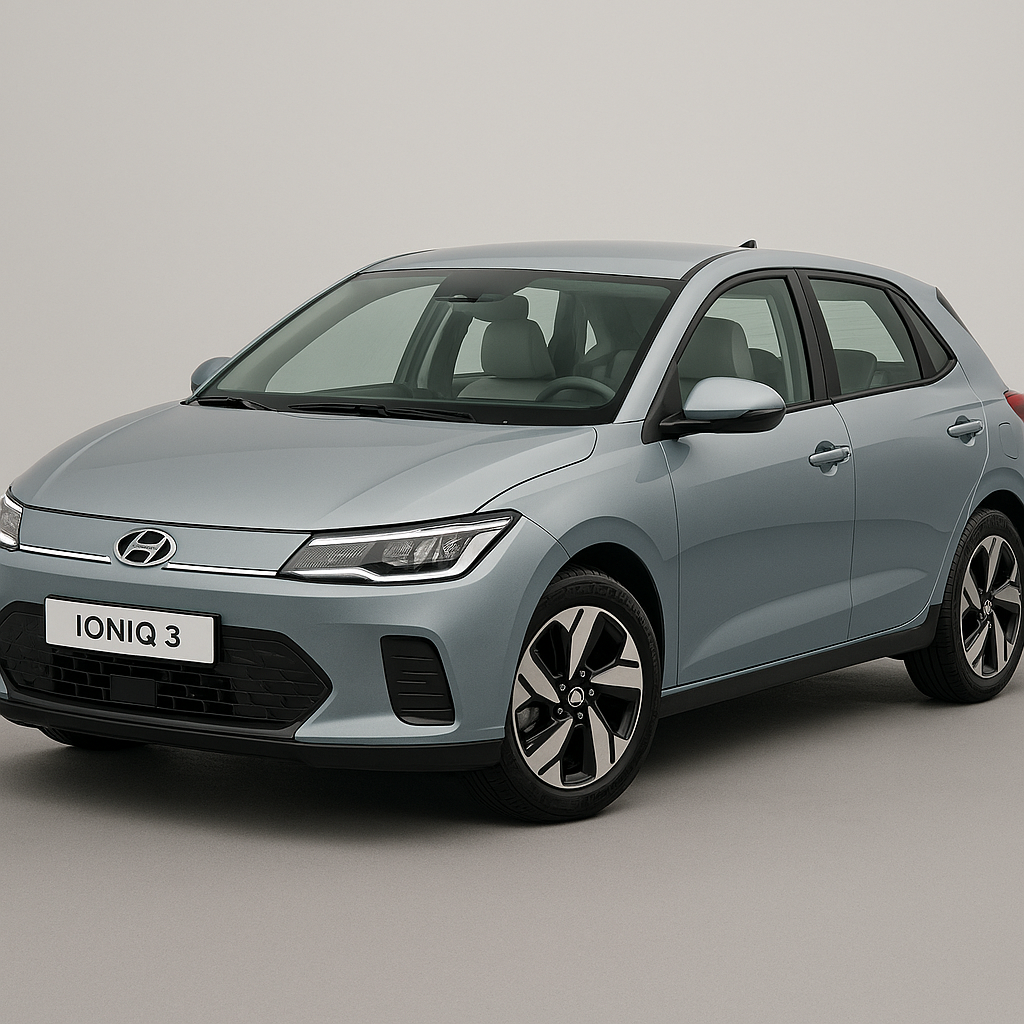
Enter the Hyundai Ioniq 3—the all-new compact electric hatchback that fills that gap perfectly. The problem? It won’t be coming to American shores anytime soon. But honestly, after seeing what Hyundai’s cooked up, you might be as disappointed as I am that we’re getting the short end of the stick.
Let’s break down why this little hatch matters—and why it’s such a shame we might not get it.
Wait, What Even Is the Ioniq 3?
The Ioniq 3 is Hyundai’s first truly compact electric vehicle. Think of it as the small sibling in the Ioniq family—sitting neatly between the tiny Inster EV and the larger Ioniq 5.
Hyundai calls it an “Aero Hatch.” That’s not just marketing speak for “it looks slippery.” The design team genuinely obsessed over aerodynamics while still delivering genuine interior space. The result is a car with a drag coefficient of just 0.263—which is remarkably low for a non-sedan.
First shown as the “Concept THREE” at the 2025 Munich Motor Show, the production version kept almost everything from that concept. That’s rare. Usually, show cars get dramatically watered down for production. Not here.
This is a proper five-seater, not some glorified two-door that only works for kids in the back seat.
Under the Hood: Battery, Range, and Performance
Here’s where things get interesting for budget-conscious EV shoppers. Hyundai made some clever choices to keep prices reasonable:
Battery Options
| Version | Battery Size | WLTP Range | Motor Power |
|---|---|---|---|
| Standard Range | 58.3 kWh | ~344 km (214 miles) | 147 hp |
| Long Range | 81.4 kWh | ~496 km (308 miles) | 201 hp |
Hold on—some sources mention up to 587 km (365 miles) for the Long Range variant under optimal conditions. That puts it in seriously impressive territory for an affordable EV.
Performance
The single electric motor sends power to the front wheels:
- Standard Range: 0-100 km/h in 9.0 seconds
- Long Range: 0-100 km/h in 9.6 seconds
Is it a hot hatch? Not quite. But it’s got enough punch for everyday driving, and that instant EV torque means it feels quicker than the numbers suggest.
Charging
Using a 400-volt architecture (the same as the Kia EV3):
- DC fast charging: 10-80% in about 29 minutes
- AC charging: Up to 22 kW
That’s solid for the price point. Yes, 800-volt systems charge faster, but they also cost more—and Hyundai made a smart choice keeping this affordable.
Inside: “Furnished Space” Meets Practical Tech
This is where the Ioniq 3 surprised me most. Hyundai pulled a clever trick with the interior—they called it “Furnished Space,” which is their way of saying it feels more like a thoughtfully designed living room than a car cabin.
The Good Stuff
- Flat floor: Massive interior space thanks to the dedicated EV platform. Rear passengers get actual legroom.
- Pleos Connect infotainment: Hyundai’s new Android Automotive-based system. This is a big deal—it’s the first European vehicle with this setup.
- Screen options: Choose between a 12.9-inch or 14.6-inch central touchscreen
- Digital instrument cluster: Slimline display keeps things clean
The “Art of Steel” design language carries through inside with strong, precise lines and quality materials. It’s simple, functional, and doesn’t try too hard—which is exactly what a daily driver should be.
Storage
- Boot capacity: 441 litres
- Megabox: Additional under-floor storage for cables and stuff
That’s more cargo space than a Volkswagen ID.3 or BYD Dolphin. For a compact hatch, that’s genuinely impressive.
What’s the Catch? Why No US Release?
Here’s the frustrating part. Hyundai built this car specifically for European tastes—smaller roads, tighter parking, city driving. They’re producing it at their Turkey plant, and the entire development was Europe-focused.
The US market gets different attention. We get trucks, crossovers, and bigger vehicles. It’s just business, but it stings.
The Ioniq 3 would likely start around €30,000 (approximately $32,000-35,000). Compare that to a Chevrolet Bolt EV (around $26,000) or Nissan Leaf (around $28,000), and you’re inaffordable EV territory with genuinely better range.
For context, here’s what you’d be competing with:
| Competitor | Starting Price | Range |
|---|---|---|
| Volkswagen ID.3 | ~€30,000 | 344 km |
| BYD Dolphin | ~€28,000 | 427 km |
| Kia EV3 | ~€32,000 | 410 km |
The Ioniq 3 holds its own—and arguably leads in some categories.
Pros and Cons
Pros
✓ Impressive range for the price (up to 496 km / 308 miles)
✓ Spacious interior for a compact hatch
✓ Affordable starting price around €30,000
✓ New infotainment with Android Automotive OS
✓ 441-litre boot rivals bigger cars
✓ Practical fast charging at ~29 minutes
Cons
✗ No US release planned (yet?)
✗ Not a performance hatch — moderate power
✗ Front-wheel drive only — no AWD option
✗ 400-volt charging — slower than 800V rivals
When Can You Get One?
Europe gets first dibs starting mid-2026. Production kicked off at Hyundai Motor Türkiye’s İzmit plant in Q2 2026, with deliveries beginning shortly after.
Americans? We’re left waiting and hoping. There’s no official word, but don’t be surprised if Hyundai announces US plans later—once Europe’s demand is met, America makes sense. The affordable EV market here is growing fast.
Tips If You’re Shopping for an Affordable EV
Consider the waitlist: Europe’s got first priority. If you’re in the US, expect 6-12 months of waiting after any announcement.
Think about charging at home: With up to nearly 500 km of range, you might only need to charge once a week. That’s the beauty of larger batteries—fewer stops at public chargers.
Don’t sleep on the infotainment: The new Pleos Connect system based on Android Automotive means seamless phone integration, regular updates, and actual app functionality. This is a big deal for daily usability.
Check for similar alternatives: If you need something now, the Kia EV3 shares the same platform and battery tech. It’s essentially a badge-swapped version with different styling.
Frequently Asked Questions
Is the Ioniq 3 a hot hatch like the Type R?
Not exactly. While Hyundai’s N division has hinted at a performance version down the road, the standard Ioniq 3 is designed for efficiency and practicality, not thrills. The 201 hp motor is decent but not quick. That said, it handles well and feels composed—exactly what you’d want in a city car.
Will Hyundai ever bring this to America?
Nothing’s confirmed, but it’s likely. Hyundai’s US EV strategy is evolving, and an affordable compact EV makes huge sense here. Keep an eye on 2027 announcements. The key phrase to watch: “US market evaluation” is practically a promise.
How does the Ioniq 3 compare to the Kia EV3?
Basically cousins—they share the same E-GMP platform and 400-volt architecture. The Ioniq 3 wins on cargo space (441L vs 361L), slightly more modern interior tech, and sharper styling. The EV3 might be easier to find at launch. Either way, you’re getting solid EV value.
Conclusion: The Affordable EV We Deserve
The Hyundai Ioniq 3 proves you don’t need to spend $50,000+ for a capable electric car. It’s practical, efficient, spacious, and actually looks good—rare in the affordable EV space.
Is it heart-wrenchingly frustrating that Americans might not get it? Absolutely. We’re missing out on what could be the affordable EV to beat.
But here’s the silver lining: this is exactly the kind of car that pushes the entire market forward. When Hyundai sees demand in Europe, they’ll see the opportunity in America. And when that day comes, I’ll be first in line.
Until then, we’ll keep watching, waiting, and hoping.
Rating
4.0/5 Stars
A genuinely impressive affordable EV that delivers where it counts—range, space, and everyday practicality. Slight deducted points for no US release confirmation and modest performance. Otherwise, a home run for budget-conscious buyers.
Video: First Look at the Hyundai Ioniq 3
See the Ioniq 3 in action just days before its official reveal:
Video: The Electric Viking on YouTube
Think we should get the Ioniq 3 in America? Let me know in the comments below.
Internal Links: For more EV reviews and buying guides, visit NextAppsZone
External Sources (Official):
- Hyundai Motor Group – Ioniq 3 Reveal
- Hyundai UK – Ioniq 3 Model Page
- Hyundai Europe – Ioniq 3
- Motoring Research – First Look

Independent tech publisher and AI enthusiast exploring the intersection of artificial intelligence, productivity, and online entrepreneurship.