


























You will probably not notice the moment your taste in music changes. That is the
uncomfortable part of the argument Thomas Solignac makes in a recent interview
with Atlantico.
Solignac is an AI entrepreneur and consultant, co-founder of Golem.ai and author
of L’intelligence artificielle en 50 notions clés pour les Nuls. He is not a
musicologist, and his claim is not a measured finding. It is a mechanism: feed
enough people enough machine-generated music, and the statistical habits of the
machines start to feel like the way music is supposed to sound.
The headline on the interview is blunt — AI could destroy our musical ear
without us realizing it. The body of the interview is more careful. What follows
is the mechanism he describes, where it is plausible, and where the evidence
runs out.
Music Is More Algorithmic Than You Think
The reason AI music works at all is that a lot of music is rule-bound.
Harmonic progressions follow sequences that produce predictable effects. Pop is
built on repetition. Those conventions are close enough to an algorithm that a
model trained on them can reproduce the surface of a song convincingly, which is
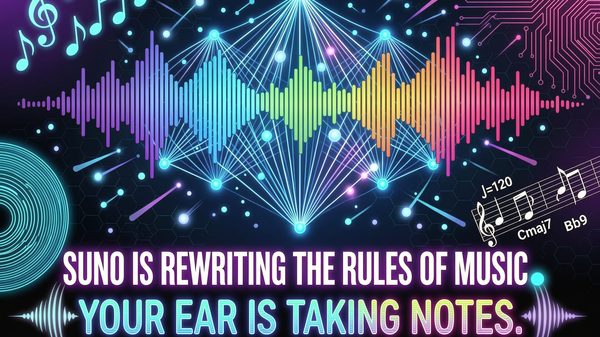
why a tool like Suno can produce something listenable from a short prompt.
Solignac’s point is that this is also why the technology is not, by itself,
artistically interesting. The rules being learned are not where creativity lives.
They are the grammar, not the sentence.
But grammar still shapes the ear. If the model’s grammar has quirks — small
biases in rhythm, structure, or voicing — those quirks get repeated at scale.
Listeners do not hear a bug. They hear a style.
And some of what the model produces is not merely unusual, it is physically
implausible: passages that a human could not play with two hands on a piano. Music
has traditionally been written with performance in mind, which quietly constrained
what composers wrote. Generated music has no such constraint. Over time, the
constraint stops being part of what listeners expect.
One Company’s Defaults Become Everyone’s Normal
There are not many players in automated music production. Suno is the dominant
one; the rest are less visible. That concentration matters more than it would in a
healthy, competitive market.
If one system produces most of the generated music that reaches listeners, its
biases are not one style among many. They become the reference point. Solignac’s
framing is that generalizing AI-assisted production also generalizes the
particular musical approaches baked into the leading tool.
This is the same dynamic that already played out in images. AI image generators
made visual content cheap,
and the result was not a flowering of new visual language. It was a flood of
output that converged on a recognizable look — and a harder problem for anyone
trying to stand out with actual craft.
Audio is following the same path, with one important difference: images are
consumed in a feed, music is consumed repeatedly. Repetition is how a style
becomes a norm.
Slop Is a Prompt Problem, Not a Model Problem
The interview draws a line that most AI-music coverage blurs.
Give a model a banal prompt and you get banal music: the same chords, the same
structures, the same arrangement choices. That is the “AI slop” phenomenon —
content generated at volume with minimal direction, which is exactly the
economics of AI content generation
applied to sound.
Give the same model precise, unexpected, or genuinely strange constraints, and it
can produce something you did not anticipate. Solignac calls this real innovation,
while being careful not to call it deep artistic creativity.
The distinction matters for where the blame goes. If AI music sounds generic, that
is partly a model limitation and largely a prompting and incentive problem. Volume
is cheap; direction is not. Platforms optimizing for catalog size will get exactly
the output their incentives ask for.
What We Actually Know About Young Ears
This is where the argument needs the most caution.
Musical sensitivity develops early in children. That much is well established. How
much AI-generated music specifically alters that development is not known, and
Solignac says so directly: it is still difficult to determine the extent of the
effect.
Two facts keep the risk in proportion. First, AI music production is already
massive, but its share of actual listening is still relatively low. Second, much of
it is functional — jingles, background beds, video accompaniment — rather than
music anyone chooses to sit with.
Both of those could change. Fully AI-generated series, with synthetic scripts,
images, and voices, are already finding audiences. Music will not be exempt from
the same supply curve. But “could” is doing real work in that sentence, and anyone
who tells you the size of the effect today is guessing.
Art Is the Part That Resists — For Now
The strongest counterweight in the interview is not technical. It is social.
People do not only want a pleasant arrangement. They want intention: a story, an
effort, a person behind the work. A track with no cost, no desire, and no history
behind it can be technically fine and still land badly. That is why the same
displacement anxiety showed up around freelance
designers
and did not produce a clean replacement.
Solignac refuses the comfortable version of this argument, though. He explicitly
warns against reassuring ourselves that AI will never replace the artist. If
demand exists for fully generated music, supply will appear — especially when
production is this cheap. Some styles will probably end up AI-dominated, and that
is not a prediction about taste; it is a prediction about unit economics.
The realistic outcome is not replacement or purity. It is coexistence with an
asymmetry: AI music can have legitimacy as content, but not the same legitimacy
as a human creation. The interesting question is whether listeners can tell which
one they are hearing.
Labels Are the New Battleground
That question is already being answered in policy, unevenly.
Deezer has identified fully artificial tracks since 2025. Spotify has started
flagging AI use in music creation. Instagram labels some AI-generated content.
The approaches differ, and none of them is a complete solution — a label tells you
that a tool was used, not how much of the work is human.
The platforms have a commercial reason to care. If catalogs fill with content that
looks human but is not, the platform’s own catalog starts to look mediocre, and
users blame the platform. Confusion is not a neutral default; it is a cost that
gets paid later.
Solignac’s position is not that AI music should be banned. It is that it must be
identifiable. Accept it, or restrict it, but do not blur it.
What You Can Actually Do
There is no proven regimen for protecting your ear, and anyone selling one is
guessing. What follows from the mechanism above is more modest.
- Vary the source, not just the playlist. Recommendation systems optimize for
what you already respond to. If generated music is in the pool, the system will
learn its patterns along with everything else. - Listen actively sometimes. Following a bassline or a structure is a skill,
and skills make deviations audible. Passive listening is where bias hides. - Pay attention to labels where they exist, and treat unlabeled as unknown
rather than human. - Follow scenes, not feeds. Human music communities have gatekeepers, venues,
and constraints that a catalog does not. - Judge the work, but ask what it cost. Not as a purity test — as a way of
noticing when effort has been optimized out.
The Ear Is a Slow Interface
The reason this argument is worth taking seriously is not that AI music is bad. It
is that the mechanism is quiet.
A bad song is obvious. A gradual shift in what sounds normal is not. It happens
through repetition, in the background, across years, and it is invisible from the
inside because the instrument doing the measuring is the thing being changed.
That does not prove Solignac’s strongest version of the claim. It does mean the
burden should not fall on listeners to notice. If generated music becomes a large
share of what people hear, the labeling question stops being a platform policy
detail and becomes the only thing standing between a culture and its own
background music.
AI has already moved past text into images, audio, and
video.
The question is no longer whether it will shape taste. It is whether anyone will be able to tell
where the shaping happened.
Source: Atlantico, 30 October 2026, interview with Thomas Solignac

Independent technology writer focused on artificial intelligence, emerging technologies, and digital innovation. Covers AI applications in sports, productivity, and online business.