
































I lost $200 on my first crypto trade. Not because I picked the wrong coin—I clicked the wrong button. I meant to set a limit order at a lower price, clicked “buy” instead, and bought at market price during a spike. Six minutes cost me two weeks of lunch money.
That mistake taught me more than any tutorial could. This guide is everything I wish someone had told me before my first trade—the practical mechanics, the common traps, and the habits that actually matter.
What Crypto Trading Actually Means
Before touching anything, let’s get the terminology straight:
Trading in crypto means buying and selling digital assets to profit from price movements. This is different from “HODLing,” where you buy and hold for years hoping price goes up. Trading is active; HODLing is passive.
Exchanges are platforms where you buy and sell (Coinbase, Kraken, Binance). Think of them like stock exchanges but for digital assets.
Wallets are where your crypto lives. For beginners, keeping it on the exchange works fine. We’ll cover self-custody later.
Order types are how you enter and exit trades. This is where most beginners mess up—and where I’ll show you exactly what to do.
Step-by-Step: Your First Crypto Trade
Here’s the complete path from zero to your first trade, tested in 2026:
Step 1: Choose Your Exchange
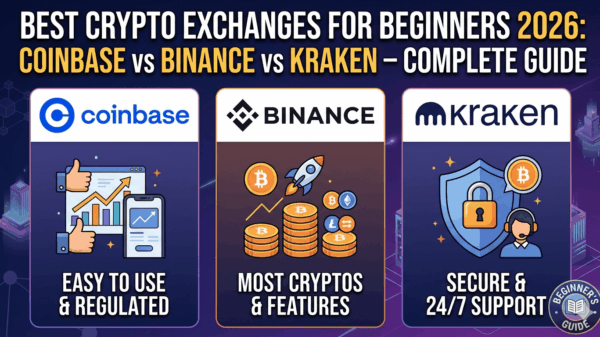
For most beginners, these three cover the bases:
| Exchange | Best For | Fees | US-Friendly |
|---|---|---|---|
| Coinbase | Absolute beginners | Higher (1.5-4%) | Yes |
| Kraken | Learning the ropes | Lower (0.9-1.5%) | Yes |
| Binance | Lowest fees | Lowest (0.1-0.5%) | Partial |
My recommendation: Start with Coinbase for simplicity, switch to Kraken when you’re comfortable. The interface matters when you’re stressed.
Step 2: Create and Secure Your Account
- Sign up with email
- Set a strong password (unique, not reuse)
- Enable 2FA immediately — use an authenticator app, not SMS
- Complete verification (KYC) — have your ID ready
Security first. Before you add one dollar, you’ve prevented 90% of the ways beginners get hacked.
Step 3: Fund Your Account
- Bank transfer (ACH): Free, takes 2-4 days
- Debit card: 3-4% fee, instant. Only for your first small buy
Start with $50-100. Your first trade’s goal is learning the mechanics, not maximizing returns.
Step 4: Make Your First Trade
Here’s exactly what to do on your exchange:
- Navigate to Spot or Trade section
- Search for BTC/USDT (Bitcoin against stablecoin) or ETH/USDT
- Choose your order type (covered next)
- Enter amount in dollars or coins
- Click Buy
Do not buy on impulse. Have the coin and price picked before you open the app.
Understanding Order Types (The Critical Part)
This is where beginners lose the most money. Master these three:
Market Orders
What it is: Buys immediately at the current price.
When to use: When you want in NOW and don’t care about paying a few dollars extra. Perfect for beginners learning the ropes.
Example: Current Bitcoin price is $48,200. You click “Buy Market” and it’s filled at $48,215. You paid $15 extra for instant execution.
My tip: Use market orders for small positions ($50-100). The slippage won’t hurt.
Limit Orders
What it is: Sets your target price. Order only fills when price reaches your level.
When to use: When you want a specific entry point. This is the professional way to trade.
Example: Bitcoin is at $48,200 but you’ve marked $47,500 as your理想的 entry. You place a limit buy at $47,500. When (and if) price drops to that level, your order executes automatically.
My tip: Always use limit orders. They force you to think about price before clicking.
Stop-Loss Orders
What it is: Automatically sells when price drops to your predetermined level, limiting losses.
When to use: On every single trade, without exception.
Example: You buy Bitcoin at $48,000. You set a stop-loss at $46,500 (3% loss). Price drops but your loss stops at 3% instead of becoming 20%.
My tip: Set your stop-loss BEFORE you enter the trade. Never promise yourself you’ll “watch it manually.”
The Three Beginner Mistakes You Must Avoid
I made all three. You won’t:
Mistake #1: No Stop-Loss
Every beginner thinks they’ll just “watch the price.” You won’t. You’ll watch it drop, panic, and hope it recovers until it’s down 40%. A stop-loss is your automatic escape plan.
Mistake #2: Buying Altcoins First
Bitcoin and Ethereum have the deepest liquidity, meaning you can always get in and out easily. Altcoins (newer coins) look tempting because prices move 100% in a day—but you also can’t sell when things go wrong.
My rule: Your first year, hold only Bitcoin and Ethereum. The “next Bitcoin” is almost always a losing bet.
Mistake #3: Trading Too Large
Your first trades should be small enough that watching price move doesn’t raise your blood pressure. Emotional trading is the expensive kind. Start with $25-50 until you’ve felt the volatility firsthand.
Real Example: Carlos’s First Month
Carlos, a reader who became a friend, started in March. His approach:
- Week 1: $50 on Coinbase, learned interface
- Week 2-4: $25/week recurring buys, no matter price
- Month 2: Added limit orders at his target prices
- Month 3: Switched to Kraken for lower fees
By month 4, he understood the platform, was comfortable with the volatility, and had built a position without the stress of timing the market. That’s the goal—not spectacular returns, it’s building competence.
Pros and Cons of Crypto Trading
Why It Makes Sense
- 24/7 markets: No waiting for market hours
- Fractional ownership: Start with $10, not thousands
- High liquidity: Get in/out of major coins instantly
- Lower barriers: No professional requirements
- Volatility = opportunity: Price movement creates profit potential
Why It’s Dangerous
- Extreme volatility: 50% drops happen regularly—plan for them
- No safeguards: No circuit breakers, no reversal button
- Emotional intensity: The chart doesn’t close at 4 PM
- Fee creep: Small trades get eaten by fees
- Unregulated platforms: Not all exchanges are trustworthy
Tips That Actually Help
- Dollar-cost average (DCA): $25/week regardless of price beats trying to time the market every time. Set recurring buys and forget.
- Keep a trading journal: Write down why you entered, at what price, and your exit plan. Review monthly. Most beginners make the same mistake repeatedly because they don’t track it.
- Wait 24 hours before any trade based on “news”: The market overreacts. If it’s still a good idea tomorrow, it was a good idea. If it’s not, you saved money.
- Check fees before every trade: Exchange fees vary. Maker/taker fees add up, especially on small positions.
- Don’t check price daily: For positions under $500, weekly check-ins reduce emotional decision-making.
- Learn chart basics: Understand support and resistance before calling yourself a trader. RSI and moving averages are enough for starters.
Frequently Asked Questions
How much money do I need to start trading?
$10-25 on most exchanges. You don’t need hundreds to start learning. The goal is education first, returns second.
Which crypto should I trade first?
Bitcoin (BTC) or Ethereum (ETH). They have the most predictable behavior, highest liquidity, and lowest spreads. Avoid altcoins until you’ve been through two market cycles.
Is crypto trading legal?
Yes, in the US and most major countries. Regulated exchanges require KYC compliance. Use licensed platforms only—unregulated ones are where people lose money to scams.
How much can you lose trading crypto?
理论上 as much as you invest. Use position sizing so one bad trade doesn’t hurt. Risk 1-2% maximum per trade and you’ll survive the learning curve.
Should I use leverage?
Absolutely not for beginners. Leverage multiplies both gains and losses. 10x leverage means a 10% drop wipes your entire position. Beginners stay at 1x (no leverage) until they have years of experience.
Final Thoughts
Your first trade won’t make you rich. It will teach you how the exchange works, how you react to volatility, and how emotions drive decisions. That’s the real value.
The traders who last aren’t the ones who found the next big coin—they’re the ones who built solid habits early and never risked more than they could afford to lose.
Start small. Use limit orders. Set stop-losses. Track everything. The first trade is just the beginning of a learning process that lasts years.
Crypto Trading Rating
| Category | Rating | Notes |
|---|---|---|
| Setup Ease | ★★★★★ | 15 minutes, fully doable |
| Order Execution | ★★★★☆ | Practice fills make perfect |
| Risk Management | ★★★★★ | Stop-losses are essential |
| Learning Curve | ★★★☆☆ | Takes weeks, not days |
| Profit Potential | ★★★★☆ | High volatility = opportunity |
Overall: ★★★★☆ — Worth exploring with proper education and position sizing.
Meta Title: How to Trade Crypto for Beginners (2026 Guide)
Meta Description: Step-by-step guide to trading cryptocurrency in 2026. Covers exchanges, order types, stop-losses, and beginner mistakes to avoid.
Internal Link: https://nextappszone.com/
Sources Referenced:
- Coinbase – Trading Basics
- Kraken – Crypto Learning
- Binance – Trading Guide
- TradingView – Chart Analysis
- CoinDesk – Market Overview

Independent technology writer focused on artificial intelligence, emerging technologies, and digital innovation. Covers AI applications in sports, productivity, and online business.