






























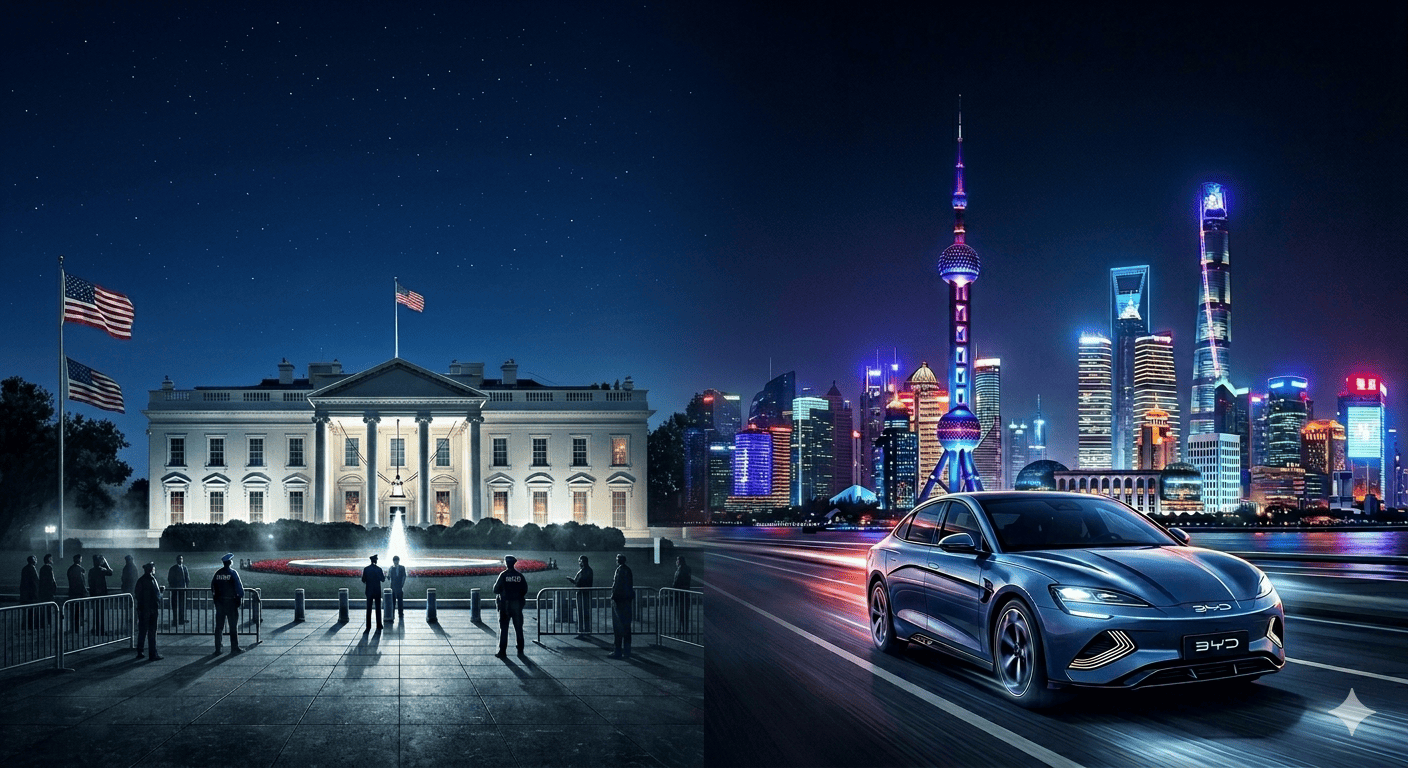
If you follow electric vehicles or global trade, BYD’s name has been impossible to miss lately.
The Chinese automaker is now involved in a lawsuit against the Trump administration. It has been placed on a Pentagon list of companies linked to China’s military. And it is effectively locked out of the US market by 100% tariffs.
On paper, these are separate policy tools.
But together, they are shaping a much bigger question: are these measures slowing BYD down—or accelerating its transformation into something far harder to compete with?
This article looks at why the US is targeting BYD, what makes the company structurally different from traditional automakers, and why Washington’s strategy may be producing unintended consequences.
The Three Layers of US Pressure on BYD
Tariff Walls and the IEEPA Lawsuit: A 100% Barrier
The most direct barrier is the tariff.
In 2025, President Trump imposed a 100% tariff on Chinese imports, including electric vehicles. In practical terms, that doubles the price of a Chinese-made car before it even reaches an American port. A $20,000 vehicle becomes $40,000 overnight.
That makes commercial entry into the US market effectively impossible for BYD.
The company does not sell passenger cars in the United States. It cannot under current conditions.
In January 2026, four of BYD’s US subsidiaries filed a lawsuit challenging these tariffs. Their argument is straightforward: the administration relied on the International Emergency Economic Powers Act (IEEPA), a law that never explicitly mentions tariffs or border taxes.
They are not alone. Large companies including Costco and Goodyear, along with smaller importers, have filed similar cases. A separate lawsuit by a New York wine importer has already succeeded in lower courts.
The Supreme Court heard arguments in late 2025, and a ruling expected in 2026 could reshape how US presidents use trade authority altogether.
If the Court rules against the administration, companies like BYD could be entitled to refunds—and the tariff wall itself could collapse almost overnight.
The Pentagon’s 1260H List: A Label With Real Consequences
In 2026, BYD was added to the Pentagon’s Section 1260H list, alongside major Chinese firms like Alibaba, Baidu, and Tencent.
The designation does not impose sanctions or ban trade. But it does create friction in two important ways.
First, US defense agencies will be prohibited from contracting directly with listed companies, with broader restrictions expanding later. Second, it sends a strong signal to private companies and investors: dealing with these firms now carries regulatory risk.
BYD denies any military links, and Beijing has rejected the designation as politically motivated. Still, the practical effect is clear.
Even without selling passenger cars in the US, BYD’s American operations—such as its electric bus facility in California and energy projects—now operate under a cloud of additional scrutiny.
The Connected Vehicle Ban: A New Kind of Trade Barrier
Tariffs are only one part of the picture.
The US has also moved to restrict Chinese connected vehicle technology on national security grounds.
Modern electric vehicles are essentially computers on wheels. They collect data on driving patterns, location, and even in-car behavior. US regulators fear that Chinese-made systems could transmit sensitive data abroad.
As a result, rules now effectively block Chinese automakers from selling vehicles with connected features in the US.
Since connectivity is now standard in almost every new EV, this creates another near-total barrier to entry.
BYD’s response has been to double down on vertical control of its technology stack—developing its own batteries, motors, chips, and now software systems.
What was intended as isolation may instead be pushing the company toward full technological independence.
What Makes BYD Different From Other Automakers
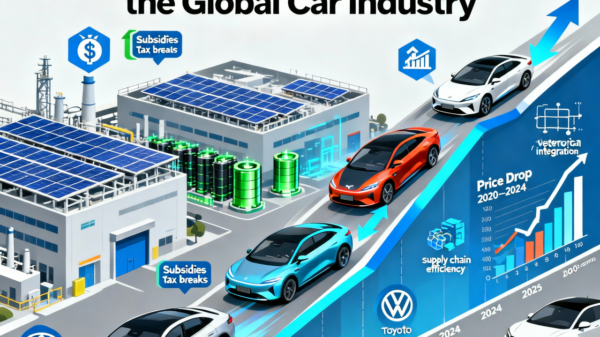
Vertical Integration: Building Almost Everything In-House
To understand BYD’s trajectory, it helps to understand how unusual its structure is.
Most automakers rely heavily on suppliers. Engines, batteries, electronics, and software are sourced from different companies around the world.
BYD is different. It produces most of its core components internally: batteries, electric motors, power electronics, and even semiconductors. Only a few parts—like glass and tires—come from outside suppliers.
This gives it two major advantages.
The first is cost. By removing supplier margins, BYD can produce vehicles significantly cheaper than competitors.
The second is speed. New components can be developed and deployed internally without waiting for external supply chains to adjust.
That combination has allowed BYD to move faster and operate more efficiently than most traditional automakers.
Scale: From Fast Growth to Global Volume Leader
BYD sold 4.6 million vehicles in 2025, surpassing both Ford and Honda, and nearly tripling Tesla’s global deliveries.
This scale is not just about numbers—it’s about momentum.
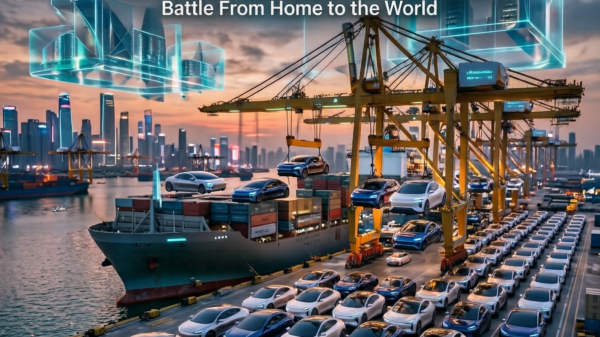
The company is expanding production capacity across multiple continents: Hungary, Turkey, Brazil, Southeast Asia, and potentially Mexico.
By 2026, it is targeting 5.5 million vehicles in annual sales, with a growing share coming from outside China.
What stands out is not just size, but acceleration. Overseas shipments alone grew by 80% year-over-year in mid-2026.
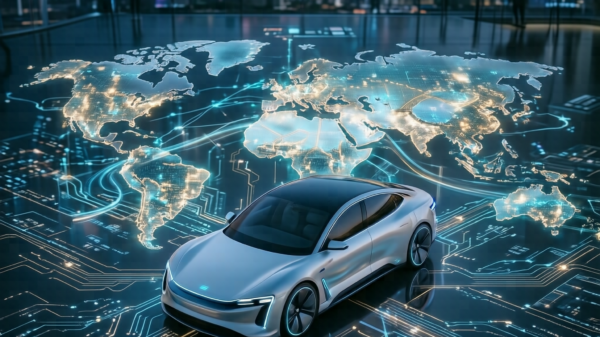
BYD is no longer a domestic Chinese EV leader. It is becoming a global volume manufacturer.
Battery Technology and Charging Speed
BYD’s battery technology, particularly its Blade Battery system, has become one of its key competitive advantages.
It is designed for safety, durability, and cost efficiency, and integrates tightly with the company’s production system.
More recently, BYD has introduced ultra-fast charging systems capable of extremely high power output, significantly reducing charging times compared to current industry standards.
Because BYD controls its entire battery supply chain—from raw materials to final assembly—competitors cannot simply purchase equivalent technology. They must build it from scratch.
That creates a structural time gap that is difficult to close quickly.
BYD’s Quiet Expansion Strategy Outside the US
Canada: A Soft Entry Into North America
While the US market remains closed, Canada has taken a very different approach, reducing tariffs on Chinese EVs and opening controlled import quotas.
BYD has responded quickly, preparing dealership networks in major Canadian cities.
This matters because it creates exposure. North American consumers will begin interacting with BYD vehicles, service systems, and branding—even without US entry.
By the time the US market opens, BYD would no longer be an unfamiliar foreign entrant.
Mexico: A Strategic Manufacturing Shortcut
In Mexico, BYD has explored acquiring an existing automotive plant with substantial production capacity.
This approach is faster than building from scratch and offers access to established infrastructure and labor systems.
It also creates strategic proximity to the United States. Vehicles produced in Mexico can, under certain trade conditions, enter North America with reduced barriers.
Brazil and Other Markets: Building Optional Paths Into the US
BYD’s expansion in Brazil and other regions is not just about local demand.
It is also about optionality.
Depending on legal and trade outcomes, production in countries like Brazil could potentially serve as alternative entry points into the US market at lower tariff levels.
Even if that never happens, it strengthens BYD’s global flexibility.
Europe, Asia, and Africa: A Global Base
Outside North America, BYD is expanding aggressively.
In Europe, despite tariffs, it continues to scale production and sales. In Southeast Asia and Africa, it is rapidly gaining market share, particularly in affordable EV segments.
The company is building something unusual in the auto industry: a truly diversified global footprint not dependent on any single market.
The Core Paradox in US Policy
Pressure That Encourages the Outcome It Tries to Prevent
US policy is designed to restrict Chinese automotive expansion.
But the structure of BYD makes the response almost predictable.
When access to one market is blocked, production shifts elsewhere. When technology is restricted, internal development accelerates. When trade barriers rise, local manufacturing becomes more attractive.
Instead of slowing BYD, the system may be encouraging it to become more self-contained and globally distributed.
The Legal Battle Over Trade Power
The ongoing IEEPA case goes beyond tariffs on BYD.
If the Supreme Court limits presidential authority in this area, it could reshape how US trade policy is conducted entirely, shifting more control back to Congress.
That would affect not only BYD, but future industrial policy decisions across multiple sectors.
Three Possible Futures
Scenario 1: The Tariffs Collapse
If the Supreme Court rules against the administration, BYD could technically enter the US market relatively quickly.
Even then, it would still face regulatory and competitive hurdles—but the main barrier would be gone.
Scenario 2: Acquisition of a Legacy Automaker
BYD could bypass entry barriers entirely by acquiring an established automaker struggling with the EV transition.
This would instantly provide access to dealerships, factories, and brand recognition in Western markets.
Scenario 3: A Closed US Market in a Global BYD Economy
If US restrictions remain in place, BYD may simply continue growing without it.
The result would not necessarily be failure for BYD—but a widening gap between US automakers and a globally scaled competitor operating everywhere else.
Conclusion: Trade Policy Meets Industrial Reality
The US view of BYD is still largely defensive: a foreign competitor to be contained at the border.
But BYD is no longer operating on that assumption.
It is building factories across continents, controlling its supply chain end-to-end, and scaling production globally at a pace few competitors can match.
The outcome of this confrontation may not depend on tariffs or legal rulings alone.
It may depend on a simpler question: whether national trade barriers can still meaningfully slow companies that no longer depend on any single market.
For BYD, the US is increasingly just one piece of a much larger system.
Not the gatekeeper.

Independent technology writer focused on artificial intelligence, emerging technologies, and digital innovation. Covers AI applications in sports, productivity, and online business.