





















I have spent over a decade cutting video. I have logged thousands of hours inside Adobe Premiere Pro, DaVinci Resolve, Final Cut, and CapCut. Along the way, I have tested a dozen AI video tools that promised a revolutionary cinematic paradigm but ultimately delivered little more than an automated slideshow.
So when I first heard about VIDKO AI—a cloud-based platform claiming to orchestrate everything from scriptwriting and voice cloning to final 4K rendering under a single dashboard—my immediate reaction was skepticism. I expected another bloated all-in-one suite that does everything poorly.
I was wrong.
After putting VIDKO AI through two weeks of rigorous, real-world stress tests—building YouTube hooks, high-volume social ads, product demonstrations, and short explainer sequences—I can confidently say this: VIDKO AI isn’t perfect, but for specific content pipelines, it is genuinely impressive.
🚀 What Is VIDKO AI?
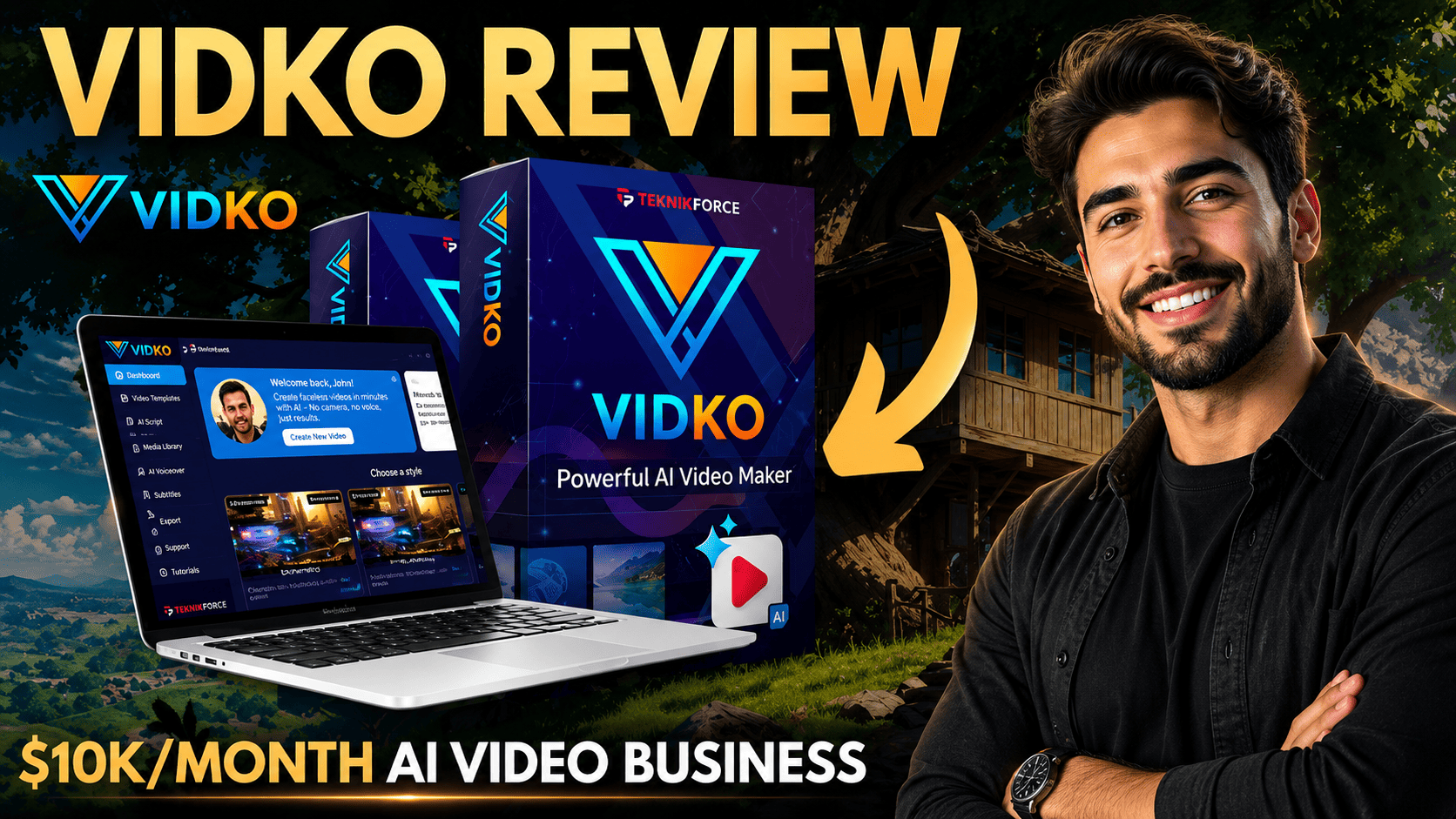
VIDKO AI is an all-in-one, cloud-based video production platform that unifies text-to-video synthesis, digital AI avatars, voice cloning, algorithmic scriptwriting, and automated multi-language captioning within a single operational interface.
Unlike single-utility competitors—such as Runway for raw clip generation, ElevenLabs for synthetic audio, or Descript for transcript-based editing—VIDKO attempts to capture the entire production vertical. You provide the conceptual prompt, and the system synthesizes a structurally coherent, fully edited video asset.
🎯 Why Pick VIDKO Over Single-Utility Tools?
While Synthesia leads in corporate presenter execution, Pictory excels at long-form asset repurposing, and specialized generative models push the boundaries of cinematic physics, jumping between five different platforms destroys a creator’s momentum. VIDKO’s core value proposition lies in its holistic, zero-friction integration—prioritizing development velocity over absolute best-in-class micro-features.
👥 Who Is This Platform Designed For?
VIDKO AI is engineered to scale volume. It serves specific target demographics exceptionally well:
- High-Volume Content Creators: Digital publishers who need a consistent daily output of short-form vertical assets.
- Agile Small Business Owners: Founders running direct-response social campaigns without the budget for full-time video editors.
- Performance Marketers: Teams deploying rapid variants of explainer sequences and product feature drops.
- E-Learning & Course Architects: Educators building lecture-driven presentation modules utilizing dynamic virtual presenters.
🛠️ Step-by-Step Architecture: Constructing a Video with VIDKO
[Script Generation] ➔ [Format Definition] ➔ [Visual Style Choice] ➔ [Voiceover Engine] ➔ [Refine & Render]
📝 Step 1: Script Generation
The process initiates by entering a content brief or pasting an outline. The integrated LLM outputs a structured script equipped with audience hooks, transitional markers, and optimized calls-to-action (CTAs).
- My Experience: I prompted the engine to build a script for “How to start a podcast in 2026.” The output was structurally sound, though it required brief manual modifications to inject custom tonal personality.
📱 Step 2: Format Definition
The deployment dashboard splits into four structural creation models:
- Text-to-Video: Generates visual asset sequences aligned with text markers.
- AI Avatar: Deploys a photorealistic synthetic presenter reading the script.
- Talking Photo: Animates static portrait photography with matching jaw movement.
- Screen Recording: Captures active desktop displays enhanced by AI visual smoothing.
🎨 Step 3: Visual Style & Template Choice
Users select a stylistic preset: Corporate, Cinematic, Vector Animation, Interactive Whiteboard, or Social Media. The selection dictates the background typography, transition timing, color grading palettes, and default motion graphics layers.
🎙️ Step 4: Voiceover & Audio Cloning
The system provides access to 120+ synthetic voices across 40+ global languages. Alternatively, users can upload a 30-second audio snippet to generate a custom voice clone.
- Pro Tip: While the 2026 synthetic models are highly advanced, they still carry a slight digital signature. For high-tier enterprise clients, upload your own clean vocal tracks and let VIDKO handle visual synchronization.
🎬 Step 5: Iterative Refinement & Rendering
The platform renders a complete working draft in roughly 2 to 5 minutes. From there, creators can use the timeline editor to manually hot-swap dynamic background plates, shift text placements, customize auto-captions, or balance backing audio tracks.
📦 Step 6: Multi-Platform Export
Final renders export at 1080p HD or uncompressed 4K resolution (premium tier), featuring direct publishing APIs for instant distribution to YouTube, TikTok, Instagram Reels, and Facebook.
📊 Feature Comparison: VIDKO AI vs. The Industry Elite
| Operational Metric | VIDKO AI | Synthesia | Pictory | Runway |
| Core Workflow Value | Full Production Vertical | Virtual Presenter Scaling | Long-to-Short Re-editing | Advanced Video Synthesis |
| Script‑to‑Video Pipeline | Fully Integrated | Manual Setup Required | Highly Automated | Prompt-Based Manual Steps |
| Avatar Presentation | Good (85% Lip-Sync Accuracy) | Elite Corporate Tier | N/A | Experimental |
| Voice Cloning Features | Native Integration | Enterprise Restricted | N/A | Third-Party Dependent |
| Maximum Output Quality | 4K UHD Renders | 1080p Standard | 1080p Standard | 4K Pro Res (Leader) |
| Asset Generation Speed | 2–5 Minutes (Fast) | 5–10 Minutes | 3–7 Minutes | Segment-by-Segment |
📋 The Structural Breakdown: Pros and Cons
The Advantages (Pros):
- Context‑Switching Elimination: No more downloading audio from one platform to stitch over video clips in another.
- Rapid Deployment: Turns a text draft into a navigable video file in under 5 minutes.
- Extensive Localization: Deep multi-language database (120+ voices across 40+ languages).
- Automated Captioning: Native auto-captions deliver excellent structural text tracking for silent mobile scrolling.
The Drawbacks (Cons):
- Visual Depth Boundaries: Automated text-to-video scene generation can occasionally lean on generic stock framing.
- Rigid Multi-Camera Control: Lacks the fine-grained, frame-by-frame asset masking expected by high-end Hollywood or NLE editors.
- Credit Economy Costs: Heavy high-resolution processing scales rapidly against standard monthly computing budgets.
⚖️ Tonal Assessment & Rating Scorecard
VIDKO AI isn’t going to win an Academy Award for cinematography. But it doesn’t need to. Its objective is to weaponize speed, allowing a single creator or asset manager to execute 20 functional, high-engagement videos in the time it traditionally takes to scrub a single audio timeline in a heavy desktop application.
7-Criteria Performance Matrix
- Ease of Interface Navigation: 4.9 / 5
- Pipeline Integration Velocity: 4.8 / 5
- AI Voice Synthesis Warmth: 4.2 / 5
- Avatar Lip-Sync Calibration: 4.0 / 5
- Auto-Captioning Accuracy: 4.7 / 5
- Granular Asset Customization: 3.0 / 5
- Financial Cost to Value Ratio: 4.3 / 5
Overall Weighted Rating: 4.3 / 5
🛠️ The Master Optimization Strategy: To maximize your return on investment, batch your production lifecycle. Devote a single workspace session to generating 10 variations of your core scripts. Run the generation engines in parallel within VIDKO, then execute a unified branding pass across the timeline templates.
📥 Frequently Asked Questions
What are the official limitations of the free tier?
The introductory free tier grants 5 minutes of basic processing capacity capped at 1080p resolution with standard watermark placements. Professional tiers kick off at approximately $19 per month, scaling to $99 per month for enterprise setups needing uncompressed 4K outputs and unlimited commercial distribution licenses.
Can VIDKO completely replace traditional human editors?
For streamlined social collateral, performance marketing ad testing, standard real estate walkthroughs, and informational guides—yes. For complex brand anthems, narrative short films, or assets requiring intricate color grading and manual audio spatialization, it serves as a rapid pre-visualization asset rather than a total replacement.

Independent technology writer focused on artificial intelligence, emerging technologies, and digital innovation. Covers AI applications in sports, productivity, and online business.