

































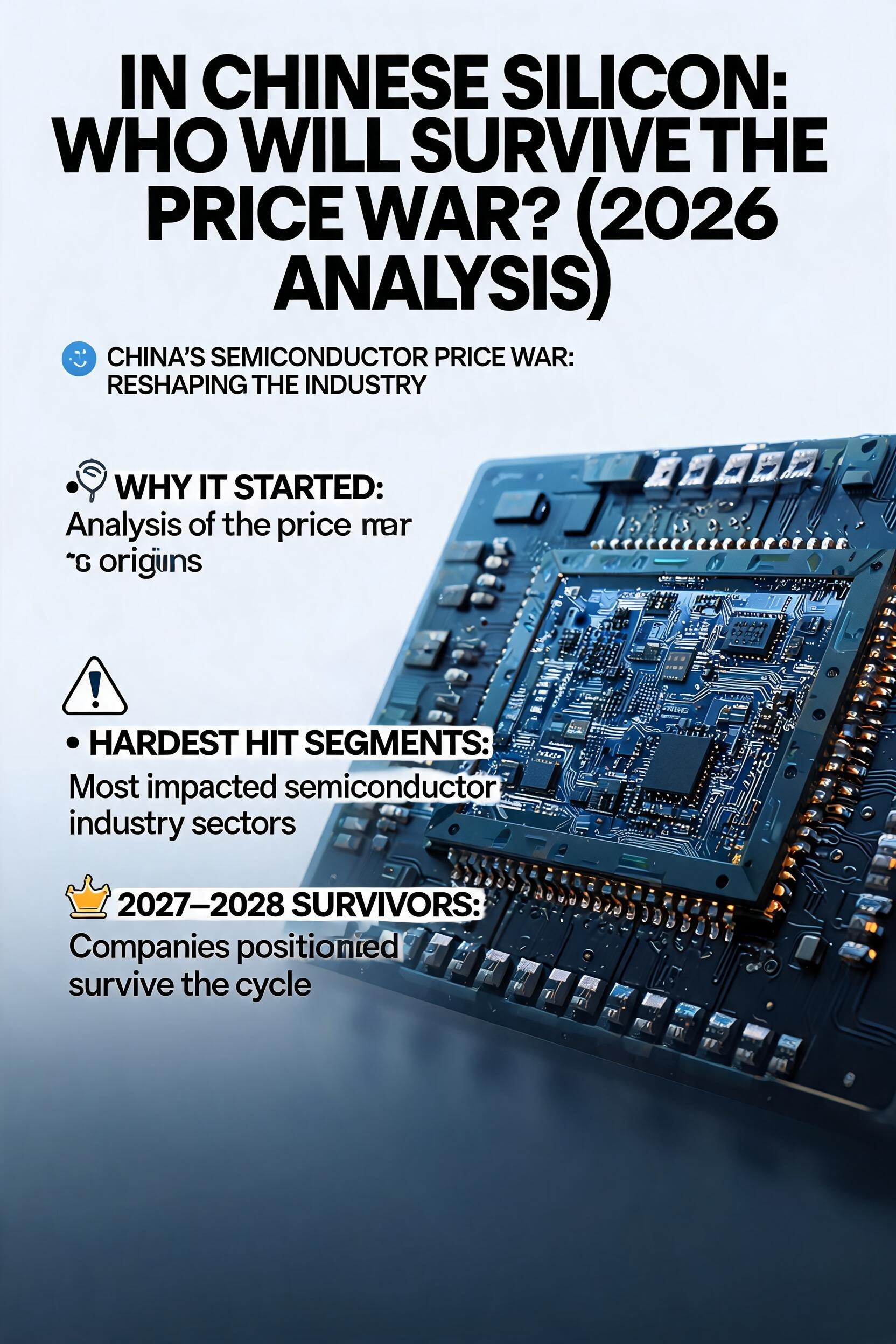
The reader promise. This is an analysis of the price war running through China’s semiconductor industry — why it started, where it is doing the most damage, and which types of companies are positioned to come out the other side. It separates what is known, what is being analyzed, and what is genuinely uncertain.
A note on scope before we begin. “Chinese silicon” here means semiconductor chips — design, manufacturing, memory, and power devices. China’s polysilicon (solar) sector is fighting a parallel and even more destructive price war, but it runs on different economics and is not covered in this article.
1. The situation in one paragraph
Between roughly 2022 and 2025, China’s chip industry ran a textbook price war. Scores of domestic chipmakers — many created in the boom years of 2019–2021, almost all chasing the same “domestic substitution” opportunity — cut prices aggressively to win share, sometimes selling below cost. The result was margin destruction across mature-node logic, power management, microcontrollers, and LED and display drivers, and a collapse in memory prices that Chinese players helped trigger. Then, from mid-2025, the market split in two: AI-driven demand pulled DRAM and NAND prices into a violent upcycle and rescued the memory makers, while much of the rest of the industry kept bleeding. The war did not end. It bifurcated.
Understanding who survives requires understanding both the down-cycle that built this fight and the up-cycle now reshaping it.
2. Why the war started
Price wars do not happen by accident. Four forces aligned in China within two years.
Export controls created a protected market with too many entrants. After the US began restricting advanced chips and equipment in October 2022, Chinese buyers had to find domestic sources for everything from server CPUs to consumer MCUs. Local governments, state funds, and VCs all rushed to fill the gap. Hundreds of fabless design companies were founded in a short window — not because the founders had differentiated technology, but because the addressable market appeared guaranteed.
State capital removed the natural discipline. China’s national semiconductor fund (the “Big Fund”) raised roughly 138.7 billion yuan in its first phase (2014) and about 204 billion yuan in its second (2019). Its third phase, registered in May 2024, is the largest at 344 billion yuan (about $47.5 billion). On top of that, provincial and city funds, state banks, and listed-company investment vehicles poured in additional money. When capital does not demand a market return, companies are willing to price below cost for years.
Low entry barriers at mature nodes made overcapacity inevitable. A tapeout at a mature node (28–65nm) can cost as little as $2–15 million, against $30 million-plus at advanced nodes. That made it cheap for a wave of startups to produce near-identical power chips, MCUs, and analog parts using the same foundries and the same wafer designs. When the economy weakened and consumer demand softened, this homogeneous supply crashed into shrinking demand. SMIC itself warned in early 2025 that its mature-node market could be oversupplied in the second half of that year.
Market share became the only metric that mattered. In a substitution-driven market, design wins are the currency, and price was the fastest way to win them. As one analysis put it, China’s low-cost mature chips and silicon carbide output have helped ignite a global price war, not just a domestic one.
3. Two wars, three phases
It is useful to think of this not as one price war but as three phases of a single competitive cycle.
| Phase | Rough period | Dominant dynamic |
|---|---|---|
| Deflation | 2022 – mid-2025 | Oversupply, price cuts, losses; memory collapses; consolidation begins |
| Reinflation | mid-2025 – 2026 | AI demand creates DRAM/NAND shortages; prices surge; Chinese memory makers scale aggressively |
| Glut risk | 2027 – 2028+ | New capacity from China (and others) may outrun demand; a second downcycle is possible |
The three phases are not academic. In January 2025, CXMT’s below-cost DDR4 output helped push the 8Gb DRAM spot price to about $1.63, its lowest level since 2016. Eight months later, simultaneous end-of-life announcements from the three incumbent memory makers triggered a buying panic that took the same chip to roughly $12.76 — a swing of over 600%. By late 2025, DDR4 traded at a per-gigabyte premium to DDR5 for the first time in the industry’s history.
That is the environment in a single example: a Chinese price war helped create a crash, and the AI boom then created a shortage the Chinese were best positioned to fill.
4. Where the war is hottest (segment by segment)
The war is not uniform. Some segments are brutal, some are insulated, and memory has flipped from casualty to beneficiary.
| Segment | Intensity | What is happening | Who is exposed |
|---|---|---|---|
| Memory (DRAM/NAND) | Cyclical, now hot | CXMT and YMTC expanded capacity rapidly; prices collapsed in 2023–24, then surged from 2025 on AI demand | CXMT, YMTC vs. Samsung, SK Hynix, Micron, Kioxia |
| Mature-node logic | Very high | Oversupply of consumer and IoT chips; SMIC flagged H2 2025 oversupply risk | SMIC, Hua Hong, Nexchip, dozens of fabless firms |
| Analog / PMIC / drivers | Extreme | Near-identical parts, brutal price cuts, thin margins | Hundreds of me-too startups |
| MCUs | High | Commodity MCUs discounted heavily; differentiated automotive MCUs fare better | GigaDevice and peers; ST/NXP pressure in China |
| Power / SiC | Rising | Chinese SiC capacity expansion is driving prices down and pulling consolidation forward | Domestic SiC producers vs. Infineon, ST, onsemi |
| Advanced logic / AI accelerators | Insulated | Few players (Huawei’s HiSilicon, SMIC’s advanced nodes); export controls, not prices, set terms | SMIC, HiSilicon |
| HBM | Insulated | Chinese players are not yet competitive; a technology wall, not a price wall | CXMT (targeting HBM), global incumbents |
Two patterns stand out. First, the segments with the lowest entry barriers (analog, drivers, commodity MCU) are the most destroyed. Second, the segments protected by technology (advanced logic, HBM) are untouched by price — the wall there is equipment and process know-how, not cost.
5. The economics of a chip price war
To predict who survives, you need the mechanics. A chip company survives a price war when one of three things is true:
- It can price below the competitor’s cash cost and still survive — because its own costs are lower (better yields, better process, better scale).
- Its product is not a commodity — so buyers cannot simply switch on price (qualified automotive parts, proprietary IP, custom designs).
- It can outlast the others — because its capital is patient (state backing, locked-in customers, pre-orders) while rivals run out of cash.
Everything else is detail. The classic failure sequence is: revenue collapses → utilization falls → unit cost rises (fixed depreciation is spread over fewer wafers) → margins turn negative → debt or investor money runs out → the company dies or is absorbed.
In a subsidy-heavy market there is a fourth, darker path: a company survives on grants and local procurement without ever becoming competitive. These “subsidy zombies” are the industry’s hidden inventory of failure — they disappear the moment the money moves, as it is now doing. The Big Fund began trimming stakes in listed chipmakers in 2026, and at least one of those companies has already flagged declining revenue and widening losses.
6. Who survives: the survival scorecard
Across all segments, the same handful of factors separate survivors from casualties.
| Survival factor | What it really measures | Why it decides the outcome |
|---|---|---|
| Cost position | Yield, utilization, process efficiency | Determines the price at which you still break even |
| Product differentiation | IP, spec sheets, qualification base | Commodity parts are priced at the margin; differentiated parts are not |
| Capital access | Cash runway, state support, public markets | Determines who can outlast whom |
| Customer lock-in | Design wins, qualification cycles, contracts | Once qualified, switching takes 1–3 years — a moat |
| Demand anchoring | Domestic substitution mandates, sovereign procurement | Guarantees a floor of volume even at low prices |
| Application mix | Automotive, industrial, defense vs. consumer | Industrial and auto demand is stickier and less price-sensitive |
| Consolidation capacity | Ability to buy or absorb rivals | Mergers let strong players take share without new capacity |
| Pricing realism | Whether pricing covers cash cost on average | Subsidy-funded pricing is a feature, not a strategy |
The same scorecard predicts different winners in different segments.
The state-anchored champions — SMIC and Hua Hong in foundry, CXMT and YMTC in memory — survive by design rather than by unit economics. They can run at low or negative margins because the state treats them as strategic assets and domestic buyers treat them as mandatory suppliers. Their risk is not death; it is technological stagnation, because the export controls that protect their demand also cap their technology ladder (HBM, EUV-class manufacturing).
The diversified leaders — established fabless firms with real product franchises, such as GigaDevice (microcontrollers, NOR flash) and Will Semiconductor (image sensors) — survive because they have a mix of commodity and differentiated products, global customer bases, and enough scale to ride out the downcycle. The commodity lines subsidize nothing; the differentiated lines carry them.
The niche specialists — companies that chose a narrow, hard-to-qualify lane (automotive-grade power, industrial MCU, RF, specialty analog) — survive because their customers cannot substitute easily. Qualification takes years, and safety or reliability requirements make buyers reluctant to switch on price alone.
The casualties — the me-too fabless startups founded in the 2019–2021 window, making generic PMICs, LED drivers, and consumer MCUs with no IP differentiation and thin balance sheets. Their product is a commodity, their cost position is no better than the incumbent’s, and their capital is exhausted. They will not survive the cycle; the only question is whether they fail quietly or are absorbed.
7. Who probably does not survive
There is a recognizable casualty profile. The firms most likely to disappear or be absorbed share several traits:
- Undifferentiated product: their catalog is a replica of the market leader’s, sold cheaper.
- Thin capital: funded in the boom, no access to public markets, and investor patience is gone.
- Subsidy dependence: revenue that would not exist without local-government procurement or grants.
- Single-customer concentration: one anchor customer (often a state entity) that holds the pricing power.
- No qualification moat: nothing stops the next startup from shipping the same part next quarter.
The warning signs are visible before the end: falling gross margin below the cost of capital, inventory days climbing, R&D spend declining as a share of revenue (because the company has given up on differentiation), and key engineers leaving. When a company stops spending on the next product, it has already conceded the war.
8. Second-order effects: what the war does to the industry
Even the winners will be changed by this. The war is reshaping the industry in ways that matter beyond individual companies.
Consolidation is coming by default. With dozens of weak players and too much capacity, the endgame is M&A and closures. State funds are beginning to exit early-stage bets, which removes the floor under marginal firms. The survivors will be larger, fewer, and more integrated.
Quality risk is real. When parts are sold below cost, the first things to suffer are reliability testing, customer support, and long-term availability. Procurement teams buying on price alone are buying risk they cannot see. This is not speculation about any specific company — it is a structural consequence of pricing that cannot fund quality.
Talent redistributes toward the winners. Design teams at failing startups do not disappear; they move to whoever is still raising money. The war accelerates the concentration of engineering talent in the champions, which widens the gap between first and second tier over time.
Global spillover. Chinese low-cost output in mature chips and SiC has already been identified as a source of downward price pressure globally. But the memory case shows the direction can flip: in a shortage, Chinese capacity becomes a relief valve for global buyers, and global brands (PC makers and module vendors) have begun qualifying Chinese memory. The same industry that destabilized pricing is also becoming indispensable to it.
A potential 2027–2028 glut. This is the most important forward risk, and it deserves its own section.
9. The 2027–2028 question
The current memory boom feels like the opposite of a price war, but it may be the bridge to the next one. The numbers are striking and the direction is contested.
On the demand side, AI infrastructure is absorbing memory at an unprecedented rate, and multi-year supply agreements between GPU makers and cloud providers point to demand that appears structural rather than speculative. On the supply side, China’s memory makers are adding capacity quickly: CXMT grew from roughly 100,000 wafers per month in early 2024 to about 290,000 by the end of 2025, and estimates suggest China as a whole could add another 120,000–140,000 wafers per month of memory capacity in 2026. YMTC’s NAND share has climbed from around 10% in early 2025 to roughly 13% by late 2025, and CXMT’s DRAM share is estimated in a range of roughly 5–12% depending on the source and the measure.
Two scenarios bracket the likely outcomes. The first: AI demand keeps absorbing supply, the boom extends, and the price war in memory stays dormant — with CXMT and YMTC winning share and profitably funding their next process nodes. The second: the capacity wave lands just as AI spending normalizes, memory oversupply returns, and the 2027–2028 downcycle is harsher than 2023 because it will include far larger Chinese competitors. A senior Samsung adviser has publicly warned that memory prices could retreat toward lower levels by 2028 if supply expands too quickly.
Both scenarios are plausible, and the honest answer is that the industry does not know yet which one dominates. What is more predictable: whichever scenario arrives, the Chinese players with cost position, capital, and customer contracts are the ones that will be standing when it does.
10. For decision makers: what to watch
For investors. Judge chip companies against the survival scorecard, not against revenue growth. Check cash runway against gross-margin trajectory. Ask whether the product could be replaced by a competitor’s next tapeout. Treat subsidy dependence as a liability, not an asset — the subsidy cycle is already turning. In memory specifically, watch utilization and pricing signals; the current boom will eventually test who built capacity on real demand versus borrowed optimism.
For procurement and engineering teams. Chinese parts can be excellent value, and in shortage conditions they may be the only option. But qualification and reliability testing are non-negotiable, and single-sourcing from a price-war participant is a supply-risk decision, not just a cost decision. Design for dual sourcing wherever the qualification cost allows.
For industry players. Decide deliberately which of the three survival paths you are on: cost leadership, differentiation, or outlasting. Companies that straddle all three are rare. The most common strategic error in a price war is trying to be the cheapest and the most differentiated — you end up being neither, and you spend twice as fast as your competitors.
11. FAQ
Is China “winning” the price war? Winning is the wrong frame. The price war is a mechanism for concentrating the industry — it is eliminating the weak and strengthening the strong. Chinese champions are gaining share and capacity, but the war has also destroyed enormous amounts of capital and diverted resources from innovation into imitation.
Why are Chinese chip prices so low? The proximate cause is overcapacity driven by subsidized capital and low entry barriers at mature nodes. The deeper cause is that the domestic-substitution mandate makes market share the strategic objective, and price is the fastest route to it.
Does the memory boom mean the price war is over? No. It means one segment of the industry is temporarily in shortage while the rest remains oversupplied. The memory boom is itself creating the conditions (capacity expansion) for the next downcycle.
Can Chinese memory reach HBM and advanced nodes? Not yet, and this is the key technology boundary. Chinese DRAM and NAND compete well in commodity segments; HBM requires a stack of advanced-process and packaging capabilities that no Chinese player has demonstrated at production quality so far. CXMT has stated ambitions in this direction, but ambition is not capability.
Should Western companies buy Chinese chips? That is a business decision with a cost, a risk, and an increasingly political dimension. Commercially, the value can be excellent, especially in shortages. Operationally, reliability, continuity of supply, and export-control compliance all need to be assessed case by case.
Who actually loses? The losers are the undifferentiated me-too firms, the subsidy zombies, and — in the long run — the industry’s overall innovation rate, because years of pricing below cost have starved many companies of the margins needed to fund real R&D. The winners consolidate the market and, if they are disciplined, reinvest.
12. Summary and action plan
Five takeaways worth keeping.
- The price war is not one event; it is a cycle with a deflation phase (2022–2025), a reinflation phase (2025–2026), and a looming glut risk (2027–2028).
- The war is most destructive in low-barrier commodity segments and barely touches technology-protected ones (advanced logic, HBM).
- Survivors are identified by cost position, differentiation, capital access, and customer lock-in — not by current market share.
- Subsidy-backed “zombie” companies look like survivors until the subsidy cycle turns; it is now turning.
- The next test for everyone is the 2027–2028 capacity wave: it will separate capacity built on real demand from capacity built on optimism.
What to do next, depending on who you are. If you invest, score companies against the survival factors and treat the memory boom as temporary. If you buy chips, qualify carefully and design for dual sourcing. If you work inside the industry, pick a lane — cost, differentiation, or patience — and commit to it, because the market will not reward half-commitments.
The price war in Chinese silicon is not about who has the best products today. It is about who still has the capital, the cost structure, and the discipline to be standing when the next downcycle arrives. The current memory boom is a reprieve, not a resolution.

Independent technology writer focused on artificial intelligence, emerging technologies, and digital innovation. Covers AI applications in sports, productivity, and online business.