















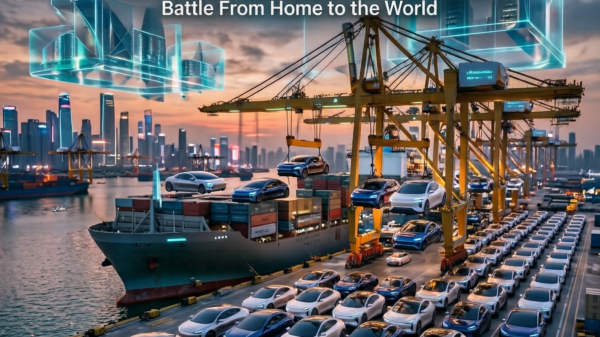








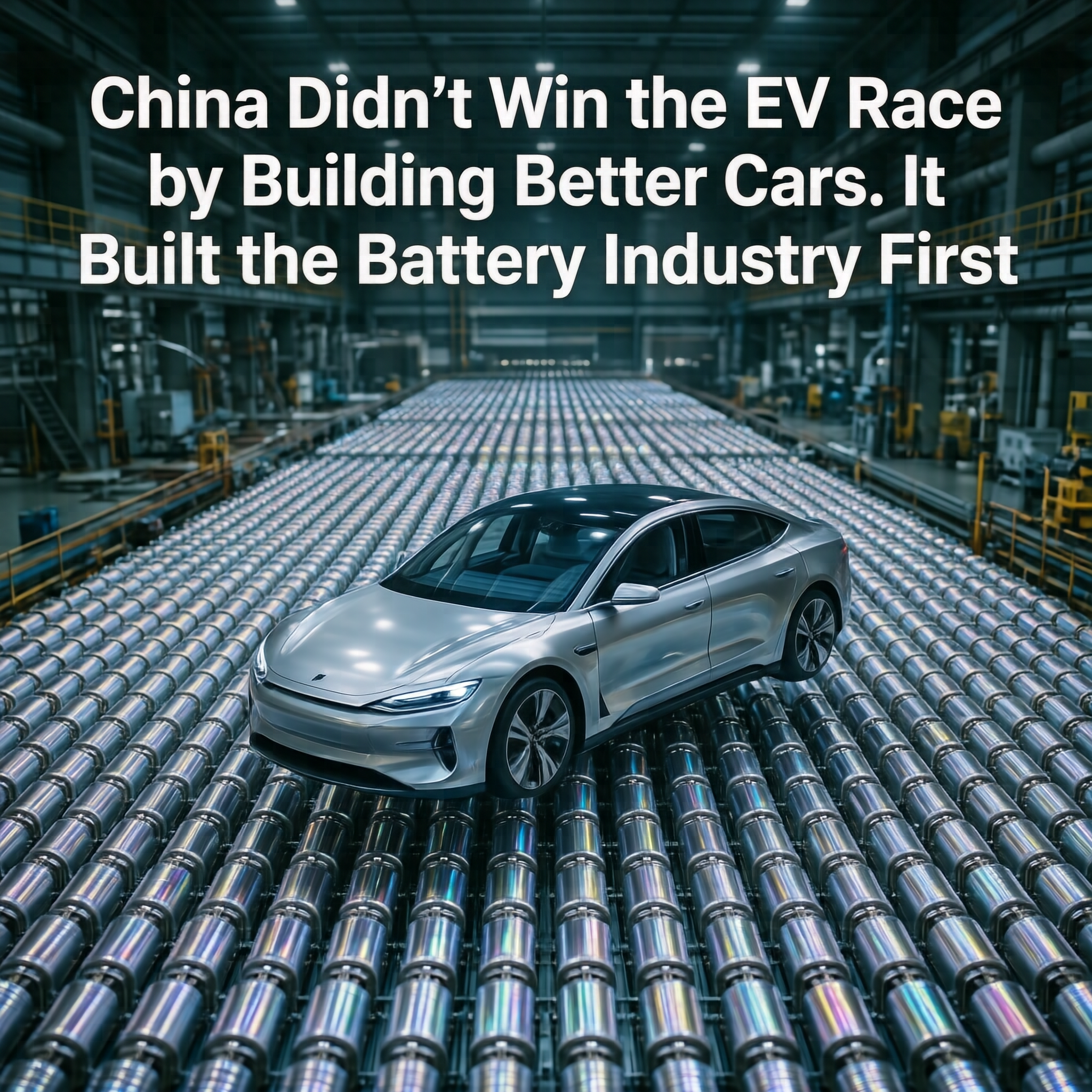
When you read that China dominates electric vehicles, your mind pictures cars. Factory lines, showrooms, BYD sedans on foreign roads. That picture is the top of the structure, and it is the least interesting part of it.
Strip the cars away and a different competition appears, one that happens three stages before a vehicle is ever assembled. In that hidden competition, China does not merely lead. It owns the field. The International Energy Agency’s Global EV Outlook 2026 puts China’s share of global battery cell production in 2025 at more than 80 percent, its share of cathode active materials at roughly 85 percent, and its share of anode active materials at more than 90 percent.
This article, the first deep dive in a series whose overview is laid out in how China came to dominate the global electric vehicle market, answers one question: is China’s dominance in EVs actually the downstream result of a deeper dominance in batteries?
The evidence says yes. Here is the industrial structure behind that answer.
The chain nobody sees
Every EV battery passes through the same sequence before it reaches a car:
Minerals → Refining → Battery Materials → Cells → Packs → Cars
Here is the pattern that defines the entire story: the further you move up this chain, the more concentrated China’s position becomes. At the mining stage, China is a big player but not a monopoly. At the cell stage, it is everything.
| Stage of the chain | China’s position | What it means |
|---|---|---|
| Mining | Large but not dominant | The world’s mines are surprisingly globalized |
| Refining | Dominant chokepoint | Raw ore is worthless until it is processed, and China does most of the processing |
| Cathode and anode materials | ~85% and >90% | The chemistry that makes a battery work is overwhelmingly Chinese |
| Cells | >80% of global production | CATL and BYD alone hold more than half the market |
| Packs and cars | Dominant | This is the layer you see; it is the result, not the cause |
Work through each layer and the mental model corrects itself.
Layer one: the mines are not the real story
The most common mistake in supply-chain discussions is assuming China controls the minerals. It does not, and the fact that it does not is precisely why its refining dominance matters.
Lithium is mined heavily in Australia and Chile. Indonesia is the world’s largest source of nickel. The Democratic Republic of Congo produces roughly two-thirds of the world’s cobalt. None of these countries supply China’s dominance; they supply raw material that must be converted into battery-grade chemicals.
Mining is the most distributed stage of the entire chain, and that distribution is a trap. Anyone can dig up ore. Almost no one outside China can turn that ore into a battery.
Layer two: refining is the real chokepoint
Raw lithium carbonate, nickel sulfate, cobalt sulfate, and graphite concentrate are not battery materials. They become battery materials only after energy-intensive chemical processing, and this processing is where China’s grip is tightest.
The IEA’s data shows the shape of the control:
- Roughly 65 percent of global lithium refining happens in China, with another quarter in Chile.
- Three-quarters of the world’s cobalt refining happens in China, most of it from ore mined in the DRC.
- China accounts for more than 90 percent of battery-grade graphite refining.
- Chinese firms produce about 70 percent of the world’s lithium chemicals.
In 2024 China processed somewhere between 70 and 95 percent of the global supply of the four critical inputs for EV batteries: lithium, cobalt, phosphate, and graphite, depending on the material.
The practical consequence is brutal for competitors. Australia and the US sit on massive lithium reserves, but the concentrate is shipped overwhelmingly to China for conversion into battery-grade hydroxide. The refining step sits between every mine and every cell factory in the world, and China is the toll booth.
Layer three: the materials are the chemistry, and the chemistry is Chinese
A lithium-ion cell has two electrodes. The cathode is built from expensive metal oxides, and the anode is overwhelmingly graphite. Both are chemically engineered products, not commodities, and both are dominated by China.
The IEA’s Global EV Outlook 2026 reports that China supplies roughly 85 percent of cathode active materials and more than 90 percent of anode active materials. The concentration is even starker for the chemistry that now defines the affordable EV market. Lithium iron phosphate, or LFP, batteries supply nearly half the global electric car market, up from under 10 percent in 2020, and more than 98 percent of LFP cathode material and LFP cells are produced in China.
That LFP statistic deserves emphasis. China did not just win the battery race on existing technology. It invented the manufacturing foundation of the battery chemistry that the world is now converging on, because LFP is cheaper, safer, and longer-lived than the nickel-based cells that preceded it. BYD scaled this chemistry in China, and LFP is now the standard for affordable long-range packs everywhere, including in US-market Teslas and several Western brands.
Layer four: the cells, where the market share lives
At the cell stage the dominance becomes corporate rather than structural. SNE Research’s 2025 data puts CATL at 39.2 percent of global EV battery installations and BYD at 16.4 percent. Together, the two Chinese companies hold roughly 56 percent of the world’s EV battery market, and CATL alone is larger than every non-Chinese battery maker combined.
This matters because the cell is where battery cost is won. CATL has kept operating margins of 10 to 15 percent through the industry’s brutal pricing cycles, and reported around 18 percent in 2025. Its scale lets it produce cells at a cost that defines the global floor. Foreign rivals are not competing with a company; they are competing with a cost curve.
Layer five: the price floor that decides everything
Now connect the chain to the cars.
A battery represents roughly a third of an EV’s manufacturing cost. Whoever controls battery cost controls car price, and the numbers show how directly that flows through. BloombergNEF measured average global battery pack prices falling 20 percent in 2024 to a record low of $115 per kilowatt-hour. Inside China, prices fell around 30 percent that year, compared with 10 to 15 percent in the US and Europe.
The gap compounds. Every year Chinese carmakers get cheaper relative to their Western rivals, not because of labor, not because of subsidies, but because the single most expensive component in their product gets less expensive faster for them than for anyone else. The battery price differential is the price of the car, one component at a time.
The leverage nobody talks about enough
Industrial dominance is only a fact. It becomes a weapon when a government decides to use it, and that is what has happened since 2023.
China’s first move was on graphite. In late 2023 it required export permits for certain graphite products, a signal aimed at the one critical mineral where the entire global chain depends on Chinese processing. Then in October 2025 it escalated dramatically. Beijing announced export controls covering synthetic graphite anode materials, blended anodes, cathode material precursors, high-performance batteries above 300 watt-hours per kilogram, and the manufacturing equipment required to make all of them. The IEA read the move plainly: the controls target critical chokepoints in the global battery supply chain where alternatives outside China are extremely limited.
The strategic logic is easy to miss and hard to overstate. A country that controls the factories can be competed with. A country that controls the equipment to build the factories, plus the chemicals those factories consume, plus the standard-setting scale of the largest market, has moved the conflict to a level where industrial policy alone cannot answer. This is the same pattern visible across the wider US-China tech war: control the enabling layer, and the downstream products take care of themselves.
Why catch-up is measured in decades, not years
Western governments are spending heavily to break this dependence, and they should. But the honest timeline is slow, and independent analysts who have modeled it converge on uncomfortable numbers:
| Capability | Realistic timeline for a material non-China share |
|---|---|
| Battery cell production | 2028-2030 to cover a third of US domestic demand |
| Cathode and anode material production | 2032-2038 |
| Battery-grade mineral refining | 2035-2045 |
The reasons are structural, not financial. China has a fifteen-year head start, a trained workforce that did not exist elsewhere until recently, ownership of the specialized manufacturing equipment, an integrated ecosystem where every layer feeds the next, and a domestic market large enough to keep every layer busy. A Western plant can be built. A Western ecosystem cannot be purchased.
There is one more compounding factor that gets almost no coverage: China’s processing of cobalt and graphite is not just geographically dominant, it is also ownership-dominant. Chinese companies own a significant share of Indonesia’s refined nickel capacity, which means even where ore is processed outside China, Chinese firms collect the margin and control the supply decisions.
The honest counter-case
Dominance that deep invites complacency, and the counter-case deserves respect. Battery technology is not finished. Three shifts could, in theory, reset the board.
Solid-state batteries promise higher energy density and better safety, and Japan and South Korea are racing to commercialize them. Silicon anodes could reduce the centrality of graphite. Sodium-ion chemistry could ease dependence on lithium itself.
The uncomfortable fact for China’s rivals is that China leads most of these transitions too. Chinese firms dominate solid-state research filings, and Chinese suppliers are scaling silicon anode production. The IEA’s Global Critical Minerals Outlook warns that the emerging chemistries, LFP, LMFP, and sodium-ion, have supply chains that are even more concentrated in China than the nickel-based chain they replace. A technology transition does not break China’s grip if China is the largest participant in the transition.
The genuine risk to China’s position is political and financial, not technical: the price war at home, overcapacity that forces ever-cheaper exports, and the possibility that trade walls accelerate local manufacturing outside China. Those pressures are real and are examined in the pillar article’s analysis of what could reverse the advantage. But they attack the car layer. The battery layer keeps compounding.
The answer to the central question
China’s dominance in electric vehicles is real, and it is not the root cause of its own success. The cars are the visible product of a much deeper position: control of refining, control of active materials, control of cell manufacturing, control of the equipment that builds the factories, and control of the chemistry the world is adopting.
BYD winning the global EV sales crown in 2025, covered separately in this series’ look at the company, is downstream evidence. CATL being larger than every foreign battery maker combined is the cause. When the most expensive component of the product is made where no one else can match the cost, the cars were never the real competition.
China did not win the EV race by building better cars. It won by making the battery industry so efficient that no one outside it could afford to build cars at the same price. The race everyone watches was decided, years earlier, at a layer almost no one sees.

Independent technology writer focused on artificial intelligence, emerging technologies, and digital innovation. Covers AI applications in sports, productivity, and online business.