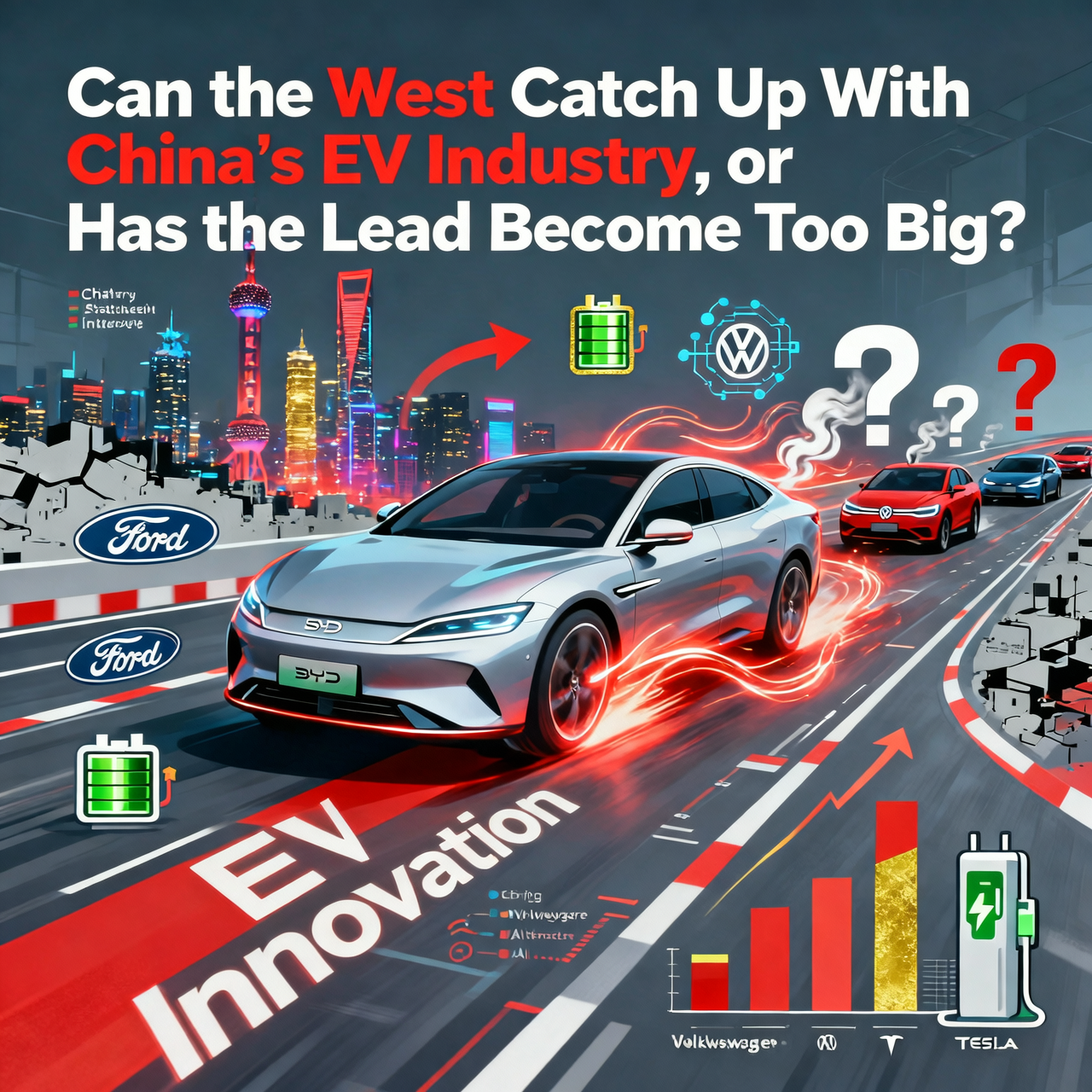





















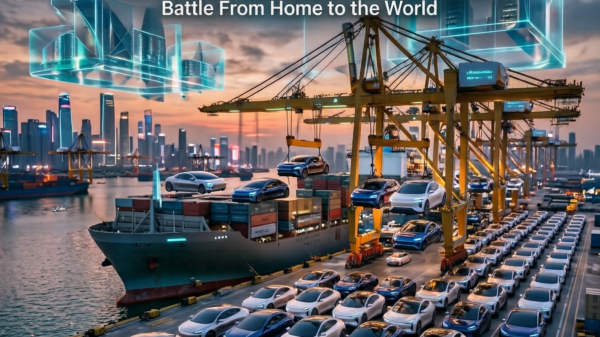















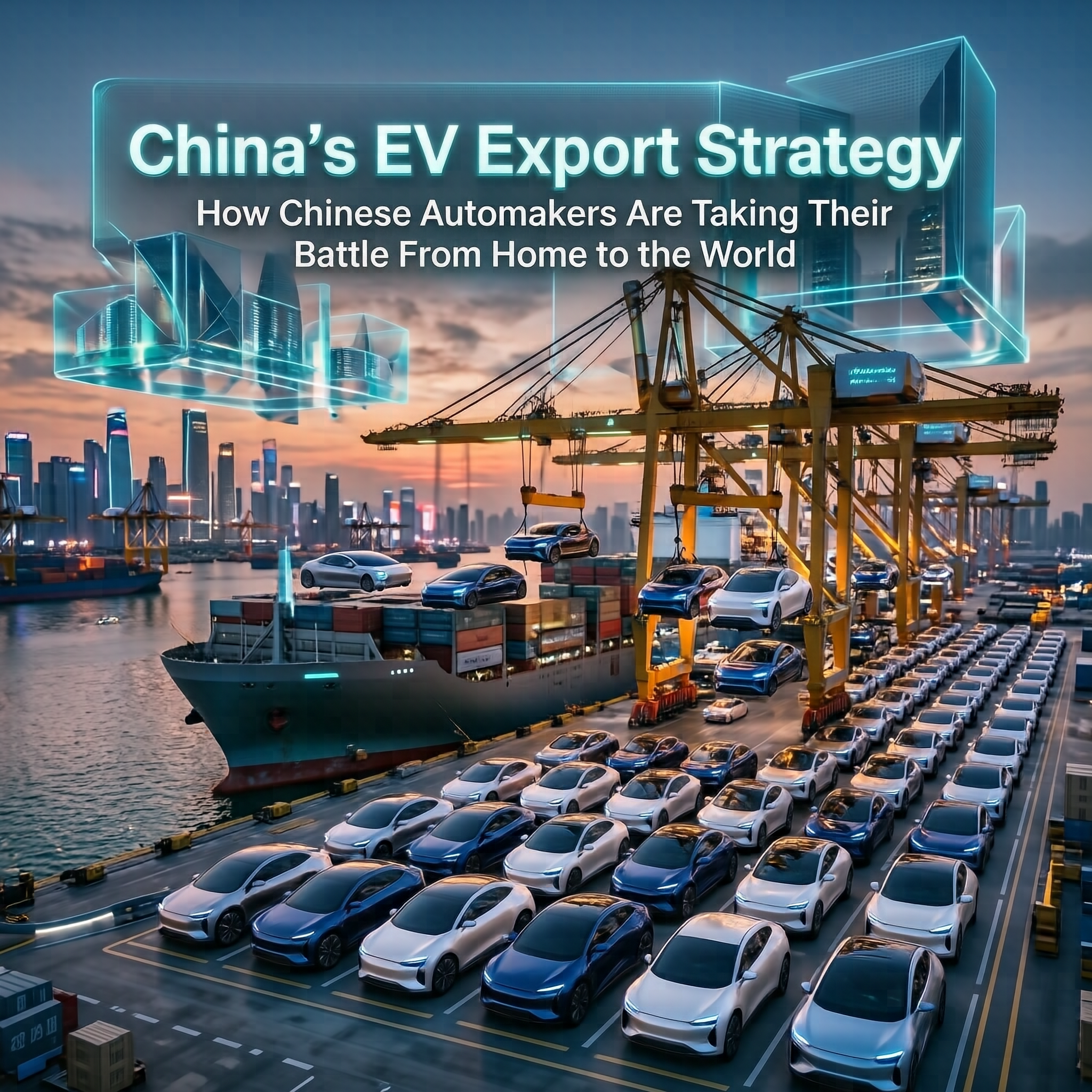
In June 2026, China exported more than one million vehicles in a single month for the first time in its history. In the first half of the year, exports reached 5.1 million units, up 65 percent, and now account for a third of all the cars China produces. Meanwhile, domestic sales fell for a tenth straight month.
Those two lines, export records and home-market decline, are not two separate stories. They are one story, and it is a strategy.
China did not stumble into the global EV market. It won a war at home, accumulated industrial capacity that its own buyers can no longer absorb, and then turned that surplus into the most aggressive overseas automotive campaign of the modern era. This third article in the series, after the overview in how China came to dominate the global electric vehicle market, explains how that campaign works, theater by theater.
The sequence that made the campaign possible
The export strategy only makes sense in order. Get the sequence wrong and the whole thing looks like random dumping.
Phase one: win at home. China built the world’s largest EV market through policy, competition, and the battery-cost machine described in the first article of this series. Domestic automakers survived a brutal price war, examined in the second article, which selected for the cheapest, fastest, most integrated manufacturers on Earth.
Phase two: hit the export ceiling at home. China’s factories can build roughly 55 million vehicles a year against domestic demand of about half that. When the home market cannot absorb capacity, the capacity does not disappear. It moves.
Phase three: turn surplus into a global offense. The companies that survived the domestic war take the same cost structures and the same cutthroat discipline to markets where competition is gentler, prices are higher, and every sale builds the brand.
The export boom is not an escape valve. It is the next stage of the same battle.
The map of the campaign
The campaign is not one market. It is several theaters with different objectives, and the results in 2025 showed how deliberately they are being fought.
| Theater | Strategy | The 2025-2026 evidence |
|---|---|---|
| Europe | Volume, brand prestige, then factories | Chinese brands took about 10% of the European market in 2025; EU registrations for BYD and SAIC grew sharply |
| Southeast Asia | Volume and early lock-in | Chinese brands made up roughly 88% of EVs sold in Thailand in 2025 |
| Latin America | Volume and tariff-proofing | Brazil took 200,000+ Chinese NEVs in 2025; Mexico became a top-three destination before raising tariffs |
| Middle East | High-growth, low-tariff expansion | UAE imports rose 60% in 2025; the region is now a top-tier destination |
| Russia and neighbors | Closed-market dominance | Russia and the Middle East together beat Europe and North America in export share as early as 2024 |
| North America | Closed front | The US 100% tariff blocks imports; Chinese brands build around it instead |
The regional split matters more than the headline totals. In 2025, more than half of China’s new-energy vehicle exports went to markets outside Europe and North America. The traditional picture of Chinese EVs flooding into the West is outdated. The growth engines are Southeast Asia, Latin America, the Middle East, and Central Asia, where Chinese brands frequently account for 60 to 85 percent of all EV sales.
The playbook: three stages of conquest
Watching any single Chinese automaker overseas, the moves look uncoordinated. Watched together, they form a deliberate three-stage sequence.
Stage one: ship aggressively
The opening move is pure cost advantage. Ship complete vehicles at prices local brands cannot match, win volume, and prove the product. This is the stage the world noticed first and the stage tariffs were designed to stop.
Stage two: build the brand infrastructure
Once volume exists, the automakers stop acting like exporters and start acting like local brands. Brand experience centers open in commercial districts. Regional parts warehouses cut repair times. Service networks convince skeptical buyers that after-sales support will exist. XPeng, for example, delivered over 45,000 overseas vehicles in 2025, up 96 percent, with Europe contributing nearly half, before announcing a three-year plan to cover Latin America by 2028.
Stage three: build the factory inside the wall
The final stage turns trade into investment. When tariffs rise, the factory moves across the border. Chery reopened a Nissan factory in Spain. BYD is building in Hungary, Thailand, and Brazil. Leapmotor assembles through Stellantis in Poland and Spain. Dongfeng is moving Voyah production into a Stellantis plant in France. By 2030, analysts at AlixPartners estimate, Chinese automakers’ overseas production capacity will reach roughly three million vehicles a year.
This is the playbook Japan and Korea used decades ago, executed at higher speed and greater scale. The reason it is unstoppable by tariffs alone is that tariffs attack stage one. The campaign is now firmly in stage three.
The commanders and their armies
The campaign has no single leader, which is part of its strength. Each major exporter has a different posture.
| Automaker | H1 2026 exports | Export share of sales | Strategic profile |
|---|---|---|---|
| Chery | 939,000 | 69% | Export king; deepest geographic diversification |
| BYD | 792,000 | 44% | Most balanced; NEV-first; building factories worldwide |
| SAIC | 677,000 | 34% | MG brand as European spearhead |
| Geely | 585,000 | 35% | Fastest-growing big exporter; owns Zeekr and Lynk & Co |
| Great Wall | 291,000 | 50% | Quiet, concentrated in Russia and Latin America |
BYD is the symbol of the campaign. Its overseas sales crossed one million units in 2025 for the first time, up about 140 percent, and the company is aiming for 1.5 to 1.6 million overseas sales in 2026. Chery is the volume machine, selling two of every three cars it builds abroad. SAIC has the strongest European footprint through MG, its registrations in the EU rising more than 30 percent in 2025. Geely is growing fastest among the established exporters, its first-half exports up 150 percent.
The 2026 inflection: from optional to existential
The campaign accelerated for a structural reason that became impossible to ignore in 2026: the domestic market stopped growing.
After an unusually aggressive subsidy regime pulled demand forward in 2025, Beijing curtailed entry-level purchase incentives entering 2026. The result was predictable. Domestic passenger-car retail fell more than 20 percent year on year in the spring of 2026, and sales kept falling through the summer. With the home market shrinking, exports stopped being a strategic option and became the survival engine.
The inversion is visible in the data. Exports now make up a third of China’s total vehicle output, and for some automakers, half. The industry is no longer a domestic business that happens to export. It is a global manufacturing system headquartered in China, and that distinction changes how every future tariff, subsidy, and trade negotiation must be understood.
The weapons and the counter-weapons
Every offensive generates a defense, and the tariff war is the counter-move.
The walls are high. The United States imposes a 100 percent tariff on Chinese-built EVs. The European Union applies countervailing duties of 17 to 35 percentage points on top of its standard tariff, depending on the manufacturer. Mexico, a top destination, raised tariffs on China-origin vehicles to 50 percent from January 2026. Multiple markets are adding local-content requirements and assembly mandates.
China’s answer is the same answer it used at every stage: change the location of production. A BYD built in Hungary is a European car. A Leapmotor assembled in Spain enters the EU market without the countervailing duty. The cost gap that made Chinese cars cheap, rooted in the battery supply chain and domestic competition discussed across this series, survives the move of the factory, because it lives in the supply chain, not the port of departure.
What could stop the campaign
It is fair to ask where this ends, and the honest answer includes real constraints.
Localization is expensive. Building a factory in Europe or Brazil requires billions of dollars and years of construction, and the capital demands come at exactly the moment domestic margins are collapsing. The transition from exporter to manufacturer abroad is measured in years, not quarters. Destination markets are also learning the game, shifting from tariff walls to local-content requirements that force genuine production rather than simple assembly. And the export boom itself invites coordinated responses, as the EU and Mexico have already shown.
There is also a quieter risk: the more Chinese brands dominate markets like Thailand and Brazil, the more those governments will face domestic pressure to protect local industry. The campaign’s success creates the conditions for its own resistance.
What the campaign has already changed
Whatever happens next, the permanent fact is established. The Chinese automotive industry has stopped being a domestic market with an export channel. It is a global operation whose home market no longer determines its growth.
That is why the export numbers in 2026 deserve attention even from readers who will never buy a Chinese car. They show an industry reorganizing itself around world demand, building factories on every continent, and carrying a cost advantage that no tariff wall has yet neutralized. The campaign is not a response to the price war at home. The price war was the training ground, and the world is now the battlefield.
The final article in this series goes inside the company that best embodies this entire story, from battery maker to global challenger: BYD.

Independent technology writer focused on artificial intelligence, emerging technologies, and digital innovation. Covers AI applications in sports, productivity, and online business.