
























Here’s the uncomfortable number that should open any serious answer to this question.
According to the International Energy Agency, more than 70 percent of electric vehicles built outside China still contain batteries or components sourced from Chinese suppliers. Not Chinese brands. Not Chinese factories. Chinese components, inside vehicles made by everyone else.
Think about what that means. The United States, Europe, Japan, and Korea are spending hundreds of billions of dollars to build their own EV industries. And the IEA’s numbers say that most of the cars they’re building are still, in the most important part, Chinese.
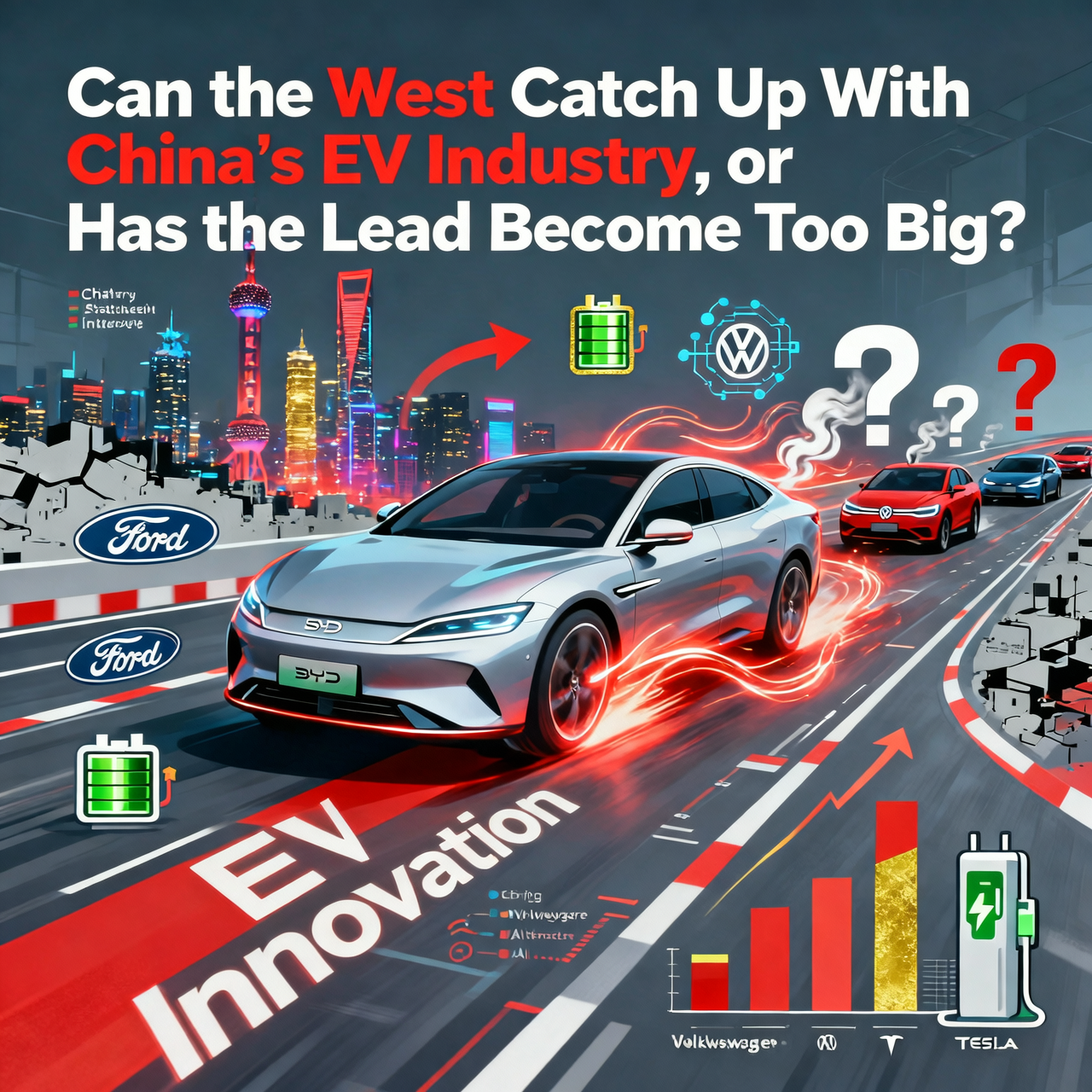
So the real question isn’t “can the West catch up?” That’s one question hiding about five different ones. And the honest answer is different for each.
First, decide what “catching up” even means
Catching up on electric vehicles is not a single race. It’s five races running at the same time, and the West is winning some, losing others badly, and not even entered in a couple.
- The battery cost race
- The supply chain race
- The manufacturing scale race
- The speed race
- The technology race
The mistake most commentary makes is treating them as one. A country can win the technology race and still lose the cost race. That’s exactly where the West sits today.
Race one: the battery cost race
This is the race that decides everything else, because the battery is the most expensive part of an EV, and whoever makes it cheapest sets the price for everyone.
China’s advantage here is brutal. The IEA puts Chinese battery packs at roughly 30 percent cheaper than American equivalents and 35 percent cheaper than European ones. Even producing a battery cell in the US costs about 20 percent more than in China before any material costs are counted, because Chinese factories benefit from an integrated supply chain and economies of scale that don’t exist anywhere else.
There is one genuine bright spot for the West. The core patents on LFP chemistry, the cheap, safe battery type that now dominates the market, expired in 2022. Before that, China was essentially the only country mass-producing LFP. Now anyone can, legally. And Benchmark Minerals, a respected industry analyst, has argued that US battery production could actually become cheaper than China’s by the end of the decade, once Inflation Reduction Act tax credits are counted.
But notice the word “could.” Building is the hard part, and that’s where the second race comes in.
Race two: the supply chain race
This is where the West’s deficit is deepest, and it’s the reason the 70 percent statistic won’t move quickly.
China controls roughly 85 percent of global cathode material production and more than 90 percent of anode material. It refines the majority of the world’s lithium, cobalt, and graphite into battery-grade chemicals. Korea holds a sliver, about 9 percent of cathode capacity, Japan even less. Europe and the United States, the two regions spending the most on “battery independence,” hold almost nothing.
The timeline reflects that. Independent analysts who have actually modeled the catch-up converge on uncomfortable dates: cell production that could cover a third of US domestic demand by 2028 to 2030, cathode and anode material by 2032 to 2038, and battery-grade mineral refining somewhere in the 2035 to 2045 range. We’re not talking about a gap you close with a round of subsidies. We’re talking about building, from scratch, an industry China spent fifteen years scaling.
There are wildcards. Morocco has the world’s largest phosphate reserves and free-trade agreements with both the US and the EU, and it’s attracting serious LFP investment. Indonesia is building an anode materials industry. But these are early moves in a race that China is still sprinting.
Race three: the manufacturing scale race
China now accounts for about 40 percent of global car manufacturing and produces roughly 70 percent of all EVs sold in the world. Its battery industry runs at a scale that makes Western factories look like pilot plants.
The numbers aren’t flattering. Global lithium-ion capacity passed 4 terawatt-hours by the end of 2025, and most of it is Chinese. In North America, of the 413 gigawatt-hours of battery capacity announced as under construction, more than a third hadn’t broken ground, and the average plant takes about 30 months to build against just over 20 in China. Europe is in a similar spot, with much of its announced capacity dependent on Korean companies, who own about three-quarters of the existing European battery plants.
Scale is not decorative. Scale is what makes batteries cheap, which is why China’s cost advantage and China’s scale are the same advantage.
Race four: the speed race
Chinese automakers move new models from concept to showroom in 20 to 24 months. Western automakers typically need 40 to 50. Chinese models get refreshed every 12 to 18 months. That’s not a small gap, it’s a different way of running a company, and the price war article in this series explained how it compounds into cost.
There’s no sign this is closing. But speed is also where the West has its one genuinely dangerous counter-weapon: next-generation battery technology.
Race five: the technology race, and the West’s real card
This is the race the West can actually win, and it matters because it’s the only race that could reset the others.
Solid-state batteries promise higher energy density, faster charging, and better safety than today’s liquid-electrolyte cells. Japan has led the research field for a decade, and Toyota, working with Idemitsu, has said it will bring solid-state EVs to market around 2027 to 2028. The US leads pilot production, with QuantumScape and Solid Power as the flagship companies. Fraunhofer’s analysis puts Japan, South Korea, and the US ahead of China on solid-state research investment.
That’s the good news. The bad news is that leadership in research is not the same as leadership in scale. Chinese firms dominate the patent filings that are still growing, while filings in Japan, the US, and the EU have flattened. China has launched large-scale government funding for solid-state commercialization. And even the “China-free” alternatives have a China problem: the announced sodium-ion battery capacity in China is roughly ten times the rest of the world combined.
A technology leap that the West commercializes first could genuinely change the cost equation. But China has the same technology, more money to scale it, and a bigger domestic market to absorb it. The West is not ahead in a way that guarantees anything.
The paradox that explains the whole problem
Here’s the part people don’t like to hear. Even when the West “builds local,” it’s often still Chinese.
CATL and BYD are building factories in Germany, Hungary, and beyond. Korean cell makers, who supply most of the Western factories that do exist, depend heavily on Chinese cathode material and lithium hydroxide. A “local” battery plant in Europe or America is frequently a Korean-owned plant eating Chinese materials. The IEA’s point about grid storage is even starker: more than 90 percent of the world’s battery storage uses LFP cells made in China.
So the West isn’t just competing with Chinese factories. It’s competing with Chinese factories while still depending on them. Localization without decoupling. That’s the current state of the “independent Western EV industry.”
The tools the West actually has
It’s not all hopeless, and pretending otherwise is its own failure of analysis.
Tariffs work, in the limited sense that they raise the price of Chinese cars and keep some domestic production alive. The US 100 percent tariff and EU duties up to roughly 45 percent are the reason Chinese brands are building factories in Europe instead of shipping in. That’s a real strategic win, forcing the competition to play on Western turf.
Subsidies work too. The IRA’s tax credits, per Benchmark, could genuinely flip US battery economics, and European governments are funding gigafactories at scale. Construction of the US plants is slow, but it’s happening.
And the West has one structural advantage China doesn’t: most of the world’s raw minerals are on Western-allied ground. Australia mines the lithium, Chile the brine, the DRC the cobalt, Morocco the phosphate. China’s dominance was never about owning the rocks. It’s about owning the processing, and that can theoretically be built elsewhere.
The question has always been whether it will be, fast enough.
So, can the West catch up?
The honest answer, which almost no one wants to hear: not on cost, not on supply-chain depth, and not on manufacturing scale, within the next decade or more. Those are the three races where the deficit is structural and the timeline is measured in decades.
But catch-up was never the only meaningful objective. The realistic goals are these: build enough regional production to survive without China in a crisis, win the technology race in solid-state and next-gen cells, keep the premium segments where margins survive, and use tariffs and industrial policy to slow the transfer of value. That’s not parity. It’s co-existence with a gap.
The full picture of how that gap was created is laid out across this series: the rise of the industry, the battery foundation under it, the price machine that made it unbeatable, and the global expansion now carrying it overseas. It’s also a reminder that this is not only an industrial story; it’s the newest front of the wider US-China technology competition.
The lead is real, it’s compounding, and it will not be reversed by a single policy or a single technology. What can change is the question the West is asking. It shouldn’t be “can we beat China at their own game?” It should be “which game can we win instead?” Because that’s the only one with a plausible answer.

Independent technology writer focused on artificial intelligence, emerging technologies, and digital innovation. Covers AI applications in sports, productivity, and online business.