




























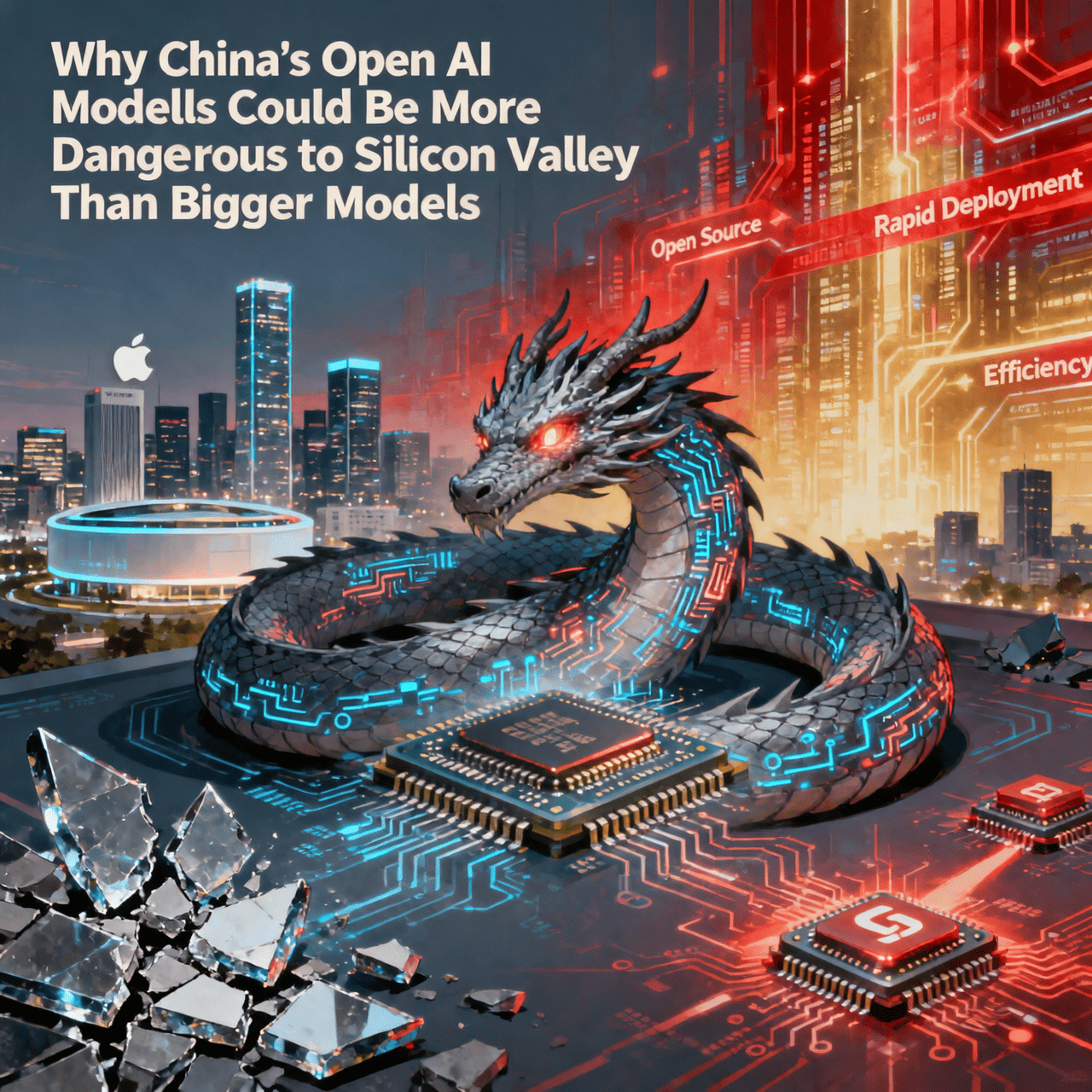
The conversation about the US-China AI competition keeps returning to a familiar question: can China build models as powerful as GPT-5 or Claude Opus? The question is wrong. The more dangerous threat is not that Chinese models will become bigger or smarter. It is that they have already become cheap enough to make Silicon Valley’s core business model unworkable.
In August 2026, the Financial Times reported that OpenAI and Anthropic entered a price war, slashing API costs to retain customers defecting to Chinese alternatives. (The full dynamics of this price war are covered in OpenAI vs DeepSeek: The AI Price War Reshaping Global Tech.) OpenAI cut GPT-5.6 Luna to $0.20 per million input tokens. Anthropic made Claude Sonnet 5’s $2/$10 pricing permanent. These are not competitive moves born of strength. They are defensive reactions to a market shift that neither company anticipated would happen this fast.
The shift is not about capability. It is about economics. And economics, not benchmarks, determine which technologies survive. (For the full ecosystem context, see How China Built a Rival AI Ecosystem.)
The Price Gap That Changes Everything
The numbers are no longer theoretical. They are operating realities for thousands of companies.
DeepSeek V4 Pro costs $0.66 per million input tokens and $1.98 per million output tokens (off-peak; $1.32/$3.96 at peak) — still roughly 3x to 5x cheaper than Claude Opus 4.8 at $5 input and $25 output, and GPT-5.5 at $5 input and $30 output. Before DeepSeek’s August 16 price increase, the gap was even wider: $0.435/$0.87, a 10x to 35x difference. The price increase itself is evidence of the dynamic at work — even after raising prices, DeepSeek remains dramatically cheaper than American alternatives.
At the budget tier, the gap widens further. DeepSeek V4 Flash is priced at $0.22 input and $0.66 output (off-peak; $0.44/$1.32 at peak) with a one-million-token context window. OpenAI’s cheapest comparable offering, GPT-4.1 nano, sits at $0.10/$0.40 — competitive on price but built as a smaller, less capable tier rather than a frontier-competitive model at budget pricing.
The production math is stark. A workload that costs $788 per month on GPT-5.5 costs roughly $22 on DeepSeek’s cheapest model for the same measured capability index — still a 35x cost reduction even after DeepSeek’s August 16 price increase. That is not an edge case. It is the new baseline for any company running AI at scale.
For context: OpenAI posted a negative 122% adjusted operating margin in Q1 2026, effectively losing $1.22 for every $1 of revenue. The company was already losing money at premium prices. At the prices it is now forced to charge to remain competitive, the path to profitability becomes structurally harder.
Why Open-Weight Models Break the Business Model
The price gap alone would be manageable if Chinese models were merely cheap API alternatives. Companies could switch providers, negotiate volume discounts, and maintain their existing architecture. But open-weight models do something more fundamental: they eliminate the dependency on any single provider entirely.
When DeepSeek releases V4 under the MIT license and Alibaba releases Qwen under Apache 2.0, any company can download the weights, host them on their own infrastructure, and run inference without paying per-token fees to anyone. (For the broader open-source AI race context, see Why Open Source AI Is Winning the Global AI Race.) The model becomes a commodity. The hosting becomes commoditized. The only remaining cost is compute — and compute is a commodity too.
This is the structural threat that keeps Silicon Valley executives up at night. It is not that Chinese models are better. It is that they make the concept of paying a premium for model access increasingly irrational for a growing share of use cases.
MIT Technology Review put it plainly in April 2026: “Silicon Valley AI companies follow a familiar playbook: Keep the secret sauce behind an API, and charge for every drop. China’s leading AI labs are playing a different game: They ship models as downloadable ‘open-weight’ packages.”
The game is not about outperforming. It is about making the opponent’s revenue model obsolete.
The Enterprise Defection Is Already Happening
The threat is no longer theoretical. It is measurable.
By January 2026, DeepSeek and Qwen had captured roughly 15% of the global AI market, up from barely 1% at the start of 2025. That is the single fastest market share acquisition in AI infrastructure history. By mid-2026, Chinese models accounted for 34.25 trillion tokens in weekly usage on OpenRouter, surpassing American models for the 15th consecutive week.
The enterprise adoption pattern has followed a predictable three-phase trajectory. In early 2025, individual developers began using DeepSeek and Qwen on local machines — no formal approval, no procurement process. By mid-2025, engineering teams ran formal evaluations. The results surprised many: on standard enterprise tasks like customer support classification and document summarization, Qwen and DeepSeek matched or exceeded GPT-4o accuracy at one-tenth the cost. By late 2025 and into 2026, production deployments began in earnest.
The Washington Post reported in July 2026 that US companies, burdened by rising costs from OpenAI and Anthropic, had begun shifting to Chinese models in what it called “a landmark adoption of the country’s software.” A technology executive at a major financial institution told CNBC: “We cannot ignore DeepSeek. When the operational cost of an AI agent drops by 80%, ethical and geopolitical dilemmas take a backseat to the necessity of competitiveness.”
The companies driving this shift are not marginal players. They are enterprises that ran the math and concluded that paying 10x to 35x more for a marginally better model does not make commercial sense for the majority of their AI workloads.
The “Good Enough” Threshold
The critical concept in understanding this threat is the “good enough” threshold — the point at which a cheaper model’s capability is sufficient for a specific task, making the premium price of a frontier model unjustifiable.
For most enterprise AI workloads, that threshold has already been crossed. Customer support classification, document summarization, data extraction, code review, content generation, translation, and basic reasoning tasks do not require the absolute frontier. They require models that are reliable, fast, and affordable. Chinese open-weight models satisfy all three conditions.
The premium that OpenAI and Anthropic charge buys real advantages: deeper reasoning on complex multi-step problems, stronger performance on frontier coding benchmarks, better multimodal creative capabilities, and enterprise-grade support and compliance. These advantages matter enormously for the hardest tasks and the most regulated industries.
But those tasks represent a fraction of total AI usage. The bulk of AI workload — the millions of routine inference calls that constitute the volume layer of the market — does not need frontier capability. It needs good enough at the lowest possible cost. And in that layer, which is where volume and therefore revenue live, Chinese models are winning decisively.
The risk for Silicon Valley is that the volume layer subsidizes the frontier layer. Companies use revenue from routine inference to fund the research that produces the next generation of frontier models. If the volume layer migrates to Chinese alternatives at 10x lower prices, the funding mechanism for frontier research weakens — even if the frontier models themselves remain American.
The IPO Problem
This dynamic creates a specific problem for OpenAI and Anthropic, both of which are pursuing public market listings in 2026. (For a detailed look at how Chinese models are disrupting Silicon Valley’s profit machine, see How China’s AI Ecosystem Is Disrupting Silicon Valley’s Profit Machine.)
Their valuations depend on a growth narrative: that they can capture an outsized share of a multi-hundred-billion-dollar AI market. OpenAI’s valuation narrative assumes it can maintain premium pricing across a vast and expanding user base. Anthropic’s narrative assumes it can sustain rapid revenue growth while building the safest and most capable frontier models.
Chinese open-weight models attack both narratives. If the volume layer of AI inference migrates to cheap Chinese alternatives, the total addressable market that OpenAI and Anthropic can profitably serve shrinks. If enterprises adopt hybrid architectures — routing routine tasks to DeepSeek and reserving GPT or Claude for the hardest problems — the revenue per customer drops even as usage increases.
The distinction between revenue and profit matters here. If Chinese models capture a large share of global developers and emerging-market users, that could eat into the total revenue opportunity investors think OpenAI and Anthropic can chase — denting the hyper-growth story that both need to justify trillion-dollar valuations. The most profitable customers — regulated enterprises, governments, Fortune 500 companies with compliance requirements — will likely remain with Western providers for now. But the growth story depends on capturing the next billion users and the next million developers, and those users and developers are choosing based on cost, not brand loyalty.
The Global South Dimension
The threat is amplified by geography. In markets where OpenAI and Anthropic have limited presence or where their pricing is prohibitive, Chinese models are not competing. They are defaulting. (For the broader strategic context, see Why China Is Winning the AI Race.)
Singapore’s government-backed AI Singapore program chose Alibaba’s Qwen over Meta’s Llama as its foundation model for its SEA-LION large language model. Malaysia has integrated Chinese AI models into its sovereign AI initiatives. In Africa, DeepSeek usage is estimated at two to four times higher than in other regions, aided by Huawei’s distribution partnerships. Russian bank T-Bank built its entire Gen-T model family on Qwen, reporting that basing on Qwen cut model-building costs dramatically versus training from scratch.
These are not temporary preferences. They are infrastructure decisions. Once an enterprise, government, or national AI program builds its stack on Qwen or DeepSeek, the switching costs are real. Developers learn the API patterns. Fine-tuning pipelines are built around the architecture. Institutional knowledge accumulates. The model becomes embedded in workflows.
Every adoption in the Global South is a market that OpenAI and Anthropic will find extraordinarily difficult to recapture. The models are free. The licenses are permissive. The hardware requirements are manageable. And the performance is sufficient for the tasks that matter most in those markets.
The Structural Advantages That Won’t Go Away
None of this means that Chinese models will replace American models at the frontier. They will not — at least not soon. OpenAI, Anthropic, and Google maintain genuine technical leads in complex reasoning, long-horizon agentic tasks, multimodal creativity, and safety alignment. These leads are real and represent years of research investment.
But the question is whether the frontier is the only dimension that matters. For the companies whose valuations depend on capturing the broadest possible market, the answer is no.
Chinese open models have three structural advantages that compound over time and cannot be easily countered:
Cost. Open-weight models commoditize hosting. When anyone can run the model, the only cost is compute. Chinese labs have optimized for inference efficiency more aggressively than American labs, partly because constraint forced it and partly because their business model depends on volume rather than margin.
Distribution. Permissive licenses (MIT, Apache 2.0) eliminate legal friction. A developer can deploy Qwen the same day it is released. Deploying Llama requires legal review of usage thresholds. Deploying a proprietary model requires a commercial relationship with a gatekeeper. In a market moving at AI speed, the difference between same-day and same-week deployment matters.
Ecosystem. Alibaba has open-sourced more than 460 Qwen models. The family has spawned over 300,000 derivative models. Every derivative is a distribution node that makes the ecosystem stickier. Every developer who fine-tunes Qwen for a specific use case creates institutional dependence on Alibaba’s architecture. This is the same network effect that made Linux dominant in servers and Android dominant in mobile — and it is happening faster in AI than it did in either of those markets.
What Silicon Valley Can and Cannot Do
The American AI industry’s response has been contradictory. In July 2026, major US technology companies — including Nvidia, Microsoft, and Meta — signed an open letter against “premature restrictions” on open-weight models. OpenAI and Anthropic declined to sign. The split reveals the core tension: the companies that benefit from open ecosystems (Nvidia, Meta) want to compete on merit; the companies whose business model depends on closed access (OpenAI, Anthropic) would prefer a regulatory moat.
Restricting Chinese open-weight models through policy is practically impossible. (For the hardware dimension of this story, see How China’s Chips Are Outpacing America in the AI Infrastructure Race.) The weights are files. They are hosted on Hugging Face, ModelScope, GitHub, and countless mirrors. Any prohibition broad enough to be effective would sweep in thousands of derivative models created by developers worldwide. The US government acknowledged this implicitly when it exempted open-weight models from the AI Diffusion Rule’s export controls in January 2025.
The realistic response is competition on three fronts:
Price. OpenAI’s GPT-5.6 Luna at $0.20 input is a direct response to Chinese pricing. Anthropic’s permanent $2/$10 Sonnet 5 pricing is another. Even after DeepSeek’s August 16 price increase (V4 Pro to $0.66/$1.98, V4 Flash to $0.22/$0.66), the Chinese models remain dramatically cheaper. The margin compression is painful, but it is necessary to slow defection.
Quality. The frontier remains American. OpenAI, Anthropic, and Google can defend their position by continuing to deliver capabilities that Chinese models do not yet match — complex reasoning, frontier coding, multimodal generation. As long as the hardest tasks still require American models, there is a defensible premium tier.
Enterprise trust. Compliance, security, support, and auditability remain genuine advantages for Western providers in regulated industries. A bank running AI on customer financial data faces different risk calculus than a startup building a chatbot.
But none of these responses address the fundamental problem: the volume layer of AI, where the most revenue lives, is migrating to models that are free to license and cheap to run. The premium tier can remain profitable. The question is whether it can remain large enough to fund the next generation of frontier research.
The Uncomfortable Truth
The most dangerous thing about China’s open AI models is not what they are today. It is the economic logic they have made irreversible.
Before DeepSeek’s R1 in January 2025, the AI industry operated on a simple assumption: frontier capability requires massive capital, massive capital requires massive revenue, and massive revenue requires closed access and premium pricing. The entire investment thesis — hundreds of billions of dollars in venture funding, infrastructure spending, and public market valuations — rested on this chain.
Chinese open-weight models broke the chain. They demonstrated that frontier-adjacent capability can be produced at a fraction of the cost, released freely, and distributed globally without permission from any gatekeeper. The capability spreads through adoption, not through supply chains. Export controls can slow hardware access. They cannot slow open-source model adoption.
The companies that built their valuations on the assumption that model access would remain scarce and expensive now face a world where model access is abundant and cheap. They can compete on quality, on trust, on ecosystem. But they can no longer compete on scarcity.
That is the danger. Not that China’s models will become bigger. But that they have made the size of the model — and the price of accessing it — a problem that Silicon Valley no longer controls.
FAQ
Are Chinese open models actually replacing OpenAI in enterprises?
For routine inference workloads — classification, summarization, data extraction, basic coding — yes. DeepSeek and Qwen captured roughly 15% of the global AI market by January 2026, up from 1% a year earlier. For the hardest tasks requiring frontier reasoning, OpenAI and Anthropic maintain clear leads. The shift is toward hybrid architectures: cheap Chinese models for volume work, premium American models for complex tasks.
Why can’t Silicon Valley just match the prices?
They can and are trying. OpenAI cut GPT-5.6 Luna to $0.20 input in July 2026; Anthropic made Claude Sonnet 5’s $2/$10 pricing permanent. But OpenAI was already operating at negative 122% margins in Q1 2026. Further price cuts accelerate losses. Chinese labs can sustain lower prices because their training costs are lower (efficiency innovations), their inference infrastructure is cheaper (domestic compute), and their business model prioritizes ecosystem growth over immediate profitability. Even after DeepSeek’s August 16 price increase, its models remain 3x to 5x cheaper than American alternatives.
What is the difference between open-weight and open-source?
Open-weight means the trained model parameters (weights) are freely downloadable. Open-source additionally requires the training code and data to be released. DeepSeek and Qwen are open-weight — you can download, run, and modify the model, but the full training pipeline is not disclosed. For most commercial purposes, the distinction does not matter: open weights enable self-hosting, fine-tuning, and deployment without any API dependency.
Why don’t enterprises just use the free models instead of paying for APIs?
Many are. But self-hosting requires GPU infrastructure, engineering expertise, and operational overhead. For companies without dedicated ML teams, using a hosted API — even a cheap Chinese one — is simpler. The market is splitting: technically sophisticated companies self-host open weights; smaller companies use cheap APIs; regulated enterprises pay premium prices for Western providers with compliance guarantees.
Does this mean OpenAI and Anthropic will fail?
No. Both maintain genuine technical advantages at the frontier. Both serve enterprise customers whose compliance and security requirements make Chinese models unsuitable. Both are cutting prices to compete. The risk is not failure but shrinkage: a smaller addressable market, lower margins, and a growth narrative that no longer supports trillion-dollar valuations. The question for investors is whether the premium tier alone can justify the prices those companies need to command.
How does this affect AI development costs for startups?
Dramatically. A startup that would have spent $10,000 per month on OpenAI API calls can now spend $500 to $1,000 on DeepSeek or self-hosted Qwen for comparable capability. This lowers the barrier to entry for AI-native companies and shifts competition from “who has the most funding for API bills” to “who builds the best product.” The net effect is more competition, faster innovation, and lower consumer prices — which is precisely what makes Silicon Valley’s margin-dependent business model uncomfortable.
This article synthesizes data from the Financial Times (August 2026), MIT Technology Review (April 2026), The Washington Post (July 2026), Hugging Face state of open models report (August 2026), OpenRouter usage data, the Artificial Analysis Intelligence Index, DeepSeek’s official pricing page (verified August 21, 2026), Pickurai’s API pricing analysis (July 2026), MLQ’s pricing comparison (August 2026), Finimize’s investment analysis (July 2026), and enterprise adoption surveys from CoderCops and China Biz Insider. All figures reflect the most recent publicly available data as of August 25, 2026.

Independent technology writer focused on artificial intelligence, emerging technologies, and digital innovation. Covers AI applications in sports, productivity, and online business.