






























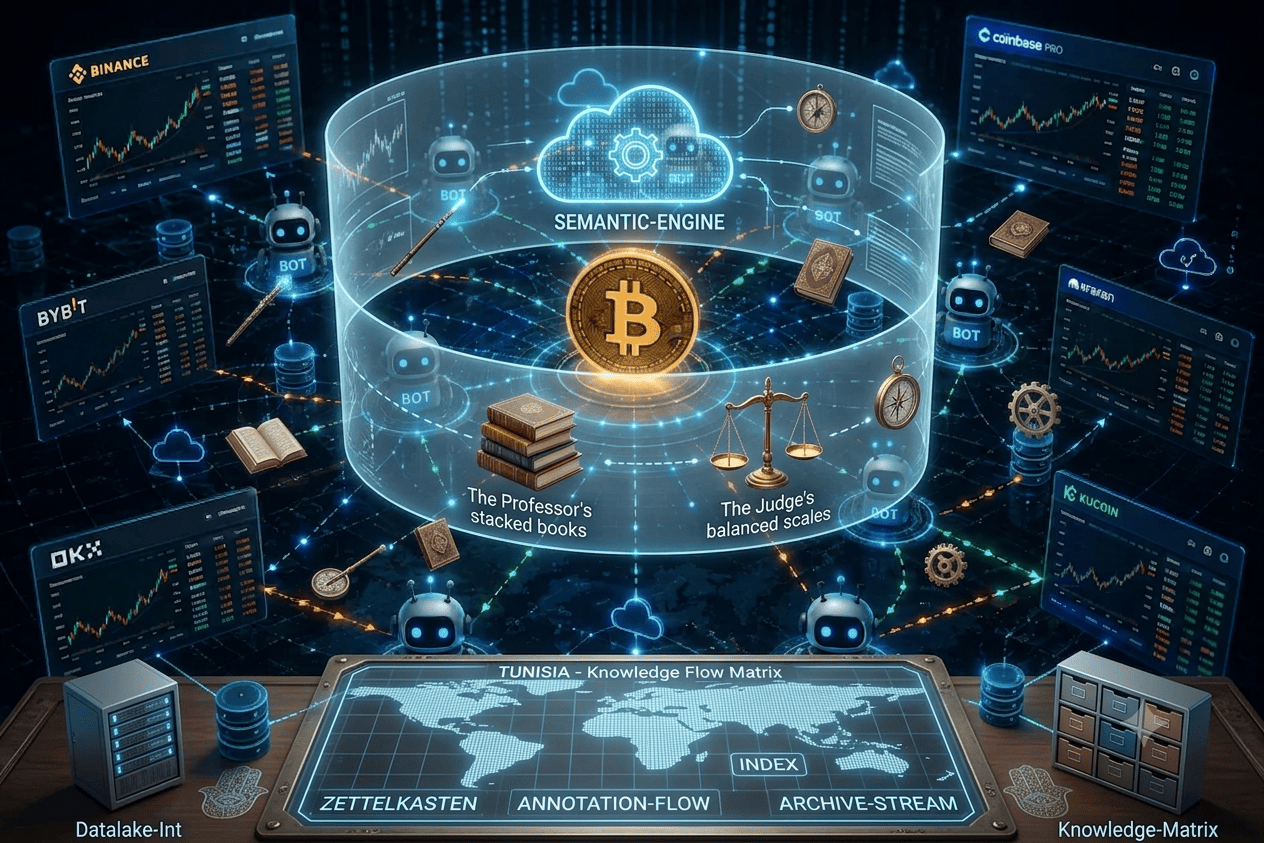
This topic is interesting to me, especially since we always see the same advertising promises everywhere. So, I started testing some AI tools for cryptocurrencies. Every platform claims to offer “institutional-level insights,” but after reading the fine print, I discovered that most are just simple scripts based on specific rules and sources, with AI logos added. Therefore, I spent about a month creating accounts on seven different platforms, using a small amount of real money to fund some of them, and monitoring the actual results for each. This is what prompted me to write this article.
I won’t tell you that AI can predict the price of Bitcoin. It can’t. Anyone who claims otherwise is just promoting a product. But AI can process more data in a second than you can in a week, and that speed has real value if used correctly.
How AI Crypto Analysis Tools Actually Work in 2026
Many people believe that AI tools designed for cryptocurrencies “predict” the market, but this is simply not true. Here’s what they actually do:
First, these tools collect and monitor data. Typical tools extract data from blockchain nodes (on-chain transactions, whale activity, wallet flows), trading platforms (order book depth, trading volume, funding rates), and social media platforms (Twitter, Reddit, Discord). This amounts to thousands of data points per second.
Second, these tools then apply models. Some use Long Term Memory Networks (LSTMs) (a type of recurrent neural network) to detect patterns in time-series data. Others use transformer models trained on millions of classified market events. By 2026, the number of these tools using multi-agent systems—multiple specialized AI models, each analyzing a single aspect (sentiment, technical analysis, on-chain data) and then comparing their results—had increased.
Third, they output a signal. This could be a risk score, a buy/sell suggestion with confidence percentage, or a plain-English summary of what the data says.
The important distinction: most retail AI tools operate on pattern recognition, not prediction. They tell you what has historically happened when certain conditions aligned. That is useful. It is not magic.
What to Watch Out For
There are some platforms that claim to use artificial intelligence, but all they offer are very basic moving average crossover indicators with a rather attractive user interface (lol). I tested one for $99 a month, and it turned out to be just a MACD indicator with alerts. The only AI it offered was a chatbot explaining the meaning of the Relative Strength Index (RSI).
Always make sure the platform publishes live, recorded performance data, not just past test results. Past test results are susceptible to manipulation, while live, recorded data cannot.
If you want a deeper look at how AI handles market analysis more broadly, our article on AI market trend detection — how algorithms spot shifts before humans explains the technical side in more detail.
Free AI Crypto Analysis Tools That Are Worth Your Time
High-quality cryptocurrency tools don’t have to be expensive. Especially if you’re new to the world of crypto or managing a small investment portfolio, many of these AI-powered cryptocurrency analysis tools offer free versions to suit your specific needs.
ARC AI — Instant Token Risk Scoring, No Login Needed
ARC AI does one thing and does it well. You paste any token contract address into its analyzer, and it returns an instant AI-generated risk report. Hype score, scam probability, narrative classification, whale interest — all in under five seconds. No account required. No credit card.
I use this before buying any token I have not researched personally. It caught a fake Solana meme token last month that had red flags across three categories. Saved me about $200 in what would have been a bad bet.
The free tier gives you five AI reports per month and a ten-token watchlist. That is enough for casual research. If you are launching or tracking tokens regularly, the Pro tier costs $15/month and bumps you to 50 reports.
Best for: Anyone who buys tokens they have not personally vetted. This should be most people.
Augmento — Social Sentiment Without the Noise
Most crypto sentiment tools promise to tell you whether the market is bullish or bearish, but many of them stop at simple keyword counting. They see more positive words and assume traders are optimistic, or detect negative terms and label the market as fearful. The problem is that crypto sentiment is rarely that simple. A market can be full of excitement while traders are actually uncertain, or it can show fear while smart money is quietly accumulating.
This is where Augmento takes a different approach. Instead of only measuring positive and negative mentions, it tries to identify different emotions behind market discussions, including fear, uncertainty, hype, and genuine FOMO. Its algorithm analyzes sentiment across 93 crypto-related topics and was trained using 32,000 manually labeled Bitcoin discussions to better understand the context behind online conversations.
The free version gives access to delayed sentiment scores for more than 25 cryptocurrencies, using data collected from communities such as Bitcointalk, Reddit, and Twitter. The information is refreshed hourly, allowing you to track how market sentiment changes before and after major price movements.
I usually check Augmento when a coin suddenly starts gaining attention. A sharp rise in sentiment can be a useful warning sign — especially when the score approaches extreme levels. It does not predict the market perfectly, but it can help identify moments when excitement is getting ahead of reality and reduce the temptation to buy after a move has already happened.
Best for: Traders who incorporate social sentiment into their decisions. The free tier’s delay is fine for daily checks.
CryptoLens Free Tier — Surprisingly Generous
CryptoLens presents itself as a practical alternative to Nansen for anyone who wants on-chain insights without paying around $150 a month. Even on the free plan, it offers a surprisingly useful set of tools. You get a market dashboard covering the top 20 cryptocurrencies, basic indicators like price, trading volume, and RSI, seven-day token charts, DeFi statistics for the leading protocols, and a whale tracker that highlights recent large transactions.
One feature that stands out is the built-in AI assistant. The free plan includes three AI questions per day, allowing you to ask things like, “What’s causing the recent volume spike on SOL?” Instead of returning a simple data point, the Claude-powered assistant explains the market context, combines relevant on-chain metrics, and points out notable whale activity that may be influencing the move.
Considering it costs nothing, the overall feature set is impressive. The whale tracker, in particular, offers functionality that many competing platforms reserve for paid plans costing $50 or more per month. There are limits—you can only view the last six hours of whale activity and a small number of transactions at once—but they’re reasonable for day-to-day market monitoring.
If you’re looking to learn on-chain analysis or follow the crypto market without paying for a premium analytics platform, CryptoLens provides one of the strongest free all-in-one dashboards currently available.
Best for: Traders who want one dashboard instead of five browser tabs.
Paid AI Crypto Analysis Tools Worth the Subscription
Paid tools become worth it when you outgrow what free tiers offer. Here are the ones that justify their price tags.
CryptoLens Pro — The Best Bang for Your Buck at $29/Month
CryptoLens Pro is designed for users who want advanced crypto analytics without paying the premium prices charged by platforms like Nansen. At $29 per month, it bundles together a wide range of features that would normally require several separate subscriptions. These include all 12 trading signal categories, such as whale activity, unusual trading volume, price momentum, RSI extremes, smart money tracking, copy trading signals, and more.
The Pro plan also unlocks the complete whale feed with up to 30 days of historical data, real-time updates through WebSockets, wallet scoring for smart money addresses, exchange inflow and outflow analysis, and support for 50 custom alerts delivered through Telegram, email, push notifications, or the web app. On top of that, users can ask the built-in AI analyst up to 100 questions per day.
After comparing it with Nansen, the biggest difference isn’t the number of features but the value for money. While CryptoLens Pro doesn’t match every advanced capability that Nansen offers, it covers most of the tools that active traders use on a daily basis at a much lower monthly cost. The AI analyst is particularly useful because it can summarize what happened to a token over the past 24 hours by combining on-chain activity, technical indicators, and market sentiment into a single explanation instead of forcing you to check multiple dashboards.
One limitation is worth keeping in mind. Copy trading signals on the Pro plan aren’t truly instant—they typically arrive with a delay of around 30 seconds. For long-term investors or swing traders, that delay is unlikely to make much difference. For high-frequency or scalping strategies, however, those few seconds can be significant.
Best for: Intermediate traders who want near-institutional analytics without the institutional price tag.
MidasFlow — 10+ Specialized AI Agents in One Response
CryptoLens Pro targets traders who want deeper crypto analytics without committing to the high monthly fees that platforms like Nansen charge. For $29 a month, it combines several tools that many traders would otherwise have to subscribe to separately.
The package includes all 12 signal categories, covering whale transactions, unusual volume spikes, sharp price moves, RSI extremes, smart money activity, copy trading signals, and a handful of other market indicators that are useful for day-to-day analysis.
Upgrading to the Pro plan also unlocks the full whale feed with 30 days of historical data, real-time WebSocket updates, wallet scoring for smart money addresses, exchange inflow and outflow tracking, and up to 50 custom alerts that can be sent through Telegram, email, push notifications, or directly inside the app. The built-in AI analyst is available for up to 100 questions per day.
After spending some time comparing it with Nansen, the main advantage isn’t necessarily that it has more features—it’s that the price-to-value ratio is much better. Nansen still offers some advanced capabilities that CryptoLens Pro doesn’t fully replicate, but for most active traders, the core tools are there. The AI analyst is especially convenient because it can explain what happened to a token over the last 24 hours by combining on-chain activity, technical signals, and market sentiment into a single summary.
There is one important limitation, though. Copy trading signals on the Pro plan are not completely real-time. In my testing, they tended to arrive about 30 seconds late. That delay is unlikely to matter for swing traders or longer-term investors, but for scalpers or anyone trading very short-term moves, it could make a noticeable difference.
Best for: Technical traders who want multi-factor analysis without running multiple tools.
Axos — Four AI Agents That Read Your Portfolio
Axos takes a different approach from most crypto analytics platforms. Instead of showing generic market alerts that apply to everyone, it focuses on your own portfolio. After connecting to your exchange account, its AI agents analyze the assets you actually hold and combine information from on-chain activity, social sentiment, and technical indicators across 23 different data sources to highlight what could impact your positions.
The platform uses four specialized AI agents, each with a specific role. One focuses on blockchain activity, another tracks social sentiment, a third analyzes technical patterns, and the fourth works as a coordinator by comparing insights from the other agents. This allows users to ask practical questions like, “Should I rebalance my portfolio?” or “Why is my SOL position moving today?” and receive answers based on their own holdings rather than general market data.
During the beta period, Axos is available for free and does not require a credit card to get started. The paid plans begin at $29.90 per month, which includes tracking for 37 tokens and 25 AI chat messages per day. A higher tier costs $49.90 per month and expands access to 70 tokens and 50 daily messages.
The free beta experience is one of the strongest parts of the platform. After using it for three weeks, I still had full access without being pushed toward an upgrade. The biggest limitation at the moment is asset coverage. If your portfolio includes smaller or less-known altcoins, they may not yet be supported by Axos’s data system.
Best for: Portfolio-focused traders who want personalized analysis rather than generic market coverage.
Anny Trade — Claude-Powered Portfolio Intelligence
Anny Trade connects to your exchange account (Binance, Bybit, Coinbase, Kraken, OKX, Gate.io, KuCoin) and reads your actual positions. Then it runs computations — backtests, stress tests, technical analysis, risk scoring — on your real data.
The AI is powered by Claude (Anthropic’s model) and has 20 dedicated computational tools. You can ask “how would my portfolio have performed during the May 2025 crash?” and Anny will simulate it. You can ask “what is my portfolio’s Sharpe ratio across the last 60 days?” and get an answer computed from your actual trades.
Anny’s biggest strength is the backtest engine. I ran a simple DCA strategy against my ETH position and found that my entry timing was costing me about 4% per month compared to a more disciplined approach. That insight alone paid for the subscription.
The first tier of pricing is free (1,000 credits, or about 60 talks), followed by 19/month for 5,000 credits and 49/month for 50,000 credits. The complexity of the inquiry affects credit charges; a basic pricing check is less expensive than a complete portfolio backtest.
The trade-off: Anny does not generate trading signals or predictions. It analyzes what you have and what you did. That makes it more useful for self-improvement than for finding the next trade.
Best for: Traders who want to audit their own performance and backtest strategies without leaving their exchange.
If you are new to crypto trading entirely, our how to trade cryptocurrency for beginners guide covers the basics before you start adding AI tools to the mix.
Free vs Paid — How to Decide
Here is the decision framework I use:
Choosing between free and paid crypto tools mainly depends on how seriously you approach trading. If you are a casual investor with a smaller portfolio, mostly holding major assets like Bitcoin and Ethereum, or you are still learning how indicators and market signals work, free tools are usually enough. A combination of ARC AI for quick token research, Augmento for understanding market sentiment, and CryptoLens’s free dashboard can provide a solid starting point without adding another monthly expense.
Paid platforms start to make more sense when your trading activity increases. If you manage a larger portfolio, trade frequently, need real-time market data, or want automated alerts instead of constantly watching charts, the extra features can save both time and effort. For many active users, CryptoLens Pro at $29 per month offers a practical balance between advanced features and affordability.
For traders who rely on crypto as a serious source of income, using more than one specialized tool can be the better approach. Portfolio-focused platforms help you understand your own positions, while market analysis tools help you discover new opportunities and track broader trends. Combining a portfolio assistant like Anny Trade with a market scanner such as MidasFlow can give you a more complete view of both your investments and the market around them.
For a broader look at how AI is reshaping financial services, our piece on how AI agents are reshaping financial services in 2026 provides useful context.
Frequently Asked Questions
Which AI crypto analysis tool is best for beginners? CryptoLens free tier. The dashboard is intuitive, the AI queries are in plain English, and you get whale tracking without paying anything. Start there.
Do any of these tools guarantee profits? No. Anyone who guarantees crypto returns is either lying or running a scam. These tools improve your information edge. They do not eliminate risk.
Can I use multiple tools together? Yes, and many traders do. A common stack is ARC AI for token vetting + CryptoLens for market data + Anny Trade for portfolio performance.
Which tool has the most accurate AI signals? MidasFlow publishes consensus accuracy data (72–85%), which is more transparent than most. But accuracy varies by market condition. Ranging markets produce better signals than volatile ones.
Are these tools safe to connect to my exchange? The ones I listed use read-only API connections. Your funds stay on the exchange. But always check permissions when connecting any third-party tool to your exchange account.
Is there a free alternative to Nansen or Glassnode? CryptoLens free tier covers the basics. For deeper on-chain data, Dune Analytics (free for public dashboards) and DeFiLlama (free, DeFi-focused) are solid complements.
What happened to Nansen and Glassnode — are they still worth it? Although they are too expensive for retail dealers, they are nonetheless quite good. For those with limited income or full-time professionals, Nansen at $150+ per month and Glassnode at $99+ per month make sense. For everyone else, the more recent tools on this list offer comparable capabilities at a far lower price.
AI-powered crypto analysis tools have changed significantly in 2026. What once required expensive subscriptions and complicated dashboards is now available through affordable and even free platforms. For many users, free options such as CryptoLens for market monitoring and ARC AI for token safety checks are already enough to cover the basics. For those who need deeper insights, paid solutions like CryptoLens Pro at $29/month or tools such as Axos during its beta period provide more advanced analysis without the high costs usually associated with professional platforms.
After testing these tools, the biggest takeaway is that the platform itself is only part of the equation. The most advanced AI assistant will not replace a clear strategy or protect you from emotional decisions. In many cases, a free tool that you check consistently can be more valuable than an expensive subscription that you rarely use.
The best choice is the tool that fits naturally into your own workflow. Use it to understand market conditions, discover potential risks, and support your decisions — not as a shortcut or a signal that blindly tells you when to buy or sell. AI can process information faster, but the final decision still depends on how you interpret and use that information.

Independent technology writer focused on artificial intelligence, emerging technologies, and digital innovation. Covers AI applications in sports, productivity, and online business.