





















A Confession Before We Start
Most “best AI tools for product managers” articles have the same problem: they start with the tools, not with what happens after you actually use them.
In real product-management work, AI adoption is rarely a clean success story. A tool gets added because everyone is talking about it. Another looks promising during a demo and gets abandoned a week later. A third becomes indispensable for one very specific task. Some subscriptions quietly survive for months before someone finally asks why the company is still paying for them.
This article takes the form of a realistic reconstruction of that process.
The timeline, decisions, frustrations, and workflow changes below are based on the kinds of situations product managers commonly encounter when adopting AI tools in 2025 and 2026. The first-person voice is used to make that experience concrete; it should not be read as a claim that one specific person followed this exact timeline or used every tool in precisely this way.
The tools themselves, their capabilities, and the pricing discussed here reflect the mid-2026 landscape, while the failures are just as important as the successes.
Think of it as a changelog rather than a recommendation list: tools added with enthusiasm, kept with grudging respect, dropped after a week, reconsidered months later, and eventually reduced to a small stack that actually earns its place.
Because the interesting question isn’t which AI tool is the best.
It’s which tools are still worth using after the novelty wears off.
Every “best AI tools for PMs” article starts fresh, as if the author just discovered the tools yesterday and everything is going great. Real adoption doesn’t look like that. It looks like a changelog: tools added with enthusiasm, kept with grudging respect, dropped after a week, resubscribed to three months later, and slowly, painfully whittled down to the few things that actually earn their subscription.
This is that changelog.
v0.1 — June 2025: the default
I start with what everyone already has: ChatGPT. It’s fine. It drafts, it brainstorms, it rewrites. For the first month I use it for everything, including things it shouldn’t do, and I pay for it the way everyone does — in trust. It tells me things about my market that sound true and aren’t. Lesson one, learned the hard way: a chat assistant has no idea whether its answer is right, and neither do I unless I check. Lesson two: checking everything is exhausting, so I stop checking the low-stakes stuff. (That habit, I’ll learn later, is its own article.)
Status: ChatGPT kept, but demoted in my head from “research tool” to “drafting tool.”
v0.2 — July 2025: Perplexity, the first real addition
A colleague shows me Perplexity. The difference is immediately obvious: it cites sources. Every answer comes with links I can actually chase. For the first time, an AI answers a market question and I can verify it in thirty seconds instead of half an hour. It replaces Google for most of my competitive research within two weeks.
Kept. The citations are the whole product.
v0.3 — August 2025: Granola enters, and meetings stop eating my week
Someone drops Granola into a team meeting and I watch it do something quietly transformative: it captures the conversation without a bot visibly sitting in the call, and hands back clean notes with actual decisions and action items. No more “who said we’d do the pricing doc?” arguments. No more half-remembered commitments. It recovers maybe forty-five minutes of my week in notes alone, plus the mental overhead of wondering what I forgot.
Kept. First tool that pays for itself before the trial ends.
v0.4 — September 2025: the $200 mistake
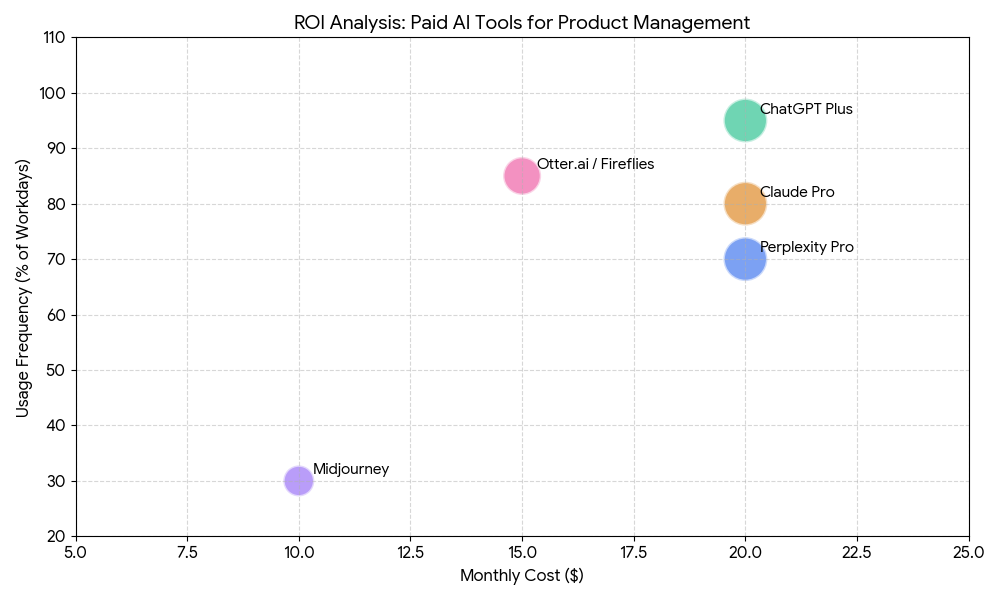
This is where it goes off the rails. I’ve now got ChatGPT Plus, Perplexity Pro, Granola, and I’m told I “need” NotebookLM (which is free, at least). Then I add two more things — a second general assistant, because someone online swore by it, and an AI note-taking app that syncs with my calendar. Within a month I’m subscribed to six AI tools and using three. The second assistant is worse than the first for everything I try. The note-taking app transcribes and then I don’t read the notes, because I don’t read transcribed notes. I’m paying for the illusion of organization.
A Productboard survey around this time says essentially every product team is now using AI in some form. Great. The problem isn’t adoption anymore. The problem is that most of the money is going to tools I open once a week and forget.
First pruning: two subscriptions cancelled, ~$35/month saved. Nobody in the company notices. I do.
v0.5 — October 2025: the autonomous agent experiment
I try Manus, the fully autonomous research agent — give it a goal, come back later, get a completed task. This is the exciting one. I hand it a competitive analysis brief and go to a meeting. It comes back with… a document. Which is impressive until I read it. It’s confident, well-structured, and wrong in the places I know best and unverifiable in the places I don’t. The sources are there but the reasoning over them is shaky. I spend more time correcting it than I’d have spent writing the thing.
The honest verdict: autonomous agents are solving the wrong problem for me right now. I don’t need a machine to do the whole task. I need a machine to do the boring 70 percent and leave the judgment to me.
Dropped, with respect. The category will get there. This version doesn’t.
v0.6 — November 2025: the audit
I do what I should have done in September: I open my bank statement, list every AI subscription, and add up the total. It’s over $200 a month. There’s a reason the guidance keeps repeating the same sentence about $200 months on tools you don’t use — because everyone does it.
The rule I adopt and keep from this month on: a tool survives only if it owns a concrete job end-to-end. Not “helps with.” Owns. If I can’t name the exact recurring task a subscription kills, it’s cut. This rule eliminates half my subscriptions and every ounce of guilt about using fewer tools.
v0.7 — December 2025: Claude enters for the long documents
I need to synthesize ten user-interview transcripts into a research readout, and I’m dreading it — the kind of task that eats an afternoon. Someone points me at Claude for long-context document work, and I paste the transcripts in. It does in minutes what used to take me most of a day: pulls the themes, quotes the participants, separates what’s repeated from what’s anecdotal. The output isn’t perfect. But it’s a ninety-percent draft of work I’d have spent hours on, and editing is cheap.
This is the moment the stack starts to feel like a stack. Perplexity for the outside world, NotebookLM for my own documents, Granola for meetings, Claude for the long reading-and-synthesizing work. Each one owns a lane.
v0.8 — January 2026: I get brave about the terminal
I’ve been watching people use Claude Code — the terminal-based agent that works on actual files — and my own earlier skepticism about terminal agents was partly wrong. It turns out it’s not just for engineers. I give it a folder of research notes, specs, and drafts and ask it to assemble a PRD. It reads the files, follows the structure I describe, and produces a document that would have taken me the better part of two days. The prompt quality matters enormously — garbage prompt, garbage PRD. But when the input is real files, the output is dramatically more grounded than anything I ever got from pasting context into a chat window.
Keep, but scoped. The tool is a multiplier for people who know what a good PRD looks like. It’s a shortcut, not a substitute for knowing the product.
v0.9 — February 2026: prototyping gets faster
v0 by Vercel enters the picture when I need to show a stakeholder what a new onboarding flow might feel like. I describe the screens; it generates a usable interactive prototype. Two hours later I’m in a meeting with something to click instead of a sketch. For a PM, that’s a meaningful difference — stakeholders react to things you can click.
Kept, used rarely but used deliberately. It’s not a monthly subscription I fret about. It’s a tool I reach for when the job needs a visual.
v1.0 — March 2026: the line in the sand
By March I’ve settled into something and I notice a pattern: the tools handle the production of work, and I handle the decisions about work, and the boundary is starting to feel stable. The AI drafts the roadmap; I argue about the priorities. The AI synthesizes the feedback; I decide what it means. The AI writes the first version of the launch note; I rewrite the opening paragraph until it sounds like us.
And there are things I won’t let it touch, and I’m not ashamed of that. I don’t let it draft anything that goes to an executive without a human edit pass. I don’t let it answer for me in a sensitive stakeholder conversation. I don’t let it prioritize my backlog by itself, ever — it’s too good at sounding logical about things it has no stake in. The research on automation bias keeps saying the same thing: the smoother the machine, the easier it is to stop checking. The tools are better now. The human obligation to review isn’t.
The stack that survived
Here’s what’s actually left, and what it costs:
| Tool | The job it owns | Cost | Honest catch |
|---|---|---|---|
| Perplexity Pro | Cited market and competitor research | $20/mo | Verify before you present it, but at least you can verify |
| Granola | Meeting capture and action items | $14/mo | Only as good as your habit of reading the output |
| NotebookLM | Synthesizing my own docs and interviews | Free | No hallucinations on your files, but it won’t invent insight either |
| Claude (Pro) | Long-document reading and synthesis | $20/mo | Output quality tracks input quality |
| Claude Code | File-based assembly: PRDs, readouts | included | Needs a clear brief to be worth the setup |
| Linear | Execution, backlog, planning | Free tier | The AI features are nice; the discipline is the point |
| v0 | Clickable prototypes on demand | Occasional | Rarely used, but irreplaceable when needed |
Total: about $55 a month for the subscriptions that matter, and no tool that doesn’t own a job.
What this stack will not do
The honest part, saved for the end, because every real changelog has a known-issues section.
It won’t make you a better product thinker. The tools compress the work around the thinking; they don’t do the thinking. My best calls this year were still mine, made with incomplete information and a deadline.
It won’t replace judgment calls about people. I still read every sensitive email twice, with the AI’s draft as a suggestion, not a verdict.
And it won’t stop changing. Three of the tools in this stack didn’t exist in their current form two years ago, and at least two of them won’t be in the stack two years from now. The useful skill, I’ve decided, isn’t knowing the tools. It’s the discipline of asking, every quarter, the same boring question the changelog forced me to ask: does this tool own a job, or is it just renting my attention?
The tools that survive that question are the stack. Everything else was a subscription.

Independent technology writer focused on artificial intelligence, emerging technologies, and digital innovation. Covers AI applications in sports, productivity, and online business.