




















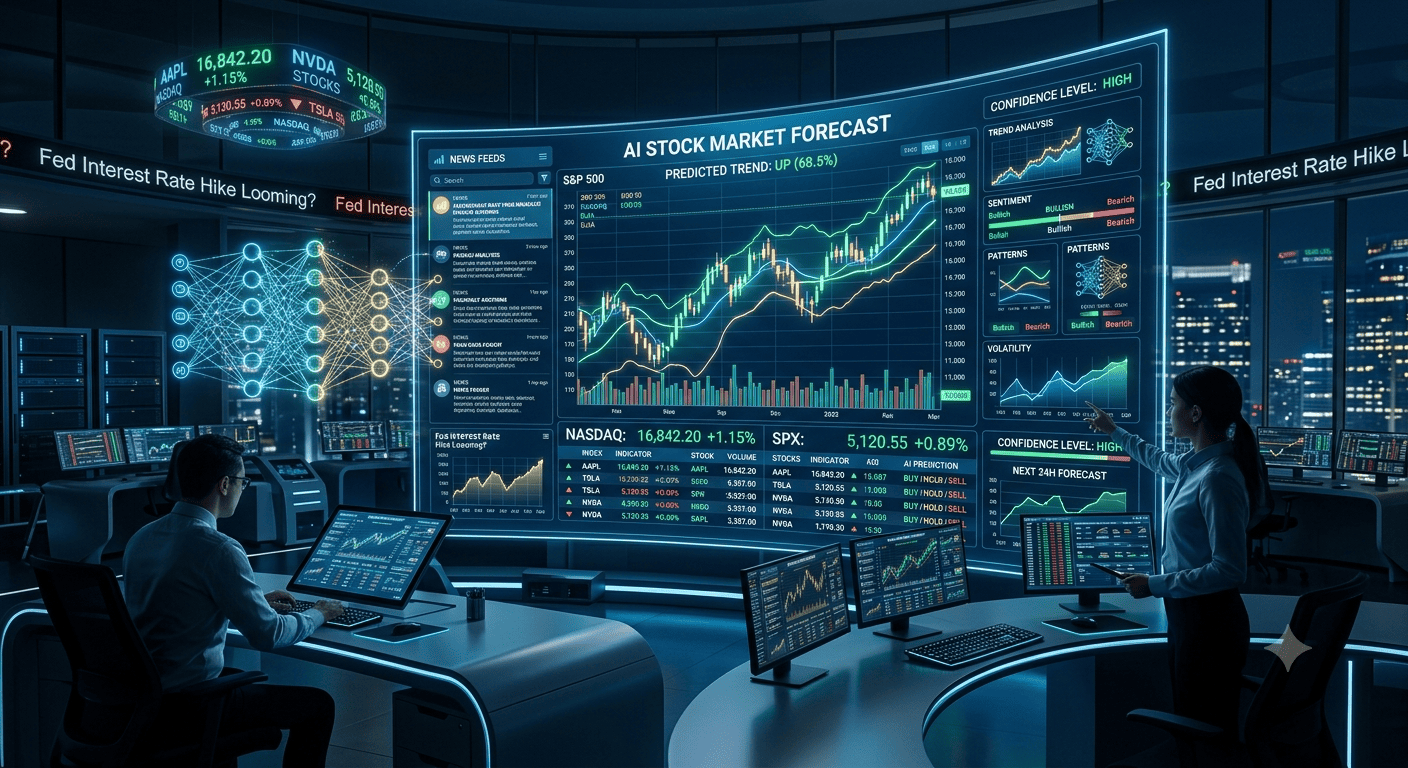
The short answer is no — AI cannot reliably predict the stock market in any way that generates consistent returns for the average person. The longer answer is more nuanced and more useful. Some forms of AI, deployed by institutions with infrastructure retail users cannot access, extract small statistical edges. Consumer LLMs do not. This article examines the evidence.
The Short Answer
No, AI cannot reliably predict the stock market.
The U.S. Commodity Futures Trading Commission stated it directly in 2025: “AI technology can’t predict the future or sudden market changes.” In a controlled 2026 contest where eight leading AI models traded real money, they were profitable in only 6 of 32 runs and lost about a third of their capital overall. Retail AI trading bots show a median monthly return of -2.1%. Over 80% of retail bot users lose money.
These numbers matter because they contradict the marketing. The tools being sold to retail users do not do what they claim.
What Academic Research Actually Says
A 2025 review of 84 papers on LLMs in equity investing found that direct LLM prediction “cannot outperform models with numerical values as input.” A March 2026 mathematical paper proved that for a specific and common class of financial prediction tasks — using historical prices to predict future prices — increasing model complexity strictly and provably increases prediction error. The model learns noise, not signal.
Some specialized models show marginal edges. A June 2026 study published in Humanities and Social Sciences Communications demonstrated that a hybrid LSTM-MLP neural network, using high-frequency intraday data, reduced signal volatility and produced lower turnover than Random Forest or XGBoost. But this model requires granular transaction data from the TAQ database and is designed for institutional portfolio management, not retail trading.
Another study showed that grounding LLM stock recommendations in official regulatory filings improved forecasting accuracy — but even then, the models required substantial human oversight and still exhibited recurring reasoning failures in data retrieval, financial interpretation, computation, and meta-reasoning.
The academic consensus: narrow, specialized models can extract small statistical edges. General-purpose LLMs cannot.
The Institutional vs. Retail Gap
The gap between institutional AI trading and retail AI tools is not small. It is structural.
Institutional quant funds operate with:
- Data latency under 1 millisecond (retail: 100-500 milliseconds)
- 200+ alternative data feeds (retail: 15-30 feeds)
- Continuous model retraining (retail: daily or weekly)
- Annual R&D budgets in the hundreds of millions
- Custom FPGA and ASIC hardware (retail: cloud GPU)
Renaissance Technologies’ Medallion Fund — the most successful quantitative fund in history — returns are built on statistical edges measured in fractions of a percent across enormous numbers of trades. That is the actual ceiling on AI-driven trading performance, and it is built by hundreds of PhDs over decades, not by a subscription bot.
Retail AI tools cannot replicate this infrastructure. The retail trading bots on the market are, in many cases, simple rule-based scripts dressed in AI marketing. An estimated 95% of retail “AI” bots fall into this category.
What LLMs Specifically Get Wrong About Markets
Large language models fail at stock prediction for reasons that are structural, not fixable with better prompting.
They train on stale data. LLMs are trained on a frozen snapshot of the web. By the time a model is trained, deployed, and queried, the news it is reasoning about has been priced for hours or days. Markets are roughly efficient — anything available in public information is already reflected in prices.
They optimize for plausibility, not accuracy. An LLM generates the most likely next token. For prediction, this is a fundamental mismatch. The plausible answer is almost always “this stock will continue what it has been doing” — which fails during reversals. The model’s optimization target has nothing to do with being right about the future.
They hallucinate financial data. Ask an LLM for a current stock price and you will get either a confident wrong answer or a refusal. They have no live data feed without external integration.
They have no concept of risk management. An LLM does not know your account size, your drawdown tolerance, your sector concentration, or your overnight risk. It will confidently recommend a position size that could wipe out your portfolio.
For a deeper look at related AI limitations, our article on How AI Agents Are Reshaping Financial Services in 2026 covers what AI can and cannot do in finance.
Where AI Does Help Traders
AI cannot predict prices. It can help with narrower, real tasks.
Research acceleration. Perplexity and similar tools can summarize earnings calls, extract key metrics from filings, and aggregate analyst opinions faster than manual reading. The output still needs human verification.
Strategy discipline. Rule-based bots can execute a predefined strategy without emotional interference. The value is in the execution discipline, not in prediction.
Risk monitoring. AI tools can scan portfolios for concentration risk, correlation shifts, or volatility changes that a human might miss.
Educational scaffolding. LLMs can explain financial concepts, walk through options mechanics, or clarify regulatory requirements.
The honest framing: AI is a research and execution assistant, not a forecasting engine.
H2: The Regulatory Picture
Regulators have noticed the gap between marketing and reality.
The CFTC issued an advisory titled “AI Won’t Turn Trading Bots into Money Machines,” stating flatly that AI cannot predict the market and calling promises of high win rates a red flag for fraud. The SEC issued formal guidance in February 2026 requiring disclosure of AI involvement in investment advice. FINRA placed AI supervision as one of its top two examination priorities for 2026.
These are not hypothetical concerns. The SEC has sued operators of fake AI trading bot schemes. The regulatory direction is clear: making unsupported claims about AI trading performance is an enforcement risk.
For more on evaluating AI tools critically, see our How to Evaluate AI Tools framework.
Frequently Asked Questions
Has any AI ever consistently beaten the market? Institutional quant funds like Renaissance Technologies have generated extraordinary returns using machine learning. But their methods — proprietary data, custom hardware, hundreds of PhDs — are not replicable by retail users. The funds that make these returns also consume enormous resources.
What about AI trading bots with 90% win rates? Win rates in isolation are misleading. A bot can have a 90% win rate and lose money overall if the 10% of losing trades are much larger than the winning ones. Any platform that advertises win rates without risk-adjusted return metrics is using a selective statistic.
Can ChatGPT pick stocks? ChatGPT can generate a list of stocks with rationales that sound convincing. There is no evidence that these recommendations outperform the market over time when tested out-of-sample with proper methodology.
Is there any AI tool that helps with trading? AI tools like TradeAlgo that focus on options scanning or pattern recognition have reported win rates in the 57-67% range for retail. These are narrow tools, not prediction engines. They identify patterns in data; they do not forecast prices.
What should I look for in an AI trading tool? Transparent, live-tracked performance data. Clear explanation of methodology. Realistic return expectations. Regulatory compliance disclosures. Avoid any tool that guarantees returns or claims to predict the market.
Conclusion
AI cannot predict the stock market in any way that generates reliable returns for retail users. Consumer LLMs lack the data, the optimization target, and the infrastructure for the job. Specialized institutional models extract small edges at enormous cost. The gap between what AI trading marketing promises and what AI can actually deliver is wide and well-documented. Use AI for research, discipline, and risk monitoring. Do not use it for predictions.

Independent technology writer focused on artificial intelligence, emerging technologies, and digital innovation. Covers AI applications in sports, productivity, and online business.