







The opening tick
For affiliate marketers, there is exactly one currency: traffic. Everything else — rankings, content, algorithms — is just the machinery that moves it. And in 2026, the market for that currency is split between two venues that play by different rules, reward different skills, and pay different rates.
The question isn’t academic. Your income is a function of the answer. So let’s read the tape on both venues — where the traffic is now, where it’s flowing, and where an affiliate should be positioned when the year closes.
Market One: Google Search the incumbent exchange
Google is still the biggest venue on the board, and it’s still the default for most product research. But the incumbency is now defensive. According to BrightLocal’s 2026 survey, Google’s share of local-business discovery fell from 83% to 71% in a single year — while something else was rising fast on the other side of the board.
The bigger structural change is in what a Google result even is. AI Overviews now sit at the top of a large share of commercial queries, and when they appear, click-through rates drop by roughly half — from around 15% to around 8%. The venue is becoming an answer machine: the user gets the summary on the page, and the affiliate behind the link gets the click only when the summary isn’t enough.
Google’s rules for affiliates have also hardened. The Helpful Content era reclassified thin, aggregated content as noise, and the surviving winners are the first-hand, tested, original-content pages. The exchange still pays — but it pays only for proof, and it withholds its traffic from everything else.
Market Two: AI Search the new venue
The other side of the board is the fastest-moving asset in the market. ChatGPT, Perplexity, Gemini’s AI mode — the answer engines — went from 6% of local-business discovery to 45% in a single year. That’s not a trend; that’s a takeover in progress.
The mechanics are different, and affiliates must understand them. In the old venue, the user clicks your link. In the new venue, the user doesn’t click anything — the engine answers from your content. The model of value shifts from “getting the click” to “getting the citation.” Research on how these engines choose sources has found that clear, direct answers in the 40-to-75-word range get cited far more often — and that deep, first-hand content is the material the engines keep coming back to.
The trust data is startling and worth sitting with: 64% of AI users say they trust ChatGPT’s recommendations as much as customer reviews. But — and this is the counterweight that saves the affiliate — 88% of AI users verify the sources before acting. The citation is the click of the new venue. It’s just a click that happens in a different place.
The price action: the metrics that matter
Read the numbers side by side and the divergence in the tape is unmistakable:
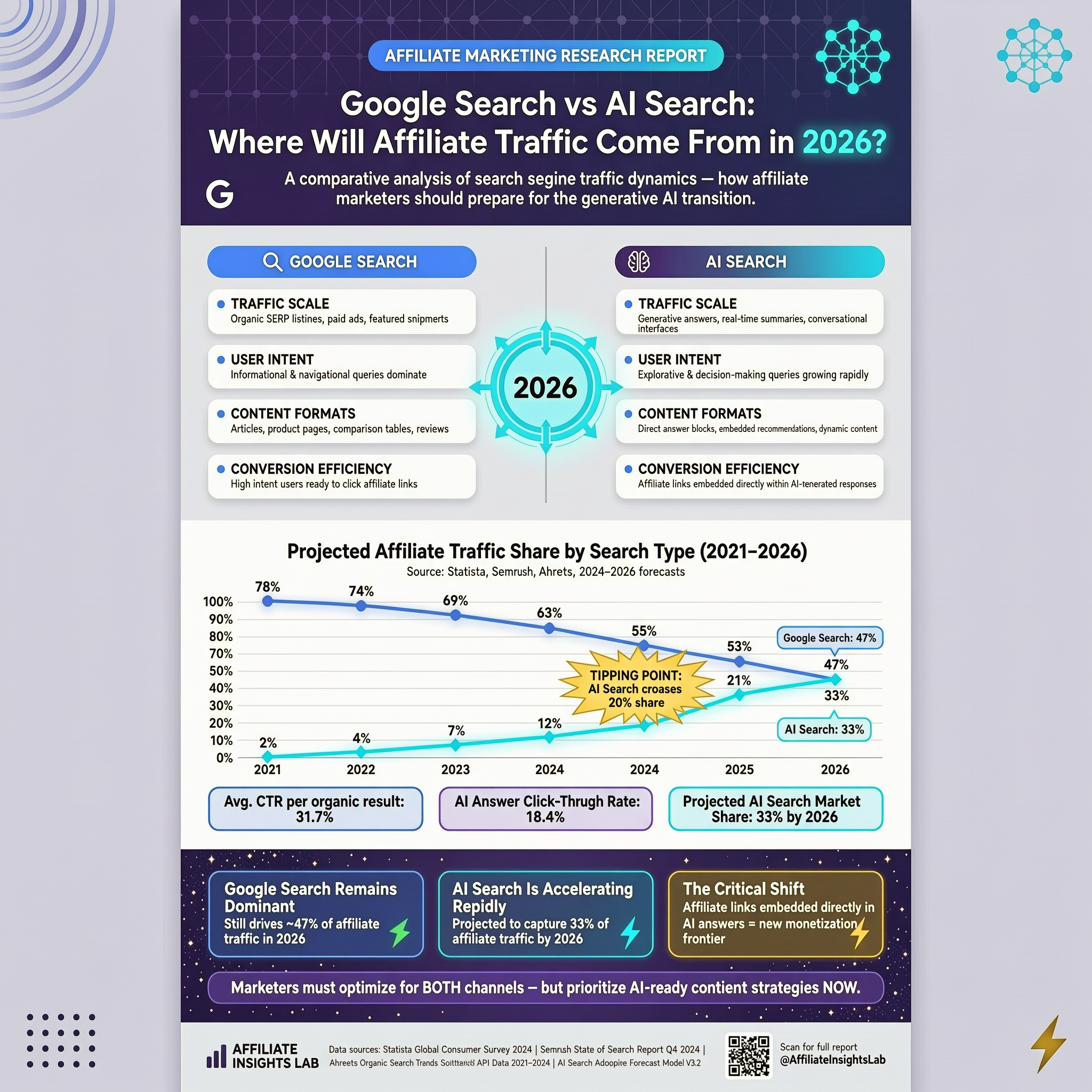
- Volume: Google still holds the larger share of overall traffic. AI search went from almost nothing to 45% of discovery in twelve months and is still climbing.
- Yield per interaction: A Google click is worth what your page converts. A citation is worth what it’s worth when the user verifies — which is less predictable, and frequently happens later, on a different channel.
- Volatility: Google’s updates have made its payouts historically unstable. AI search’s citation game is young, less gamed, and structurally calmer — for now.
- Information vs. intent: This is the trade that defines both venues. Informational queries — “how do I choose X?” — are being absorbed by AI answers. Transactional intent — “buy X now” — still flows through the old exchanges and through direct sources. The money in 2026 is in the difference between those two.
If you’re watching this market, the shift was visible in the data long before the headlines caught up — the same way algorithmic trend detection spots movements in markets before the crowd does. The movement was already in the tape in 2025; 2026 is the year it became the main story.
The divergence: two venues, two different games
Here is the point where most affiliates get hurt: they treat both venues as one market, and they aren’t.
Google rewards authority. First-hand experience, original research, E-E-A-T signals, demonstrated proof. Its filters were built to bury everything that looks synthesized. The winner on Google is the expert.
AI search rewards quotability. Structured answers, clear direct sections, specific numbers, content that can be lifted and cited without distortion. Its engines were built to summarize, and they cite whatever summarizes cleanly. The winner in AI search is the reference.
These overlap — the first-hand expert content is exactly what both engines end up citing — but they’re not identical skills. An expert essay that rambles gets buried by AI search. A crisp, structured page with no proof gets buried by Google. The affiliate who only optimizes for one venue is trading on one leg.
The flow forecast for 2026
The forecast, clearly labeled as projection rather than promise:
The mix is not a switch, it’s a migration. Google will not die this year, or next. It will keep paying for transactional traffic and for content that proves itself. But its share of informational discovery will keep eroding as AI answers absorb the questions. AI search will keep growing as a discovery layer, and — the honest wrinkle — it will increasingly be the first stop for the decision-making process.
The durable position for an affiliate is not a bet on either venue. It’s a portfolio: content that ranks on Google and gets cited by engines and reaches an owned audience the moment a citation converts into curiosity. The pattern is consistent across every surviving affiliate: three or more independent traffic sources. The ones who survived the last two years of algorithm chaos were the ones diversified across channels. The ones who thrive through 2026 will be the ones diversified across venues — including the one they own outright.
The good news embedded in the forecast: the two venues reward the same underlying asset. The content that ranks is the content that gets cited, because both markets are hungry for the same thing — proof. You are not building for two engines. You’re building one asset that two engines both want.
The playbook: trading both venues
Practical positions for the year ahead:
- Structure for citations. Answer-first sections, direct summaries in the 40-to-75-word band, specific numbers, methodology. Make your content liftable — the engines that lift it become your distribution.
- Prove everything. Original testing, original images, real measurements. It’s the single factor that both ranking systems reward, and the one thing mass-produced content can’t fake.
- Keep the transaction on your side. Build the email list and the community now, because a citation that becomes a visitor who becomes a subscriber is worth ten clicks. Owned audience is the hedge that pays when every venue changes its rules.
- Watch the tape. Venue shares are moving quarterly now. The affiliate who measures which channel produces actual revenue — not just traffic — reallocates early. The rest arrive late to every shift.
The risk disclosure
No trading advice is complete without the honest disclaimer, so here it is. Nothing in this market is guaranteed. AI engines could tighten citation practices. Google could respond with a commercial AI layer of its own that changes the entire board. Attribution across the two venues is still imperfect, which means your measurement of “where traffic came from” has real error bars.
But the direction of the flow is not ambiguous: it runs from answer-less clicks toward answered questions, from discovery toward verification, from rented attention toward owned attention. Affiliates don’t control the market. They control their position in it. In 2026, the correct position is the same in every forecast: build proof, structure it to be quoted, and own the audience that both venues can only reach by first pointing at you. Predict where the flow goes all you want — forecasting is probabilistic, not guaranteed — the affiliate who survives is the one positioned on both banks of the river when the current shifts.
The opening tick was one sentence, and the closing one is its conclusion: Google search still brings traffic, AI search is taking the discovery layer, and the money in 2026 belongs to whoever is findable in both and owned by neither.

Independent technology writer focused on artificial intelligence, emerging technologies, and digital innovation. Covers AI applications in sports, productivity, and online business.