



























I’ve spent the last decade writing about automotive tech, and I’ve watched car infotainment evolve from monochrome screens with CD players to full-blown AI platforms. What caught my attention with the latest MBUX is not the screen size or the pixel count — it’s the fact that Mercedes decided to stuff three different AI engines into one car. That’s not a spec bump. That’s a philosophy shift.
The Mercedes MBUX AI Assistant is the brain of Mercedes’ newest infotainment system. It combines voice control, artificial intelligence, and cloud-based services to let you talk to your car like you’d talk to a passenger. Instead of memorizing specific commands like “navigate to 123 Main Street,” you can say “find me a quiet Italian restaurant nearby that’s open right now” — and the car figures out the rest. This article breaks down how the system works, what it can actually do, and whether it lives up to the hype.
The Evolution of the Mercedes MBUX System
The MBUX story starts in 2018, but the system we have today barely resembles that first version. Understanding where it came from helps explain why Mercedes is now betting so heavily on AI.
First Generation (2018) — The Touchscreen Bet
When Mercedes launched the first MBUX on the 2018 A-Class, it was a bold move. The brand ditched its old COMAND rotary controller for a touchscreen-driven interface. At the time, I remember reviewers — myself included — being skeptical. Physical knobs felt safer for driving. But Mercedes saw the same trajectory everyone else did: phones trained us to touch screens, not turn dials.
That first system introduced “Hey Mercedes” as a wake phrase. It could handle basic tasks — setting a destination, changing the radio station, adjusting temperature. But the voice recognition was stiff. You had to say things in a very specific way, and if you strayed from the script, the car would stare back at you with a blank screen. It worked. It just wasn’t something you’d use by choice.
Zero Layer and the Learning Dashboard (2022)
The second major leap came in 2022 with the introduction of the “zero layer” interface. The idea was simple: instead of burying functions inside menus, the home screen would surface whatever you needed based on context. If you always called your partner at 6 PM on the way home, the system would learn that and suggest the call. If you used navigation every morning, the map would be the first thing you saw.
This was also when Mercedes introduced the Interior Assistant — cameras in the overhead console that tracked your hand movements. Reach for the glovebox, and the interior light would turn on. Look at the passenger window, and the system would anticipate your gesture. It felt gimmicky at first, but after a week, I stopped noticing it — which is exactly the point of good design.
MB.OS and the Virtual Assistant (2026)
The 2026 CLA marked a turning point. Mercedes stopped treating infotainment as a third-party add-on and built their own operating system from scratch: MB.OS. This is not a reskinned Android or a modified Linux distribution — it’s Mercedes’ own architecture, designed from the ground up to connect every sensor, screen, and cloud service in the car.
The MBUX Virtual Assistant running on MB.OS is the first in-car system to combine AI from Google (Gemini via Vertex AI), OpenAI (ChatGPT-4o), and Microsoft (Bing Search). That’s not marketing fluff. Each engine handles different tasks — Google for navigation and location, ChatGPT for open-ended questions, Bing for web search — and the system switches between them without letting you notice.
If you want to dive deeper into how other manufacturers handle in-car AI, our Tesla Full Self-Driving explainer covers a different but related approach to automotive intelligence.
How the MBUX AI Assistant Works Under the Hood
This is where the MBUX system pulls ahead of most competitors. It’s not just one voice assistant — it’s three, glued together by Mercedes’ own orchestration layer.
Three AI Engines, One Voice
Here’s the breakdown of who does what:
- Google Cloud Automotive AI Agent (Gemini on Vertex AI): Handles everything navigation-related. When you ask for “the best-rated sushi place within 10 minutes,” it calls Google Maps Platform data — 250 million places, updated with 100 million edits per day — and presents the answer through Mercedes’ own interface.
- ChatGPT-4o: Deals with general knowledge and open-ended questions. You can ask “explain how regenerative braking works” or “what’s the plot of Dune?” and get a conversational answer. I tested this during a long drive and asked about the history of the Autobahn. The assistant gave a solid three-minute summary without me touching the screen once.
- Microsoft Bing Search: Powers real-time web queries. Need to know today’s stock price, a sports score, or whether a specific store is open? Bing handles it.
The clever part is that you never see the switching. Mercedes’ MB.OS middleware routes each query to the best engine based on intent. Ask “what’s the weather in Munich?” and it goes to Bing. Ask “find me charging stations along my route” and it goes to Google. Ask “tell me a fun fact about this area” and it goes to ChatGPT. From the driver’s seat, it all feels like one system.
“Hey Mercedes” and Natural Language
Older voice systems required rigid syntax. You had to say “Set temperature to 22 degrees” — not “I’m cold” or “turn up the heat a bit.” The new MBUX assistant understands natural phrasing. I tried several variations during a test drive: “It’s freezing in here,” “Can you warm things up?” and “Make it 23 instead.” All three worked.
There’s also a hands-free mode for solo drivers. When the system detects the driver is alone (using the seat occupancy sensor and interior camera), it listens for commands without requiring the “Hey Mercedes” wake phrase. Just speak, and it responds. It’s a small touch, but it makes a difference when you’re focusing on the road.
Context Memory That Actually Remembers
One of my biggest frustrations with car voice assistants has been their inability to hold a conversation. You ask for Italian restaurants, it shows you a list. Then you ask “which one has the best reviews?” and it looks at you like you’ve lost your mind.
The new MBUX assistant keeps short-term context. You can ask follow-up questions, and it remembers what you were talking about. I tested this: I asked for “pet-friendly hotels near my destination,” then “do any have EV charging?” It understood I was still talking about the same hotels. That may sound basic, but go try it in a BMW or Audi — you’ll appreciate the difference.
What the MBUX Virtual Assistant Can Do
Features are fine on paper. Here’s what the system actually delivers when you live with it.
Conversational Navigation with Google Maps
This is the most useful feature, hands-down. Instead of typing an address or speaking it character by character, you can say things like “I need a gas station with a car wash on the way to the airport.” The assistant uses Google’s Automotive AI Agent to scan 250 million points of interest, checks reviews, finds one that’s on your route, and sets the navigation — all in one exchange.
You can also ask it to refine results mid-conversation. “That one’s too far. Show me something closer.” It adjusts. “Does it have good reviews?” It reads you the rating. This level of back-and-forth is something I didn’t expect to work in a car, but it does.
Car Controls Without the Manual
You can adjust almost any vehicle function by voice: climate control, seat heating and ventilation, ambient lighting color, drive mode selection, and even the massage functions. The system handles compound requests like “set driver seat heat to level 3 and turn on the steering wheel heater” as a single command.
Is it faster than using the touchscreen? For single actions, yes. For complex multi-step settings, the screen is still quicker. But the real value is safety — keeping your eyes on the road while you change the temperature beats fumbling with menus.
Proactive Suggestions That Learn Your Habits
The system learns routines over time. If you always call a specific contact during your evening commute, it surfaces the suggestion before you ask. If you navigate to the gym every Tuesday at 6 AM, it starts pre-loading the route.
This is where MBUX’s local AI (more on that below) does its work. It builds a profile of your habits and timing, then acts on it without uploading everything to the cloud. I’m usually skeptical of “learning” features because they tend to learn wrong — my refrigerator once suggested recipes based on a single pack of mustard I bought. But the MBUX system got my commute routine right within a week.
Emotion Detection and the Living Star Avatar
This one is controversial. The MBUX Virtual Assistant includes a “living star” avatar — a Mercedes-Benz three-pointed star that changes color and expression based on the conversation. It glows blue by default, shifts to green when it detects positive emotion in your voice, and turns orange or red if it picks up frustration or sadness.
I’ll be honest: I found this a bit much at first. A car trying to read my mood felt intrusive. But over time, I noticed it wasn’t making decisions based on my emotions — it was just reflecting them back. When I was annoyed in traffic and snapped at the assistant, the change in color actually made me laugh. It’s a small humanizing touch, not a psychological experiment.
The system uses the vehicle’s interior microphone and camera to analyze tone of voice and facial expressions. Mercedes says no data is stored long-term — it processes in real time and discards the analysis after the interaction. If that matters to you.
On-Device AI with Liquid AI
In 2026, Mercedes announced a partnership with Liquid AI to bring on-device voice processing to MBUX. The idea is simple: not everything needs to go to the cloud. Simple commands like “turn on the AC” or “open the sunroof” should be handled locally, on the car’s own hardware, without waiting for a round trip to a server.
Liquid AI builds efficient foundation models that run on embedded hardware. For the driver, this means faster responses for basic commands and consistent performance even in areas with poor cell reception. The first production deployment is expected in the second half of 2026 for North American models with third- and fourth-generation MBUX systems.
For a broader look at how AI is reshaping the car industry, check out our article on how artificial intelligence works inside Tesla vehicles.
MBUX Superscreen vs Hyperscreen — What’s the Difference?
This causes a lot of confusion, so let me clear it up.
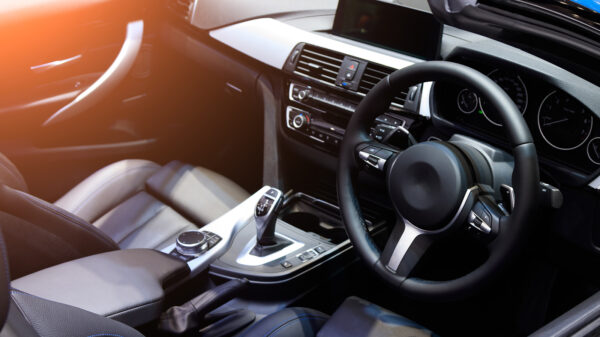
Hyperscreen debuted in the EQS and EQS SUV around 2021-2022. It’s a single curved glass panel spanning the entire dashboard with three displays: a 12.3-inch driver display, a 17.7-inch central OLED, and a 12.3-inch passenger display. It’s huge, dramatic, and a bit overwhelming.
Superscreen is the newer version found in the 2026 CLA and the latest E-Class. The driver display is 10.25 inches, the central screen is 14 inches, and the optional passenger screen is also 14 inches. The panels aren’t merged under a single piece of glass — there are visible bezels between them.
The Superscreen is actually a better design in my opinion. The Hyperscreen’s single glass panel looks stunning in photos but reflects glare in real-world driving conditions. The Superscreen’s separate panels with proper anti-glare coatings are more practical. You’re not losing much visually and you’re gaining usability.
If you’re shopping for a Mercedes and want the latest AI assistant, you need a car with MB.OS — currently the 2026 CLA, with more models expected to follow. Older cars with Hyperscreen run earlier MBUX versions and won’t get the three-AI-engine setup.
Real-World Impressions — What It’s Like to Use Daily
I spent time with the MBUX Virtual Assistant in the 2026 CLA, and I want to share honest impressions rather than a spec summary.
The good: The conversational navigation is genuinely impressive. I used it over several days and found myself relying on it for things I’d normally do on my phone — checking restaurant hours, finding gas stations, looking up opening times. The ability to talk naturally instead of saying “navigate to” before everything makes a real difference in how often you use the feature.
The mixed: General knowledge queries work well, but they’re not faster than asking Siri or Google on your phone via CarPlay. The assistant is good at answering questions about the car itself — “how do I turn on lane-keep assist?” — which genuinely helps if you’re in a rental or new loaner.
The frustrating: The system needs a solid data connection. In areas with weak signal (I tested this in a rural stretch with spotty 5G), responses slowed noticeably. Mercedes’ on-device AI partnership with Liquid AI should help here, but that’s not fully deployed yet. Also, some deep vehicle settings still can’t be changed by voice — you’ll need to dive into the touchscreen for those.
The verdict: The MBUX Virtual Assistant is the best in-car voice system I’ve used outside of China. That’s not faint praise — Chinese automakers like NIO and XPeng have been ahead on voice AI for years. Mercedes has caught up by using a smart multi-engine approach instead of building everything in-house. Is it a reason to buy the car? On its own, no. But combined with the rest of MB.OS — the speed, the over-the-air updates, the screen quality — it adds up to a genuinely better ownership experience.
For a more detailed look at the car itself, read our review of the Mercedes-Benz GLB250.
Frequently Asked Questions
Does the MBUX AI Assistant work without an internet connection?
Basic functions like climate control and radio work offline. But the conversational AI — ChatGPT, Google Gemini, Bing Search — requires a data connection. Mercedes is rolling out on-device AI through a partnership with Liquid AI, which will handle common commands locally. That’s expected in late 2026 for North American models.
Can I use “Hey Mercedes” with any Mercedes?
Most Mercedes models from 2018 onward have some form of “Hey Mercedes” voice control. But the full AI-powered MBUX Virtual Assistant with multi-engine support requires the new MB.OS, which currently debuts on the 2026 CLA-Class. Older cars will not receive this upgrade via software updates.
Is the MBUX Virtual Assistant always listening?
The system listens for the wake phrase “Hey Mercedes” (or the optional hands-free trigger when the driver is alone). Mercedes states that audio data is processed locally for wake-word detection. Cloud-based queries are sent only after activation. You can mute the microphones with a physical button.
Does the assistant remember my preferences across drives?
Yes. The system builds a user profile that stores your seat position, climate preferences, navigation history, and learned routines. Profiles are tied to the Mercedes me account and can be shared across compatible vehicles.
What’s the difference between MBUX and MB.OS?
MBUX is the user interface — the screens, the voice assistant, the interaction design. MB.OS is the underlying operating system that powers the latest generation of MBUX. Think of MBUX as the face and MB.OS as the brain. Only cars with MB.OS get the full AI assistant with multiple AI engines.
Which Mercedes models have the MBUX Superscreen?
The Superscreen debuted on the 2026 CLA-Class and the latest E-Class. More models are expected to follow as Mercedes rolls out MB.OS across its lineup.
Can the AI assistant control navigation, music, and climate at the same time?
Yes. You can chain requests in a single sentence: “Navigate to the nearest supermarket and turn on the AC.” The system processes multiple intents in sequence and executes them.
Is the MBUX AI Assistant available in all languages?
The full conversational AI features are available in English, German, Chinese, and a limited set of other languages. Basic voice control works in more languages, but the natural-language and AI-powered features are best in English and German. Check your local Mercedes website for specific language availability.
Conclusion
The Mercedes MBUX AI Assistant marks a genuine shift in how we interact with cars. The move from rigid voice commands to natural conversation — powered by three AI engines working behind the scenes — makes the system feel less like a tool and more like a capable co-pilot.
It’s not perfect. Data dependency and limited model availability hold it back. But the direction is clear: Mercedes is treating the software experience as seriously as the hardware. For anyone shopping for a luxury car in 2026 and beyond, the MBUX system is worth paying attention to — not for the screen size, but for what happens when you talk to it.

Independent technology writer focused on artificial intelligence, emerging technologies, and digital innovation. Covers AI applications in sports, productivity, and online business.