






















A limited-edition car is supposed to give its owner something most cars can’t: exclusivity.
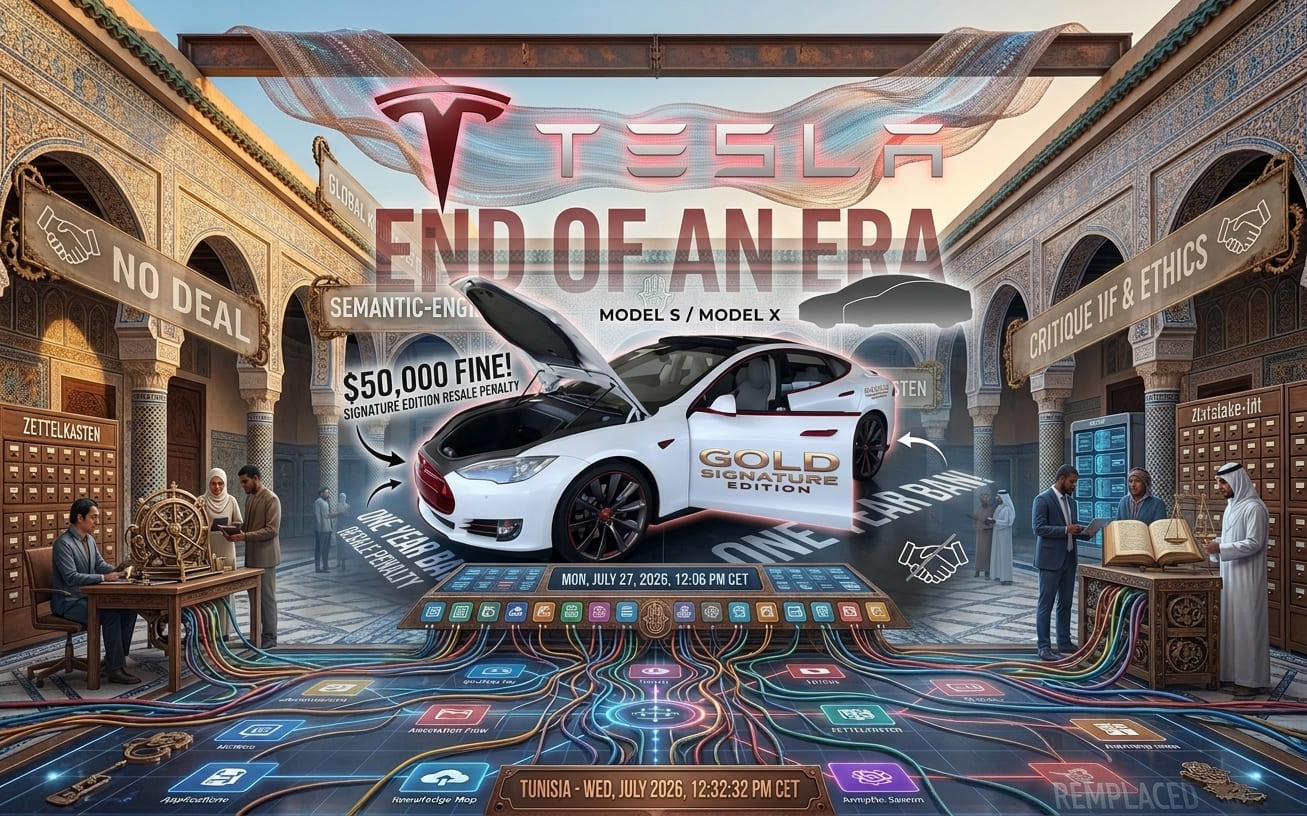
Tesla’s final Model S and Model X Signature Edition takes that idea a step further.
Only 350 are being made — 250 Model S cars and 100 Model X SUVs. The cars were offered through an invite-only process, finished with exclusive styling and numbered details, and positioned as the final chapter for two of Tesla’s most important vehicles.
But there is a catch that matters far more than the gold badges.
Buyers who signed Tesla’s Signature Edition No Resale Agreement agreed not to sell or even attempt to sell the vehicle during the first year after delivery. According to a copy of the agreement reported by Electrek, violating that restriction can trigger liquidated damages of $50,000 or the full resale amount, whichever is greater.
That makes the Signature Edition more than a collectible.
It makes the contract part of the product.
Tesla Really Is Ending the Model S and Model X
Before getting into the resale controversy, it’s worth separating the facts from the outrage.
Tesla has actually ended production of the Model S and Model X.
Tesla’s own website now describes the Model X as no longer in production, while the final Signature Edition served as a limited farewell to both models. The last run consists of 350 vehicles: 250 Model S units and 100 Model X units.
The cars were based on the Plaid versions and received a distinctive Garnet Red finish, gold Tesla and Plaid badges, special interior details and numbered identification.
They were also expensive.
The Signature Edition launched at around $159,420, depending on model and configuration.
That combination — tiny production numbers, a final-production status and a high price — creates exactly the kind of vehicle that can attract collectors and speculators.
And that’s where Tesla’s resale restriction comes in.
What Tesla’s No-Resale Agreement Actually Does
The important thing here is not the headline “$50,000 fine.”
It’s the structure behind it.
The agreement reported by Electrek requires the buyer not to sell or otherwise attempt to sell the vehicle during the first year following delivery.
If the buyer violates that restriction, Tesla can seek liquidated damages of $50,000 or the full resale amount, whichever is greater, according to the published agreement.
The agreement also reportedly gives Tesla rights around a proposed third-party sale, including the ability to intervene in the transaction under specified conditions.
That’s a significant restriction for someone who has just spent more than $150,000 on a vehicle.
But there’s an important distinction:
Tesla isn’t claiming that buyers can never sell the vehicle.
The restriction applies to the initial one-year period described in the agreement.
That sounds like a small technicality.
It isn’t.
Why Would Tesla Care Who Resells the Car?
The obvious answer is speculation.
A car limited to 350 units has scarcity built into its value proposition.
If someone buys one today and immediately lists it for a substantially higher price tomorrow, the vehicle effectively becomes a tradable commodity before most legitimate buyers have even received theirs.
Automakers have used restrictions like this before, particularly around highly limited or desirable vehicles.
Tesla itself previously used a similar anti-resale approach with early Cybertruck buyers before changing course.
So the basic idea isn’t completely unprecedented.
What’s unusual here is the size of the financial consequence attached to the Signature Edition agreement.
A $50,000 penalty creates a powerful incentive to leave the car alone for the first year.
And for Tesla, that may be the entire point.
The Signature Edition Isn’t Just Another Model S
This is where Tesla’s strategy makes more sense.
The Model S has been part of Tesla’s identity since 2012.
Both helped establish Tesla as something more than a niche electric-car company. The Model S in particular demonstrated that an EV could compete in the luxury-car market while offering a very different ownership experience.
Now both are gone from new-vehicle production.
Tesla is shifting its attention toward other areas, including the lower-volume flagship models’ production capacity being repurposed and the company’s broader push into AI, robotics and autonomous driving. Recent reporting has connected the Fremont production changes with Tesla’s focus on Optimus manufacturing.
That makes the Signature Edition an unusual product.
You’re not simply buying a special trim.
You’re buying one of the last 350 examples of a discontinued chapter in Tesla’s history.
That scarcity is precisely what makes flipping attractive.
And precisely what Tesla is trying to discourage.
The $50,000 Number Is the Part Buyers Should Take Seriously
Imagine buying a Signature Edition because you genuinely want to keep it.
Everything is fine.
Then six months later, your circumstances change.
You move to another country.
Your financial situation changes.
You decide the car isn’t practical.
Or you simply change your mind.
That’s where a restrictive resale agreement becomes more than an interesting footnote.
A normal car depreciates.
A collectible car can behave differently.
But this particular purchase comes with a contractual restriction that can make getting out of the deal significantly more complicated during the first year.
That’s why the agreement matters even to someone who has absolutely no intention of flipping the car.
The question isn’t:
“Do I plan to resell it?”
It’s:
“Am I comfortable being unable to freely resell it for the period covered by the contract?”
Those are two very different questions.
Does This Mean You Don’t Really Own the Tesla?
This is where some coverage goes too far.
You do not need to conclude that Tesla has somehow transformed the Signature Edition into a lease.
A purchase contract can contain restrictions without eliminating ownership.
The more interesting question is narrower:
How much freedom should a manufacturer have to restrict what an owner does with a scarce product after the sale?
That’s a legitimate debate.
Tesla isn’t controlling every future use of the vehicle.
The reported agreement is specifically targeting resale during a defined period.
And there is a straightforward commercial reason for it: protecting the intended distribution of a highly limited product.
Still, the policy changes the normal expectations surrounding an expensive purchase.
When you buy an ordinary used car, the ability to sell it later is one of the basic practical freedoms associated with ownership.
With a limited-production vehicle governed by a no-resale agreement, that freedom becomes conditional for a period of time.
That’s the real story.
This Isn’t a New Problem Created by Tesla
It’s tempting to frame this as something uniquely Tesla.
It isn’t.
Limited-edition products create the same tension across many industries.
A manufacturer announces something scarce.
Demand exceeds supply.
Collectors want it.
Speculators want it.
The manufacturer wants to control who gets it and prevent immediate resales from turning the product into a marketplace asset.
The problem is that every restriction designed to stop speculation also affects legitimate buyers.
Someone buying a limited-edition car as a long-term collector and someone buying it specifically to flip it may look identical at the moment of purchase.
The contract is how the manufacturer tries to distinguish the two behaviors.
Tesla’s approach is simply unusually visible because the financial penalty is so large.
The Part I Would Pay Attention To
If I were evaluating this purchase, I wouldn’t start with the gold badges.
I’d start with the agreement.
That’s because the Signature Edition’s most important feature might not be mechanical at all.
It’s contractual.
Before paying for any limited-edition vehicle with a resale restriction, a buyer should understand exactly:
- how long the restriction lasts;
- what counts as an attempted sale;
- what financial damages can apply;
- whether Tesla has rights to intervene in a proposed sale;
- what happens if the owner has an unexpected change in circumstances;
- and whether other consequences apply after a violation.
Those details matter more than the collector appeal.
A numbered plaque is nice.
A $50,000 contractual obligation is not something you discover after signing.
The Collector’s Perspective Is Different
For the right buyer, the restriction may not matter much.
Someone who has wanted a final Model S or Model X for years, has the money to buy one and intends to keep it long term may see the agreement as an acceptable trade-off.
In fact, the restriction could even help preserve the exclusivity Tesla is trying to create.
If the first 350 cars immediately appeared on resale platforms at inflated prices, the Signature Edition would start looking less like a final factory edition and more like a short-term speculative asset.
Tesla clearly doesn’t want that.
The company wants these vehicles to land with selected customers and remain there, at least initially.
From a manufacturer’s perspective, that’s understandable.
From a buyer’s perspective, it’s still a restriction worth taking seriously.
Both things can be true.
My Take: The $50,000 Penalty Is Less Interesting Than the Principle
The easy headline is:
Tesla can charge $50,000 if you flip its limited-edition car.
That’s attention-grabbing.
But I think the more interesting story is what happens when scarcity changes the normal rules of ownership.
The Signature Edition is not a mass-market Model 3.
It’s a tiny final run of two discontinued flagship vehicles.
Tesla is trying to prevent a predictable problem: people buying scarce cars primarily because they expect someone else to pay more for them later.
A resale restriction is one way to fight that.
The question is whether the restriction goes further than buyers should reasonably accept.
And that is something only the individual buyer can decide after reading the agreement.
What Tesla’s Strategy Gets Right
There’s a reasonable argument in Tesla’s favor here.
If the company simply sold 350 cars without restrictions, the wealthiest buyers and professional resellers could potentially dominate the allocation.
That wouldn’t necessarily serve the customers Tesla wants to reward.
An anti-flipping clause gives Tesla another way to discourage immediate speculation.
It also sends a clear message:
This is intended to be a collector car, not a short-term trading opportunity.
The fact that the restriction is disclosed before purchase matters.
A buyer isn’t discovering the rule after handing over the money.
The agreement is part of the transaction.
That’s an important difference.
But Buyers Shouldn’t Confuse Scarcity With Guaranteed Value
There’s another point worth making.
A limited production number doesn’t automatically mean a car will appreciate.
The Signature Edition may become highly desirable.
It may retain value unusually well.
Or the market may decide that the car isn’t as collectible as Tesla expects.
Nobody knows that yet.
And that’s another reason the resale restriction matters.
If you’re buying the car because you believe it will appreciate, you’re taking market risk while simultaneously accepting contractual restrictions on your ability to sell during the first year.
That’s a very different proposition from simply buying a rare object and keeping it in your garage.
Scarcity is not a guarantee of profit.
The Bottom Line
Tesla’s final Model S and Model X Signature Edition is an unusual way to close the chapter on two of the company’s most important vehicles.
Only 350 are being produced, the cars are invite-only, and Tesla has attached a one-year no-resale agreement to the purchase.
The agreement reported by Electrek includes potential liquidated damages of $50,000 or the full resale amount, whichever is greater, if the buyer violates the restriction.
That’s aggressive.
But it’s also understandable why Tesla would want to discourage immediate flipping of a 350-car collector run.
The bigger lesson isn’t that Tesla has somehow abolished car ownership.
It hasn’t.
The lesson is that limited-edition products can come with very different ownership terms from ordinary consumer products.
If you’re buying one of these cars because you genuinely want the final Model S or Model X, the restriction may be a tolerable price for exclusivity.
If you’re buying because you think you can resell it for more six months later, the contract changes the equation completely.
And that’s the question every invited buyer should answer before signing:
Are you buying the car because you want to own it — or because you want to own the opportunity to sell it?

Independent technology writer focused on artificial intelligence, emerging technologies, and digital innovation. Covers AI applications in sports, productivity, and online business.