











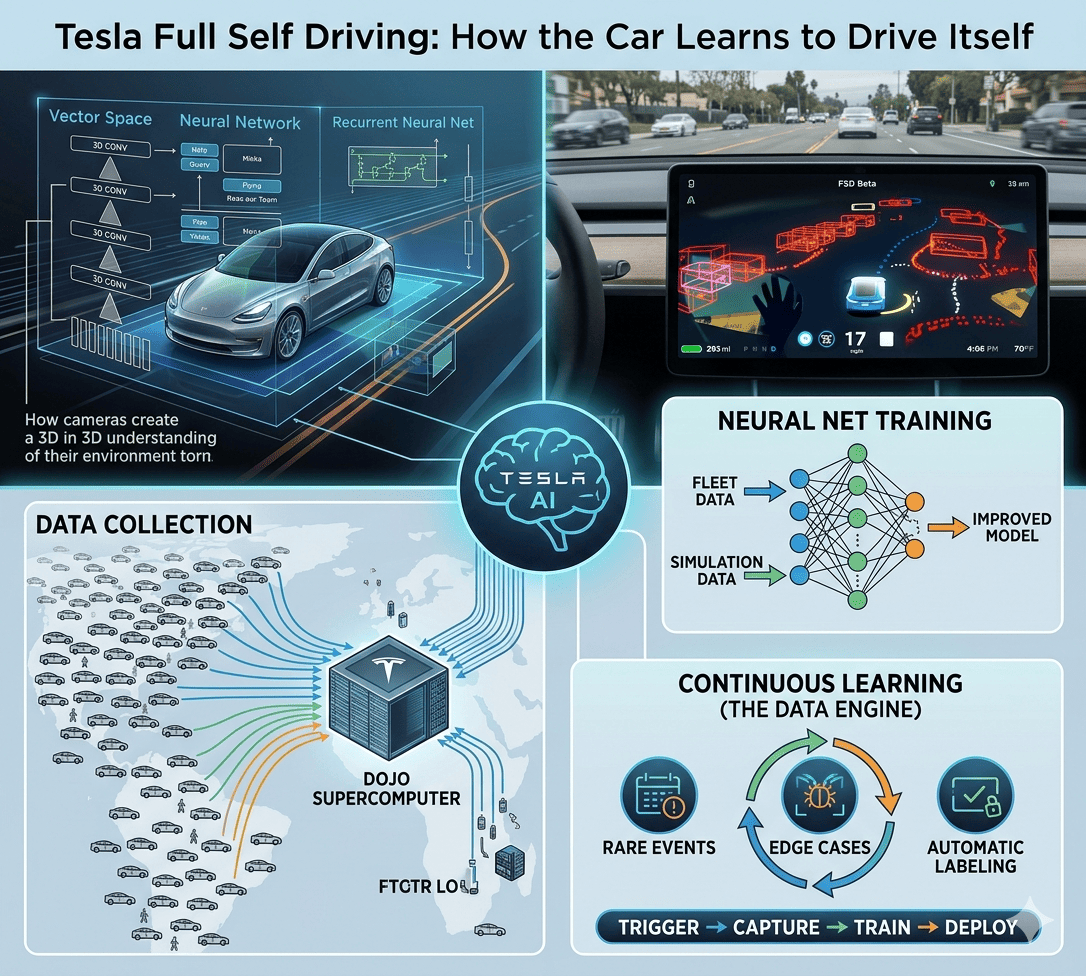
Tesla’s Full Self Driving system does not follow a fixed set of rules written by engineers. It learns by watching millions of real-world driving clips captured from Teslas on the road every day. This article explains how Tesla Full Self Driving works under the hood — the neural networks, the training data, and the simulation tools that turn camera images into steering commands. Whether you own a Tesla or are simply curious about how does Tesla Full Self Driving learn, here is the full picture.
Most self-driving car projects rely on expensive sensors like lidar and high-definition maps. Tesla went a different route. It uses only cameras and neural networks trained on data from its own fleet. The core idea is simple: let the car watch how humans drive, learn from the patterns, and get better over time. In practice, the process involves billions of miles of video, massive data centers, and a constantly evolving AI brain. Here is how Tesla FSD works from the ground up.
What Makes Tesla’s Full Self Driving Different
Vision-based system — no lidar, no radar
Most autonomous vehicle companies use lidar to create a 3D map of the surroundings. Tesla removed lidar and radar from its newer vehicles entirely. The system relies on eight cameras positioned around the car. This is called a vision-only approach. Tesla believes that if humans can drive with just two eyes, a computer can drive with eight cameras. This decision cuts hardware costs but makes the software much harder to build. The car must guess depth, speed, and object type using only 2D images. That is where the Tesla neural network comes in.
The role of the Tesla neural network
The Tesla neural network is a deep learning model that processes video feeds from all eight cameras at once. It performs object detection, lane recognition, traffic light reading, and path prediction. Instead of treating each frame as a separate image, the network looks at video clips over time. This helps the car understand motion and predict what will happen next. Tesla’s self driving technology is built on this architecture — a large, unified model that replaces dozens of smaller modules.
How Tesla FSD Learns to Drive
Training data from the fleet
Every Tesla on the road can capture and send back short clips of interesting driving situations. When the system detects something unusual — a rare road sign, a construction zone, an animal crossing — it saves that snippet and uploads it to Tesla’s servers. Engineers then label these clips manually or with automated tools. This creates a training dataset that covers edge cases human drivers rarely encounter. The more Teslas are on the road, the more data the system collects. This is a key advantage over competitors: no one else has millions of cars feeding real-world data every day.
Neural network architecture
The FSD neural network is built on a transformer architecture, similar to the models used in chatbots and language processing. It converts camera images into a bird’s-eye view representation of the road. The model does not just identify objects; it predicts their future positions. Tesla trains this model on a cluster of thousands of GPUs in its own data centers. A single training run can take weeks. When Tesla improves the neural network training process, every car in the fleet gets the update over the air.
Simulation and virtual testing
Not every driving scenario can be captured from real cars. Dangerous situations — like a car running a red light or a pedestrian stepping onto the highway — are too rare and too risky to collect naturally. Tesla built a simulation engine that generates these scenarios artificially. The simulator creates realistic video footage of edge cases, and the neural network trains on that footage as if it were real. This allows the system to practice rare events millions of times without anyone getting hurt. How does Tesla Full Self Driving learn to handle a child running into the street? The simulator creates that exact moment and lets the model practice until it gets it right.
From Perception to Action
How the car sees the road
The system runs real-time inference on the car’s own computer, called Hardware 3 or Hardware 4 depending on the model year. It processes 36 frames per second from each camera. The neural network detects lane lines, curbs, traffic signs, pedestrians, cyclists, and other vehicles. It also estimates the drivable area — the space where the car can safely move. This output is called a “vector space” representation and looks nothing like a human view. It is a mathematical description of the road, with every object assigned a 3D position, speed, and heading.
Decision making and planning
Once the car understands its surroundings, a separate planning module decides what to do. It considers the current speed, the path ahead, traffic rules, and the behavior of nearby objects. The planner runs multiple scenarios in parallel — what if I accelerate? What if I brake? What if the other car swerves? — and picks the safest action. Tesla AI driving is not a single decision per second. It runs this loop hundreds of times per second, constantly adjusting the steering angle, throttle, and brake. This is why FSD can handle complex intersections and highway merges, though not always perfectly.
Where Tesla FSD Stands Today
Current capabilities
As of 2026, Tesla FSD can navigate city streets, handle stop signs and traffic lights, make unprotected left turns, and merge onto highways. The system works in most daylight and weather conditions, though heavy rain or snow can cause problems. It improves every few weeks via over-the-air updates. Tesla’s computer vision has become more reliable with each release, and false braking events have dropped significantly. Many owners report using FSD for most of their daily commute with minimal interventions.
Limitations and challenges
FSD is not fully autonomous. The driver must stay attentive and keep hands on the wheel. The system struggles with unusual road layouts, construction zones with temporary markings, and intersections with poor visibility. Tesla Autopilot vs FSD confusion still exists — Autopilot handles highway driving only, while FSD is designed for full city street navigation. The biggest long-term challenge is proving the system is safer than a human driver across all conditions. Tesla FSD 2026 is impressive, but it has not yet reached the level 5 autonomy Tesla has promised.
Conclusion
Tesla’s Full Self Driving system learns to drive the same way a human does — by watching, practicing, and correcting mistakes. But unlike a human, the Tesla neural network can learn from millions of cars simultaneously and improve overnight. The vision-only approach is bold and controversial, but the training pipeline built around it is arguably the most sophisticated in the auto industry. FSD is not perfect and may never be. But understanding how does Tesla Full Self Driving learn reveals just how far the technology has come. The car gets a little smarter every day — and that is what makes it different from every other vehicle on the road.

Independent technology writer focused on artificial intelligence, emerging technologies, and digital innovation. Covers AI applications in sports, productivity, and online business.