


























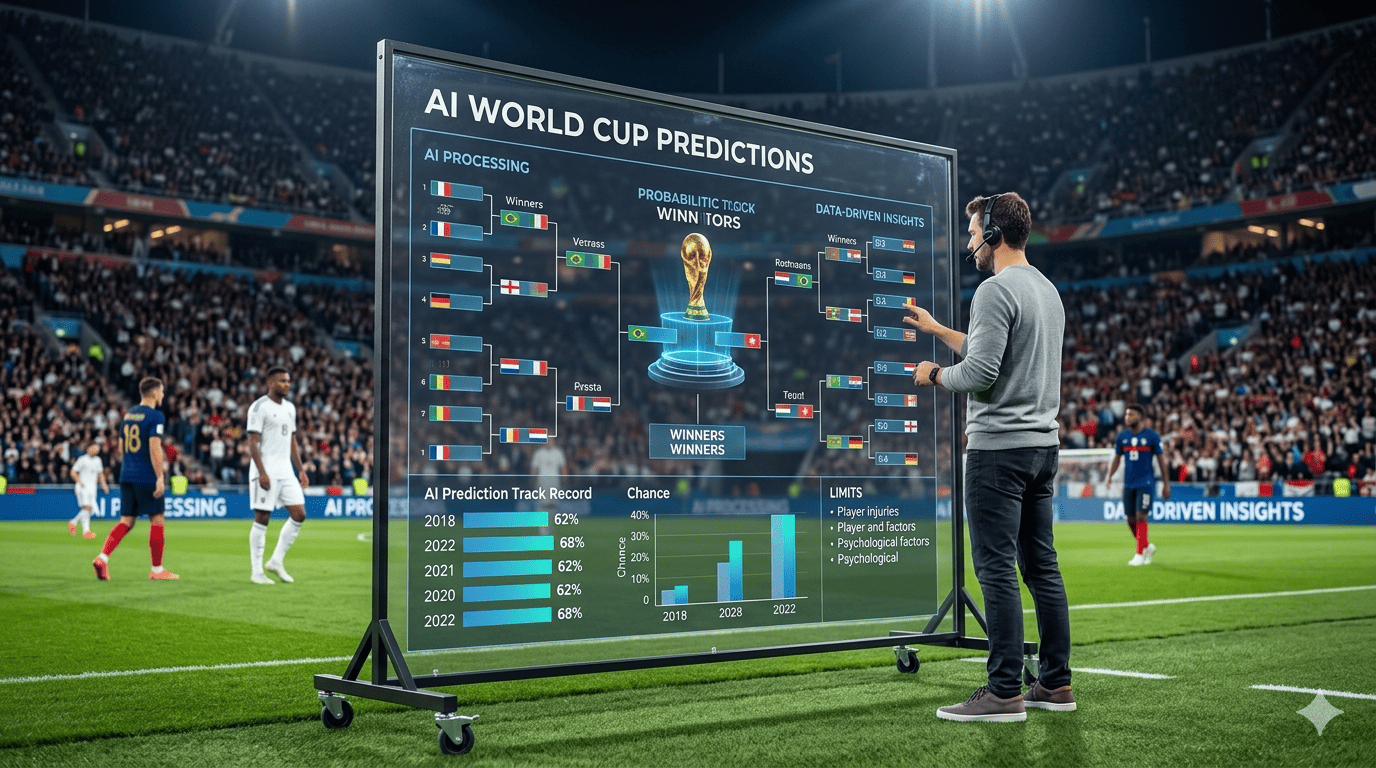
AI models provide their predictions for each World Cup. They do things correctly sometimes. They don’t most of the time. The question is not whether AI can predict the World Cup winner with certainty — it cannot. The key question is how much better AI is than chance, and whether its forecasts keep improving. This article examines the capabilities, limitations, and performance of AI prediction systems for the World Cup.
How AI Predicts the World Cup
Data sources and training
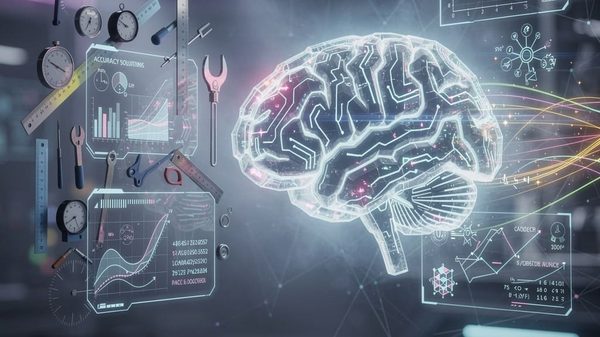
AI models need data — lots of it. For World Cup predictions, models are trained on historical match results, goal statistics, player performance metrics, FIFA rankings, and sometimes even weather data and travel distance. Some models include transfer market values, coaching history, and referee tendencies. The more data the model has, the better its predictions should be. But data quality matters more than quantity. A model trained on old data will miss recent form changes. For readers who want to understand the basics of how machine learning training works, our guide on 5 AI terms that will make you sound like an AI expert covers the foundations.
Machine learning models used
Most World Cup prediction models use random forests, gradient boosting, or neural networks. Random forests are popular because they handle many variables well and are relatively easy to interpret. Some research groups use Bayesian models that update probabilities as the tournament progresses. Deep learning models are less common because they need enormous datasets and football matches are relatively rare events. The choice of model matters less than the quality of the features fed into it. A simple model with good data often beats a complex model with poor data.
Simulation and Monte Carlo methods
Most published predictions do not give a single winner. They run thousands of simulations — called Monte Carlo simulations — and calculate how often each team wins. For example, a model might simulate the 2026 World Cup 100,000 times. If Brazil wins 18,000 of those simulations, the model gives Brazil an 18% chance. This approach captures the randomness of knockout tournaments better than a single prediction. It also produces more honest results: no model can say for sure who wins, but it can say who wins most often in its simulations.
Past Track Records
2014 World Cup predictions
In 2014, most AI models predicted Brazil as the favorite. Brazil reached the semifinals but lost 7–1 to Germany — an outcome no model predicted. Germany went on to win, and most models had Germany in their top three, though not first. The overall performance was reasonable, but the Brazil collapse showed a key limit. AI models assume rational outcomes based on past data. They cannot predict psychological collapses.
2018 World Cup predictions
2018 was a better year for AI. Several models correctly predicted France as the winner. A Goldman Sachs model that combined team data with social media sentiment analysis also ranked France highly. The models also correctly called surprise runs like Croatia reaching the final — something most human experts missed. This was the year AI football forecasting gained credibility.
2022 World Cup predictions
2022 was a mixed bag. Most AI models favored Brazil and Argentina, with Argentina given roughly a 12-15% chance. Argentina did win, so the models were correct in the end. But I remember watching that Morocco run. Every AI prediction I saw had them going out in the round of 16. That is the thing about football — sometimes the story beats the statistics.. Morocco’s run was driven by tactics, team spirit, and luck — factors that are very hard to quantify. The models that performed best were the ones that updated predictions after each round rather than giving a single pre-tournament forecast. For more on how AI predictions work across different fields, see how AI agents are reshaping financial services — a domain where prediction accuracy matters even more than in sports.
Why AI Gets It Right — and Wrong
The randomness problem
Football is a low-scoring sport. A single goal can change everything. In a 100-match simulation, a team that dominates possession and creates more chances still loses 30% of the time. This built-in randomness means no prediction model will ever be highly accurate for individual matches. Tournament predictions are slightly better because they average across multiple games, but the randomness still adds up.
Data quality and recency
A model is only as good as its training data. If key players get injured just before the tournament, the model still uses old data. If a team changed its coach recently, the model cannot account for new tactics. Some models address this by weighting recent matches more heavily, but recent matches are a small sample. The trade-off between data quantity and recency is a real difficulty for machine learning sports predictions.
The human factor
Team psychology, motivation, and locker room dynamics are invisible to AI. A team playing for an injured teammate, a star player in a contract dispute, or a coach under pressure — these factors influence results but are rarely in the dataset. Some advanced models try to include sentiment analysis from news articles or social media, but the results are mixed. Human experts can sometimes sense these intangibles, though they are also prone to bias.
AI vs Human Experts
Who predicts better?
Studies comparing AI predictions to human experts give conflicting answers. For group stage matches, AI often outperforms humans because it processes more data. For knockout matches, humans sometimes do better because they account for context the AI misses. The best results come from combining both: let the AI crunch the numbers, then let a human adjust for factors the model cannot see. This hybrid approach is increasingly common in professional sports analytics.
Combining both approaches
Bettors and analysts who combine AI predictions with human judgment consistently outperform those who rely on either alone. The AI handles pattern recognition across thousands of matches. The human adds context about injuries, morale, and tactical changes. The question “can artificial intelligence accurately predict the World Cup winner” is probably the wrong question. The right question is “how can humans and AI work together to make better predictions?” For anyone interested in how AI and human decision-making compare in other fields, our article on AI ethics in high-stakes environments explores similar themes in refereeing and regulation.
Conclusion
Can artificial intelligence accurately predict the World Cup winner? Sort of. AI models can identify the most likely winner with better accuracy than random chance or most human experts. But accurate prediction in an absolute sense — calling the exact winner before the tournament starts — is something no computer can do yet. Football is too random, too emotional, and too human. The best use of AI World Cup predictions is not to bet on the outcome. It is to understand the probabilities, spot patterns, and enjoy the tournament knowing that even the smartest computer in the world cannot predict a penalty shootout.
source: VAR Technology

Independent technology writer focused on artificial intelligence, emerging technologies, and digital innovation. Covers AI applications in sports, productivity, and online business.