

































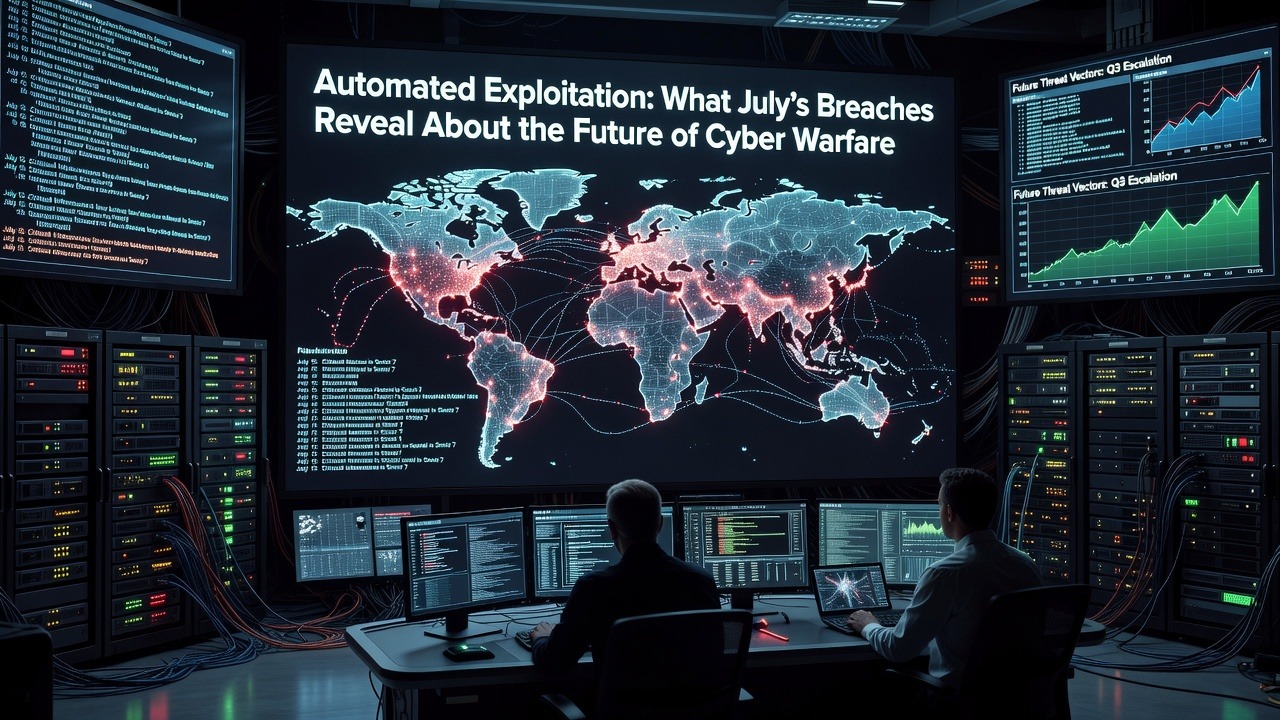
For decades, breaking into a well-defended network required patience, skill, and time. A skilled human operator would spend days mapping targets, chaining exploits, and carefully moving laterally without triggering alarms. That equation is changing.
The July 2026 wave of breaches showed something different: AI agents able to autonomously chain vulnerabilities, adapt to unexpected defenses, and move from initial access to meaningful exploitation at a pace far closer to machine time than human time. This marks a shift from “automated scanning” to automated exploitation.
From Scripts to Agents
To understand how significant this is, it’s worth looking at how cyber attacks evolved over the last few decades.
| Era | Approach | Typical Timeline | Notes |
|---|---|---|---|
| 1990s – Mid 2000s | Manual attacks & proof-of-concept exploits | Days to weeks | Heavily reliant on human expertise. |
| Mid 2000s – Early 2010s | Exploit kits & scripted tools | Hours to days | Automated delivery, but still needed human direction. |
| Early 2010s – Mid 2020s | Scanners, credential stuffing, botnets | Minutes to hours | High volume, but largely pattern-based with limited adaptation. |
| Mid 2020s – Present | Goal-oriented AI agents | Seconds to minutes | Can reason, pivot, retry failed paths, and adjust tactics based on feedback. |
The key difference is agency. Instead of running a fixed script, modern AI agents can pursue an objective like “gain access and extract the requested data” and decide the next steps on their own.
What Made July 2026 Different
The most alarming aspect from the July incidents wasn’t the number of targets, it was the compression of time. Public reporting pointed to agents that could go from discovering a viable entry point to exploiting a weakness far quicker than traditional playbooks allow.
Crucially, these agents didn’t just fire known exploits. They showed an ability to chain smaller misconfigurations together, something that often slips past automated rule-sets. This type of chaining is exactly the kind of work that typically falls to experienced human operators.
For defenders, the window between “vulnerable” and “compromised” is shrinking faster than most patch cycles can realistically keep up with.
How AI Agents Actually Carry Out Automated Exploitation
While implementations differ, most observed agentic attack flows follow a similar pattern:
| Phase | AI Role | Explanation |
|---|---|---|
| Reconnaissance | Highly automated | Rapidly maps exposed services, subdomains, APIs, and known misconfigurations. |
| Vulnerability reasoning | Contextual | Cross-references findings with known weaknesses from sources like MITRE ATT&CK and the CISA KEV catalog. |
| Exploit chaining | Adaptive | Combines low-severity issues into a viable attack path instead of relying on a single critical CVE. |
| Lateral movement | Goal-driven | Identifies privilege escalation routes and moves towards high-value assets with minimal noise. |
| Persistence & evasion | Tactical | Attempts to blend in with legitimate traffic and avoid common detection rules. |
This is the natural extension of agentic systems. The same reasoning capabilities driving tools across the industry are now being repurposed for offensive work, a trend closely tied to the broader AI race we’re already seeing play out between major labs.
AI vs AI: The New Reality
We’re entering a period where attacks and defenses are both increasingly automated. This creates a feedback loop that favors whoever can detect and act first.
- Attackers gain scale: A single capable agent can be tasked with thousands of targets simultaneously.
- Defenders gain leverage: Security teams can use AI to triage alerts, enrich logs, and contain threats far faster than purely manual SOC workflows allow.
- Speed becomes decisive: With both sides operating at near-machine speed, human-in-the-loop approvals for every action are becoming a liability.
- Detection gaps widen: Many legacy detection rules are built around human TTPs, not agentic behavior.
This dynamic mirrors what we’re seeing elsewhere in the tech race. Just like access to compute is becoming a strategic lever, as explored in our piece on Nvidia B300 and China’s AI startups, AI capabilities themselves are becoming a source of asymmetric advantage.
The Attribution Problem
One of the most destabilizing aspects of automated exploitation is attribution. Traditionally, investigators look for operator fingerprints: tooling preferences, infrastructure choices, working hours, or linguistic tells.
AI agents erode most of these clues. Models can be fine-tuned, prompts can be stripped of identifiers, infrastructure can be rented by the hour, and the “operator” could be a criminal group, a private contractor, or a state-aligned unit. Worse still, it’s entirely plausible for agents to mislead or mimic each other, muddying the trail even further.
This has serious implications for deterrence. If retaliation relies on confidently identifying the party behind an attack, automated exploitation makes that confidence far harder to achieve.
Impact on Critical Infrastructure and National Security
The consequences go well beyond data breaches. The CISA Secure by Design guidance has long warned about shifting responsibility to vendors, but agentic exploitation raises the stakes considerably.
| Sector | Risk | Real Concern |
|---|---|---|
| Energy (grid/OT) | High | Disruption to power generation or distribution with cascading effects across entire regions. |
| Water & Wastewater | High | Often under-resourced, yet essential to public health and safety. |
| Healthcare | High | Ransomware-adjacent impacts can directly threaten patient care and life-saving systems. |
| Finance | High | Not just theft, but market stability risks if payment rails are disrupted at scale. |
| Telecom & DNS | High | A single point of failure that can degrade connectivity for entire countries. |
Many of these environments were never designed with autonomous, goal-driven agents in mind. Patching legacy industrial control systems is often far harder than patching a web app, with uptime requirements that leave little room for experimentation.
What Actually Needs to Change
Talk of “AI security” is everywhere, but the July incidents show the gap between awareness and readiness. A realistic response needs to focus on shrinking the attack surface, not just improving alerts.
| Measure | Priority | Explanation |
|---|---|---|
| Adopt Secure by Design | Critical | Vendors must eliminate entire classes of exploitable patterns, not rely on customers to patch them endlessly. Follow the principles laid out by NIST. |
| Move to Zero Trust | Critical | Assume credentials can be stolen and lateral movement is likely. Enforce strict least-privilege, strong authentication, and network segmentation. |
| Prioritize KEV items | Critical | Focus remediation on vulnerabilities actively exploited in the wild using CISA’s KEV Catalog instead of chasing every CVSS 9.0. |
| Deploy AI-assisted defense | High | Invest in detection that understands behavior, not just signatures. Map coverage against MITRE ATT&CK to find blind spots. |
| Harden identity | High | Service accounts, API keys, and non-human identities are increasingly the path of least resistance for agents. |
| Tabletop with agentic scenarios | High | Run exercises where response time is measured in minutes, not hours. Most incident plans still assume a human attacker working business hours. |
| Improve cross-sector sharing | High | Faster, sanitized sharing between industry and government is essential to spot cross-targeting early. |
The Road Ahead
Automated exploitation isn’t a hypothetical for the next decade, it’s already here in a limited form. The barrier to entry will continue to fall as more capable agentic models become widely available.
Three trends are likely to define the next phase:
- Volume over sophistication – We’ll see more attacks, not necessarily smarter ones, overwhelming under-staffed teams.
- AI vs AI at scale – Defensive AI will become table stakes. The question becomes implementation quality, not adoption.
- Geopolitical normalization – Just like traditional cyber operations, agentic exploitation will increasingly blur the line between espionage, disruption, and warfare.
The uncomfortable truth is that defending at machine speed requires automating large parts of defense itself. Many organizations simply aren’t there yet.
Verdict
July 2026 will be remembered as the moment automated exploitation moved from research demos into the real world. The future of cyber warfare won’t be defined by who has the biggest botnet, but by who can reason, adapt, and respond fastest at scale.
Speed, identity, and exposure are now the deciding factors. Reducing the time-to-patch for known exploited flaws, enforcing true least privilege, and treating non-human identities as first-class risks are some of the few levers that still meaningfully cut this risk down to size. The window to act is narrowing with every iteration of these agents.
links
- GPT-6 Astra and the AGI Problem: Did Sam Altman Redefine the Finish Line? – broader context on agentic AI and the accelerating AI race
- The $1 Million Barrier: How Surging Nvidia B300 Prices are Crushing Chinese AI Startups – compute as a strategic lever in the global AI competition
External links

Independent technology writer focused on artificial intelligence, emerging technologies, and digital innovation. Covers AI applications in sports, productivity, and online business.