




































The death notice
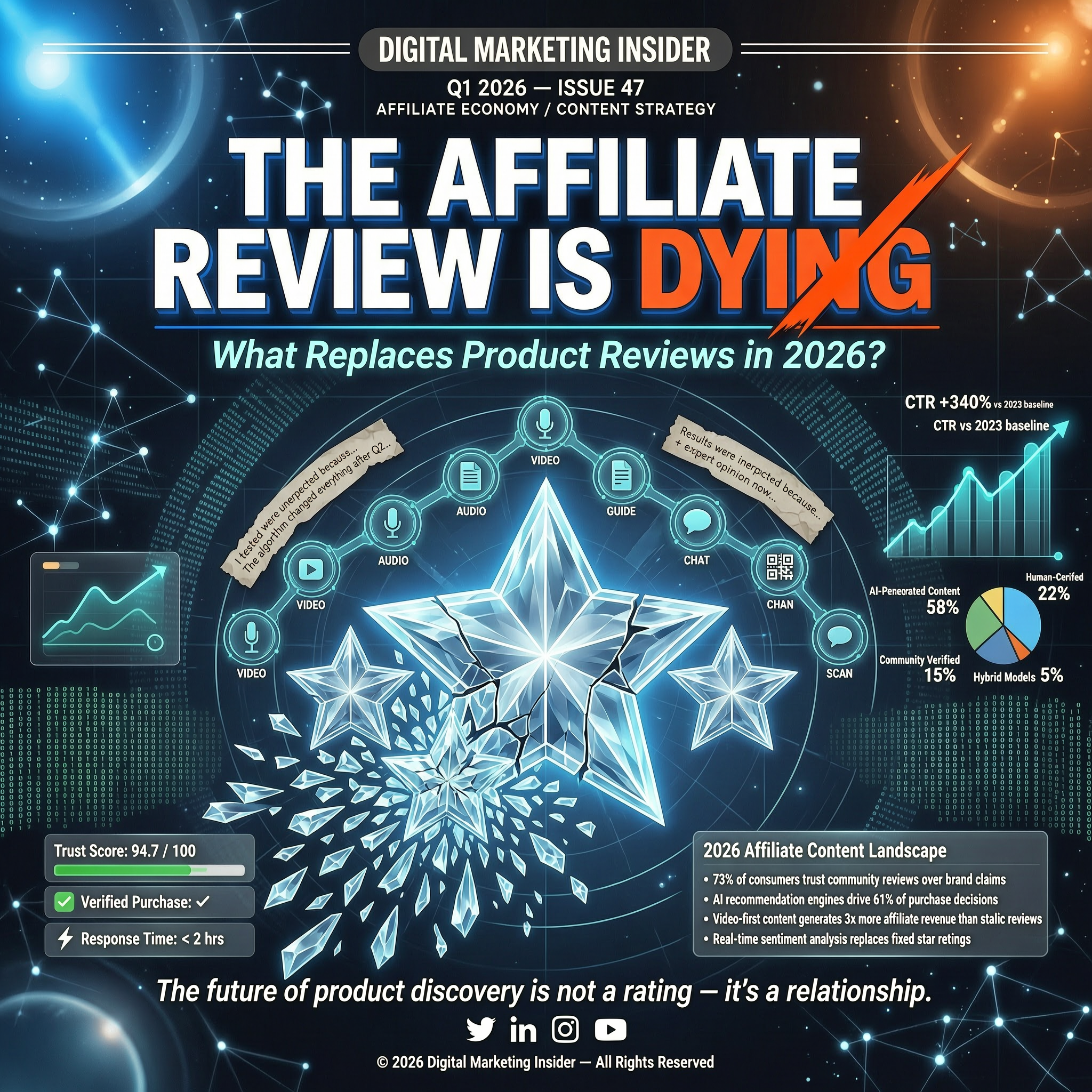
It is with regret that we announce the passing of the classic affiliate review. You knew it well: the “10 Best Wireless Headphones” listicle, the “Best CRM for Small Business” page, the five-thousand-word product roundup that ranked items it had barely touched. For fifteen years it was the most reliable money machine on the internet. In 2026, it is being laid to rest — not with a bang, but with a slow decline into irrelevance. This is its obituary. And since every obituary should answer one practical question, this one ends with what replaces it.
The life it lived
The affiliate review had a good run. Its formula was elegant: a keyword-driven page, rankings of “best” products, affiliate links, a 3-8% commission on whatever converted. Traffic came from Google; Google rewarded volume; the format scaled by repetition. Hundreds of thousands of sites lived on it. It created the entire modern SEO content industry, and at its peak it was so profitable that it funded its own corruption the very thing that killed it.
The cause of death
No single killer. It was a death by a thousand system changes, and they all landed within two years:
The clicks were taken by AI. Google’s AI Overviews now appear on a large share of commercial searches, and when they do, click-through rates drop by roughly half from around 15% to around 8%. The user gets a synthesized answer in the results page, and the review page behind it goes unseen. The decision now often happens inside an AI engine that answers without ever linking out. That single change removed the format’s entire economic premise: the click.
Google turned on the format it created. Years of Helpful Content updates explicitly targeted thin affiliate content — pages without real experience, without original research, without proof. The ranking system now rewards the first-hand article and buries the synthesized one. The very structure of the “best X” listicle — ten items, none tested — was reclassified by the algorithm as noise.
Trust collapsed under the weight of fake. This is the part the industry prefers not to discuss. Roughly 43% of Amazon reviews were estimated to be fake in recent analyses; the majority of consumers encounter fake reviews within any twelve-month period; and a majority now say they won’t buy a product if they suspect its reviews are fabricated. Trust in reviews didn’t just dip — it became a liability. And the regulators noticed: the FTC’s Consumer Review Rule took effect in late 2024, its first enforcement letters went out in December 2025, and violations now carry civil penalties of up to $53,088 each. The era of manufactured credibility ended with a compliance deadline.
The economics stopped working. Amazon cut affiliate commission rates by up to 50% in early 2026. The cookie-based attribution the old model depended on was dismantled. And the audience, exhausted by a decade of “I’ve tested these extensively” written by people who’d tested nothing, developed a scanner for it: nearly half now report being suspicious of reviews that read like AI-generated content.
The autopsy
The deeper cause, found on the table: the affiliate review died of a contradiction. It was a trust-based format built on untrustworthy methods. It sold “personal recommendation” at industrial scale. It could not survive the moment consumers learned to detect the difference — the moment 30% of buyers said they’d been deceived by a fake review, and the moment AI engines began summarizing reviews instead of sending readers to them. Here’s the uncomfortable structural detail: in 2026, a product’s reviews feed three audiences at once — the consumer, the AI assistant that answers for 45% of discoverers, and the regulators. A format built for one of those audiences, with content for none of them, had no place left.
The successors
The estate has heirs, and they’re already dividing the inheritance. Here’s what replaces the product review:
1. The documented experience. Not “we tested it” — receipts. The article that says “I used this for six months, here are the measurements, here’s what broke, here’s what I’d do differently.” This is the first-hand format both Google’s algorithms and the AI engines reward, because it’s the one they can’t reproduce. The survivor of the review format is the journey, told with proof: the tools, the workflow, the actual results, the mistakes. This is exactly why the most durable content on the internet in 2026 isn’t “here are 10 tools” — it’s “here is the system I built, and here is the documented month-by-month path it took.” The machine behind that kind of content — asynchronous, agent-driven workflows that keep working while you’re away — has quietly become the new production line for the formats that survive.
2. The live demonstration. Video and live commerce killed the static review the way sound killed silent film. On TikTok Shop, YouTube and Instagram, the review became a performance: unpolished, real-time, showing the product working — or failing — in front of an audience. You can’t fake a live demo the way you could fake a paragraph. The audience now demands to see it move.
3. The real-time database. Reviews were static opinions; the new format is current fact. Live pricing, real availability, actual current specs, maintained data — the kind of content an AI engine quotes and a buyer trusts, because it’s not an opinion, it’s a feed. The comparison of “best value today” beats the review of “best product, published last year,” because one of them is true right now.
4. The community verdict. Trust migrated from the professional reviewer to the network of peers — subreddits, forums, Discords, private groups. The consumer’s calibration strategy in 2026 is explicitly anti-authoritative: read multiple sources, look for complaint patterns, weight verified purchases, seek second opinions outside the primary review surface. The “second opinion” is now the primary opinion.
5. The specialized evaluation. The review format didn’t die everywhere. It survived where it was narrow enough to be honest: the single-tool deep dive, the niche evaluation with real benchmarks. A review of one specific product, with real numbers, in a niche the reviewer actually knows, still works — precisely because it’s no longer pretending to be a ranking of ten things it never touched. The reviews that live on are the ones that look like engineering reports, not shopping lists.
The inheritance
What survives the death is the currency that was always the actual product: proof. Specificity, detail, verified experience, recency, response patterns — the things real content produces naturally and fake content cannot replicate at scale. The consumers’ 2026 behavior makes the division of the estate explicit: 97% still read reviews, and they read them more carefully than ever — but they read them as evidence, not as verdicts. The genre that replaces the review is the genre that produces evidence.
The eulogy
The affiliate review served a purpose worth honoring: it helped people decide. Its failure was treating that responsibility as a scale operation. The format that replaces it isn’t a new template — it’s a return to the original promise. Show the thing. Tell the truth about what happened. Give the numbers. Let the reader decide.
The death of the review is not the death of affiliate income. It’s the death of the shortcut — the page that got paid for pretending to have experience. What’s being rewarded now, by algorithms and by a wary public, is the content that actually had the experience in the first place. The review died so that the record could live.

Independent technology writer focused on artificial intelligence, emerging technologies, and digital innovation. Covers AI applications in sports, productivity, and online business.