
































The triage principle
Every emergency room does the same thing: sort by severity, treat in order. In 2026, the AI employee is doing the same to office work — and it’s not arriving everywhere at once. It arrives in a strict order, decided by how much a job looks like documents, repetition, and bounded process, and how little it looks like physical presence, judgment under ambiguity, and accountability. This article is the triage ward: who gets tagged red, who yellow, who green — and what the tags actually mean.
The triage tags
Three tags, issued by the evidence rather than by fear:
- RED — automated now. A machine does the core task better and cheaper; the human moves to review.
- YELLOW — augmented first. The agent becomes the co-pilot; the role changes faster than it disappears.
- GREEN — safe for now. Requires presence, accountability, or messy judgment no model owns yet.
The rule of thumb: the more a job resembles “information in → structured information out,” the faster it gets tagged. The criteria aren’t mysterious — document weight, repetition, bounded steps, low physical consequence.
Red tag: the document workers
First through the door are the roles that live inside bounded documents and repeatable formats:
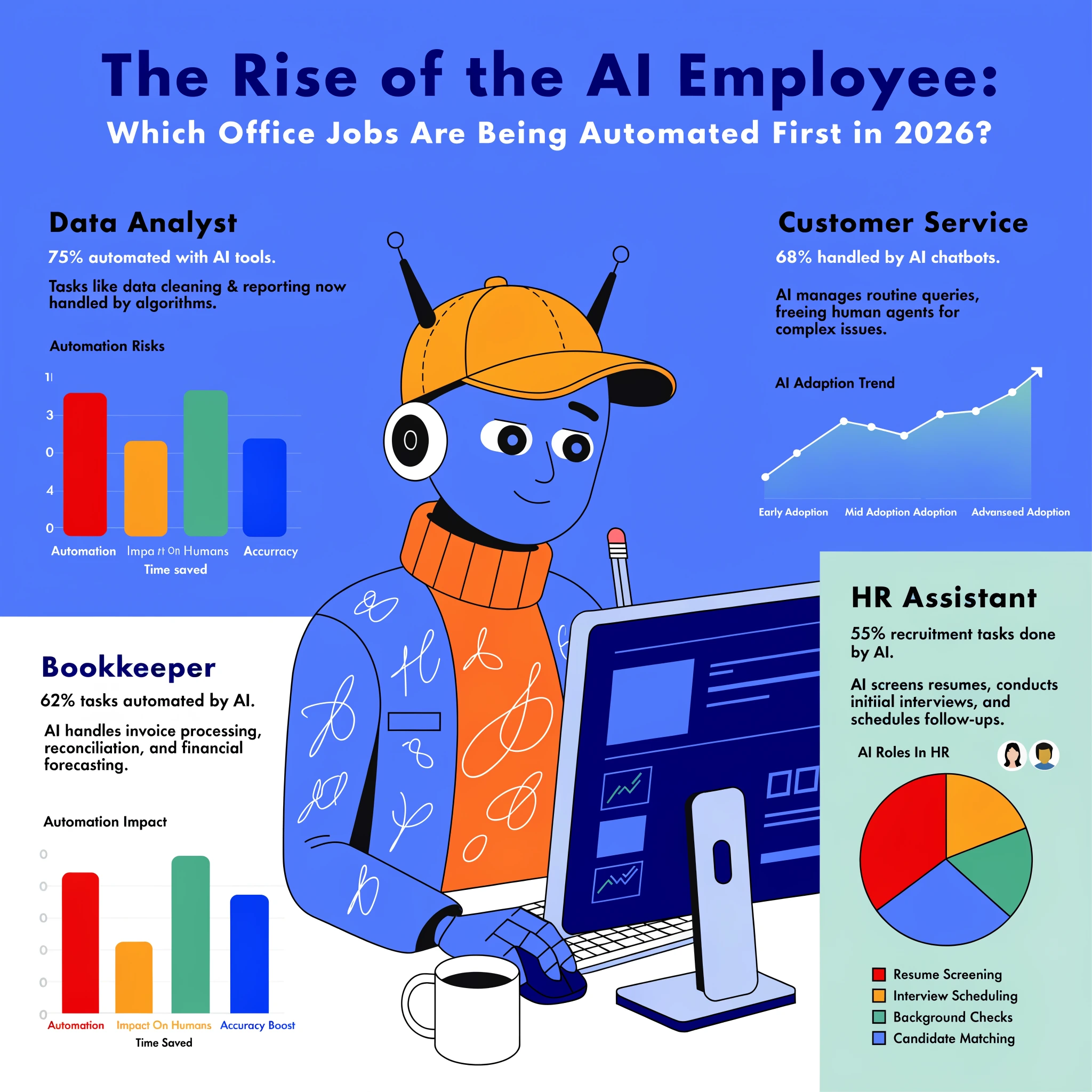
- Finance operations: tax-form processing, report generation, reconciliation of structured data. The 2026 evidence is concrete — one finance workflow running on GPT-5.5-powered agents reviewed 24,771 K-1 tax forms totaling 71,637 pages, with personal information excluded, in hours instead of roughly two weeks.
- HR administration: onboarding documents, policy drafts, benefits processing, compliance checklists. HR was named among the departments in the large enterprise agent rollouts of 2026.
- Legal support: contract review, clause extraction, regulatory checklists.
- Marketing operations: weekly reporting, campaign performance summaries, content briefs — one automated reporting workflow saved a single employee 5 to 10 hours per week.
- Sales operations: lead summaries, proposal drafts, follow-up preparation.
Notice the pattern: none of these roles vanished in 2026. Their core tasks became agent work. The human moved to the approval gate. That’s the red tag: the task is automated, the seat is repurposed.
Yellow tag: the augmented professionals
Next are the roles too valuable to kill and too routine to keep manual:
- Financial analysts — the modeling and the first-draft summary go to the agent; the judgment about what the numbers mean stays human.
- Marketing managers — briefs, research, and performance decks are drafted by the machine; the strategy, the brand call, and the accountability remain human.
- HR generalists — documentation and scheduling are handled; the conversations, the conflict, and the hiring judgment remain human.
- Project coordinators — the coordinator’s new job is coordinating agents, not just people and calendars.
The evidence line for yellow is the benchmark that got attention this spring: an 84.9% score on GDPval across 44 occupations means the model can handle the majority of tasks in roles like financial analysts, HR specialists, marketing managers, and legal assistants. Read that carefully: tasks, not jobs. A role survives by owning the tasks the score can’t measure — the ones involving accountability, taste, or a person on the other end of the table.
Green tag: what isn’t being automated first
The safe zone shares at least one of three properties:
- Physical presence: operating equipment, fieldwork, anything where the work is the room you’re in.
- Accountability: roles where someone’s name must sit on the decision — sign-offs, liability, regulated calls. No board accepts “the AI said so” as a signature.
- Cross-system messiness: work that means negotiating between five broken systems, reading a room, and improvising around people. Models improve here every quarter — it’s simply the last floor to flood.
This is also the honest place to state what triage doesn’t do: it doesn’t predict unemployment waves, and anyone quoting precise “percent of office jobs automated in 2026” figures is inventing precision that doesn’t exist. What’s verifiable is direction and order.
The triage order in practice
Look at where the agents were actually deployed in 2026, and the order matches the tags:
- Enterprise rollouts — such as NVIDIA putting GPT-5.5-powered Codex in the hands of 10,000+ employees — started with engineering, then extended to legal, marketing, finance, sales, and HR: the red and yellow zones first.
- The tooling became a department in its own right. Workspace agents went generally available in ChatGPT Business, Enterprise, and Edu in May 2026; “Skills” turned proven workflows into reusable instructions in March; the agentic products arrived by July.
- The pattern everywhere is identical: document-heavy knowledge work first; physical and judgment-bound work last.
Getting re-triaged
If you’re sitting in a red or yellow seat, the 2026 playbook is the same in every enterprise case study: move up the supervision chain.
- Own a workflow, not a task. The employee who maps “how this work actually flows” is the one who ends up supervising the agent that runs it.
- Learn to write the score, not the steps. Directing an agent — defining outcomes, choosing tools, designing handoffs — is the new entry-level skill, and it’s learnable from where you sit. That’s what asynchronous agentic workflows reward: the people who run them unattended aren’t programmers, they’re operators.
- Practice at the free tier before anyone pays for you. The gap between “worried about the AI employee” and “deploying one” is small — and the tools to learn on start genuinely free.
- Remember the barrier that fell. The reason so many roles are red or yellow is that technical skill stopped being the gatekeeper — building real tools from a description is now something an operations person can do in an afternoon.
The ward’s verdict
The AI employee of 2026 is not a robot in the break room. It’s the automation of the most document-shaped parts of office work, triaged in a predictable order: red for the process-bound, yellow for the judgment-adjacent, green for the physical and accountable. The fear framing asks which jobs it will take; the evidence-based framing asks which tasks it takes first — and who gets promoted to supervision.
The triage is real, and it’s already running. The useful part of the metaphor is the end of it: in the ER, the green patients help the red ones. In the office, the humans who understand the ward are the ones running it.

Independent technology writer focused on artificial intelligence, emerging technologies, and digital innovation. Covers AI applications in sports, productivity, and online business.