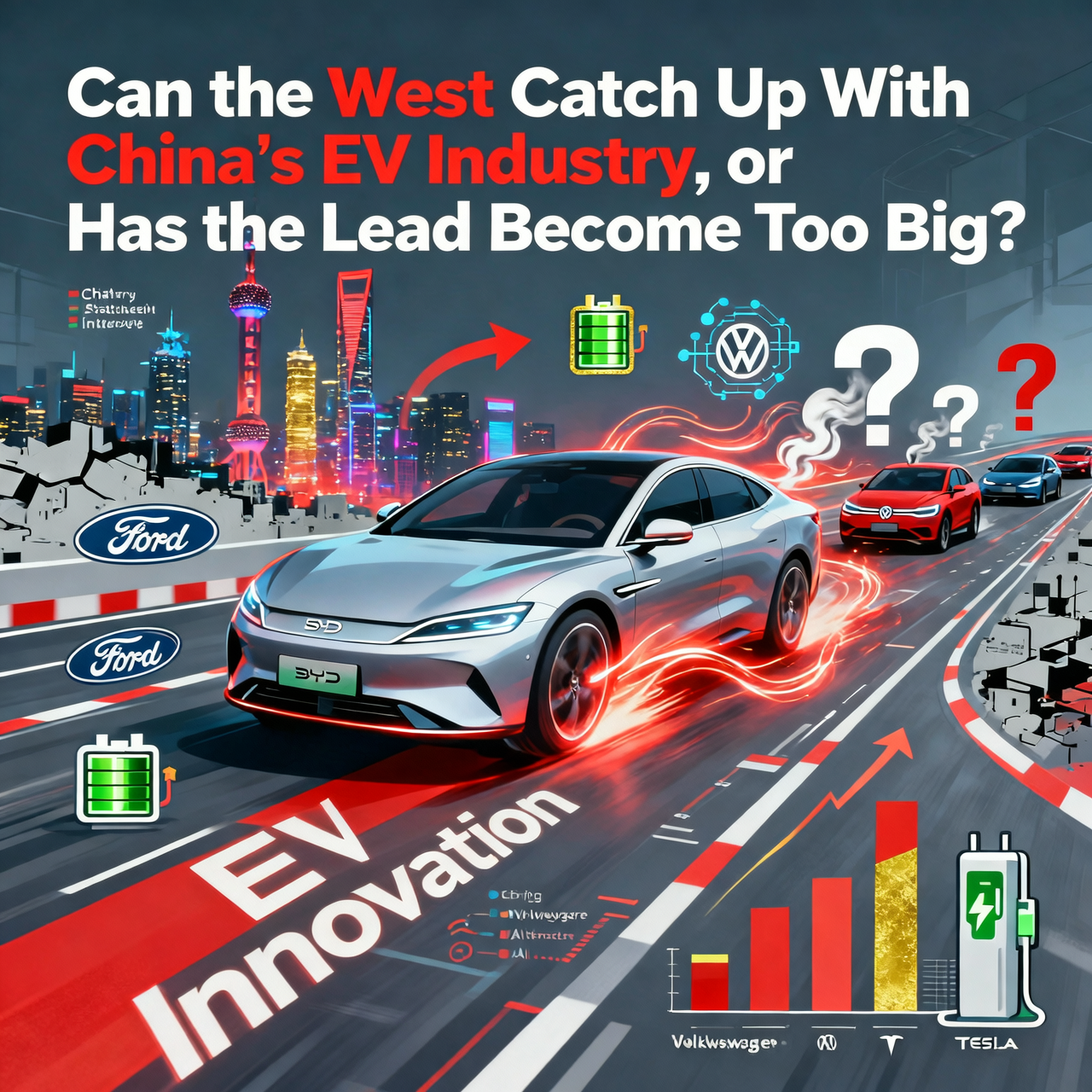


















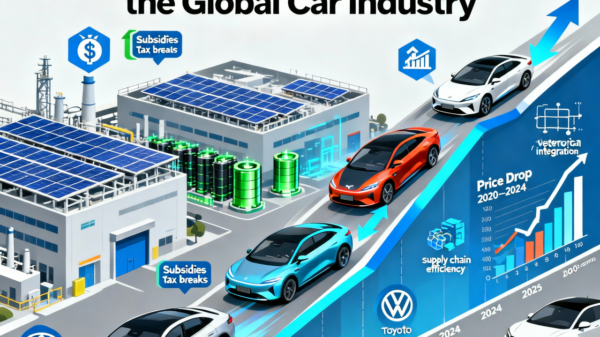










In 2025, BYD sold 4.6 million new-energy vehicles, more cars than most of the world’s largest automakers produce in total. CATL, a battery maker from the city of Ningde, supplied about 39 percent of every EV battery installed on the planet. China exported 2.6 million electric vehicles in a single year, more than double the volume of 2024. And in the first eleven months of 2025, Chinese brands accounted for 68 percent of global NEV passenger-car sales.
None of this existed two decades ago. In the 2000s, China had no globally competitive car industry, and its domestic automakers were widely seen as assemblers of foreign designs. Today it is the center of gravity for the world’s electric vehicle market.
This is the pillar article of a series. It answers one question at a survey level, and it deliberately leaves the deep dives to the articles that follow it. The question is simple to state and hard to explain:
How did China move from a late, follower car market to the center of global EV manufacturing?
First, define the terms
Before any comparison makes sense, three words need fixing.
| Term | Meaning |
|---|---|
| NEV (New Energy Vehicle) | China’s umbrella category: pure electric, plug-in hybrid, and fuel-cell cars |
| BEV | Battery-electric vehicle, powered only by a battery and electric motor |
| PHEV | Plug-in hybrid, which runs partly on battery power and has a backup gasoline engine |
China’s official statistics mix BEVs and PHEVs under NEV. That matters because Chinese plug-in hybrids, which were often dismissed as a compromise, became one of the fastest-growing export segments in 2025. Ignoring the PHEV half of the story produces a distorted picture.
Act One: the late start was not an accident
China’s late arrival in conventional cars is the foundation of the whole EV story, not a footnote.
Through the 1990s and 2000s, Beijing required foreign automakers to build cars in China only through 50/50 joint ventures with local partners. The deal traded market access for assembly technology. It produced massive factories and very little domestic engineering capability. Chinese brands spent years competing on price against global giants, with limited success outside their home market.
The result: an industry with scale but without ownership of core technology. In engines, transmissions, and chassis engineering, the gap to Toyota, Volkswagen, or GM looked structural.
This weakness is exactly what made the EV bet rational. An electric car has far fewer moving parts than a combustion car. The engine and gearbox, the two hardest areas of automotive engineering, are replaced by a battery and a motor. If a country can master batteries, motors, and software, it can bypass a century of combustion-engine catching up. China decided to master batteries.
Act Two: the state built the demand, then the market took over
Government support is the most cited explanation for China’s EV rise, and it is a real one, but the emphasis is usually wrong. The common telling, “Beijing poured money into EVs,” is incomplete. What actually happened was a sequence of instruments that created demand first and let industry respond to it.
The early tools are well documented:
- 2009: the “Ten Cities, Thousand Vehicles” program put subsidized electric buses and taxis on the streets of pilot cities.
- 2010: purchase subsidies for consumers began, layered on top of central and local government support.
- City-level advantages: in Beijing and Shanghai, EV buyers could skip the long queues, lotteries, and high auction prices applied to gasoline-car license plates. This single policy quietly did more than cash subsidies to move buyers toward electric.
- 2015 “Made in China 2025”: EVs were named a strategic industry, which directed credit, land, and procurement toward it.
- 2020, New Energy Vehicle Industry Development Plan (2021-2035): the state set an official target of NEVs making up roughly 20 percent of new car sales by 2025.
China cleared that target years early. By the first half of 2026, NEVs were nearly half of all new car sales in the country, and in June 2026 the share hit a record 58.5 percent, according to the China Association of Automobile Manufacturers.
Two facts about this policy machine are usually missing from the standard account.
First, the subsidies were phased out. Central purchase subsidies were wound down and eliminated at the end of 2022. The market kept growing after they disappeared. The lesson is that policy created the initial curve, but by the time the money left, something else was sustaining demand: falling prices and improving products.
Second, the policy did not pick winners the way a command economy usually does. It protected the domestic market from foreign competition long enough for dozens of Chinese companies to fight each other. That competition, not the subsidies, is what produced the modern price-performance gap.
Act Three: the private sector did the heavy lifting
The two companies that define China’s position today both started far outside the car industry.
CATL was founded in 2011 in Ningde. It became the world’s largest EV battery maker by winning every cost war and technology cycle it entered. In 2025 it held 39.2 percent of the global EV battery market, a higher share than all of its foreign rivals combined, per SNE Research. Add BYD’s batteries and Chinese suppliers held more than 55 percent of global installations in 2025.
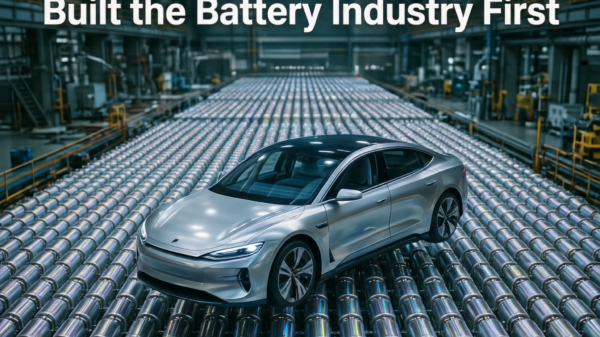
The battery is not one advantage among many. It is the root advantage. The battery is typically a third or more of an EV’s cost, and whoever controls batteries controls the cost curve. CATL and BYD combined to make China the country that sets the world’s battery price.
BYD was founded in 1995 as a maker of rechargeable batteries for phones, and its founder, Wang Chuanfu, still carries that company culture: vertically integrate everything and drive cost down relentlessly. BYD entered cars in 2003, launched the Blade battery in 2020, and made a historic decision in 2022: it stopped producing combustion-engine vehicles entirely.
The results are the cleanest proof of China’s position:
- BYD sold 4,602,436 NEVs in 2025, up 7.7 percent.
- Pure-electric sales reached 2.26 million, more than Tesla delivered worldwide in the same year.
- Overseas sales crossed 1 million units for the first time, roughly 140 percent above 2024.
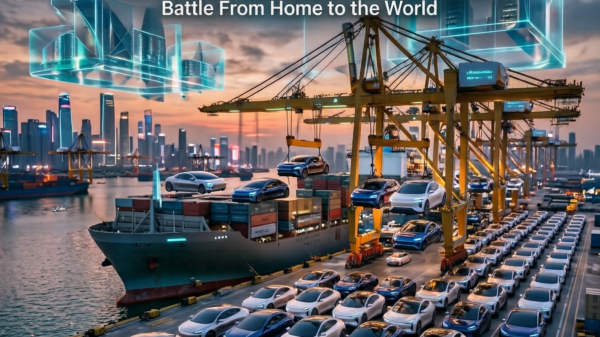
BYD’s integration goes deeper than the car. It makes its own batteries, its own semiconductors, and in 2024 it added its own car-carrying ships. When a company controls its own logistics, its own cells, and its own assembly, the word “supply chain” stops being abstract.
Act Four: the domestic market became a test lab, then an export engine
China’s rise to global exporter did not begin with exports. It began with the largest, most demanding, and most crowded EV market on Earth.
Scale created a feedback loop that no other country can easily copy. Domestic sales volume paid for factories that achieved economies of scale. Those factories lowered unit costs. Lower costs allowed cheaper cars, which expanded the market further. And every year of production generated data, supplier experience, and manufacturing learning that foreign competitors could not match at comparable volume.
On top of volume, China built the world’s largest public charging network. This removed the adoption barrier that still slows EVs in most other countries, and it made the domestic market itself evidence that electric cars could be a mass product, not a niche one.
The infrastructure story is often told last, but it belongs earlier: charging availability is the reason Chinese EV penetration exceeded expectations while other markets stalled.
Only after the domestic loop was mature did China turn outward. The export data shows the acceleration:
| Year | Total vehicle exports | NEV exports |
|---|---|---|
| 2021 | 2.0 million | 310,000 |
| 2022 | 3.1 million | 679,000 |
| 2023 | 4.9 million | 1.2 million |
| 2024 | 5.9 million | 1.28 million |
| 2025 | 7.1 million | 2.62 million |
Source: CAAM (China Association of Automobile Manufacturers).
China became the world’s largest vehicle exporter by total volume in 2023. By 2025, NEVs were more than a third of all vehicle exports, and the international impact was visible far beyond the numbers. The International Energy Agency’s Global EV Outlook 2026 reports that nearly two-thirds of electric car sales in emerging markets outside China in 2025 were Chinese imports. In Thailand, Chinese brands made up 88 percent of all EVs sold in 2025, per BloombergNEF.
The flywheel most accounts miss
Strip away the policies, the brands, and the tariffs, and China’s advantage reduces to a single reinforcing cycle:
More sales → more scale → lower battery and production costs → lower prices → more sales.
The battery is where this loop turns fastest. CATL and BYD control roughly 56 percent of global EV battery installations. That control means China effectively sets the world’s battery price floor. Everything else, cheaper cars, faster charging innovation, aggressive export pricing, follows from that price floor being lower than anyone else’s.
This is why “cheap labor” is the wrong explanation. Labor is a small share of an EV’s cost compared with the battery and capital equipment. The real edge is accumulated manufacturing experience at a scale no rival can match quickly, plus ownership of the critical component.
The price war nobody mentions enough
China’s domestic market is not a serene success story. It is a battlefield.
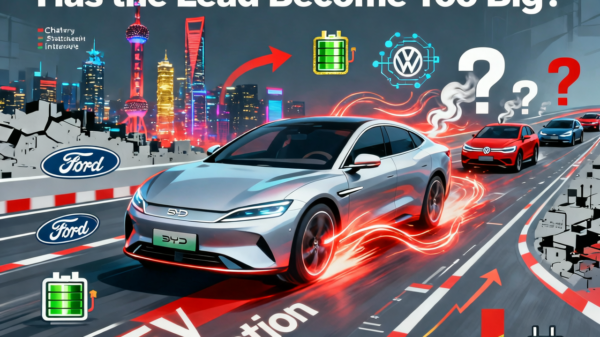
In 2023, BYD launched a model priced to undercut everything in its segment, and a price war followed that has not truly ended. Chinese automakers have been selling EVs at margins that Western companies consider impossible, and the casualties are visible: startups have folded, and even market leaders have seen profit pressure. In 2025, BYD’s retail sales in China actually declined, and its 27.2 percent share of the domestic NEV market was down from 34.1 percent in 2024, per the China Passenger Car Association.
The relentless competition matters for two reasons. It forces relentless innovation, which is the productive side. And it creates surplus capacity, which is the dangerous side: when domestic demand slows, companies export aggressively, and that is exactly what trade tensions feed on.
This is also why the common framing of China’s EV rise as a BYD-versus-Tesla story is misleading, a point this site has already argued in why the BYD-versus-Tesla framing misses what actually threatens the American auto industry. Tesla is one competitor among many. The Chinese system produces a dozen aggressive brands; Tesla is the brand everyone outside China happens to know.
Where the advantage could break
Nothing in this story is permanent. Three pressures are real, not speculative.
Geopolitics. The United States raised tariffs on Chinese-built EVs to 100 percent, and the European Union added duties that reach roughly 45 percent. These are not minor frictions; they are walls. China’s answer is to build factories inside the walls. BYD already assembles in Thailand and Brazil and has announced plants in Hungary and Turkey, among others. Tariffs slow the import model but not the build-a-factory model. The pattern, and whether Washington’s response is working, is covered in depth in why BYD became a target and why the strategy may be backfiring, part of the wider US-China tech war now shaping global industry.
Overcapacity and the domestic slowdown. China’s factories can produce far more cars than its buyers currently want. In the first half of 2026, BYD’s domestic sales fell almost 40 percent while its overseas sales grew 70 percent, according to company data. A home market under pressure makes export the only growth engine, which guarantees continued trade conflict and thinner margins.
Battery technology transitions. The next generation of batteries, solid-state and advanced lithium-based chemistries, is being pursued by Japan, South Korea, and Western firms. If any of them leapfrog China’s dominant LFP chemistry, the cost equation changes. China is not ignoring this, but it is the risk that could genuinely reset the hierarchy.
What this means, by reader type
| Reader | What to take away |
|---|---|
| Car buyer | EV prices globally are being dragged down by Chinese cost pressure, even where Chinese brands are not sold |
| Investor | The China EV trade has already moved from growth story to margin story, and it is now a geopolitical trade |
| Policymaker | The advantage rests on the battery supply chain, not on final assembly; that is where industrial policy must focus |
| Western automaker | Matching Chinese prices without access to Chinese batteries is the core strategic problem |
If you are weighing the economics yourself, the site’s breakdown of EV versus gasoline costs is the practical companion to this article.
Where this series goes next
This pillar intentionally stays at the survey level. Four deeper articles in this series will open each major door:
| Coming article | The question it will answer |
|---|---|
| The battery engine | How CATL built a 39 percent global battery monopoly and why supply chains lock it in |
| Inside BYD | How a phone-battery company became the world’s largest EV maker in twenty years |
| The policy machine | How subsidies, targets, and license plates engineered a market, and what happened when subsidies ended |
| Exporting the machine | How Chinese factories, ships, and local assembly are moving production outside China to cross tariff walls |
Each of those topics deserves a full treatment. This article’s job was to show how they fit together into one system.
The honest summary
China did not dominate EVs because it had better ideas first. It dominated because it turned a late start in cars into a strategic choice in batteries, because its state engineered demand at a scale no other government attempted, because its private companies fought each other harder than any foreign competitor would, and because its domestic market gave those companies the volume to learn faster and produce cheaper than anyone else.
The conventional explanations, cheap labor, government money, copied designs, are all real pieces. They are just not the engine. The engine is a reinforcing cycle of scale, cost, and battery control, started by policy and now running on its own momentum.
That is the difference between a subsidized industry and a structural one. China’s EV industry has crossed the line. The question for the rest of the world is not whether China’s position is real. It is whether the line can be crossed in reverse.

Independent technology writer focused on artificial intelligence, emerging technologies, and digital innovation. Covers AI applications in sports, productivity, and online business.