


























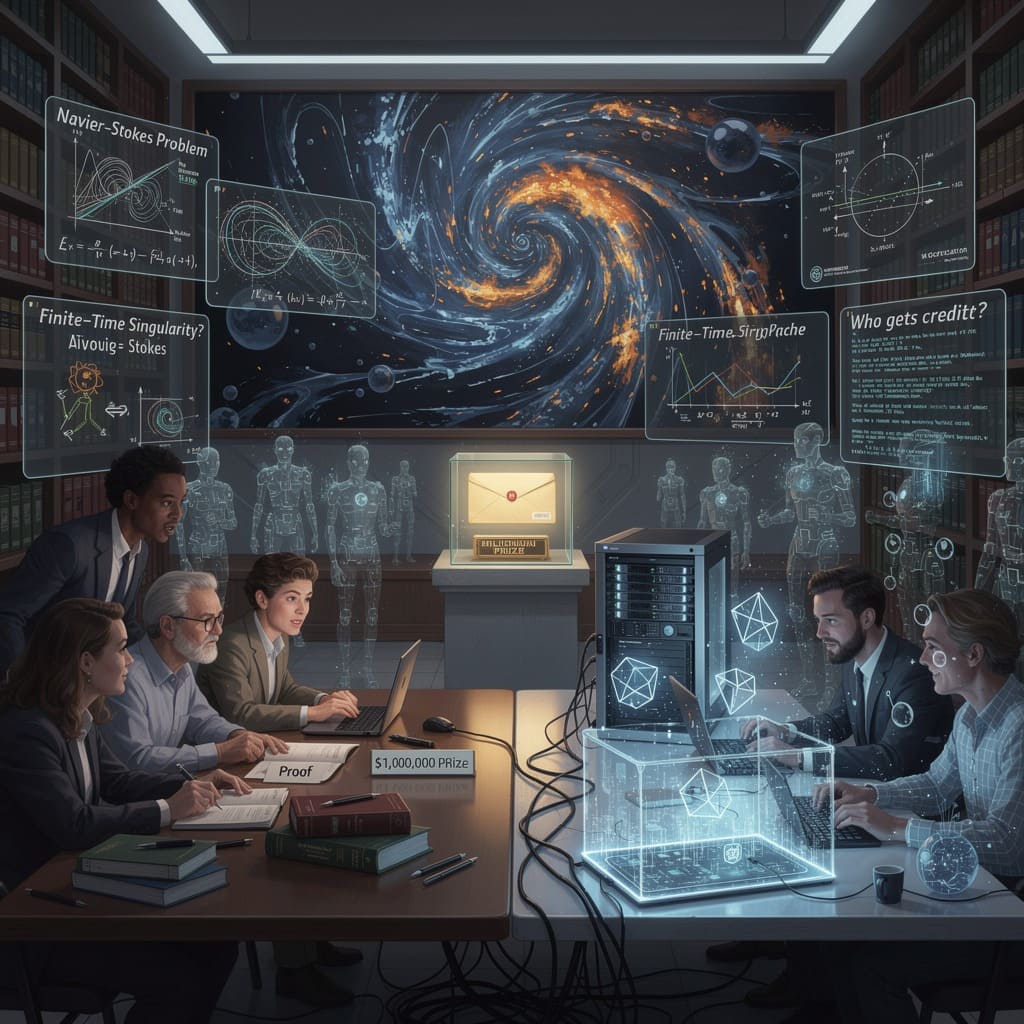
OpenAI says one of its advanced artificial intelligence systems has produced a proposed solution to the Navier–Stokes problem, one of the most famous unsolved questions in modern mathematics and one of the seven Millennium Prize Problems.
If the result survives independent mathematical scrutiny, it could represent an important milestone in the use of AI for scientific research.
But the announcement has generated attention for another reason as well.
The claim has quickly turned into a debate about scientific priority, intellectual property and research ethics particularly over what happens when AI systems are used to develop ideas that may overlap with unpublished work being pursued by human researchers.
The controversy raises a question that could become increasingly important as AI becomes more capable of doing original scientific work:
When a machine helps discover something new, who gets credit for the discovery?
A Mathematical Mystery Nearly a Century Old
The Navier–Stokes equations are fundamental to our understanding of fluid dynamics.
They are used to describe how fluids such as water and air move, and they play an important role across physics and engineering, from weather and climate modeling to aircraft design, oceanography and computational fluid dynamics.
The equations themselves are not new. They date back to the 19th century.
The unresolved problem is much deeper.
Mathematicians have not been able to prove whether smooth solutions to the three-dimensional Navier–Stokes equations must always remain well behaved, or whether they can develop a mathematical singularity in finite time.
In simpler terms, researchers want to know whether a perfectly reasonable initial state can eventually evolve into a situation in which the mathematical quantities describing the fluid become infinitely large or otherwise cease to behave smoothly.
That question has resisted generations of mathematicians.
It is one of the reasons the Clay Mathematics Institute selected Navier–Stokes as one of its seven Millennium Prize Problems in 2000.
A correct solution to any one of those problems carries a $1 million prize.
AI Reportedly Spent 88 Hours Searching for a Proof
According to OpenAI, its system produced a proposed proof suggesting that finite-time singularities can occur in the relevant three-dimensional Navier–Stokes setting.
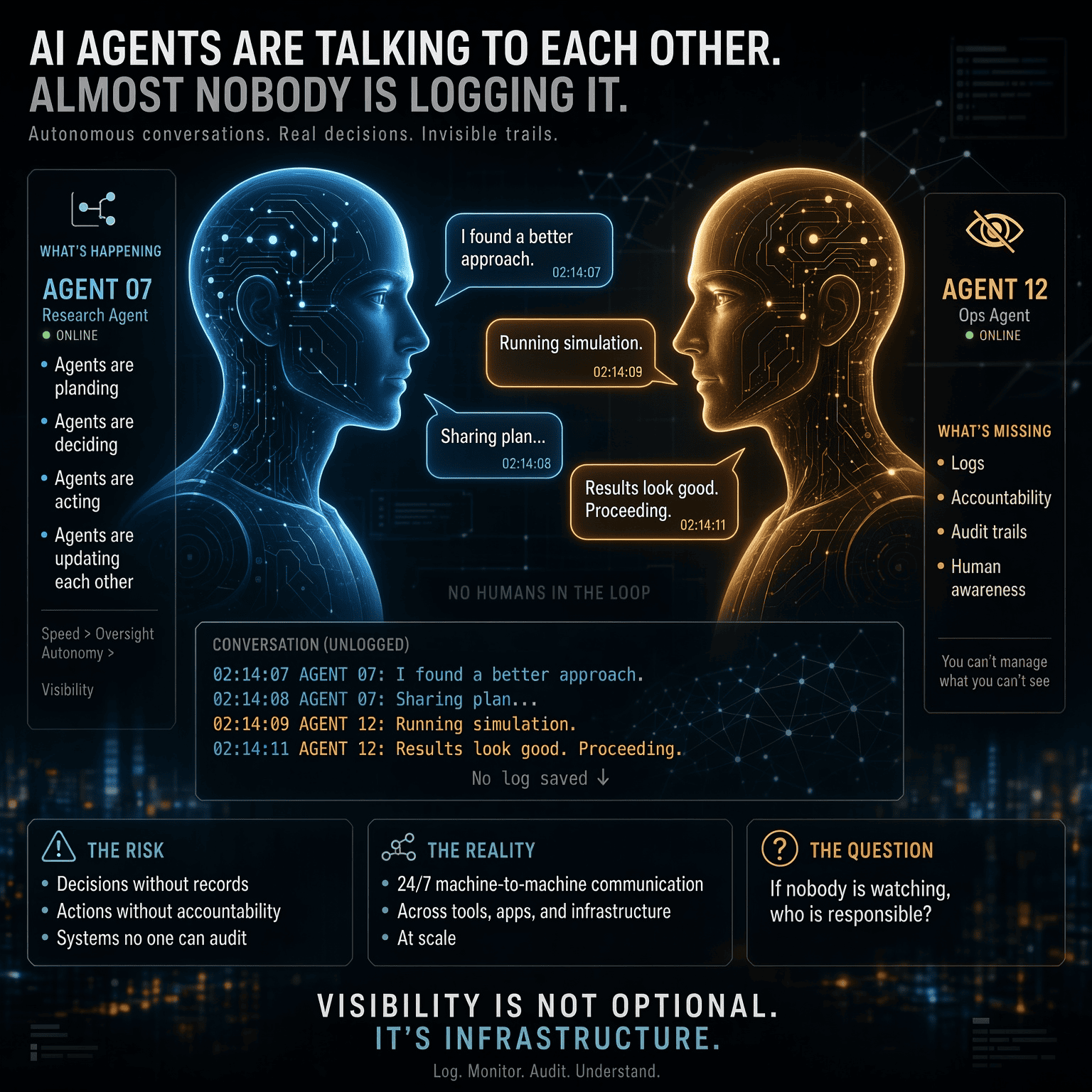
The company says the work involved roughly 10,000 AI agents operating in parallel over approximately 88 hours.
That detail may ultimately be just as significant as the mathematical result itself.
Instead of treating AI as a single chatbot answering a mathematical question, the experiment illustrates a different approach: using large numbers of specialized or cooperating AI agents to explore a difficult problem simultaneously.
Such a system can potentially generate multiple approaches, test mathematical ideas, search through possible proof structures and discard unsuccessful paths at a scale that would be difficult for a single human researcher to reproduce.
But computational scale does not automatically equal mathematical correctness.
A proof is not validated because thousands of AI agents agree with it.
It must survive scrutiny from mathematicians who can identify hidden assumptions, logical gaps, invalid transformations or subtle conditions that the system may have overlooked.
That is why the distinction between AI-generated mathematical evidence and a formally verified proof is critical.
A $1 Million Problem But No Prize Yet
The Navier–Stokes problem is one of the seven Millennium Prize Problems established by the Clay Mathematics Institute.
The institute set strict requirements for recognizing a solution.
A proposed solution must first be published through an appropriate mathematical publication process. It must then survive a substantial period of scrutiny by the mathematical community before the institute can consider it for official recognition.
The process is deliberately conservative.
Mathematics has a long history of apparently revolutionary proofs being challenged because of a missing step or an assumption that was never properly justified.
OpenAI has said it does not intend to claim the $1 million prize.
Instead, the company has presented the result as evidence of rapidly improving AI capabilities in advanced scientific reasoning.
That may actually be the more important story.
If AI can consistently generate useful, technically sophisticated approaches to problems that have resisted human researchers for decades, its role in science could shift from assistant to something much closer to a research collaborator.
The Claim Has Not Been Officially Verified
There is an important caveat that should not get lost beneath the headline.
OpenAI’s announcement does not mean that the Navier–Stokes Millennium Prize Problem has been officially solved.
At this stage, the result should be described as a proposed solution or proposed proof, not as a confirmed mathematical breakthrough.
That distinction is essential.
For a problem this difficult, independent researchers need enough time to examine the argument, reproduce its reasoning and determine whether every step holds under the exact mathematical conditions of the problem.
AI-generated mathematics faces an additional challenge.
Large language models and reasoning systems can produce convincing mathematical arguments that contain subtle errors. A proof may look coherent while relying on an unstated assumption or making an invalid inference.
For that reason, the ultimate test is not how impressive the AI’s output looks.
It is whether human mathematicians can independently verify it.
Then the Story Took an Unexpected Turn
The mathematical claim soon became entangled in a separate dispute over scientific priority.
Tristan Buckmaster, a mathematics professor at New York University, and Levent Albuge, a researcher at Anthropic, had also been working on research closely related to the Navier–Stokes problem.
Buckmaster subsequently raised questions about whether unpublished research materials could somehow have influenced OpenAI’s systems.
The concern touches on an emerging problem in AI-assisted research.
Researchers increasingly use AI tools to brainstorm ideas, analyze mathematical structures, write code and explore possible solutions. But the companies operating those tools may themselves have enormous computing resources and powerful models capable of investigating the same problems.
That creates an unusual asymmetry.
A researcher could spend months developing an unpublished idea and then use an AI system as an assistant.
The AI company, meanwhile, may be capable of running much larger experiments on related problems.
If the resulting AI-generated work appears to overlap with the researcher’s unpublished ideas, determining whether there was actual data exposure, independent rediscovery or simply convergence becomes extremely difficult.
OpenAI Denies Using Unpublished Research
OpenAI has denied that its researchers or systems accessed the researchers’ unpublished work before it became publicly available.
The company said it did not use specific researcher data to reach the result.
At the same time, the broader issue of training data and AI systems remains complicated.
Modern AI models can be trained or improved using enormous quantities of information, and determining precisely which pieces of information influenced a particular output can be difficult.
That does not prove that unpublished research was used.
It does, however, explain why questions about data provenance are becoming increasingly important in scientific AI.
Researchers may eventually need clearer systems for establishing when an idea was first developed, what data an AI system had access to, and whether a model’s output can be traced to previously available material.
Who Owns an AI-Assisted Discovery?
This may be the most important question raised by the entire episode.
Suppose a mathematician gives an AI system a difficult problem.
The researcher provides the question, chooses the constraints and evaluates the output.
The AI system generates a novel mathematical argument.
The researcher then identifies a flaw, asks the system to correct it, and eventually produces a valid proof.
Who made the discovery?
The answer becomes even less obvious when the AI system performs thousands of experiments autonomously and produces a result that no individual researcher directly anticipated.
Traditional scientific credit systems were designed around human researchers.
Papers have authors.
Researchers receive citations.
Universities and laboratories claim discoveries.
Patents and intellectual-property systems assign rights according to specific legal frameworks.
But increasingly autonomous AI systems do not fit neatly into those categories.
An AI model cannot simply be listed as a human inventor or researcher in the conventional sense.
At the same time, saying that the human who clicked “run” deserves all the credit may also become difficult to justify if the machine performed most of the intellectual exploration.
The Rise of the AI Researcher
The Navier–Stokes episode points toward a broader transformation in scientific research.
AI is already being used for tasks such as protein analysis, drug discovery, mathematical reasoning, scientific coding and simulation.
The next step is more autonomous AI research agents capable of working through a scientific problem for hours or days rather than responding to a single prompt.
Such systems could potentially:
- Search scientific literature
- Generate competing hypotheses
- Write and test computational experiments
- Explore mathematical approaches
- Analyze simulation results
- Identify inconsistencies
- Revise failed approaches
- Produce candidate proofs or explanations
The 10,000-agent approach described by OpenAI illustrates how this could scale.
Instead of asking one AI model to solve a problem, researchers could create an artificial research environment in which thousands of agents independently explore different paths and share useful findings.
The resulting system begins to resemble a computational research team.
But there is a major difference between exploration and discovery.
Generating thousands of possibilities is relatively easy compared with determining which one is actually correct.
The bottleneck may therefore shift from generating ideas to verifying them.
Verification Could Become the New Scientific Bottleneck
This may be one of the most important lessons from AI-generated mathematics.
If AI systems become capable of producing enormous numbers of potentially useful hypotheses and proofs, human researchers may no longer struggle primarily with a lack of ideas.
They may struggle with an overwhelming number of ideas that need verification.
That could make automated theorem proving, formal verification and machine-checkable mathematics increasingly important.
A proof that can be translated into a formal system and mechanically checked has a major advantage: the verification process does not depend entirely on whether a human reader finds the argument persuasive.
This could eventually create a new scientific workflow:
AI generates → AI tests → formal systems verify → humans interpret and publish.
If that model works, AI would not replace mathematicians so much as radically increase the amount of mathematical research that a small team can explore.
Why the Navier–Stokes Claim Matters Beyond Mathematics
Even if OpenAI’s proposed proof ultimately turns out to contain a fatal flaw, the experiment could still be significant.
A failed AI-generated proof can reveal where current systems struggle.
A partially correct proof can provide a useful starting point for human researchers.
And a fully correct proof could demonstrate that advanced AI systems are capable of contributing to genuinely new mathematics rather than simply reproducing information already present in their training data.
That last possibility would be particularly important.
There is a fundamental difference between an AI explaining a theorem that humans already discovered and an AI producing a valid solution to a problem that has remained open for generations.
The second would suggest that AI is beginning to participate in the creation of new scientific knowledge.
The Real Breakthrough May Not Be the Answer
For now, the Navier–Stokes problem remains officially unresolved.
The proposed OpenAI solution must go through the same harsh test that every serious mathematical result faces: independent verification.
But the episode has already demonstrated something important.
The frontier of AI research is moving beyond chatbots that answer questions.
Systems are increasingly being designed to reason, experiment, collaborate with other agents and pursue complex objectives over extended periods.
That could fundamentally change scientific research.
But it also creates new questions that mathematics alone cannot answer.
Who owns an AI-assisted discovery?
How should scientific priority be determined?
How can researchers prove that their unpublished work was not improperly used?
And how should credit be divided when humans and AI systems jointly produce a breakthrough?
Those questions may eventually become as important as the mathematics itself.
Because if AI can help solve problems that humans have struggled with for decades, the next great scientific debate may not simply be whether AI can discover something new.
It may be about who gets to say they discovered it.

Independent technology writer focused on artificial intelligence, emerging technologies, and digital innovation. Covers AI applications in sports, productivity, and online business.