





















Let’s settle the obvious question first: affiliate marketing is not dead. In 2026, affiliate channels account for roughly 16% of all e-commerce orders in the United States, and US affiliate spending is projected to pass $13 billion this year. The money is still there, at scale, and growing.
What changed is where it flows and who captures it. The last two years broke the old map completely — and a lot of affiliates are still standing on it, looking at the ocean. This is a remapping: what broke, what it was replaced by, and the four directions where the real money now actually lives.
The earthquake
Affiliate marketing survived three shocks at once, and each one alone would have been enough to redraw the industry. Together, they moved the ground beneath everyone:
- AI took the clicks. Google’s AI Overviews now appear on a large share of commercial searches, and when they do, click-through rates roughly halve — from around 15% to around 8%. Users get the answer in the search results, and never scroll to your link.
- The cookie died. Third-party tracking is being replaced by intent-based attribution and server-to-server tracking, and it’s not uniform: the modern networks (impact.com, PartnerStack, Awin, ShareASale) support it; Amazon Associates remains cookie-dependent, which is exactly why its performance has slipped on mobile.
- Google got strict. Years of Helpful Content updates and quality crackdowns punished thin affiliate sites — including a wave of AI-generated content that flooded search in 2023-2024 and is now being systematically filtered out.
And to cap it off, Amazon — the giant every beginner leaned on — cut commission rates by up to 50% in early 2026.
The old map
The old map had one route to money, and it looked like this: build a “best X product” page, rank it in Google with keyword stuffing, drop Amazon links, earn 3-4% per sale. Repeat across hundreds of pages. That map is now actively hostile. The same page that used to rank in the top five is now sandwiched under an AI summary that answers the question without you, and the commission on the click you do get has been halved.
The old map rewarded volume. The new terrain rewards something the old map never even charted.
The five fault lines
Before the compass, the fractures, because each one tells you what the ground now favors:
1. Search became generative. The decision moment now happens inside an AI answer — ChatGPT, Perplexity, Google’s AI Overviews — before the user ever clicks anything. But the counter-intuitive finding of 2026: AI systems still cite original sources, and they cite the deep, first-hand content. Princeton research found that clear, direct answers of roughly 40-75 words get cited far more often. Getting cited became a traffic channel.
2. Attribution outgrew the cookie. With third-party cookies gone, credit goes to whoever the data says drove the conversion — often across devices and touchpoints. This rewards affiliates with real relationships and real data, and punishes the passive link-droppers.
3. Commerce went native. TikTok Shop matured from beta into a full affiliate channel: in-feed videos, LIVE shopping, and a dedicated Shop tab, with the purchase happening inside the app. Creator-commerce tools (Shopify Collabs, LTK, Amazon Live) let creators tag products and earn without the link-leaving friction — and affiliates who treat their channel as a media brand report three to five times higher earnings per click than link-droppers.
4. Quality became the filter. Google’s systems now separate the original from the aggregated. First-hand testing, original images, methodology pages, author authority the E-E-A-T signals are the price of admission to the new search.
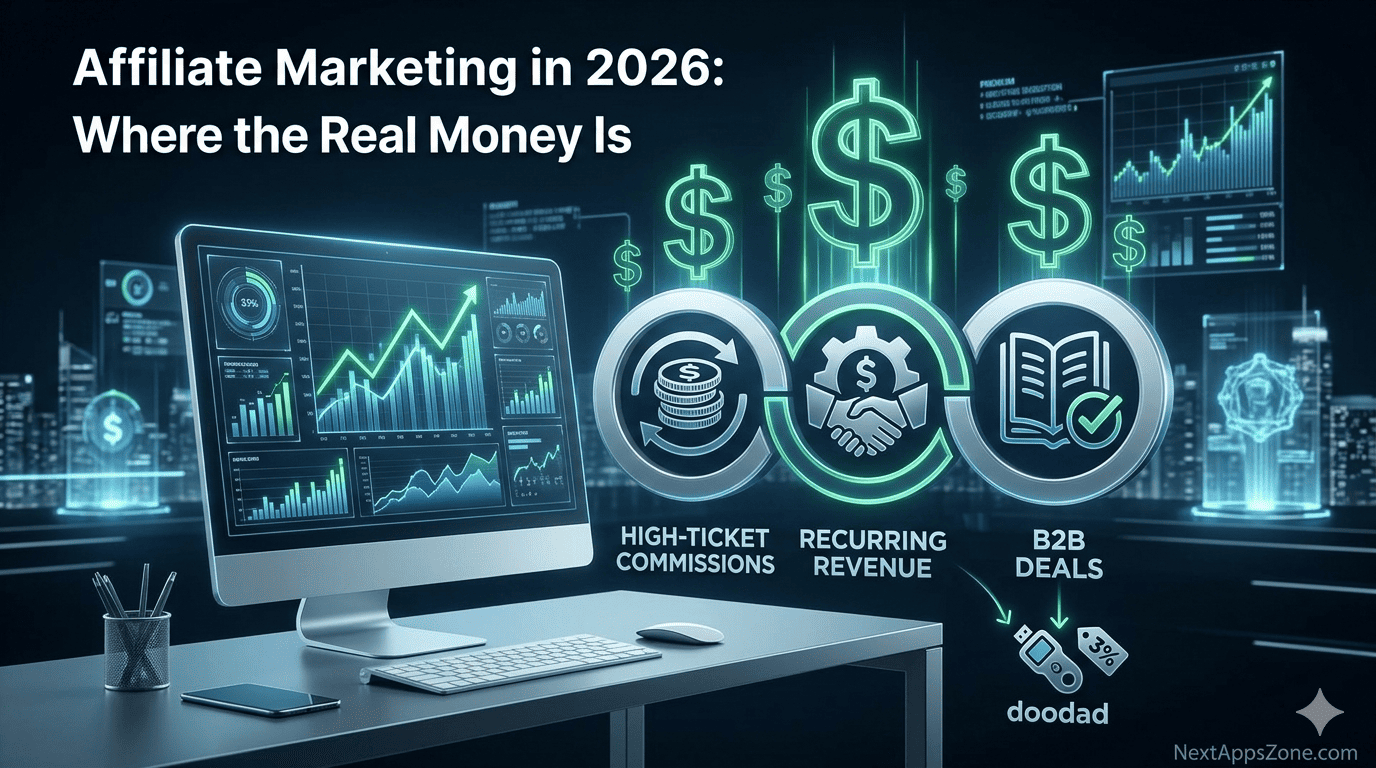
5. The single-sale model stopped compounding. One-time commissions on commodity products have been eclipsed by recurring revenue. PartnerStack’s industry data shows 71% of SaaS partner programs now pay recurring commissions, and the median SaaS affiliate commission sits around 22.5% of first-year revenue — against a median of about 8.4% for e-commerce. A $100-a-month subscription can quietly become a $1,000+ lifetime customer. That’s the difference between selling sneakers and selling infrastructure.
The new compass: where the real money is now
Four directions, and the money clusters in all of them. Pick one that matches who you are; the error in 2026 is trying to stand on all four at once.
North — owned audiences. Email lists and communities became the most stable asset in the industry, because no algorithm update or AI summary can take them from you. The affiliates sustaining income through every 2025-2026 update are the ones who own the relationship — the list, the newsletter, the direct line. Rented attention is shrinking; owned attention is appreciating.
East — creator-led commerce. The visual niches — beauty, fashion, gadgets, fitness, home — are where TikTok Shop and LIVE shopping now print money. The math is counterintuitive: you don’t need an empire. With even a modest following, consistent LIVE sessions can generate meaningful monthly commissions — the platform’s algorithm actively promotes shoppable, native, unpolished content, which flattens the old “big creator” barrier.
South — depth and authority. This is the search survivor’s direction. The content that AI Overviews cite and users trust is the content that proves experience: tested products, real numbers, specific comparisons, current pricing, original research. The transactional, “here are 10 products we didn’t touch” pages are gone; the “here’s what I actually used for six months, and here’s the measurement” pages are the new rankings.
West — B2B SaaS and recurring. The highest margins in the industry now sit here: software, hosting, marketing tools, platforms — where a single closed deal can pay $500 to $2,500+, and where subscriptions keep paying monthly. It’s slower (longer sales cycles, stricter qualification), but it compounds. The average affiliate earns around $8,000 a month on paper — and the honest reality is that 80% earn under $80,000 a year, with only a small minority crossing $150,000. The ones at the top are overwhelmingly the ones in this direction.
The currency
What’s actually being paid with, in 2026, is not traffic. It’s four things:
- Trust, because recommendation quality — not click volume — is what converts when the user already has an AI answer.
- Proof, because first-hand experience is the only filter both Google and the AI engines respect.
- Compounding, because recurring commissions and retained audiences grow while one-time sales restart from zero.
- Speed, because social commerce is real-time; the affiliate who shows the product now, in a live session, wins the impulse purchase the article can’t.
How to navigate
The practical route, condensed:
- Pick one direction — the compass above — and go deep. Depth beats breadth everywhere on the new map.
- Own your audience. If you don’t have a list, build one from day one. It’s the only asset on this map that can’t be revoked.
- Diversify channels anyway. Affiliates with three or more traffic sources are roughly four times more likely to hold their income through algorithm updates. Compass direction ≠ single channel.
- Structure for AI. Clear question-answer sections, specific numbers, methodology, original images — build content an AI engine can quote, not just a person can read.
- Use AI as a co-pilot, not an author. The 2023 wave of AI-written affiliate content is being filtered out. AI for ideation, research, and scaling; humans for testing, experience, and the voice that sells.
- Verify your tracking. If your network still relies on third-party cookies, move to server-side attribution — the platforms that measure correctly are the only ones you can trust the math of.
And if the whole thing feels expensive to start — it doesn’t have to be. The tools that do most of the heavy lifting have genuinely free tiers, and a working workflow can begin at zero cost, exactly the way a real, documented path from nothing to income did. Whether you’re testing your first niche or your first audience, starting with what’s free that actually works is the safest first step on the new map — and there’s a proven route from free tools to real first income worth studying.
The uncharted
Finally, the prediction section — clearly labeled. Three forces will shape the map over the next eighteen months, and positioning yourself now matters more than predicting the winners:
- Buying agents. As AI assistants get hands (and they are, fast), a growing share of purchases will be delegated to agents that compare, verify, and buy on the user’s behalf. The affiliates who win that future are the ones whose content is structured for machine consumption — cited, factual, verifiable — because that’s what agents will trust.
- Commission on value, not sales. Attribution is shifting from “who got the click” toward “who influenced the decision,” and the payouts are migrating toward recurring and lifetime-value models. The affiliate gets rewarded for the customer’s lifetime, not the purchase.
- The GEO battleground. Search is becoming a citation economy. The fight to be the source an AI engine quotes — Generative Engine Optimization — will matter as much as traditional rankings, and the content that wins it is the content that earns it: original, experienced, and structured.
The map has been redrawn. The money didn’t move off the map — it moved across it. The affiliate marketers still standing in 2026 are not the loudest or the largest; they’re the ones who own their audience, prove their claims, and ride the recurring wave. Pick a direction, walk it with proof, and the rest is navigation.

Independent technology writer focused on artificial intelligence, emerging technologies, and digital innovation. Covers AI applications in sports, productivity, and online business.