















Course overview
Enrollment open. No prerequisites required.
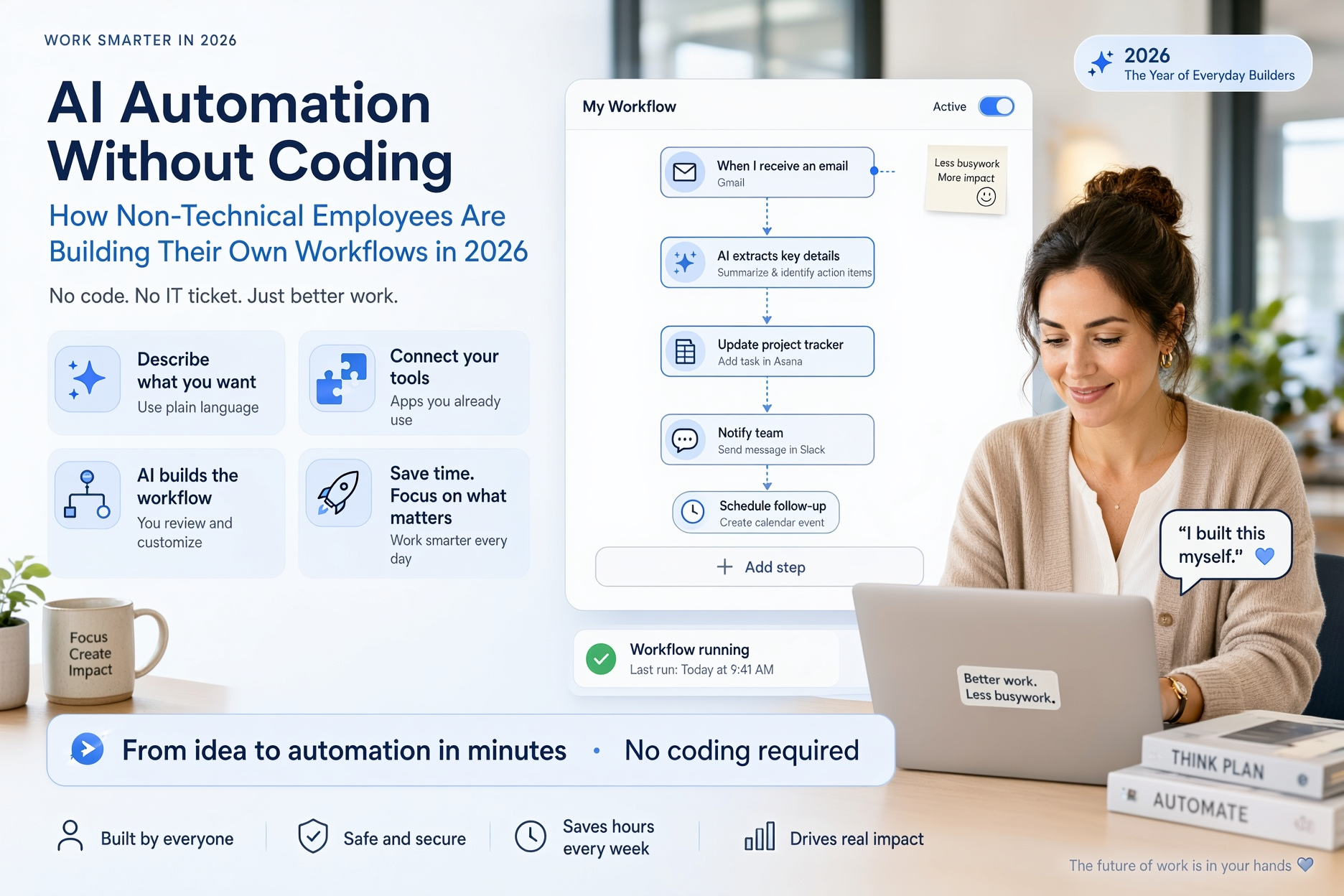
2026 is the first year “AI automation” stopped being an engineering specialty. The things that previously needed a developer — build a workflow, connect it to your apps, let it run unattended — are now tasks a marketing coordinator, an HR generalist, or a finance analyst can assemble in an afternoon. This is the syllabus for the course the industry is quietly teaching: how a non-technical employee goes from “I keep doing this report every week” to “my workflow does the report.” No code written. Real work automated.
Who this is for: anyone whose job contains a task done more than three times in the same shape. Which is everyone.
Module 1 — Spot the workflow
Skill: recognize automation-shaped work.
The first skill isn’t technical; it’s observational. Automation wants the same raw material every time: a task that is repetitive, bounded, and document-shaped. The weekly report. The onboarding packet. The routine contract review. The vendor follow-up email. Three diagnostic questions:
- Does it happen on a schedule? (weekly, monthly, recurring)
- Does it follow the same steps each time? (even if the content differs)
- Does it end in a deliverable you could describe in one sentence?
If yes to all three, you’ve found your first workflow. The 2026 evidence backs the instinct: the year’s most-cited automation wins — a tax-form review processing 24,771 K-1 forms, and a weekly reporting job saving 5 to 10 hours a week — are exactly this shape. Repetitive, bounded, documented.
Module 2 — Write the score
Skill: describe the process as steps, not as a prompt.
This is the shift most beginners miss: you don’t hand the AI a request; you hand it a process. Write the steps in order, name the tool each step touches, and state the outcome of the whole thing. “Every Friday, gather sales data from the CRM, summarize it by region, flag anything 20% off forecast, and draft the summary email to leadership.” That’s a workflow definition, not a chatbot question. You don’t need to know how the wiring works — you need to know the order and the outcome. That’s the entire job.
Module 3 — Borrow the components
Skill: assemble what already exists. Do not build from scratch.
2026’s real news for non-technical people is that the components are pre-built:
- Workspace agents went generally available in ChatGPT Business, Enterprise, and Edu in May 2026: agents you build by describing the job, with safeguards on what actions they can take, shared across your team so “build once and use together” is literal.
- Skills (introduced in March) turn a proven workflow into reusable instructions — when to run it, the steps, the result format — and apply automatically when relevant. You build it once; the assistant reuses it forever.
- The protocol layer — MCP — means connecting a workflow to your calendar, your drive, or your CRM is a configuration, not an integration project.
- The no-code path is broader than workflow assembly: building real tools from a description is now ordinary, and the serious workflow tools start at the genuinely free tier.
The pattern of 2026: the smart non-technical builder doesn’t create components. She picks them.
Module 4 — Add the guardrails
Skill: decide what the workflow may and may not do.
Before your workflow runs unattended, define its borders:
- Read-only first. Let it observe; expand write access only after you’ve watched it work.
- Approval gates on irreversible actions. Anything that sends, spends, or publishes stops at a human.
- A defined threshold. “Flag anything 20% off forecast” is a guardrail; “decide what to do about it” is not.
The enterprise pattern is consistent — the deployments that work are the ones with structured oversight. Your personal workflow gets the same rule: automate the doing, keep the deciding.
Module 5 — Test, measure, hand off
Skill: run it, watch the meter, iterate, and share.
- Test on real-but-safe data. Run the workflow alongside your manual process for a few cycles and compare outputs.
- Watch the meter. Workflow tools are increasingly credit- or token-based, and pricing shifts as products mature — track what a run costs, not just what it saves.
- Set it loose gradually. Run with you reviewing; then run without you and review on schedule; then run and check exceptions only. That escalation — full attention, then exceptions only — is how asynchronous agentic workflows quietly do their work in the background.
- Share it. The second-order win is that your workflow becomes the team’s workflow. One person’s automation is next quarter’s department standard.
The final project
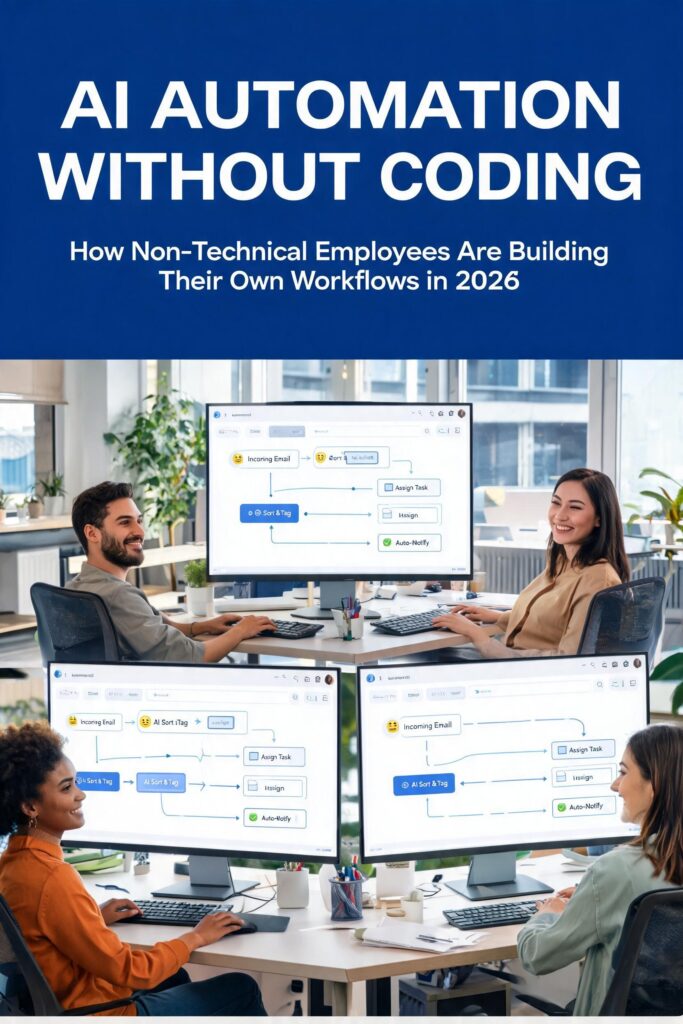
The exam, if you choose to take it: pick the weekly report, the onboarding packet, or the follow-up email — the task you repeat every week in the same shape — and run it through the modules. Spot it, score it, borrow the components, add the gates, measure it. If you can move one recurring task from “I do this” to “my workflow does this, I approve it,” you’ve passed. That single skill — going from task-doer to workflow-owner — is what the 2026 job market is quietly repricing, and the leap is available even to people who have never touched code.
Fine print
The syllabus wouldn’t be honest without its limits:
- Not everything belongs in a course. Regulated decisions, money movement, and anything with a signature on it stay human. The guardrails aren’t bureaucracy; they’re the difference between automation and incident.
- The platform moves. Agents, Skills, and model versions change quarterly; a workflow is software now, which means it needs occasional maintenance, not lifetime care.
- “Without coding” doesn’t mean “without thinking.” The skill you’re actually developing is process design. The machine provides the hands; you provide the plan.
Graduation
Here’s what 2026 changed for good: the gatekeeper is gone. The “technical skill” that used to separate the person who can automate their job from the person who can’t has been replaced by the ability to describe work clearly. That’s a marketing skill, an HR skill, a finance skill — and now, suddenly, an automation skill. The employees building their own workflows this year aren’t the ones who learned to program. They’re the ones who learned to see their job as a process.
Enroll early. The course has no waitlist, and your weekly report is not going to write itself.

Independent technology writer focused on artificial intelligence, emerging technologies, and digital innovation. Covers AI applications in sports, productivity, and online business.