


































Introduction:
If you type a question into Google and Baidu, you will get two completely different answers — and that difference goes far beyond language. Baidu dominates China’s search market while Google leads everywhere else, but both companies are racing to define the next era of AI. This article compares them across search quality, AI capabilities, and business strategy, so you can understand what each platform offers and which one matters for your needs.
The search engine battle used to be a one-horse race. Google won. But in China, a different story played out. Baidu built its own search empire behind the Great Firewall, and today it controls over 60% of China’s search market. Meanwhile, both companies have reinvented themselves as AI leaders. Google has Gemini. Baidu has Ernie Bot. This Baidu vs Google comparison looks at how they stack up in search, artificial intelligence, and business. Whether you are a developer, a digital marketer, or just curious about tech, this comparison will help you understand the two giants.
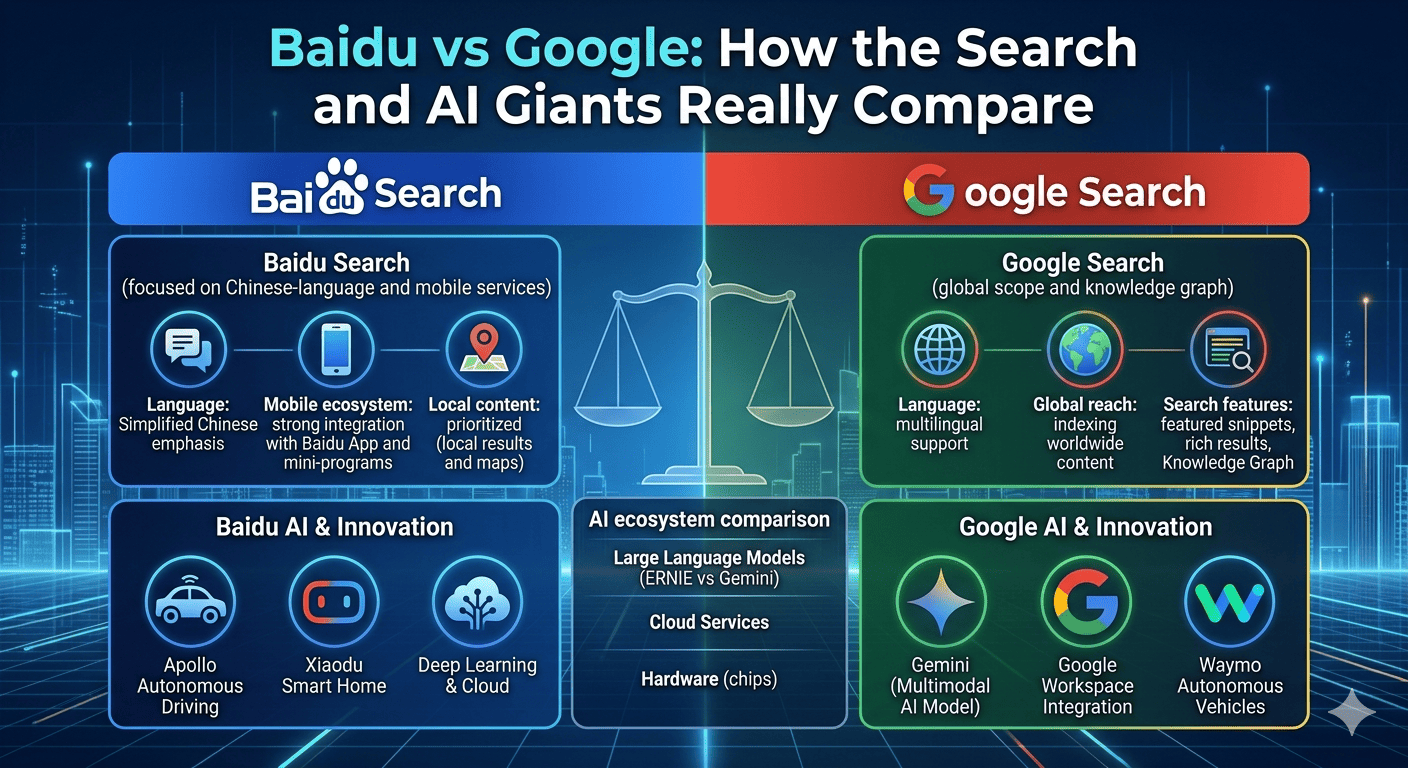
Baidu vs Google at a Glance
| Feature | Baidu | |
|---|---|---|
| Main Market | Global | China |
| Search Market Share | Dominant worldwide | Around 65% in China |
| AI Model | Gemini | Ernie Bot |
| Cloud Platform | Google Cloud Vertex AI | Baidu AI Cloud |
| Ecosystem | Gmail, YouTube, Maps, Android | Baidu Maps, Baidu Drive, Baidu Knows |
| Best For | International users and businesses | Chinese users and China-focused companies |
| Strength | Broad ecosystem and AI research | Chinese language and local services |
At a high level, Google and Baidu serve different audiences. Google dominates the global web, while Baidu is deeply integrated into China’s internet ecosystem. The better choice depends less on which company is “better” and more on where your audience lives and which language they use.
Search Engines — Two Different Philosophies
Market reach and user base
Google processes over 8.5 billion searches per day. It dominates everywhere except China, Russia, and a few other markets. Baidu, on the other hand, holds roughly 65% of China’s search market share. Outside China, Baidu is barely used. The main reason is language and policy. Google is blocked in China, and Baidu’s entire platform is built for Mandarin speakers. If you compare Google vs Baidu search purely by user numbers, Google wins by a wide margin. But inside China, Baidu is the default.
Search quality and features
Google is known for fast, accurate results with rich snippets, knowledge panels, and voice search. Baidu has improved significantly over the years. It now offers image search, video search, and a news aggregation feature called Baijiahao. However, Baidu’s search results include more ads and promoted content, which can make the experience feel cluttered. For a Chinese search engine comparison, Baidu works well for local queries like restaurants, directions, and news in Chinese. For global queries, Google is more comprehensive.
Content policies and censorship
This is where the Baidu Google differences become most visible. Google follows a mostly open web philosophy with moderation for spam and illegal content. Baidu operates under Chinese law, which requires strict content filtering. Search results for sensitive topics are blocked or altered. This affects everything from news to academic research. If you need unrestricted access to information, Google is the clear choice. If you operate inside China, Baidu’s approach is simply a fact of doing business.
The AI Arms Race
Ernie Bot vs Gemini — head to head
Both companies launched large language models around the same time. Google released Gemini (formerly Bard) and integrated it across Workspace, Android, and cloud services. Baidu launched Ernie Bot, which is built into its search engine, cloud platform, and smart speaker products. In terms of raw capability, Gemini performs better on benchmarks like MMLU and math reasoning. But Ernie Bot is optimized for Chinese language and culture. It understands idioms, local references, and regulatory boundaries in a way Gemini cannot match. In the Baidu AI Ernie vs Google Gemini debate, your language and region will determine the winner.
AI in search results
Google now shows AI Overviews at the top of many search results. These summaries answer questions directly without requiring a click. Baidu has a similar feature called “AI Search” that uses Ernie Bot to generate answers. Both tools aim to keep users on the search page longer. Critics say this reduces traffic to external sites. Supporters say it makes search faster. In both cases, the Google AI ecosystem and Baidu’s AI platform are evolving in the same direction — toward answer engines rather than link lists.
Cloud and enterprise AI
Google Cloud offers AI services through Vertex AI, which lets companies train and deploy machine learning models. Baidu Cloud provides similar tools through its AI Cloud platform, with a focus on Chinese enterprise customers. Baidu also leads in autonomous driving with its Apollo platform, while Google leads in AI research papers and open-source contributions through TensorFlow and DeepMind. For enterprise customers, Baidu vs Google 2026 looks like a split market: Baidu is stronger in China’s regulated industries, and Google is stronger globally.
Business Models and Revenue
How each company makes money
Google still generates most of its revenue from advertising. Alphabet reported more than $307 billion in revenue in 2024, making it one of the largest technology companies in the world.
Baidu also depends heavily on advertising, but it has expanded into cloud computing, AI services, and autonomous driving. Baidu reported roughly $17 billion in annual revenue, which is much smaller than Alphabet’s scale but reflects its strong position inside China.
The difference is striking. Google operates globally and competes across dozens of markets. Baidu focuses mainly on China, where it faces a very different competitive landscape and benefits from the absence of Google.
Ecosystem and services
Google’s ecosystem includes Gmail, YouTube, Maps, Drive, Android, and Chrome. These products feed data into its AI models and create a sticky user base. Baidu’s ecosystem includes Baidu Maps, Baidu Drive, Baidu Knows (a Q&A platform), and iQiyi (streaming video). The ecosystem is deep but mostly China-only. When comparing which is better Baidu or Google in terms of daily utility, Google offers more tools for a global audience. Baidu is more convenient if you live in China and speak Mandarin.
Which One Should You Use?
Choose Baidu If:
- Your audience is located in China.
- You are investing in Chinese SEO.
- Your content is written primarily in Mandarin.
- You want AI tools designed for Chinese users and businesses.
Choose Google If:
- Your audience is international.
- You rely on English-language information and research.
- You use services like Gmail, YouTube, Maps, Android, or Google Workspace.
- You need access to a broader ecosystem and more mature AI tools.
In my experience, the gap between the two platforms becomes obvious when searching outside their core markets. Baidu performs surprisingly well for Chinese-language searches, but Google remains stronger for international content and broader research. Neither platform is universally better. They are optimized for different users and different internet environments.
Conclusion
Baidu and Google are both AI and search giants, but they serve different masters. Google dominates the open web. Baidu dominates the Chinese web. Their AI tools — Gemini and Ernie Bot — reflect the same split. One is built for global scale and open research. The other is built for China’s regulated market. Rather than asking which is better, ask which fits your context. For most of the world, Google is the answer. For China, Baidu is the answer. And in the long run, both companies will continue to push each other forward.
- “Google Gemini vs ChatGPT comparison” — Link from the Ernie Bot vs Gemini section to help users who want a broader AI chatbot comparison.
- “How to do SEO for China (Baidu SEO guide)” — Link from the “When Baidu makes sense” section to support readers who want practical Chinese SEO steps.
- “Google AI tools overview” — Link from the Cloud and enterprise AI section to detail Google’s Vertex AI offerings.

Independent technology writer focused on artificial intelligence, emerging technologies, and digital innovation. Covers AI applications in sports, productivity, and online business.