



























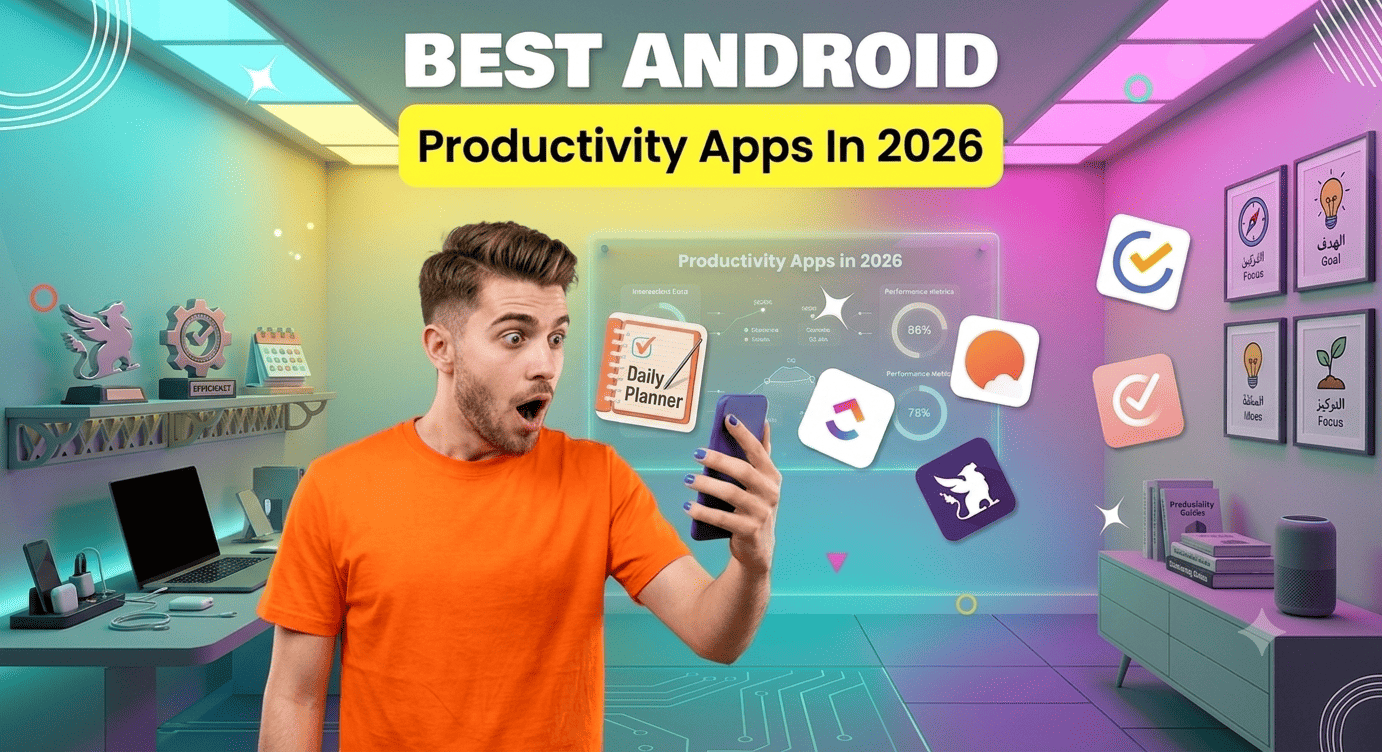
I’ve been covering mobile productivity tools since 2019, and one pattern keeps showing up: most people download a productivity app, use it for three days, and forget it exists. The problem is rarely motivation — it’s that the app doesn’t fit their actual workflow. I wanted to find apps that stick.
Yes, you can stay productive on Android without spending a cent. There are genuinely free apps that handle task management, note-taking, focus timing, habit tracking, and document editing — and they’re not limited trials with a 14-day countdown. The difference between a useful list and a useless one comes down to two things: whether the free tier is actually usable long-term, and whether the app fits your specific workflow. This guide covers both.
I tested over 30 apps across five categories over six weeks. Below are the ones I kept installed after the experiment ended.
How I Picked These Apps (My Criteria)
There are thousands of productivity apps on the Play Store. Most of them want your credit card within the first hour. I filtered using three hard rules.
What “Free” Actually Means Here
Free means you can use the core features indefinitely without paying. No 7-day trial. No “premium required to set more than five tasks.” I excluded apps where the free version feels deliberately broken to push upgrades. If an app has a paid tier for advanced features, I note it — but the free tier must stand on its own.
The Five Pillars of Mobile Productivity
I grouped apps into five stages that mirror how work actually flows: Capture (getting ideas out of your head fast), Organize (turning chaos into a system), Focus (doing the work), Execute (producing output), and Reflect (reviewing progress). An app that nails one stage is more useful than an app that does five things poorly.
Capture — Best Free Apps for Quick Notes and Ideas
H3: Google Keep — Still the Fastest Way to Capture
Google Keep is the default for a reason. It loads instantly, supports voice notes, and syncs across devices without any setup if you have a Google account. I use it for quick grocery lists, parking spot reminders (the location-based reminder feature), and random ideas that pop up during the day.
What I like: the color-coding system. I use yellow for personal, green for work, and blue for content ideas. It’s simple, but it works. What I don’t like: the lack of real organization. You can’t nest notes or create folders — it’s one flat grid. Keep is for capture, not for deep organization.
H3: Microsoft OneNote — Free Power Organizer
OneNote is the opposite of Keep: it gives you notebooks, sections, and pages like a physical binder. The Android app has improved massively. You can handwrite with a stylus, attach files, and record audio that links to your notes.
The free tier gives you 5 GB of OneDrive storage. For note-taking, that’s plenty. I use OneNote for research notes and long-form writing outlines. It’s slower to launch than Keep, but once you’re inside, the organization is unmatched among free options. You can check the full feature list on Microsoft’s official OneNote page.
H2: Organize — Best Free Task Managers
H3: Todoist — The Free Tier That Actually Works
Todoist’s free plan lets you manage up to five active projects, add up to 300 tasks per project, and use labels and filters. That’s more than enough for an individual. The smart date recognition — type “meeting every Tuesday at 3pm” and it sets a recurring task — saves me a few seconds per entry, which adds up.
The catch: the free version only shows your last seven days of activity in the productivity graph. But honestly? Most people don’t need a week-over-week comparison. What matters is that the core task management is unrestricted. As of 2026, Todoist remains the best free to-do list app for Android for people who work with projects.
H3: Tasks.org — Open-Source and Privacy-First
Tasks.org is the best free Android productivity app you’ve never heard of. It’s fully open-source, has zero ads, and syncs with Google Tasks, CalDAV, or its own cloud. The free version on F-Droid includes every feature — the Play Store version asks for a voluntary $1/year donation to unlock the same.
I use it for personal task management. It supports subtasks (unlimited nesting), location reminders, and custom widgets. The interface looks clean without trying to be cute. If privacy matters to you, this is the one. You can grab it from Tasks.org’s official site.
H3: TickTick — All-in-One With a Free Pomodoro Timer
TickTick bundles a task manager, calendar, Pomodoro timer, and habit tracker in one app. The free version supports up to 9 lists and 300 tasks, plus the built-in Pomodoro timer with white noise options. That last feature alone makes it worth trying if you use time-blocking.
Where it falls short: the habit tracker in the free tier is basic — you get one habit. But if you mainly need a task manager with focus features, TickTick’s free plan delivers more than Todoist does in some areas. The calendar view alone justifies the download.
H2: Focus — Best Free Apps to Beat Distractions
H3: Forest — Stay Focused, Grow Trees
Forest gamifies focus. You plant a virtual tree when you start a focus session. If you leave the app, the tree dies. Over time, you build a forest. The free Android version gives you a few tree species and the core timer. A one-time $1.99 purchase unlocks more trees and a real tree planted via Trees for the Future.
I was skeptical about gamified productivity until I realized I didn’t want a dead tree on my conscience. It’s silly, but it works. For a completely free alternative, the source code is available on Forest’s official GitHub. Official app is on the Google Play Store.
H3: Super Productivity — Deep Work, No Tracking
Super Productivity is an open-source task manager and time tracker built for deep work. It includes a Pomodoro timer, time tracking, and a daily planner. There are no accounts, no data collection, and no premium tier.
The Android app syncs via WebDAV or Dropbox if you want, or you can use it fully offline. It integrates with Jira, GitHub, and GitLab — useful if you’re a developer. But it works just as well for anyone who wants to time-box their day without giving up their privacy. You can grab it from the Google Play Store.
H2: Execute — Free Tools That Get Things Done
H3: Google Workspace Apps (Docs, Sheets, Drive)
You already have a Google account. That means you already have Google Docs, Sheets, and Drive — all fully functional on Android. The mobile versions support offline editing, real-time collaboration, and voice typing.
I write first drafts of articles on Google Docs on my phone all the time. It’s not ideal for long sessions, but for quick edits, reviewing feedback, or starting something while commuting, it’s hard to beat. 15 GB of free storage across Drive, Gmail, and Photos is enough for most document-heavy workflows.
H3: Notion — Free Personal Wiki and Database
Notion’s free plan in 2026 includes unlimited pages, 7-day page history, and up to 10 guests. For personal use, that’s everything. I use Notion as a central database — content calendars, reading lists, project trackers, and a “second brain” of saved ideas.
The Android app is not as fast as the desktop version, and the offline support is limited. But for browsing, adding quick entries, and checking your databases on the go, it works well. If you want a free project management app for Android that doubles as a wiki, Notion is your best bet.
H2: Reflect — Track Your Habits and Progress
H3: Loop Habit Tracker — Minimal and Effective
Loop Habit Tracker is open-source, ad-free, and dead simple. You set a habit, mark it each day, and Loop shows you your completion rate over time with a clean graph. No gamification. No social features. No notifications trying to upsell you.
I’ve been using Loop for two years. The streak view and the detailed score (which accounts for how consistently you do a habit) give me honest feedback without guilt-tripping. It’s available on F-Droid and the Play Store.
H3: HabitNow — All-in-One Habit and Routine Builder
HabitNow combines habit tracking with a daily planner. The free version lets you create unlimited habits, set reminders, and view statistics. What sets it apart is the routine builder — you can chain habits into a morning routine, for example, and it walks you through step by step.
The interface is more polished than Loop’s, but the free version shows occasional ads. Still, for someone who wants a habit tracker and a daily planner in one app without paying, it’s a solid choice.
H2: Free Productivity Apps Comparison Table
| App | Best For | Free Tier Limit | Open Source |
|---|---|---|---|
| Google Keep | Quick capture | Unlimited notes | No |
| OneNote | Organized notes | 5 GB storage | No |
| Todoist | Project-based tasks | 5 projects, 300 tasks/project | No |
| Tasks.org | Privacy-focused tasks | Fully free (F-Droid) | Yes |
| TickTick | Task mgmt + Pomodoro | 9 lists, 300 tasks | No |
| Forest | Focus/gamification | 3 tree species | No |
| Super Productivity | Deep work timeboxing | Fully free | Yes |
| Notion | Databases & wikis | Unlimited pages | No |
| Loop Habit Tracker | Minimal habit tracking | Fully free | Yes |
| HabitNow | Routines & habits | Unlimited habits | No |
H2: Frequently Asked Questions
What is the best free to-do list app for Android in 2026? Todoist for project management, Tasks.org for privacy, and TickTick if you want a built-in Pomodoro timer.
Are there any fully free Android productivity apps without subscriptions? Yes. Google Keep, Loop Habit Tracker, Tasks.org, and Super Productivity have no paid tiers at all. Everything is included.
Can I replace Microsoft Office with free Android apps? For most personal use, yes. Google Docs, Sheets, and Slides handle 95% of what people do in Office. OneNote is also free and covers note-taking.
What is the best free Pomodoro timer app for Android? TickTick includes a good one in its free plan. Super Productivity has a more advanced version with break reminders and time tracking.
Which free productivity app respects privacy the most? Tasks.org and Super Productivity are open-source with no data collection. Loop Habit Tracker also stores everything offline.
H2: Conclusion
You don’t need to spend money to be productive on Android. The apps above cover the full workflow — capture, organize, focus, execute, reflect — without asking for your credit card. The trick is picking one from each category and sticking with it for at least two weeks. No app will fix procrastination overnight. But the right tools reduce friction, and less friction means more gets done.
Start with Google Keep for notes and Todoist for tasks. Add Forest or Super Productivity when you need to focus. That’s a complete, free productivity system in three apps.

Independent technology writer focused on artificial intelligence, emerging technologies, and digital innovation. Covers AI applications in sports, productivity, and online business.