



























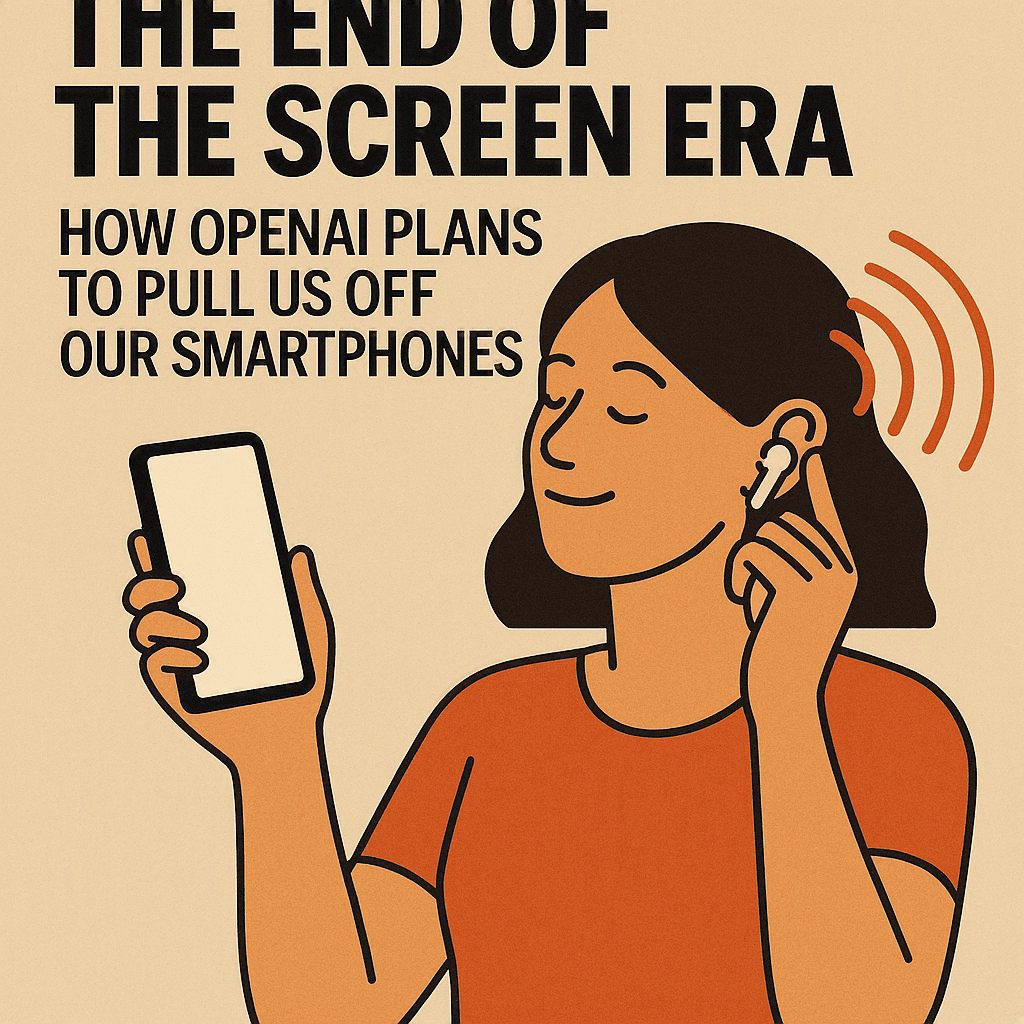
The last screen you ever hold might not be a screen at all. That’s the quiet bet OpenAI is making, and this week it stopped being a rumor and became a strategy. In an interview with Joanna Stern, OpenAI president Greg Brockman confirmed what half of Silicon Valley has been whispering for years: the company is building a “family of devices” to interact with its AI models. No release date, just a promise that feels like a countdown — “you can expect them soon.”
Sit with what that actually means. The company that put a chatbot on everyone’s phone is now trying to make sure you stop looking at it. That’s not a product decision. That’s a worldview.
From Glowing Rectangle to Conversation
Here’s the vision, stated plainly: you’ll talk to your computer instead of typing. Brockman says voice will take over for the “vast majority of what we do.” Not some of it. Not the little stuff. The vast majority. Your thumbs, it turns out, were always the bottleneck a keyboard is just a very slow way of asking a very fast machine a question.
The device line-up itself is still foggy, and that’s half the fun. Earlier reports pointed to a smart speaker that could arrive as soon as 2027, plus a wearable in the spirit of the Humane AI pin — you remember, the one that almost nobody bought but everybody copied. Underneath it all sits the collaboration with former Apple design chief Jony Ive, the man who made the smartphone feel inevitable in the first place. If the guy who designed the iPhone is now helping design what comes after it, that’s not a headline. That’s a eulogy for a form factor.
The funniest detail in the whole interview, though, is the one Brockman mentioned almost in passing. Apparently, soundproof “beak” masks are starting to appear in open offices — little mouth-covers so you can talk to your AI without everyone in the room hearing your grocery list. He says he doesn’t use one, but it “really shows you where there’s product market fit.” It’s a perfect little snapshot of where we’re headed: the future of computing looks like a man in a bird mask, whispering to the air, while his coworkers pretend not to hear.
The Elephant in the Room: Apple’s Lawsuit
You can’t talk about the end of screens without mentioning Apple, and Apple has noticed. The company is currently suing OpenAI, accusing it of stealing hardware trade secrets through former employees — a lawsuit that reads a bit like a landlord suing the tenants for designing a nicer apartment. When asked whether the litigation could derail the device work, Brockman brushed it off with the calm of someone who’s been sued before: “We are focused on our own development and technology. We have no interest in other companies’ trade secrets. We are plenty innovative.”
Whether that’s true or not, the timing is delicious. The company that owns the screen era is legally fighting the company trying to end it. Apple’s lawyers aren’t just protecting trade secrets. They’re protecting a business model. Every AI device that doesn’t ship with a glass rectangle is a small argument that the App Store’s 30 percent cut is not, in fact, the natural order of things.
The Hardest Part Isn’t the Hardware
Now here’s the part where I stop being impressed and start being honest. The engineering here was never the hard part. We’ve had voice assistants for a decade — Siri turned fourteen this year and still can’t book a table without apologizing. The hard part is that people don’t trust the machine enough to make it their primary interface. Talk to a speaker all day? Sure, as long as it’s not the one that heard you say something embarrassing at midnight.
OpenAI knows this. Brockman explicitly acknowledged the trust problem, pointing to concerns about ChatGPT’s “temporary chat” mode and promising “verifiable, auditable guarantees” that only the AI can review your private data. That’s a wild sentence if you unpack it. The pitch is essentially: we’ll prove to you that our machine is the only one reading your thoughts. Which is progress, I guess, over not being sure who was reading them.
And then there’s the social cost, which no chip can fix. The reason the beak masks are selling is the same reason video calls feel exhausting and why you still text your husband from the next room. Talking to a computer out loud in public makes you look slightly unhinged. It did when Bluetooth earbuds appeared, and it still does now, only the guy on the bus is no longer pretending to call his mom — he’s negotiating a refund with an AI and losing the argument.
So will we actually give up the glowing rectangle? Not all at once. The phone isn’t going to die; it’s going to be demoted — retired from the center of your attention to the pocket where you keep your keys and your wallet. You’ll still fish it out for the things that need eyes and fingers. But the things that need answers? Those will come from your voice, your wrist, your living room, maybe even your earbuds.
Brockman’s interview this week wasn’t a product announcement. It was a prediction dressed as a press moment. And honestly, it’s the most confident prediction a company can make: OpenAI isn’t betting that you’ll stop using screens. It’s betting that screens will stop being the point. The screen era doesn’t end with a bang or a keynote. It ends quietly, the way typewriters ended — one morning you reach for it, and it’s just a museum piece with a keyboard.
The only real question left is whether we’ll miss the feeling of holding our attention in our hands. Or whether, the first time we ask the air for directions and it just answers, we’ll realize we never wanted the phone at all. We wanted someone who listens. The phone was just the nearest thing to it.
Source: Stevie Bonifield, “OpenAI president says it’s ‘building a family of devices’ for its AI chatbots,” The Verge, July 29, 2026.

Independent technology writer focused on artificial intelligence, emerging technologies, and digital innovation. Covers AI applications in sports, productivity, and online business.