












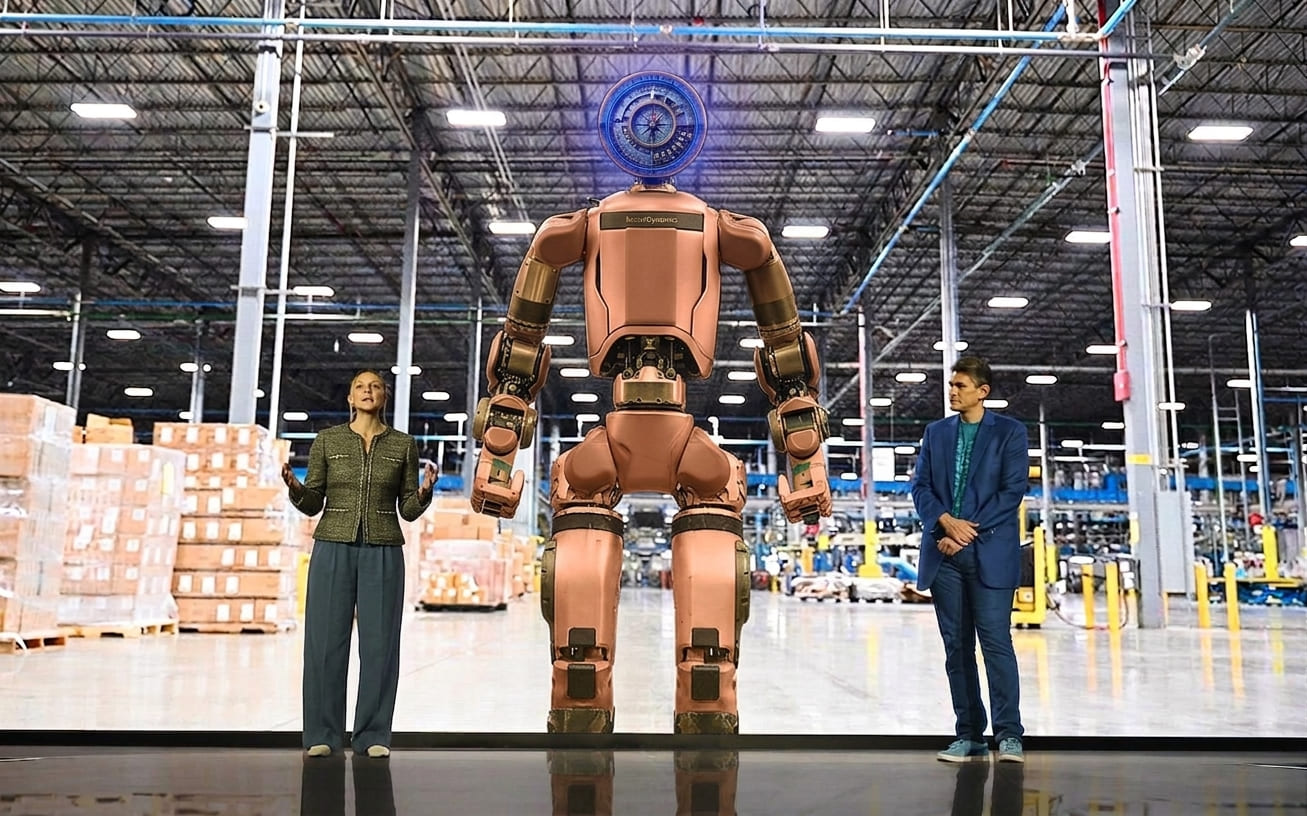
I’ve followed the automotive industry’s relationship with AI for years, and every major carmaker has made some kind of “AI transformation” announcement. Most of them amount to slightly better infotainment systems and a press release about autonomous driving that never materializes. Hyundai’s approach caught my attention because it’s not just another software announcement — it’s a fundamental restructuring of what the company intends to be.
Hyundai Motor Group has committed 26 billion to North America and over ₩125 trillion ( 86.7 billion) to South Korea through 2030. The money is going toward something the company calls “physical AI” — embedding intelligence into robots, factories, and eventually entire cities. At the center of this vision sits Boston Dynamics’ Atlas humanoid robot, a partnership with NVIDIA for computing infrastructure, and a collaboration with Google DeepMind on next-generation robotics.
This isn’t a car company making vague promises about the future. Hyundai is building robot production facilities, investing in AI data centers with tens of thousands of GPUs, and constructing what it calls an “AI Hydrogen City.” Whether this vision works or not, it’s one of the most concrete bets any traditional manufacturer has placed on physical AI. I wanted to understand the strategy behind the headlines.
Before the Bet: What Hyundai Was Already Working On
Boston Dynamics and the Robotics Foundation
Hyundai didn’t start from scratch. The Group acquired an 80 percent stake in Boston Dynamics from SoftBank in 2021 for roughly $674 million (₩1 trillion). By mid-2026, Hyundai moved to acquire SoftBank’s remaining 9.65 percent stake, signaling full ownership and a long-term commitment to robotics as a core business pillar.
Boston Dynamics gave Hyundai something most car companies lack: a proven robotics portfolio with real-world deployment. Spot, the quadruped robot, is already used in industrial inspections and construction sites. Stretch, the logistics robot, handles package sorting in warehouses. And Atlas — the humanoid robot that became famous for its uncanny agility — is the centerpiece of Hyundai’s physical AI ambitions.
What makes this different from a typical acquisition is how Hyundai plans to integrate Boston Dynamics’ technology with its own manufacturing capabilities. The Group isn’t treating Boston Dynamics as a separate experiment. It’s building an end-to-end AI robotics value chain that connects Boston Dynamics’ AI expertise with Hyundai’s factory systems, supply chains, and mobility technologies.
The Shift from Carmaker to AI Company
Executive Chair Euisun Chung described the transformation directly at the San Francisco AI Summit in July 2026: “Hyundai Motor Group is evolving beyond the traditional boundaries of automotive manufacturing to become a physical AI solution company.”
That statement carries weight when you look at what’s behind it. Hyundai has established a dedicated Silicon Valley division under its Advanced Vehicle Platform organization. The company recruited Jeremy Ma, a technology executive with experience at NASA, Apple, and NVIDIA, to lead the new unit. It’s also planning a “HMG Tech Talent Forum” to recruit AI and robotics engineers.
The shift isn’t just about making robots. Hyundai is redefining itself as a company that builds intelligent machines of all kinds — cars, robots, factory systems, and eventually urban infrastructure. The car business isn’t going away, but it’s no longer the only thing Hyundai wants to be.
The Physical AI Vision: Step by Step
From Intelligent Devices to City-Level Intelligence
Chung laid out a three-stage progression for physical AI. The first stage involves making individual devices intelligent — cars that perceive and respond to their environment, robots that navigate complex spaces and manipulate objects. The second stage moves to intelligent spaces: factories where AI connects production lines, logistics systems, and quality control into a single coordinated operation.
The third stage is where the vision gets ambitious. Hyundai envisions city-level integrated intelligence, where urban infrastructure — energy grids, transportation networks, robotic systems, and mobility services — are all connected and managed through AI. This is the long-term goal, and it explains why Hyundai is investing in hydrogen production and solar energy alongside robotics. The physical AI city needs power, and Hyundai wants to control the power source.
The Data Flywheel — How Manufacturing Feeds AI
One of the more interesting parts of Hyundai’s strategy is what the company calls a “data flywheel.” The concept works like this: Hyundai’s factories, vehicles, logistics systems, and robot deployments generate enormous amounts of operational data. That data trains AI models. The improved models get deployed back into the factories, vehicles, and robots. The improved performance generates better data. And the cycle repeats.
This isn’t just theory. Hyundai operates some of the world’s largest automotive manufacturing plants. The data coming from those facilities — sensor readings, production metrics, equipment performance, robot behavior logs — gives the company a training ground that most AI startups would kill for. The key question is whether Hyundai can actually close the loop fast enough to stay ahead of competitors who are building the same kind of systems.
Strategic Partnerships — NVIDIA, Waymo, and Google DeepMind
Hyundai didn’t try to build everything in-house. The partnership with NVIDIA is the most visible piece: Hyundai ordered 50,000 NVIDIA Blackwell GPUs for AI training, validation, and deployment. The two companies are also building digital twins of Hyundai’s production facilities using NVIDIA’s platform, which lets engineers design and optimize factory processes in simulation before implementing them on the physical production line.
The NVIDIA collaboration extends to a Robot Reference Platform — standardized robot hardware and software that Hyundai and NVIDIA will provide to universities, research institutes, and startups across South Korea. The goal is to create an open ecosystem where academic researchers and small companies can develop and test physical AI applications without building everything from scratch.
The Waymo partnership focuses on autonomous driving foundry services, while Boston Dynamics’ separate partnership with Google DeepMind targets next-generation humanoid robot development. DeepMind’s expertise in reinforcement learning and simulation could help Atlas learn complex manipulation tasks faster than traditional programming approaches.
What I Found Exciting
The Robot Reference Platform
The Robot Reference Platform is, in my view, the smartest piece of Hyundai’s strategy. Most hardware companies guard their robotics platforms jealously. Hyundai and NVIDIA are doing the opposite — building a reference platform specifically to share with external developers.
This approach mirrors what happened in the smartphone industry when Android gave hardware manufacturers a shared software foundation. By lowering the barrier to entry for robotics research, Hyundai positions itself as the default platform provider for Korea’s physical AI ecosystem. If enough universities and startups build on Hyundai’s reference platform, the company gains influence over the direction of the entire industry.
The platform also serves as a talent pipeline. Students who learn robotics on Hyundai’s hardware and software stack will be familiar with the company’s systems when they enter the workforce. That’s a long-term competitive advantage that doesn’t show up in quarterly earnings reports.
The Saemangeum AI Valley and Hydrogen City Concept
The Saemangeum investment — approximately ₩9 trillion ($6.3 billion) — covers AI data centers, a robotics manufacturing cluster, electrolyzer plants for hydrogen production, and an “AI Hydrogen City” demonstration zone. The plan includes a 200-megawatt water electrolysis plant powered by gigawatt-scale solar generation to produce clean hydrogen.
What makes this interesting is the integration. Hyundai isn’t building separate projects and hoping they connect. The data center powers the AI. The robots build the products. The hydrogen provides clean energy for the whole system. The demonstration zone tests how all these pieces work together in an actual urban environment.
If the Saemangeum project succeeds, Hyundai has a template it can replicate in other locations globally. If it fails, the company has at least built significant infrastructure in AI computing and clean energy that has standalone value.
What Raises Questions
The $26 Billion Commitment — Ambitious or Risky?
Twenty-six billion dollars is a lot of money, even for a conglomerate the size of Hyundai Motor Group. The North American portion of the investment focuses on manufacturing expansion, but the South Korean side — ₩125.2 trillion through 2030 — includes the robotics, AI, and hydrogen projects that define the physical AI strategy.
The risk isn’t that Hyundai is spending money. It’s that the return timeline for physical AI is long and uncertain. Robots aren’t yet capable of the kind of versatile, autonomous work that would justify mass deployment across factories. Atlas can walk, lift objects, and perform specific tasks, but it’s not replacing human workers on complex assembly lines anytime soon.
Hyundai is betting that the combination of manufacturing scale, data advantages, and strategic partnerships will let it reach commercial viability before competitors. That bet could pay off handsomely — or it could leave Hyundai with expensive infrastructure and a product that’s still five years from market readiness.
Competition from Tesla, Figure AI, and Agility Robotics
Hyundai isn’t alone in the humanoid robot race. Tesla’s Optimus program has the advantage of Elon Musk’s public platform and Tesla’s own manufacturing data. Figure AI has raised significant funding and partnered with OpenAI on robot intelligence. Agility Robotics’ Digit robot is already deployed in Amazon warehouses.
The difference is that Hyundai has something none of these competitors fully possess: an existing industrial ecosystem. Hyundai builds cars, ships, steel, and construction equipment. It operates factories across multiple countries. It has a logistics network. The data and operational experience from these businesses give Hyundai a training ground that pure robotics companies have to simulate.
Whether that advantage is enough depends on execution. Having a factory full of data is one thing. Turning that data into robots that can actually work in the factory is another.
Is Hyundai’s Bet Worth Watching?
Who Benefits from This Vision
The immediate beneficiaries are Hyundai’s existing business divisions. The factory automation systems Hyundai is building for its own plants reduce costs and improve efficiency. The AI capabilities developed for robotics enhance Hyundai’s autonomous driving programs. The hydrogen infrastructure supports the company’s fuel cell vehicle business.
Beyond Hyundai, the Robot Reference Platform could benefit South Korea’s entire robotics research ecosystem. Startups and universities that gain access to standardized hardware and software can accelerate their own development. The Saemangeum project could create jobs and economic activity in a region that has historically lagged behind Seoul.
For consumers, the long-term payoff is less clear but potentially significant. If Hyundai successfully deploys humanoid robots in its factories, the manufacturing cost reductions could eventually translate into more affordable vehicles. If the AI Hydrogen City concept works, it could provide a model for sustainable urban development.
What Could Go Wrong
The most obvious risk is overcommitment to a technology that doesn’t mature as quickly as expected. Physical AI requires solving problems in perception, manipulation, balance, and decision-making that remain genuinely hard. Hyundai is investing at scale before those problems are fully solved.
There’s also the integration challenge. Hyundai is simultaneously managing partnerships with NVIDIA, Waymo, and Google DeepMind, each with its own priorities and timelines. Coordinating these relationships while building internal capabilities requires organizational discipline that’s difficult to maintain during a major transformation.
Finally, the $26 billion commitment assumes continued profitability in Hyundai’s core automotive business during a period of intense EV competition. If the car business faces unexpected headwinds — from BYD, Tesla, or shifting trade policies — the capital available for robotics and AI investment could shrink.
- How Does Artificial Intelligence Work Inside Tesla Model 3 and Model Y Cars — Direct comparison point. Hyundai’s physical AI approach differs fundamentally from Tesla’s software-centric model. Link in the “Competition” section.
- Tesla Full Self-Driving: How It Works 2026 — Relevant for the autonomous driving discussion within Hyundai’s Waymo partnership. Link in the partnerships section.
- Hyundai IONIQ 3 Revealed: A Compact Electric Hatch We Can’t Have Yet — Same brand audience. Link as a related reading suggestion for Hyundai enthusiasts.

Independent technology writer focused on artificial intelligence, emerging technologies, and digital innovation. Covers AI applications in sports, productivity, and online business.