

















Here’s a scene I keep running into, in various forms, since around 2023. Someone usually someone perfectly sensible — is staring at a chatbot at 1 a.m. They just pasted their whole CV into it. Or a screenshot of their bank statement. Or the exact, embarrassing symptoms of something they haven’t told their doctor about. And if you ask them, they’ll tell you, with genuine feeling, that they do not trust AI. They’ve read the articles. They know the data gets collected. They know about the voice cloning, the training data, all of it.
Then they hit send anyway.
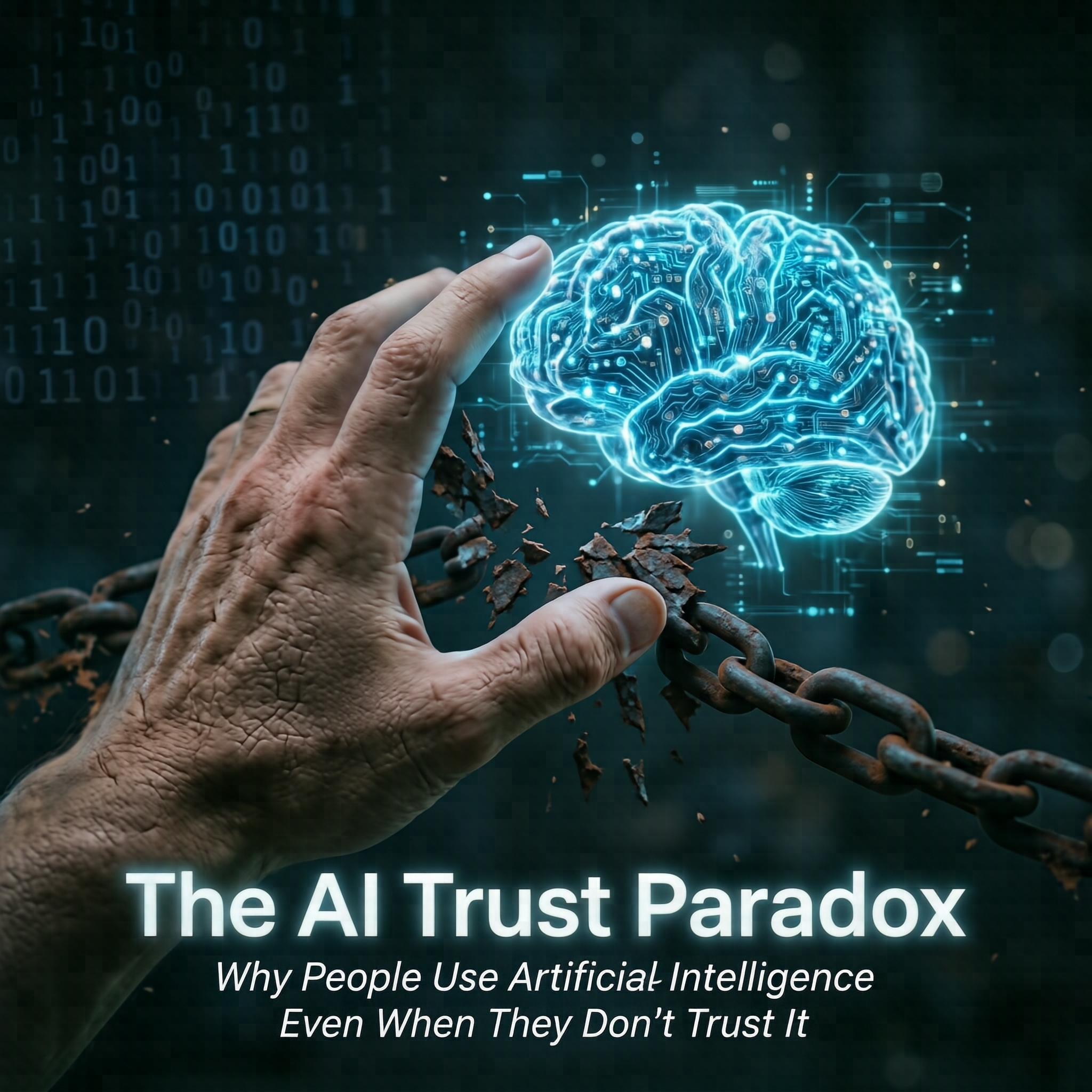
This is the contradiction at the center of the whole AI conversation, and it’s weirder than people give it credit for. Everyone talks about whether the public trusts AI. But the actual question hiding underneath is why so many people use it constantly while openly saying they don’t. That gap between what people believe and what people do isn’t a failure of logic. It’s the subject.
A bargain humans were already making
First, a bit of context that makes this less mysterious: this specific contradiction predates AI by decades. It’s called the privacy paradox, and researchers have been documenting it since the early days of the commercial internet. People say they care deeply about their data. They then hand that data over, repeatedly, in exchange for almost nothing.
But AI sharpens the paradox until it cuts. With a search engine or a social network, the exchange at least had a visible shape: you get free search, they get your clicks. With a generative AI tool, the deal is much fuzzier. You give it your thoughts, your work, your questions, your health complaints — often things you’ve never typed into any other machine — and the value you get back is… a text answer. The asymmetry is enormous. And people still do it.
Why? There are several reasons layered on top of each other, and each one is doing more work than it looks like.
The present always beats the future
The most honest answer is also the most boring one: the benefit of using AI arrives now, and the cost arrives later, somewhere else, in some form you can’t quite picture. Your paragraph gets written tonight. The data it was built on gets used somewhere, eventually, by someone, in a way you won’t be able to trace. One of these is concrete and immediate. The other is abstract and vague.
Humans are not designed to weigh those two things evenly. We’re terrible at it. We’d rather have a demonstrable win tonight than avoid an invisible loss three years from now, and no amount of journalism about AI risks changes that wiring. The companies building these tools know this better than anyone. Look at how the products are designed: no consent screens, no friction, one box that says “ask me anything,” right in the middle of the screen. The entire interface is engineered to make the path of least resistance the path you take. You’re not choosing to hand over your data most of the time. You’re just not choosing to not hand it over, and those are very different things.
The worried many and the protected few
Here’s where the research gets genuinely interesting, because it complicates the “people just don’t care” story. It turns out the people who don’t act on their privacy worries are often exactly the people who worry most — they just don’t know how to act.
A study of UK users of chatbot tools, published in a peer-reviewed privacy journal last year, found people reported feeling cynical about their privacy, overwhelmed by the technical complexity of AI, and stopped by practical barriers even when they genuinely wanted to protect themselves. Another line of work on the privacy paradox in large language models found the same shape: concerns are broad and real, but whether a person actually takes protective action tracks closely with how much privacy literacy they have — how well they actually understand what gets stored, what gets trained on, and what can be done about it.
So the picture isn’t “the public is hypocritical.” It’s more uncomfortable than that. It’s that the people with the knowledge quietly protect themselves, and the people with the concern but not the knowledge just absorb the risk, uncertainly, forever. One study of conversational AI users sorted people into four rough groups: the cautious, the inquisitive, the dismissive, and the resigned. That last group is the one to notice. Resigned people aren’t trusting AI. They’ve simply stopped believing they have any choice in the matter.
Familiarity is wearing trust’s clothes
Which brings up a distinction that doesn’t get made nearly enough. We talk about “trust in AI” as if it’s one thing. It isn’t. There’s a real difference between trust and familiarity, and repeated use produces the second without necessarily producing the first.
Think about how you feel about the coffee maker you’ve owned for four years. Do you trust it? Kind of, but that’s not really what’s happening. You’re just used to it. It’s predictable in the way things you’ve touched a thousand times are predictable. Nobody calls that trust, because the stakes are trivial. But when the same feeling develops around a tool that’s reading your emails and summarizing your work, it quietly starts to function as trust anyway. You stop noticing the tool at all. And the moment you stop noticing a system is the moment you stop questioning it.
There’s also a specific, slightly alarming version of this. People often assume that because a chatbot sounds confident and has gotten things right in the past, it has earned the right to be believed. It hasn’t. Familiarity with the interface is being traded for confidence in the judgment, and those are completely different assets. This is one of the reasons AI is moving beyond simple text answers and into things it acts on directly — the tools keep getting more responsibility handed to them, faster than people update their sense of how much the tools deserve it.
Where people draw the line
Still, it would be wrong to say people use AI for everything. They don’t. Watch a skeptical user closely and you’ll see them draw a line, usually without realizing it. They’ll happily use AI to rewrite an email, brainstorm a name, summarize an article. They will not — at least at first — let it decide anything that feels like it has real stakes. Not the medical question. Not the financial decision. Not the career choice.
This threshold is one of the most interesting things about human behavior around AI, because it’s so consistent. People are basically running an intuitive risk assessment on every prompt: how much can this hurt me if it’s wrong? For low stakes, the answer is “who cares,” so they use the tool freely. For high stakes, the answer is “a lot,” so they hold back, even when the tool is perfectly capable.
The problem is that this threshold drifts. It moves with experience, and it moves downward. People start with the email and the summary. Then, gradually, the definitions of “low stakes” stretch. The health question that was too sensitive in month one gets asked in month six, with a “just to get a second opinion.” The money question gets asked with a “just to sanity-check.” The line doesn’t disappear — it just gets pushed forward, one comfortable, justifiable step at a time. Nobody ever consciously decides to trust AI with the big stuff. It just becomes a series of small stuff that was never quite small enough to notice.
The cost of the gap
So where does this leave us? Two layers down, the situation is this: concern is real, use is real, and the two coexist because people have learned to live with the gap rather than resolve it. That has a cost, and the cost isn’t the one you’d guess.
It’s not that people get harmed constantly — most usage is harmless. The cost is that the deliberateness disappears. Every trade you make about AI — what you share, what you let it decide, what you ask it to do — is a real decision, and it’s being made by default instead of by choice. When you never stop to notice the line you’ve drawn, you can’t check whether you’d actually want it drawn there. That’s how dependence grows, quietly, the way it always does. The article in this series on the workflows AI is starting to build on its own touches on the shape of that — tools that used to answer you now run entire processes end to end. The less attention you pay to each individual handover, the more the machine ends up holding.
A more honest way to decide
None of this is an argument for swearing off AI. Honestly, the habit is too useful, and the tools genuinely help. But there’s a way to use them that keeps you in charge of your own decisions, and it’s simpler than it sounds.
The habit is this: before you paste something in, spend five seconds classifying it. What is it — a draft, a question, a piece of personal information, a decision you’re delegating? And what’s the worst realistic outcome if the answer is wrong? If the worst outcome is “I redo the email,” you’re fine; go. If the worst outcome is “my financial information is out there and I can’t take it back,” that’s a real trade, and you should make it with your eyes open instead of on autopilot.
A couple of other small things worth keeping in mind:
- The free tier is the expensive one. If a service is free, the product economics are being settled somewhere else, and usually in your data. Knowing that doesn’t mean you shouldn’t use it. It means the “free” shouldn’t count as “no cost.”
- Your privacy literacy is a real skill, and it’s learnable in an afternoon. Understanding which settings exist, what training data actually is, and whether deletion means deletion would put you in the protected minority instead of the resigned majority.
- Trust your own threshold, but check its location. The line you drew six months ago was drawn by a less experienced version of you. It deserves an occasional review.
The deeper point of all this — and the reason the paradox matters — is that the gap between concern and action is where real decisions get made, by default, without anyone noticing. The worries people carry about AI, which we mapped out in the opening article of this series, are real. The use is real too. The question that determines what happens next isn’t whether people trust AI. It’s whether they ever stop to ask themselves why they’re using it, and what exactly they’re trading away each time they do.
The series continues from here. The next pieces dig into the big worries one at a time — the jobs question, the privacy question, the misinformation question, and the control question. The trust paradox is the hinge between them: it’s the reason all that concern hasn’t slowed the adoption down, and the reason the adoption deserves your attention anyway.

Independent technology writer focused on artificial intelligence, emerging technologies, and digital innovation. Covers AI applications in sports, productivity, and online business.