






















Here’s the irony that sits at the center of everything Google has built in the last two years: its AI Overviews quote Reddit more than any other source on the internet. And the summaries flatten the exact thing that makes Reddit worth quoting.
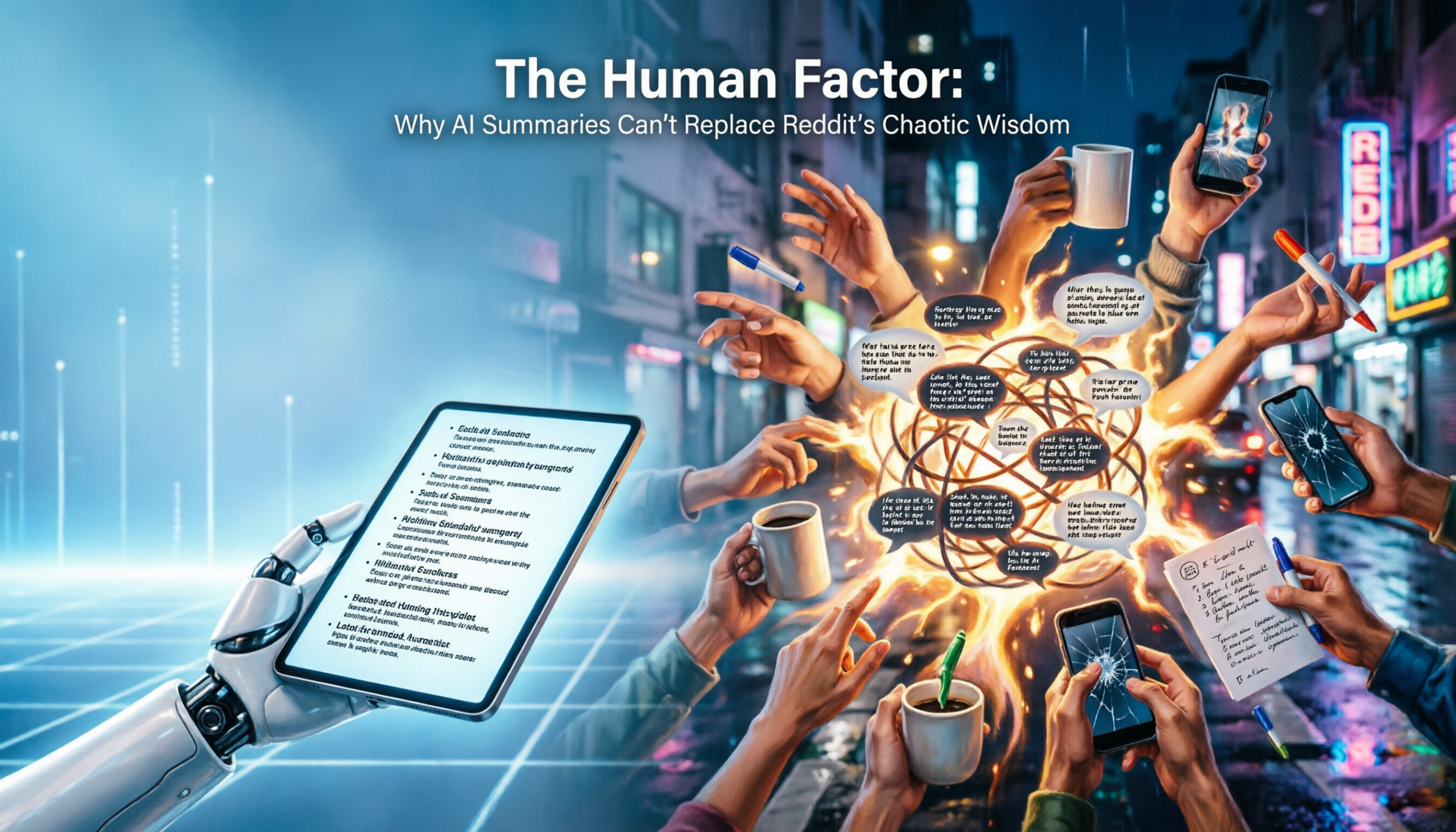
Think about what a synthesis engine does. It reads a thousand threads, finds the overlap, and produces a clean paragraph. That’s the product. The problem is that Reddit’s value was never in the overlap. It was in everything else the disagreement, the dead ends, the person who tried the thing and watched it fail, the update six months later that says turns out the real problem was X all along. An AI summary compresses the thread’s conclusion and throws away its intelligence.
This isn’t an argument about convenience. It’s an argument about what we lose when we let machines decide which parts of human conversation deserve to survive.
The Wisdom That Only Comes in Chaos
The social scientists have a name for what Reddit accidentally built: the wisdom of crowds. It’s a statistical phenomenon, and it works for a reason that matters here it relies on diversity and independence more than expertise.
Give a hundred people a jar of pennies and average their guesses, and the mean is shockingly close to the truth often better than any individual expert. But that only works if the guesses are genuinely independent. The moment you let people talk each other into a consensus first, the average gets worse. Disagreement isn’t the noise in the system. Disagreement is the system.
That’s the mechanism underneath every great subreddit. Someone asks a question, and instead of one authoritative answer, they get fifteen conflicting ones the hobbyist, the professional, the person who did it wrong for a year, the person who lives somewhere with different weather. Individually, each answer is partial and biased. Collectively, they triangulate reality better than any single source. The AI that compresses all of it into one confident paragraph doesn’t just summarize the thread it deletes the mechanism. It presents a false consensus, with all the disagreement that made the answer trustworthy sanded away.
What Gets Lost in the Summary
Go read any thread the AI has now claimed to summarize, and you’ll feel it immediately.
The summary says: “Experts recommend checking the brake fluid first.” The thread says something different. It says check the brake fluid, but also that one guy’s brakes failed anyway, and the commenter who said the sensor was mislabeled, and the shop that fixed it for $60 because the dealership quoted $900, and the update where the original poster found it was never the fluid at all. That last detail the correction, the reversal, the humility is the most valuable information in the whole thread, and it’s the first thing a synthesis engine discards.
This is the fundamental blind spot of summarization: it trades the texture of a conversation for its conclusion, and assumes the conclusion was the point. It wasn’t. The point was the trail the reasoning, the false starts, the caveats, the people who showed their work and the people who learned from their mistakes. An AI summary is a map that claims to be the territory. It gets you somewhere, but it has no idea what the place actually looks like.
There’s a deeper loss too, one that’s harder to quantify. Much of what makes Reddit’s threads valuable isn’t even answer-shaped. It’s the inside joke, the shared reference, the running story a community has been building for years. No summary captures that, and no AI is trying. Summarization assumes knowledge is a set of facts with borders. Community knowledge is a sediment layer, built one exchange at a time, and you can’t scoop it out with a paragraph.
The Self-Defeating Harvest
Now watch the loop close, because this is where it gets genuinely concerning.
Google harvests Reddit’s chaos, flattens it into summaries, and sends back almost no traffic users click through from AI Overviews about 1% of the time. Reddit responds the way any rational company would: it tightens the screws. It locks down data, chases licensing money, leans harder on official moderation, and reorients toward direct app usage instead of the open web. Those are all sensible business moves. They are also, one by one, the things that make a community feel like a community instead of a content library.
The chaos that created the wisdom gets sanitized. The independent voices that produced the divergence get chased away by paywalls and policy. And the source that AI prefers above all others quietly becomes less like the thing AI was preferring. Reddit’s own CEO put his finger on it while the stock was cratering: in an increasingly automated web, the value of real human perspective has never been higher. He’s right and the web is doing its level best to stop producing it.
The signal is already visible. Across all AI systems combined, YouTube has now overtaken Reddit as the most-cited source because YouTube is harder to summarize without watching, harder to flatten into a paragraph, protected by a format the synthesis engines can’t fully compress. The harvesters are drifting toward the content that resists them.
The Map Is Not the Territory
Nobody should pretend summaries are useless. They’re not. They save time, they surface answers, and they’re genuinely good at the narrow job they were built for. The danger is treating them as a replacement rather than an appetizer.
The honest question isn’t whether AI can summarize Reddit. It can, competently, in a second. The question is whether the web keeps producing the kind of human mess that makes the summarization worth having in the first place. The crowd’s wisdom depends on a million unpaid people showing up to argue about a stranger’s brake fluid. Those people show up because the conversation is alive. When the conversation becomes a data source, flattened and monetized and served back as a paragraph, it stops being alive.
An AI summary can tell you what the thread concluded. It can’t tell you why the conclusion was worth trusting. The gap between those two things is the human factor and it’s the only part of the web that can’t be replaced, no matter how good the summaries get.

Independent technology writer focused on artificial intelligence, emerging technologies, and digital innovation. Covers AI applications in sports, productivity, and online business.