
















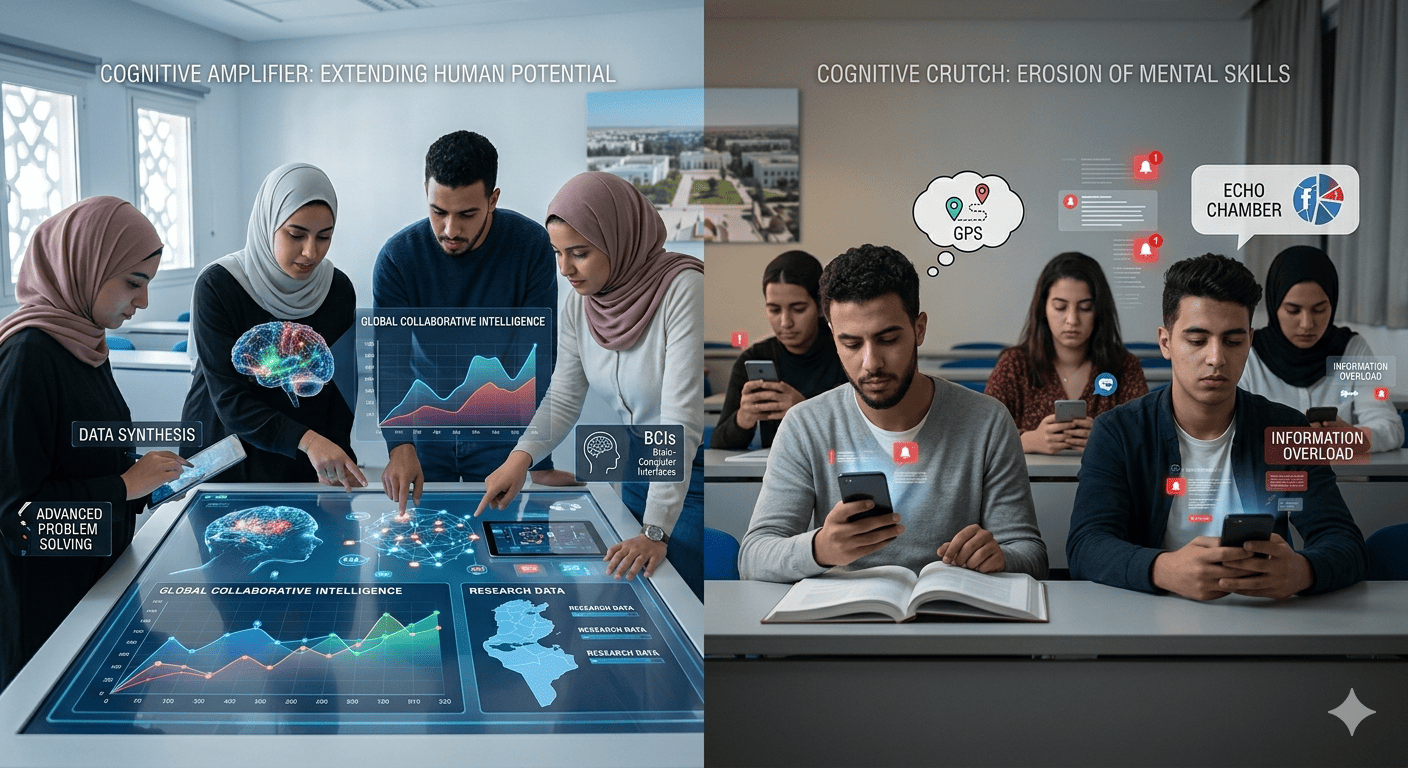
The Day I Forgot How to Get Somewhere
This is a realistic reconstruction of a very ordinary problem: what happens when we rely on technology long enough that we stop practicing the skills it replaces.
The story below uses a first-person voice, but it is not presented as the documented experience of one specific person. The scenes, reflections, and examples are composite — drawn from familiar experiences with GPS, calculators, autocomplete, search engines, and increasingly, AI assistants.
The point isn’t to argue that technology is making us stupid. That’s too simple.
The more interesting question is what happens when a tool becomes so effective at a mental task that we stop doing that task ourselves.
I imagine that moment as something like this:
I get in my car, turn the key, and sit there for a full minute before realizing I have no idea where I’m going.
Not because I forgot the address.
Because I can’t reconstruct the route from memory.
I’ve used GPS so consistently that the mental map I once relied on has become something I rarely exercise. I still know how to enter a destination. I’m just less certain I could navigate there without being told which turn comes next.
And that raises a much bigger question:
What else might we lose while gaining everything technology gives us?
The Intelligence We Built and the Intelligence We Replaced
Here’s the thing nobody wants to discuss: every technology that extends our cognition also trims something.
The calculator made complex math accessible. It also made most people dependent on machines for arithmetic they once could do in their heads. I can do basic math. I used to be able to do it faster, and I used to have an intuitive sense for numbers that I’ve since lost to convenience.
The same story repeats. Spell-check fixes typos and erodes spelling memory. Autocomplete drafts sentences and weakens the impulse to find words. GPS guides and unmakes cartographers. Each tool gives us the output and takes a piece of the process.
This isn’t new. Socrates worried about writing things down. He thought it would ruin memory. He wasn’t wrong—just early. The question his worry pointed at has never been answered. It keeps being asked differently.
What “Smarter” Even Means These Days
I want to slow down here because this word gets thrown around without scrutiny.
Smarter how? Faster at retrieving information? More capable of synthesis? Better at pattern recognition? More creative? More competent at actual decisions?
The AI boom has made “smart” feel like a single thing you can optimize toward. You can have more knowledge at your fingertips than any person in history. You can have tools that draft, design, analyze, explain. And you can still be not smart about the things that matter most.
I know people who have every productivity tool, every AI assistant, every shortcut—and who still make the same mistakes, miss the same patterns, avoid the same hard conversations, and learn nothing new from their experiences. The information flows faster. The judgment doesn’t develop the same way.
Wisdom isn’t in the silicon. It’s in what you do with the output, how you hold it, whether you test it, whether you notice when it’s wrong.
The Difference Between Answers and Understanding
I asked an AI recently to explain a concept I’d been working around for months without fully grasping. It gave me a clear, accurate explanation in about fifteen seconds. I understood the concept immediately. I also realized, moments later, that I hadn’t understood it for months because I hadn’t needed to. The AI was now doing the work of understanding so I didn’t have to.
This is the trade-off I see most clearly and still can’t stop making: I outsource the effort of comprehension and I gain time but lose depth. The concept becomes “solved” in a way that prevents the struggle that used to teach me how to think about similar concepts.
Struggle was the point. The resistance was where the growth happened. If you remove the friction, you remove the development.
You can notice the same shift in conversation. Problems that once took a long walk, a conversation, or an hour of thinking can now be handed to an AI in seconds. The output is faster. The thinking process is different. And sometimes, something is missing.. Faster. Better output. And something missing.
What We Gain, What We Lose, How to Keep Track
Here’s the conclusion I keep coming back to when I look at how this trade-off plays out in everyday life:
The technology that makes us smarter as a species does not automatically make each of us smarter as an individual.
The printing press democratized knowledge. Individual readers still had to do the reading. Some became brilliant. Most didn’t. The tool enabled; it didn’t guarantee.
We’re in the same moment now. AI can do remarkable things. What it does to your mind depends on how you use it.
Use it to offload the work you find annoying and keep doing the hard thinking yourself? Probably fine.
Use it to avoid the work that used to develop your capacities—to remember, to craft sentences, to think through problems, to sit with difficulty without resolving it immediately? Then no, you’re not getting smarter. You’re getting more productive at tasks you might not need to develop at all.
The distinction matters. A calculator doesn’t make you bad at math in the same way it makes you faster at calculating. But if you let it replace the mental math that built number sense, you’ve traded something real for something convenient.
I think most of us are making that trade without knowing it.
The Question Worth Asking
Back to the car. The important part isn’t whether I eventually find the destination. It’s the discomfort of realizing how much of the route I had stopped carrying in my own head.
That discomfort is useful. It suggests a simple practice: occasionally leave the GPS off. Try solving a problem before asking AI for the answer. Write something without autocomplete. Do the calculation in your head.
Not because technology is the enemy. It isn’t.
Because some abilities are worth exercising even when a machine can do the job faster.
That’s the only answer I have, and it’s not a policy. It’s a practice. Pay attention to what’s getting easier in ways that concern you. Notice what you can’t do anymore that you used to. Decide whether the trade was worth it.
Technology will keep making things easier. Easier is fine. But easier is not always better, and it’s almost never neutral. Something changes every time you stop doing something you used to do.
The question isn’t whether technology makes us smarter. The question is: smarter at what, and at the cost of what else, and are we keeping score?

Independent technology writer focused on artificial intelligence, emerging technologies, and digital innovation. Covers AI applications in sports, productivity, and online business.