




















The Week My Grandfather’s War Stories Stopped Making Sense
My grandfather fought in Korea. Not on the front lines—he was a communications specialist, which meant he spent most of his time stringing wire, maintaining radios, and trying to hear enemy positions through static.
He told me once that he could tell you where every unit was on the peninsula just by listening to static patterns. The gaps, the frequencies, the way interference moved. He knew the battlefield through sound in a way that took years to develop and couldn’t be taught from a book.
When I tried to explain satellite imagery and real-time drone feeds to him, he just shook his head. Not because he didn’t believe it—because he couldn’t reconcile it with what he knew. A world where you could see the entire battlefield from orbit. Where a kid in Nevada could watch a convoy move in real-time and call in a strike. Where the ground commander and the guy with the targeting information might not even be in the same country.
“That’s not war,” he said. “That’s something else.”
I think about that conversation a lot. Because I think he was right, and I think the something else has only gotten more something-elsing since.
What Technology Actually Does to Conflict
There’s a story people tell about warfare that goes: more technology equals less casualties. Smarter weapons, better intelligence, precision over carpet bombing. Fewer innocents, cleaner wars, wars that almost fight themselves.
This story is incomplete in ways that matter.
Technology changes who fights, not just how. It changes who decides and who’s responsible. It changes what conflicts look like and, crucially, what they feel like to the people waging them.
Understanding this isn’t abstract. It’s how you make sense of the conflicts you see on the news, the debates about drones, the arguments about autonomous weapons. These aren’t new questions. They’ve been playing out since the first rider on a faster horse changed what cavalry meant, and then the tank changed what the faster horse was for.
The Pattern Nobody Talks About: Distance Kills Accountability
Here’s what I keep coming back to:
Every major technological leap in warfare has done something specific. It has moved the person pulling the trigger further from the person being fired at.
Crossbows meant you didn’t need to be strong to kill a knight. Rifles meant you could kill from a distance where you couldn’t see their eyes. Bombs meant you could destroy a city without seeing a single person. Drones mean a analyst in Virginia can watch someone die in real-time and go home for dinner.
This isn’t good or evil. It’s just a pattern. And understanding it explains a lot about why modern warfare feels different than old warfare, even to the people fighting it.
The Vietnam War was called the first “living room war” because television brought it into American homes in a way that changed politics. Every war since has been more living-roomed than the last. Saturation footage from Ukraine reaches people in real-time. The psychological distance that used to protect citizens from the reality of conflict has collapsed.
But here’s the asymmetry nobody discusses: the people waging war have also gained distance. The soldier in a control room watching a feed doesn’t experience the mud, the fear, the proximity that gave warfare its older rhythms. They’re doing a job with a joystick and a screen. That changes something, even if we don’t fully understand what yet.
The Intelligence Revolution Nobody Predicted (And Nobody Handled Well)
During World War II, the British broke Enigma. The Americans broke Japanese codes. Intelligence advantages shortened wars and saved lives. This is history, not speculation.
Now fast-forward to 2026. The intelligence revolution has become something harder to track. Commercial satellites photograph bases daily. Open-source intelligence—social media, shipping data, news feeds—creates pictures of military movements that previously required spies and aircraft. Drones generate real-time footage that can be streamed to anyone with an internet connection.
The result is a transparency that commanders on both sides find uncomfortable. You can see me. I can see you. The surprise that once won wars is nearly impossible to achieve at scale.
This sounds like it would stabilize conflicts, make them cleaner. It doesn’t. What it actually does is shift conflict to domains that are harder to see. Cyberspace. Information. Logistics. The gray zones where attribution is unclear and the rules are still being written.
The Thing Everyone Argues About: Autonomous Weapons
I don’t want to weigh in on the ethics here—the ethicists are doing that work and I’m not qualified. But I do want to note something practical that gets lost in those debates.
The reason people fear autonomous weapons isn’t because they’re science fiction. It’s because they’re already here. Drones that can follow targets autonomously. Air defense systems that lock and fire faster than a human can react. The line between “automated” and “autonomous” is thinner than the advocates on either side pretend.
The question isn’t whether these exist. They do. The question is who controls them, who decides to deploy them, and who bears responsibility when they make mistakes.
The history of warfare suggests that accountability matters as much as capability. You can have the most sophisticated weapons in the world and still lose if your political will collapses, your supply chains break, or your soldiers don’t understand why they’re fighting. Technology enables. It doesn’t substitute for the other parts.
What This Actually Means
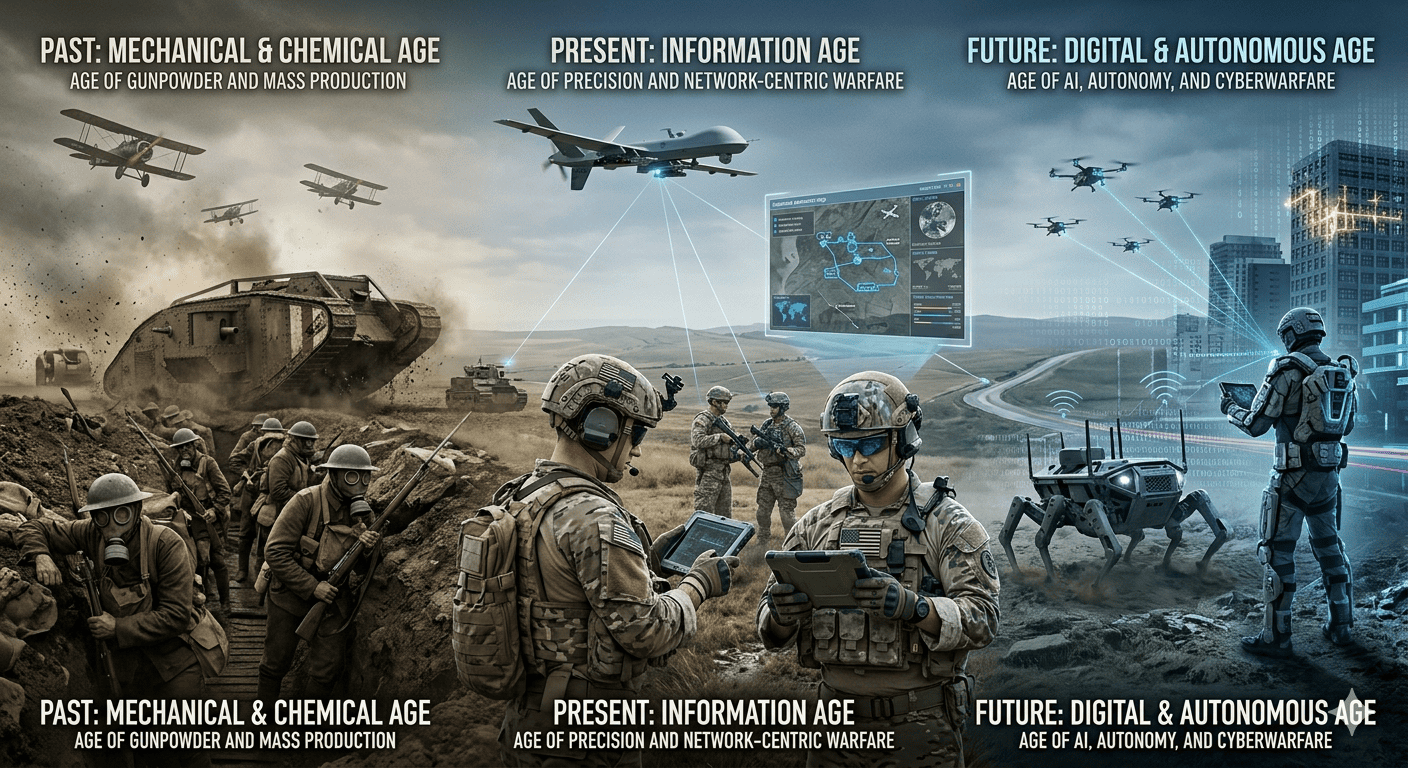
My grandfather’s war and my potential war are separated by seventy years and multiple technological generations. He learned his craft through repetition and consequence. You could tell him exactly what his tools would do because his tools were mechanical, predictable, limited.
Modern tools are software. They update. They surprise their own creators. The systems in a 2026 fighter jet contain more processing power than existed in his entire division. And they can do things the manuals didn’t anticipate.
This is not a warning. This is not celebration. This is just description.
Technology has always shaped warfare. Fire shaped what armies looked like. Metallurgy shaped who could field them. Logistics shaped how long they could fight. The digital age is doing the same, just faster and with fewer places to hide.
The soldiers and strategists who understand this fastest will have an advantage. The civilians who pretend it doesn’t affect them will learn, eventually, that it does. Usually the hard way.
Grandpa’s static patterns won’t save anyone from a satellite. But understanding why the battlefield changed—and who changed it, and for what reasons—might help us understand the wars we’re in, and the ones we’re not done having yet.

Independent technology writer focused on artificial intelligence, emerging technologies, and digital innovation. Covers AI applications in sports, productivity, and online business.